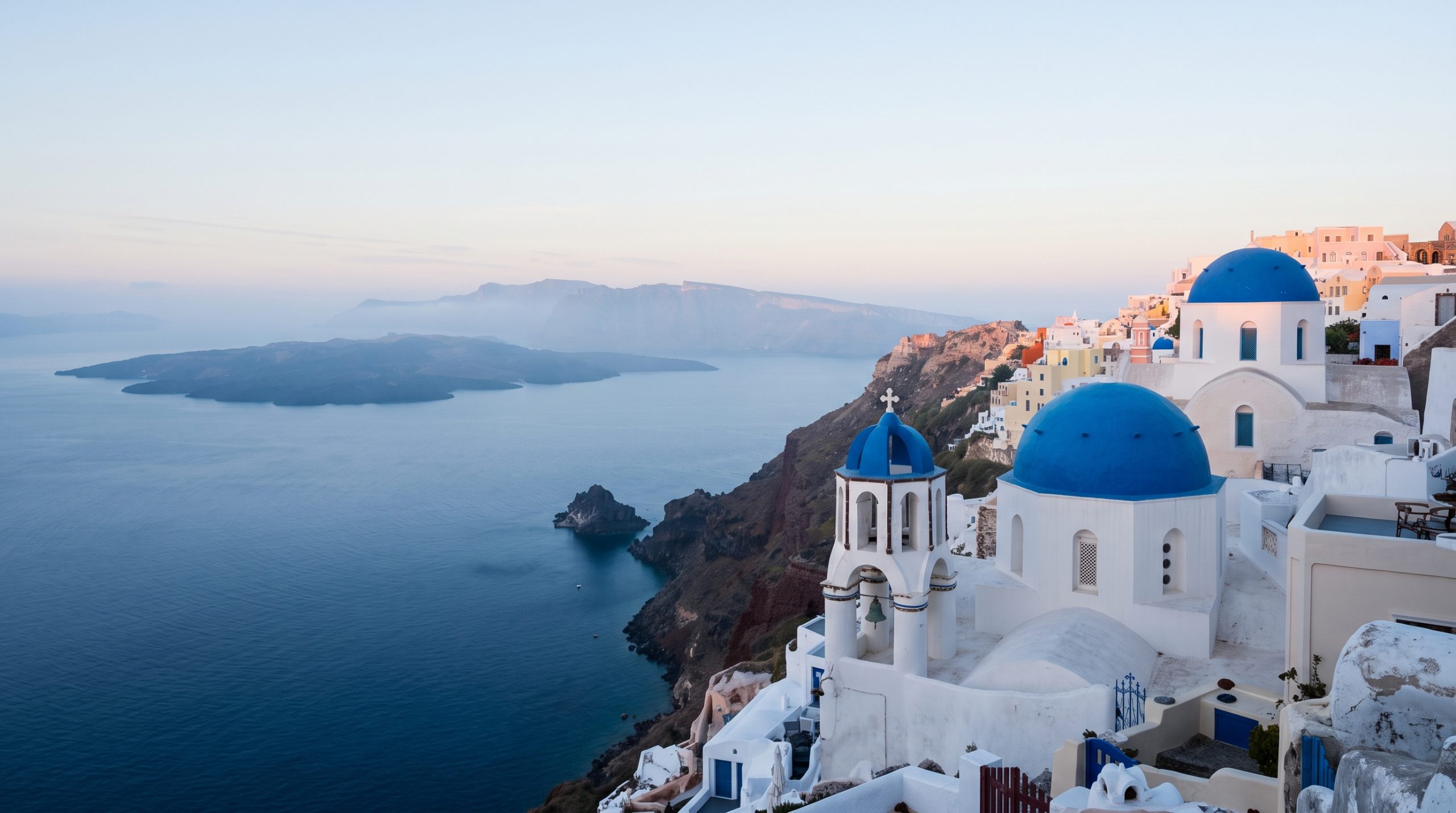
The most photographed view in Greece is a set of steps barely wide enough for two people to pass. The three-domes viewpoint in Oia is a stepped path dropping off the main marble walkway just northwest of the church of St John the Baptist, and it ends at a gate into hotel grounds. In high season a line starts forming there around eight in the morning, and the wait can run past an hour.
That one detail governs almost everything about eloping here. Not the flights, not the dress, not the villa with the plunge pool. The clock.
In late June the sun clears the water behind the village at 6:01am and sunset does not arrive until 8:40pm, which reads like nearly fifteen hours of daylight. In practice Oia hands you about two usable ones, and they are the two nobody else is awake for.
Sunrise to eight in the morning, and why
The workable ceremony hour in Oia runs from first light to roughly eight. In June the sun rises behind the village near 6am, the caldera-facing walls sit in open shade, and the stepped viewpoints are still walkable at a normal pace. From eight onward the paths fill, and on a summer day they stay full until dark.
What the light does to a village that faces the wrong way
Every photograph you have seen of Oia looks at surfaces that face southwest, out over the caldera. The sun does not go there in the morning. On 21 June it rises at an azimuth of 60 degrees, well to the northeast, which in Oia means it comes up over the open sea on the back side of the village and climbs the north slope before it touches anything on the rim.
So at quarter past six you get a specific and slightly counterintuitive set of conditions. The domes, the bell towers and the east-facing whitewash carry warm raking light. Everything looking out over the water sits in soft open shade, with the cliff below still dark and the sky above the caldera a clean unbroken gradient. Contrast is low, skin reads beautifully, and the whites hold their detail instead of blowing out. It is the least dramatic light of the day and by some distance the most flattering, and it is the reason our Oia work looks calm rather than saturated. Our published galleries and films will show you what that hour does to a whitewashed village better than another paragraph can.
By noon the sun has swung around to the southwest and hits the caldera faces square on. Whitewash at midday on a volcanic island is a wall of light with black holes in it. The afternoon is worse for heat and no better for contrast.
Then the famous part. In June the sun goes down at an azimuth of 300 degrees, off to the west-northwest; by late September it drops almost due west at 272 degrees. Either way the last hour lands full on the caldera cliffs and on the red rock at Ammoudi, and that light is as good as its reputation. What nobody writes down is that the castle point, the spot every guidebook sends you to, is flat and jammed at exactly that hour. The sun is behind a wall of people, the foreground is other travelers’ phones, and general advice is to arrive two to three hours early in peak season just to hold a standing position. We shoot evenings in Oia often, and almost never there.
Seasonal drift matters more than most couples expect. Sunset in June sits at 8:40pm. By 10 October it has moved back to about 6:50pm, and sunrise has slid from 6:01am to nearer 7:20am. An October elopement can hold a ceremony at first light and still have a genuine evening hour before dinner. A July elopement cannot do both in one day without asking you to be awake for close to seventeen hours.
Standing room on the marble path
Oia’s main artery is pedestrian. Cars, taxis and the hourly bus stop at the edge of the village and everything beyond that is on foot, along polished stone and stairs that thread between private terraces. The width is the whole story. At the domes viewpoint two people pass each other with care, three do not pass at all, and the steps below it belong to a hotel.
Crowd advice online stops at arrive early, which is not quite enough here. Early has a number attached to it. Queues at the stepped viewpoint start around eight in high season and can exceed an hour by mid-morning, and Santorini can absorb four cruise ships and something in the order of 8,400 passengers in a single summer day. Being on the path at 7:45am is not early. Being there at 6:10am, dressed, with the first frame already decided, is early. In practice that means walking the exact route the evening before, in the light we will actually have, so that at dawn nobody is looking for anything.
The physical squeeze is also why photography and film here have to be planned as one job rather than two people improvising. On a path that narrow, a photographer and a filmmaker who met that morning spend the hour in each other’s frames. Ours work to positions agreed the night before: one low on the steps, one higher on the walkway with a longer lens, swapping on a schedule so neither is ever behind the other. Wind funnels along the rim even on a calm morning, so on an Expedition day, where a photographer and filmmaker work together, vows are recorded on separate audio rather than trusted to a camera microphone six feet away.
The last stretch on foot, in shoes you did not choose for it
Getting to Oia is easy and getting around it is not. From Fira it is roughly 11 km, about thirteen minutes by car in light traffic, or twenty on the bus that runs hourly. Most couples we work with stay in the village itself precisely so that the 6am start does not begin with a drive. It is the kind of decision our destination guides exist to settle early.
What matters is the last few hundred meters. Oia’s stone is polished by decades of feet, and at dawn it carries dew, which makes smooth soles genuinely comical on the descents. Steps come in irregular runs with no handrail on the caldera side. A long train picks up volcanic grit within thirty seconds and a veil behaves like a sail the moment you clear a wall. None of this is a problem, and all of it is a plan: flat shoes for the walking, heels carried and worn for the ten minutes they are actually seen, dressing at the hotel rather than anywhere en route, and a route chosen for stone and shade rather than for the shortest line on a map.
Ammoudi is the other question. The old port sits about 278 steps below the village, and those steps are deep, cobbled and uneven, with three or four strides between one and the next, so the climb back up takes fifteen to twenty minutes at a walking pace and rather longer in wedding clothes. The promenade at the bottom runs roughly 800 meters out toward the little islet of Agios Nikolaos, which is flat, quiet at dawn and one of the best pieces of ground in Oia for a first look. A car can meet you on the switchback road at the bottom, so the descent is a choice and the ascent does not have to be.
Thira’s registrar, eight days, and the notice you probably do not need
Oia is a community inside the Municipality of Thira, and that is where a legal Santorini marriage is registered. The paperwork is more predictable than the internet suggests. Each of you needs a full birth certificate carrying an apostille, a certificate of no impediment or free-to-marry affidavit, and Greek translations of both. Where both partners are foreign nationals, each submits a separate set of documents in person at the town hall covering the place of marriage. The license is generally issued eight days after the application and stays valid for six months, which is the single most useful number in Greek elopement planning: it is short enough to require sequencing and long enough that nothing has to be rushed.
One requirement causes more confusion than the rest. Greek law calls for a marriage notice published in a daily newspaper, and for two American citizens marrying on Santorini that requirement generally does not apply, since it attaches when one party is a Greek citizen. Seeing it listed as universal on a planning blog has cost couples a week of worry for nothing.
Private vows are simpler still. Standing on a public path in Oia and speaking to each other needs nobody’s permission. What needs arrangement is anything on private ground, and in Oia that is most of the good ground: the steps below the domes viewpoint end at a hotel gate, the domes belong to their parishes, and half the terraces you recognize from the internet are somebody’s guest suite. We research and arrange that side, including drone clearance, which in Greece means operator registration for any camera drone plus airspace approval for the coordinates you intend to fly. Government, venue and landowner fees are yours to pay; the legwork of finding out which apply is ours. If the legal side is new to you, our notes on how eloping actually works cover the sequence in more detail.
When the rim is windy at six in the morning
The caldera edge is exposed, and wind on the rim can turn a veil into a full-time job and make a hem unmanageable in ten seconds. It also cools the edge fast once the sun is off it. The fix is 278 steps down: Ammoudi sits at sea level with the cliff between it and the north wind, a short run down the switchback road and completely different in feel. We hold that as the standing alternative for every Oia morning, decided the night before rather than argued about at dawn.
The couple who likes a 4:45 alarm, and the couple who does not
Oia rewards a specific temperament. If the idea of coffee in the dark, an empty marble path and being finished with the best light of the day before breakfast sounds like a good morning, this village will give you something few places can: a ceremony in the most recognized landscape in the Aegean with almost nobody in it.
If that sounds like an ordeal, say so early and the day changes shape rather than getting worse. Ammoudi at sea level holds up later into the morning. A shoulder-season date puts sunset at a civilized hour and buys back the evening. And there are stretches of the caldera rim within a short drive that stay quiet at ten in the morning, which is a conversation worth having before you book flights. Tell us what you actually want the morning to feel like and we will either build it here or tell you plainly which month or which stretch of the rim fits it better.
Photography, film and planning come from one team of eight, so the person designing your timeline is the person standing on the steps at dawn. The Adventure covers a full day with a dedicated photographer or filmmaker from $4,900, the Expedition puts both on the rim together from $7,900, and team travel to Greece is included in either; the full coverage detail sits on our pricing page. Highlights reach you within five days of the morning itself, which in practice means you are still on the island when the first frames land.
Common questions
How early do we really need to be at the blue domes?
On the path and dressed by around 6:10am in summer. Queues at the stepped three-domes viewpoint start around eight in high season and can pass an hour by mid-morning, so the difference between 6:10am and 8:10am is not a slightly busier photograph, it is a completely different morning.
Do we need a permit to say our vows on a path in Oia?
No. A private exchange of vows on a public walkway needs nobody’s permission. Permission enters the picture on private ground, which in Oia includes the hotel steps below the domes viewpoint and most of the terraces with the recognizable view, and that is arranged in advance rather than asked for on the day.
How long does the Santorini paperwork take once we apply?
The marriage license from the Municipality of Thira is generally issued eight days after your application is submitted, and it remains valid for six months. Both partners submit separate document sets when neither is Greek. The newspaper notice you may have read about applies when one party is a Greek citizen.
Do we have to climb back up from Ammoudi in a dress?
Not unless you want to. The 278 steps take fifteen to twenty minutes upward in ordinary clothes and a good deal longer in a gown, but a road switchbacks down to the port, so we time a car at the bottom and keep the steps as a downhill choice rather than an obligation.
Can you fly a drone over Oia for our film?
Aerials in Greece run on operator registration for any camera drone plus approval for the airspace and coordinates you intend to fly, so we confirm both before the film is planned around them. Oia sits at the far end of the island from the airport, which helps. Where clearance is not granted for a given morning, the film is built from the ground and the caldera does most of the work anyway.
Building the morning backwards from 6:01
Every good Oia day we have made started at the end and worked backwards. Sunset time for your date, then sunrise, then the light on the domes, then the walk in reverse, then the hour you need to wake up and the alternative you will use if the wind is up. Then, and only then, where breakfast is. Tell us your dates and roughly what you want the morning to feel like and we will send back a real timeline with the ceremony hour, the shoe change and the backup already in it. We keep the planning in one written thread, at whatever hour suits you, from the first message to the finished film.
Check Your Date and we will tell you honestly what your Oia morning can hold.