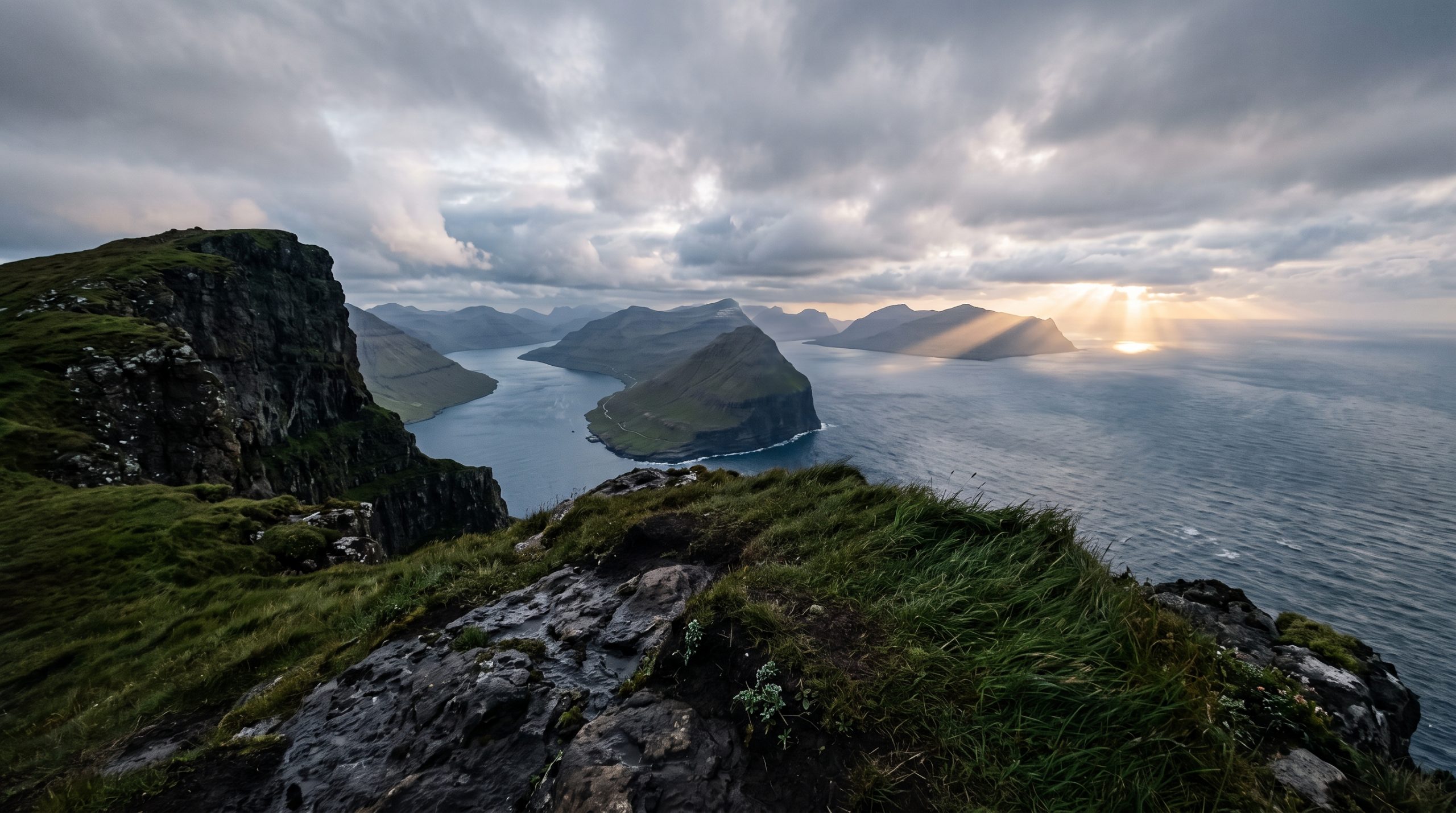
The useful thing about Slættaratindur is that you can see the whole job before you commit to it. Pull in at the parking area on the pass at Eiðisskarð, look up, and you know in about a second whether the summit is clear or sitting inside a cloud. Very few mountains anywhere give you that.
At 880 meters it is the highest point in the Faroe Islands, and the name translates as flat summit, which turns out to be the more useful half of the sentence. There are two ways up. Visit Faroe Islands puts the walk from Eiðisskarð at under an hour, and the northern route from Gjógv at about four. On a clear day you can see all eighteen islands from the top.
None of that is really what we plan around. We plan around the cloud base, the hour of the day, and the fact that the last few meters onto the plateau are loose rock rather than path. Get those three right and this is one of the more manageable high ceremonies in the North Atlantic.
Getting married at 880 meters, in plain terms
A private exchange of vows on the summit needs no permit, no officiant and no fee. The legal marriage is a separate act, carried out by Tórshavn municipality, which needs your notice at least four weeks before the date. The climb from Eiðisskarð is close to 500 meters of ascent, and the top is flat.
The pass at Eiðisskarð does half the climb for you
Eiðisskarð is the pass between the villages of Eiði and Funningur, and both of them sit at the foot of the mountain. The road over the pass is the reason this summit is realistic in wedding clothes at all: it delivers you high onto the shoulder, so what remains is close to 500 meters of climbing packed into less than two kilometers. Steep, then, rather than long. The parking is a modest pull-in on the side of the road, and on a fine summer afternoon it is full.
The ground is grazed grass over stone, cropped short by sheep, with cairns marking the worn line. It rises steadily and then more sharply, and the final pull onto the plateau turns into loose basalt and boulders where most people put a hand down. A long dress does not travel well over that last section, so we carry it up and you change on top, out of the wind, boots still on until the last moment. Coming down is the slower half, especially in a skirt on gravel, so the descent goes into the timeline properly rather than as an afterthought.
That under-an-hour estimate is honest for someone walking briskly with a small pack. We budget two to three hours on the mountain for a ceremony: the climb, the change of clothes, the vows, time to walk around the top, and a descent nobody is rushing. If you want the walk to be the day rather than the approach to it, the northern route from Gjógv takes around four hours and is a different experience entirely, with the mountain above you the whole way.
Coming from Tórshavn, the drive crosses to Eysturoy through the subsea tunnel with the roundabout inside it, tolled in both directions and currently around 175 DKK each way for a car without a subscription. Rental companies bill it to you afterwards. Staying in Gjógv or Eiði instead puts you at the base of the mountain and takes the tunnel out of your morning, which matters more than the money if you are aiming for the small hours.
What the flat top is actually like underfoot
The summit is a plateau, not a point, and that single fact changes what a ceremony can be up here. There is level ground to spread out on, bare basalt and gravel underneath, and a horizon in every direction. There is also nothing at all to break the wind. You are standing on the roof of a country that is 880 meters tall at its highest and mostly ocean, and it feels exactly like that.
Eighteen islands, or the inside of a cloud
On the clear days this is one of the great viewpoints of the North Atlantic. All eighteen Faroese islands are visible from the plateau, in gray and green layers, and some people insist Iceland’s Vatnajökull shows up on the best afternoons. We have never had that one confirmed and will not promise it to you.
What we will tell you plainly is how often the top is inside a cloud. Read enough accounts of this mountain and almost every one of them mentions a walk that ended in white, or a summit reached in mist with nothing to see but a few meters of gravel. It is the single most likely thing to change your plan here, and it is entirely workable if it is planned for. We watch the cloud base for days ahead of your date, we keep the summit hour loose inside the day rather than fixed to a minute, and we hold a low-level alternative that we can reach off the same road: Funningur below the pass with its turf-roofed church and the fjord behind it, the gorge at Gjógv, the black sand and swell at Eiði. If the mountain is closed to us, the day is not.
When it is clear, the way this place photographs is almost the opposite of a coastal elopement. There is no foreground to hide behind, so the frames go wide and you read as two small figures against ridges and water, and then very close, because on a plateau there is nothing between the lens and your faces. You can see how our team handles that combination of scale and intimacy across our galleries and films, which is a better guide to what you will actually receive than any description we could write here.
The plateau also shapes how two of us work. With level ground and open sightlines in every direction, there is nowhere for a second person to stand out of shot, so the photographer holds one edge and works long while the filmmaker moves low and wide across the back, each of them watching the other’s line rather than discovering it later. Sound is the other consideration at this height, where there is usually a breeze even on a settled evening: vows go onto a wired lavalier under a collar with a wind cover, backed by a mic held close in, and on our Expedition that audio work is part of the day.
Where the sun actually goes at 62 degrees north
This is the part most planning pages skip, and on an open summit it decides everything. Around the June solstice, Tórshavn’s day runs about fourteen and a half hours longer than at the December solstice, which puts you close to twenty hours of usable light and a sun that does not go down until nearly midnight.
Between roughly eleven and three, that sun climbs to just over fifty degrees above the horizon. High, flat and unhelpful. It bleaches the plateau, kills the terraces below, and it is also the window when the parking at the pass is fullest. Almost every photograph of Slættaratindur you have seen was taken in that hour, and it is the one we most want to avoid.
Late evening is the answer in summer. From about nine o’clock the sun swings low into the north-west and stays there for hours, raking across the ridges instead of falling on them, and because the route from the pass climbs the western flank you walk straight into that light the whole way up. In the small hours the sun returns in the north-east, which lights the far islands and the summit while the ground you are climbing sits in its own shadow, cool and blue. Two completely different films, four hours apart, on the same mountain.
Late December is the other extreme: something near five hours of daylight, and a sun that never climbs far off the horizon. Beautiful, and not reliable summit weather, so we build winter days around low ground, the villages and the coast, and treat the mountain as a bonus if conditions hand it to us.
Midsummer night is the busiest place in the country
There is a real tradition here, and it is lovely. On 21 June, Faroese people climb Slættaratindur to sing, dance in a ring on the flat top, and watch the sun set and rise again from the same spot, which works at this latitude and this height in a way it does not at sea level.
It is also, on that night, the least private summit in the country. Hundreds walk up on any clear summer day, and the solstice concentrates all of it into a few hours. Arriving early genuinely works on ordinary days, in the sense that five in the morning is empty and eleven is not. On the twenty-first it does not, and we would rather say so now than let you find out on the walk up.
So there is a choice to make, and it is a good one. Join the tradition, sing with everybody else and treat the crowd as part of the story, which some couples genuinely love. Or take a date three or four days either side, get a sky within minutes of identical, and have the plateau more or less to yourselves. Tell us which of those two nights you want and we will build the day around it. Our destination guides cover how the Faroes fit together across a week if you are pairing the mountain with Vágar or the northern islands.
Private land, no ticket booth, and a four-week clock
Access and aerials
Faroese land is privately owned, most of it outfield grazing, and each landowner decides what happens on their ground. That is why some of the country’s best-known walks now carry a mandatory charge, the Kallur lighthouse path on Kalsoy among them at 200 DKK per adult. Slættaratindur from the pass is not one of them: there is no fee and no guide requirement, which makes it one of the easier iconic Faroese locations to plan honestly. In return, the etiquette is simple. Stay on the worn line, leave every gate the way you found it, and give the sheep their space.
For aerials, both European drone rules and the Faroese order on drones apply, and there is an official map of Faroese drone zones we work from. The five-kilometer circle around Vága Floghavn sits well away from this mountain, enclosed property needs the owner’s permission before you fly over it, and nesting bird cliffs are left alone in the breeding season. We confirm the zone and the conditions before we plan any drone work into your film, rather than turning up hopeful with a case in the back of the car.
The legal marriage
Civil marriages for visitors are conducted by Tórshavn municipality, and the timings bracket your date from both sides. Notice has to reach them no later than four weeks before the wedding, and six weeks if you are marrying in weeks 34, 35 or 36. The Notice of Marriage form cannot be sent more than four months ahead, and a marital status certificate is only valid for four months from the day it is issued, so there is a real window rather than an open-ended one. The municipality also asks that the inquiry comes from the two of you rather than from a planner or a photographer, so that first email is yours to send, and we tell you what to put in it.
Two witnesses sign the register on the day, and the municipality can provide staff if you are traveling without anybody. Afterwards you are handed an international marriage certificate in Faroese and English. Because the paperwork lives in town and the mountain does not care about paperwork, plenty of couples separate the two: the legal step in Tórshavn, the words that matter on the summit at the hour the light is right. Permit research, document sequencing and timeline design sit inside our planning, while the government fees themselves are yours. If you are working out the order of operations, our guide to planning an elopement covers the fundamentals.
Common questions
How do we know whether the summit is clear before we start walking?
You can see the top of the mountain from the parking area at Eiðisskarð, so the final call is made with your own eyes about two minutes before the walk begins. We track the forecast cloud base for several days before your date and pick the most likely window, which is why the summit hour stays flexible inside the day.
Can I walk up in my dress or should I change at the top?
Change at the top. The last section onto the plateau is loose rock and boulders, and a long skirt fights you on it. Walk in boots and layers, we carry the dress, and you change on the summit with the team standing off. Coming down, most people put the boots back on.
Is there a fee to walk up Slættaratindur?
No. Several Faroese trails now carry a landowner fee, such as the 200 DKK per adult for the Kallur lighthouse walk on Kalsoy, but the route from Eiðisskarð to the summit has no charge and needs no guide. The only cost on the way is the tunnel toll if you are driving out from Tórshavn.
Do we have to be legally married in Tórshavn on the same day as the climb?
Not at all. The municipality handles the legal ceremony on its own working days in town, and the summit vows need nothing official, so the two can sit on different days. Notice must still reach Tórshavn at least four weeks before the legal date, so the sequence is worth fixing early.
Is it too windy up there to film vows with real sound?
Usually there is some wind at 880 meters, which is why we plan for it rather than hope. Vows are recorded on a wired lavalier with a wind cover and a second mic close in, and we position the ceremony on whichever edge of the plateau is in the lee that evening.
Choosing your hour on the roof of the Faroes
The version of this day we would argue for in June runs roughly like this. You leave Gjógv or Eiði late in the evening, climb from the pass into low northern light, change on the plateau, and say your vows near eleven with the islands stacked behind you and nobody else on top. Back at the car around midnight, still light in the sky when you get to bed. Highlights reach you five days later, the full gallery or film three weeks after that.
One full day with a dedicated photographer or filmmaker starts at $4,900, and the Expedition, with both working this climb together, starts at $7,900; what each one includes, including our travel to the Faroes, is set out on our pricing page. We currently have Faroe Islands dates available through 2027–2029, and every planning step stays in one written thread, on your schedule and in your time zone, with a first reply and brochure inside 24 hours. Send us your dates, tell us whether you want the solstice crowd or an empty plateau, and we will tell you honestly which hour on this mountain fits what you are picturing. Check Your Date.