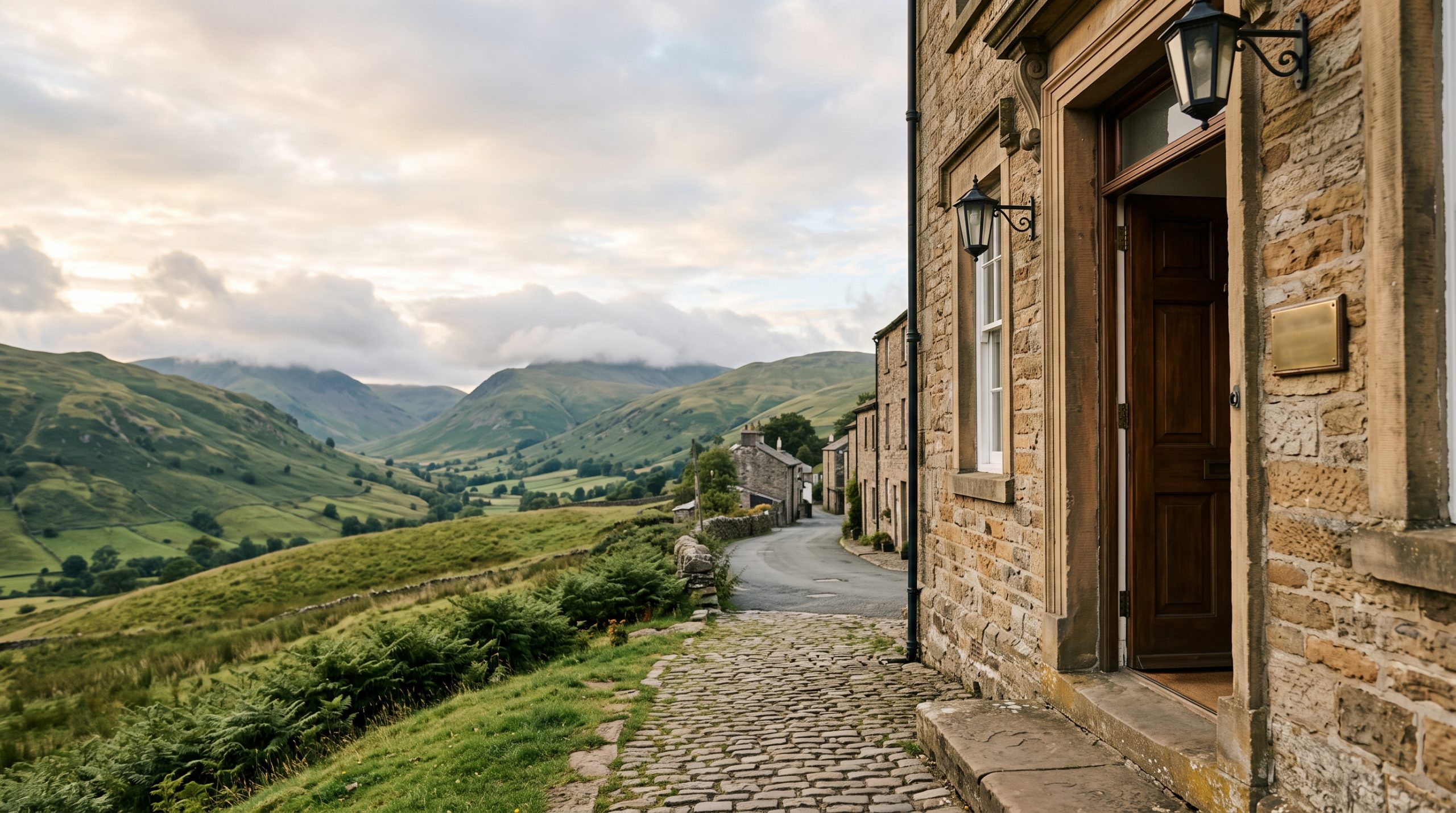
Kendal Town Hall is a Victorian building with a first-floor ceremony room that holds twenty-five people, lift access, and tall windows that do most of the lighting work for you. The registration service there is appointment only, Monday to Friday, 9am to 4.30pm, with no walk-in service at all. You sign in that room. Then you drive, and forty minutes later the Langdale Pikes are filling the windscreen and nobody is wearing shoes that match the ground.
That gap between the licensed room and the ridge is the design problem of an English elopement, and it is not a flaw. England and Wales have never licensed open fell for legally binding weddings, so the law happens indoors or in one specific approved outdoor area, while the ceremony you have actually been picturing happens somewhere with no roof, no address and no capacity limit. Two halves, one day, and the drive between them is the part couples underestimate.
What follows is the sequence as it really runs: which office does what, when the clock starts, and the handful of details that decide whether the legal half of the day feels like a formality or a scramble. The ground itself is covered in our destination elopement guides. This page is the paperwork and the clock.
Why an English elopement splits in two
A legally binding wedding in England and Wales has to happen in a register office or at approved premises, including their licensed outdoor areas. Open fellside is not licensed. So couples marry legally in a booked room, then hold the ceremony they came for on the fell, the same afternoon or months later.
How hard this is if you are both flying in from the States
The fell half is straightforward. The legal half is not difficult so much as slow, and the slowness is built into the statute rather than into any one office being awkward.
Notice of marriage has to be given in person, face to face with a registrar. Not by post, not by proxy, not over video, not through a form on a website. Both of you must have lived in England or Wales for seven days before you give it, and you give it in the district where you have been living. Because neither of you is British or Irish, you attend that notice appointment together at a designated register office, and the designated list is shorter than the full list of register offices, so ask the council’s registration service which office takes your notice before you commit to where you sleep.
After the appointment your notice sits on public display in the office for 28 days, and the legal document that authorises the marriage is usually issued 29 days after you gave it. Where either party is subject to immigration control, the Home Office may extend that notice period to 70 days. The statutory notice fee is currently £46.50 per person, rising to £63 per person where either of you is subject to immigration control, which two US passport holders will be.
There is a visa layer on top. Marrying in the UK is not something the standard visitor route allows: it needs a Marriage Visitor visa, applied for from outside the UK before you travel and granted for up to six months, which cannot be extended or switched once you are here.
Add it up and the England-legal route means somewhere around five weeks in the country between landing and signing, or two separate trips inside one six-month visa. Couples who genuinely want their legal marriage to happen in Cumbria do it, and it works. Most American couples we build days for here marry at home first and give the whole of their time in England to the ceremony, the walking and the light. Tell us which of the two you are picturing and we will build the timeline around it, or tell you honestly which one fits the dates you already have.
| The practical question | Marrying legally in England | Marrying at home, ceremony on the fell |
|---|---|---|
| Time needed in England first | Seven nights before notice, then 28 clear days | None required by the paperwork |
| Notice of marriage | In person, both of you together, at a designated register office | Not part of the route |
| Where the ceremony can happen | Register office or approved premises, licensed outdoor areas included | Any ground you have permission to stand on |
| Visa route for two US passports | Marriage Visitor visa, applied for before you travel | Standard visitor route with an ETA |
| Witnesses | Two, present throughout, and they sign | Anyone you like, or no one |
| Moving for weather | The legal slot is fixed to one venue and one time | Move the hour, or the whole valley, that morning |
We are photographers and filmmakers, not lawyers. Rules change and circumstances differ, so confirm the detail with the relevant register office or your own consulate before you book flights.
The paperwork chain in the order you need it
This is the England-legal sequence. Each step depends on the one above it, and doing them out of order is what costs money.
- Passports and permission to travel. US passport holders now need an Electronic Travel Authorisation before boarding, currently £20 and valid for two years or until the passport expires. An ETA covers a visit. It does not cover marrying, so the Marriage Visitor visa is applied for separately, from outside the UK.
- The venue, before anything else. Notice is only valid for the one venue and the one ceremony type recorded at the appointment, so the register office room or the approved premises has to be held first. Westmorland and Furness takes ceremony bookings all year apart from Christmas Day and Boxing Day, with most venues running between 9am and 4pm.
- Seven nights of residence. Both of you, in England or Wales, in the district where you will give notice, before you give it.
- The notice appointment, together and in person. Passports, evidence of where you are staying, and the original documents for any previous marriage that has ended. The current fee is £46.50 each, or £63 each where either of you is subject to immigration control.
- Certified translations for anything not in English. The office may also carry out additional checks to satisfy itself that a divorce granted overseas is valid, and those checks take working days you should not spend on the week of your ceremony.
- The 28 day display period. Your notice is shown publicly in the office. Assume the authority to marry lands 29 days after the appointment, and longer if the notice period is extended.
- The notice’s own shelf life. Once given, notice stays valid for twelve months, and it is valid only for that venue. A date moved by more than a year needs a fresh notice and a fresh fee.
- The marriage schedule. The office issues it after the waiting period. It is the document the ceremony legally runs on, and it is signed at the ceremony by the two of you and two witnesses.
- The schedule goes back. It returns to the register office to be entered in the electronic register, and certificates are issued from there rather than handed over at the signing table. Order the copies you will need for name changes while you are still in the country.
Build the legal morning around the fellside hour
The legal minimum, once you have landed, is seven nights plus 28 clear days. Round it to five weeks, with the caveat that the notice period can run to 70 days if the Home Office extends it. That is the floor, not a plan.
The comfortable version looks like this. Hold the date with us and hold the ceremony room roughly nine to twelve months out, because a specific date in a small register office and a specific registrar are not infinite resources. Give notice around three months before the ceremony, which is what most registration services suggest, and no later than eight weeks out. Land in England at least eight or nine days before your notice appointment so the seven-night residence requirement is already satisfied and not being counted on your fingers at the desk.
That nine to twelve month version is the one we would work to, mostly because the fell half rewards it. The best hour on Loughrigg Terrace or at Blea Tarn is decided by the season, not by your calendar. In late June the sun is up before 4:45am and there is still usable light after 9:30pm, which gives you two entirely separate ceremony hours in one day. In December the sun has gone before 4pm, so the register office slot and the last light on the fell are competing for the same short afternoon, and one of them has to move. Our guide to planning an elopement covers how we sequence those hours before any of the legal dates get fixed.
Details that trip couples up in Cumbria
None of these are hard. They are just the things that are easier to know in advance than to discover on the Thursday.
- The notice is welded to one venue. You cannot swap the licensed room for a nicer one down the valley when the forecast changes, because the notice names the venue. This is exactly why we keep all the weather flexibility on the fell side of the day, where none of it is regulated.
- Witnesses count as guests. Kendal’s first-floor room holds twenty-five, meaning twenty-three guests plus the two of you, and the ground-floor room holds ten. Your two witnesses sit inside that number. There is no statutory age for a witness, but whoever conducts the ceremony can set one, so ask rather than assume.
- A witness who steps outside stops being a witness. They have to be in the room for the whole thing, then sign. It is a five-minute conversation to have with two friends beforehand.
- Office hours are office hours. Kendal Register Office runs Monday to Friday, 9am to 4.30pm, strictly by appointment. Anything you need from the office in person happens inside that window, on a working day.
- A licensed outdoor area is not the same as outdoors. Where approved premises have an outdoor area licensed for ceremonies, its use has to be agreed in advance with the superintendent registrar for the district, who assesses whether the space is seemly and dignified, and public access and signage requirements still apply. It is a defined patch of a specific venue, not a summit.
- Your certificate arrives after the fact. The signing produces a schedule, not a certificate. Certificates come from the register office once the schedule has been entered, so build a couple of extra days into the end of the trip if you want them in hand before you fly.
Fees and deadlines quoted here were correct at the time of writing and are worth re-checking with the office that issues them. Ceremony fees in particular are set by the council rather than nationally, and reviewed annually.
Sign at home, then exchange vows above Buttermere
This is the route most of our American couples in the Lake District take, and it is not a compromise. It removes the notice period, the seven nights of residence, the designated office, the venue lock and the witness requirement in one move, and it hands you back the two things that actually shape the pictures: the hour and the ground.
You marry at home, in a county courthouse or a garden, with whatever paperwork your state asks for. Then you fly in as ordinary visitors on an ETA, and the ceremony happens where you want it. Blea Tarn at first light with the Langdale Pikes behind you. Loughrigg Terrace in the last forty minutes of sun. The Buttermere shore path, four and a half flat miles that most couples walk in a morning, with Fleetwith Pike standing at the head of the lake. A celebrant leads it, or a friend does, or you read to each other what you wrote on the plane with nobody else within half a mile.
What does not change is everything else. The vows are still yours, the rings still go on, the family you flew out still stands there, and the coverage is identical: highlights back to you in 5 days, the full gallery or film in 3 weeks. Our published elopement stories and films will show you how a fell hour looks when it is planned around the light rather than around an office diary.
If you already know which half of the day matters most to you, send us a message with your dates and we will tell you what the light is doing that week.
What we can coordinate across the register office and fell
We design the day and we hold the shape of it. That means the location plan, the custom timeline built around light and real travel time rather than optimistic mileage, permit research and logistics, and weather alternatives held in reserve. Kendal to Great Langdale is about forty-five minutes. Kendal to Buttermere over Honister is nearer an hour and a half. We do not put a mountain pass between your legal slot and your ceremony hour, and we do not plan a coastal or summit finish without a sheltered alternative fifteen minutes away.
Aerials work the same way. Much of the valley floor and the fell here belongs to the National Trust, so drone footage runs on the landowner’s permission and an agreed window, and we confirm both before designing any part of the film around it.
Where a photographer and a filmmaker work the day together, the two-part structure stops being a logistical squeeze. One of us is in the ceremony room for the signing while the other is already on the fell with audio set for the vows, so nothing is traded away in the drive between them. There are eight of us, which is why there is always a second camera on the ground and a colleague in reserve. Coverage options and what each one includes are set out on our elopement pricing page.
What stays with you is the paperwork itself. We are not lawyers and we do not file documents, give notice, or speak to the registrar on your behalf. You or your celebrant deal directly with the office. We plan around what the office tells you, hold your date against registrar availability, and put the ceremony hour where the light is worth standing in.
Common questions
Can we legally get married on top of a fell in the Lake District?
No. A legally binding ceremony in England and Wales has to be in a register office or at approved premises, including an outdoor area licensed as part of those premises. The fell ceremony is the non-legal half of the day, which is precisely why it can be anywhere and at any hour you like.
Do we both have to be in England before we can give notice of marriage?
Yes. Both of you need seven days of residence in England or Wales before notice is given, and notice is given in the district where you have been living. As two US citizens you also attend the appointment together, at a designated register office rather than any register office.
Can we give notice of marriage online or from the US?
No. Notice requires an in-person, face-to-face interview with a registrar, so it cannot be given by post, by proxy, over video or through a website. It is the single reason the England-legal route needs you physically in the country weeks ahead.
How much is the notice fee for two Americans marrying in England?
The statutory notice fee is currently £46.50 per person, and £63 per person where either of you is subject to immigration control, which applies to two US passport holders. The ceremony fee is separate and set by the council, so ask the register office for the current figure when you hold the room.
How long does the legal route actually take once we land?
Seven nights of residence, then 28 clear days of notice, with the authority to marry usually issued on day 29 after the appointment. That is about five weeks in England. The Home Office can extend the notice period to 70 days where either party is subject to immigration control, so build the possibility in rather than betting against it.
Who can be our witnesses if we are eloping without guests?
You need two, they have to be present for the whole ceremony, and they sign the marriage schedule. There is no statutory minimum age, though whoever conducts the ceremony may set one, so confirm it with the office. Remember they count within the ceremony room’s capacity.
Can we marry at home in the States and still have a real ceremony on the fell?
Yes, and it is the most common route we work with here. Nothing about the day on the fell changes: vows, rings, readings, family, the walk in and the light. Only the legal filing happens somewhere else, weeks earlier, in your own county.
Is the route different for a same-sex couple?
Civil marriage in England and Wales is open to same-sex couples, and the notice, residence, venue and witness rules are the same ones described here. The Lake District registration services run the process identically.
Picking your fell and your hour
The decision that shapes an English elopement is not really the register office. It is whether you want to be at Blea Tarn for a 4:45am June sunrise, on Loughrigg Terrace for the last light of an October afternoon, or walking the Buttermere shore in the flat calm of a still winter morning. The legal half then gets arranged around that, rather than the other way around.
Everything with us happens in writing, so you can read, think and reply when it suits you. Send your dates, the shape of the day you are imagining and whether you are marrying at home first, and you will have a reply and an initial brochure within 24 hours. We are booking 2027, 2028 and 2029 in the Lake District, and we would like to hear which fell you have been looking at. Check your date.