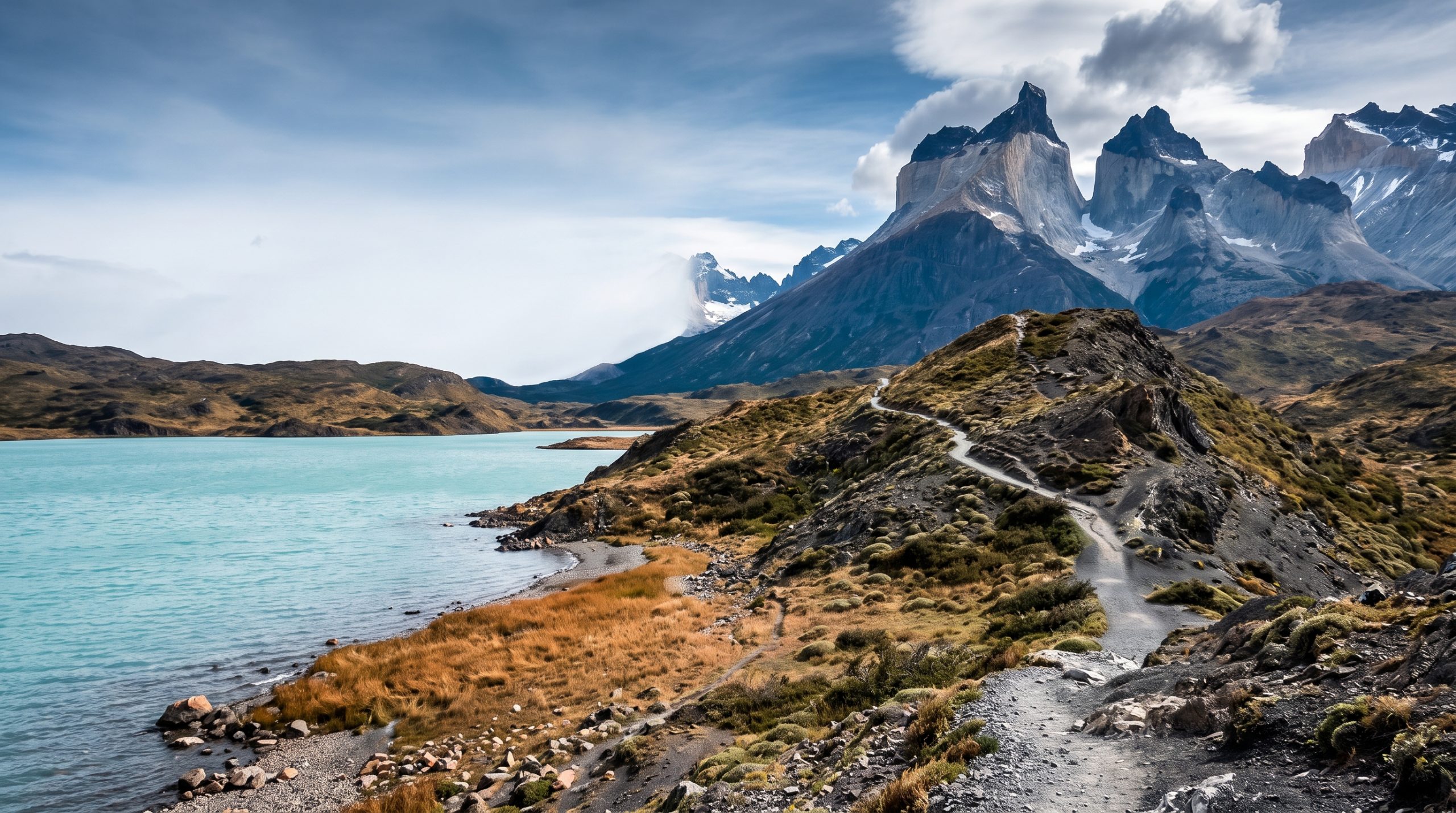
CONAF counted 367,426 visitors in Torres del Paine during 2024, and 201,731 of them arrived from outside Chile. Nearly all of them aim at the same granite towers by the same trail. That statistic is the most useful thing you can hold while deciding where to stand and say your vows, because it means two of the strongest ceremony locations in the park are also two of the quietest, and neither asks you to climb anything.
Effort is the real currency here, not beauty. The massif does not do mediocre, so every place below is worth standing in. What separates them is what you spend getting there: shoe leather, daylight, a boat seat, an alarm set for a time that does not feel like morning.
So we have ranked them by effort. Five rungs, lowest first, with what the light does at each one and what we do when Patagonia changes its mind at eleven in the morning.
Five rungs, from car door to full day
Ceremony locations in Torres del Paine sort into five rungs of effort. Rung one is a lake shore you reach in driving shoes. Rung two is flat gravel to the Cuernos. Rung three is a steep hour above Lago Pehoe. Rung four is a boat. Rung five is the Base Torres day, dark start to dark finish.
| Rung | Where you stand | Underfoot | Hour that works | What moves the plan |
|---|---|---|---|---|
| One | Lago Sarmiento, Laguna Azul, Laguna Amarga | Gravel and low scrub | First light, towers lit, you in shade | Wind off open water, so we shift along it |
| Two | Salto Grande, the Nordenskjold shore | Flat compacted path | Late evening, sun raking the Cuernos | Spray and noise at the falls, so vows move past them |
| Three | Mirador Condor, the Grey shoreline past Pingo | Steep switchbacks, black sand | Evening on Condor, any hour on Grey | Gusts, so we work the sheltered side |
| Four | Grey Glacier, Paine Grande | A deck, then a beach | Whatever the sailing gives | Swell and seasonal timetables, so shore holds a plan B |
| Five | The lagoon below the Torres | Forest, valley, loose moraine | Sunrise, and only sunrise | Cloud on the granite, and the day still works |
Rung one: shorelines you reach in the shoes you drove in
Lago Sarmiento sits east of the massif, which is the whole reason it works. You look back west at the towers across turquoise water, and at sunrise the sun rises behind you and lands on the granite before it reaches you. You stand in cool blue shade while the peaks across the water turn the colour of a struck match. It is the cheapest sunrise in the park in effort and one of the most generous in what it returns.
The shoreline itself is strange and specific. Along the waterline there are pale carbonate formations, ridged and hollow like something reef-built, laid down by microbes over a very long time. They are fragile and protected, so we frame from the gravel above them rather than walking out onto them, a constraint that gives the pictures a low, wide geometry we like anyway.
Laguna Azul, on the gravel road running north east, gives you the three towers stacked over water in the flattest, most direct composition in the park. Day visitors reach it by minibus in the middle of the day. At first light there is usually nobody, and the gap between those two versions of the same viewpoint is not subtle. Laguna Amarga, near the eastern control point, puts flamingos on shallow water with the massif behind, a stranger and better frame than it sounds.
In wedding clothes, all three are kind. Flat ground, no scrambling, a vehicle parked within sight of where you stand. A long train collects dust and the odd calafate thorn, and the low scrub is springy rather than muddy. Bare shoulders at five in the morning in Magallanes are a decision rather than an oversight, so we plan the coat as part of the outfit and time the moment it comes off.
Rung two: flat gravel to the Cuernos
From the Salto Grande car park a short compacted path runs to the falls, where the outflow from Lago Nordenskjold drops into Lago Pehoe under the full front of the Cuernos. It is the most photographable ten minutes of walking in the park. It is also loud, and spray drifts a long way in a west wind.
So we do not put vows at the falls. We walk a few minutes further onto the Nordenskjold shore, where the Cuernos stand clear, the water noise falls away, and evening sun rakes the layered rock from the west.
Rung three: the steep hour that buys you height
Mirador Condor is the trade every couple should weigh. A short, honestly steep climb from the road above Lago Pehoe puts you on a shoulder looking down on the lake, the island, and the whole Paine massif in one line. An hour of switchbacks buys a completely different picture of the park. Over on the western side, the Grey shoreline past the Pingo footbridge gives you black sand and stranded ice with almost no climbing, though the crossing is exposed and the walk out to the beach is longer than the map suggests.
This is the rung where clothing logic matters most. Boots up, then change at the top, out of the wind, behind a rock band. A dress travels rolled in a pack, and someone on our team carries it. Hair loses the argument with the wind at this height, so we stop planning against that and start using it.
The Condor shoulder is also where a photographer and a filmmaker from one team stops being a nice idea and becomes physics. There are only so many places to plant a tripod up there, the ridge falls away on the lake side, and two people who have never worked together end up in each other’s frames or shouting over the gusts. Ours stand back to back out of habit, one wide on the massif, one tight on the vows, with the audio rigged on the sheltered side of a body rather than into open wind. A full day here comes in two shapes, the Adventure from $4,900 with one dedicated photographer or filmmaker and the Expedition from $7,900 with both working the same hours, and the coverage and pricing page sets out what sits inside each. Flights and accommodation for the assigned team are inside the fee, in Patagonia exactly as everywhere else. What this light actually produces is easier to judge from finished films and galleries than from anything we could write here.
Rung four: when the effort is a boat, not a boot
Two crossings open ground you cannot otherwise reach in a day. The catamaran across Lago Pehoe to Paine Grande puts you under the Cuernos from the far side, and the sailing on Lago Grey runs up toward the glacier face and the ice that drifts down the lake from it.
Boats are a different kind of effort: not physical, conditional. Sailings run to seasonal timetables that shift year to year, and a swell rearranges the afternoon regardless of what anyone booked. So we never hang the ceremony on a departure time. Vows happen on ground we control, and the water becomes the second half of the day rather than the pivot it all turns on. Private boat charters and unusual transport sit outside our fee and are arranged in your name, so the decision stays yours.
Worth saying plainly: a deck is a moving platform with railings and other passengers. It photographs as scale and ice, which is a real thing to want, but it is not a place for a private exchange of vows.
Rung five: Base Torres, and the arithmetic of a full day
This is the one everybody pictures, and the only one here where the effort is genuinely the point. The trail climbs out of the Ascencio valley, traverses a long stretch of lenga forest, then finishes on a steep field of loose moraine boulders you climb rather than walk. At the top: a green lagoon and three granite towers standing straight up out of it.
The light is the reason to do it and the reason it costs a whole day. The towers face east, so they catch the sun before anything else in the park. For ten or fifteen minutes after first light the granite goes from grey to deep orange and back again, and to be standing there for it you leave in the dark. In late December the sky here is pale before five in the morning and still holding colour after ten at night, which sounds generous until you work backward from an alpenglow that starts before breakfast. In June you could leave at a civilised nine, but the upper trail is a different proposition in winter, so we build those months on lower ground.
In wedding clothes, be clear-eyed. Nobody climbs that moraine in a gown. You climb in layers and boots, we carry the dress and the suit, and you change at the lagoon in whatever shelter the boulders give, which is some but not much. It is cold up there at dawn even in January. Then you walk down for hours in the afternoon wind, and the boots you were grateful for on the way up matter more on the way down.
Here is the part most pages leave out. The towers are frequently in cloud. You can do everything right, leave at three, arrive on time, and find the summits inside a grey ceiling. The day is not lost when that happens, because the lagoon, the moraine, the two of you at the top of something hard and the long walk back down through the forest are all still there, and a film that includes the weather is more honest than one pretending Patagonia was polite. It does mean the couples who love this rung are the ones for whom the climb is part of the marriage rather than a tax on the view.
If you want the towers without the whole day, rung one gives you the same peaks in the same light from a gravel shore, and we would rather say so than sell you a summit you never wanted. If you want more than one day of this, the Odyssey shape runs across several days and can take in the Frances valley and the Britanico lookout, both too long to fold into a single wedding day. Tell us which version of the morning sounds like yours and we will build the timeline around it, or tell you honestly which month suits it better. Our destination guides help you weigh Patagonia against the rest of your shortlist.
Passes, witnesses, and who says the words
Park entry is straightforward and it is not optional. Passes are sold by CONAF through its own system at pasesparques.cl and must be bought in advance rather than at the gate. Since the tariff change that took effect on 1 May, the old under and over three days split is gone, replaced by two options: a single day entry, or an entry for two or more days valid across a continuous period of up to ten days. CONAF has also strengthened ranger numbers to check tickets against how people are using the park, so buy for the days you will really be inside it.
Legal marriage in Chile is a separate matter from the ceremony, and worth understanding early. It is an act of the Registro Civil, and on the day of celebration you present two witnesses over eighteen holding valid Chilean identity cards. In a Registro Civil office during working hours there is no fee beyond the marriage booklet itself, which costs 1,830 pesos. For two visiting Americans, that witness requirement is the sentence that matters. It is why most couples we work with in Magallanes sign their paperwork at home and hold the ceremony that means something at a lagoon or lake shore, led by a celebrant, with vows they wrote.
Permit research and working out who has to approve what is our job, not yours, and it happens before a timeline exists. Government, venue and landowner permit fees are paid by you directly, along with accommodation, your celebrant and any vendors. Aerials fly only where they are legal, permitted and safe, so we confirm both in writing for the exact ground you have chosen before planning a single shot around a drone. If you are still working out the order of all this, our planning fundamentals lay out the sequence.
Common questions
Can two Americans legally get married inside Torres del Paine?
Legal marriage in Chile runs through the Registro Civil and requires two witnesses over eighteen who hold valid Chilean identity cards. In an office during working hours it carries no fee beyond the 1,830 peso marriage booklet. Most couples we work with sign at home and hold their ceremony in the park with a celebrant.
Do we have to buy park passes before we arrive?
Yes. CONAF sells them online through pasesparques.cl and they need to be purchased in advance. Since the tariff change on 1 May there are two options, a single day entry or an entry for two or more days valid across a continuous period of up to ten days, and rangers check them inside the park.
Is sunrise at the Base Torres lagoon realistic if we are not hikers?
It is a full day on your feet with a steep moraine climb at the end, in the dark at the start. If that is not your idea of a good morning, Lago Sarmiento and Laguna Azul give you the same towers in the same first light from flat gravel, and you can be back at breakfast.
Where do we change out of hiking boots and into a dress?
At the vehicle on rungs one and two, and at the viewpoint itself on rungs three and five, using whatever the boulders or the treeline give you. We carry the clothes and time the change as late as we can, so the wind gets the shortest run at your hair and your hem.
What happens if the wind is too strong at the viewpoint we chose?
We move along the shore or drop below the ridge line, both of which are usually minutes rather than an hour away, and every timeline we write already names the alternative. Mornings in this part of Patagonia tend to be calmer than afternoons, one more reason the ceremony hour sits early.
Pick your rung, we build the rest
Tell us which rung sounds like your kind of morning and we will do the rest of the thinking: drive times from where you are staying, the celebrant, the ceremony hour that puts the sun where you want it, and the alternative fifteen minutes away for the day the weather votes differently. We are eight people, so there is always a second camera on the ground and a colleague in reserve. Highlights reach you within five days, the full gallery or film within three weeks. Dates are currently open across our 2027, 2028 and 2029 Patagonia seasons, and every planning step stays in one written thread, from a first reply and brochure inside 24 hours to a tailored proposal, a signed contract and a 30 percent retainer before planning begins.
Send us the dates you are holding and the rung you are drawn to, and we will tell you exactly what that morning would look like. Start Your Story.