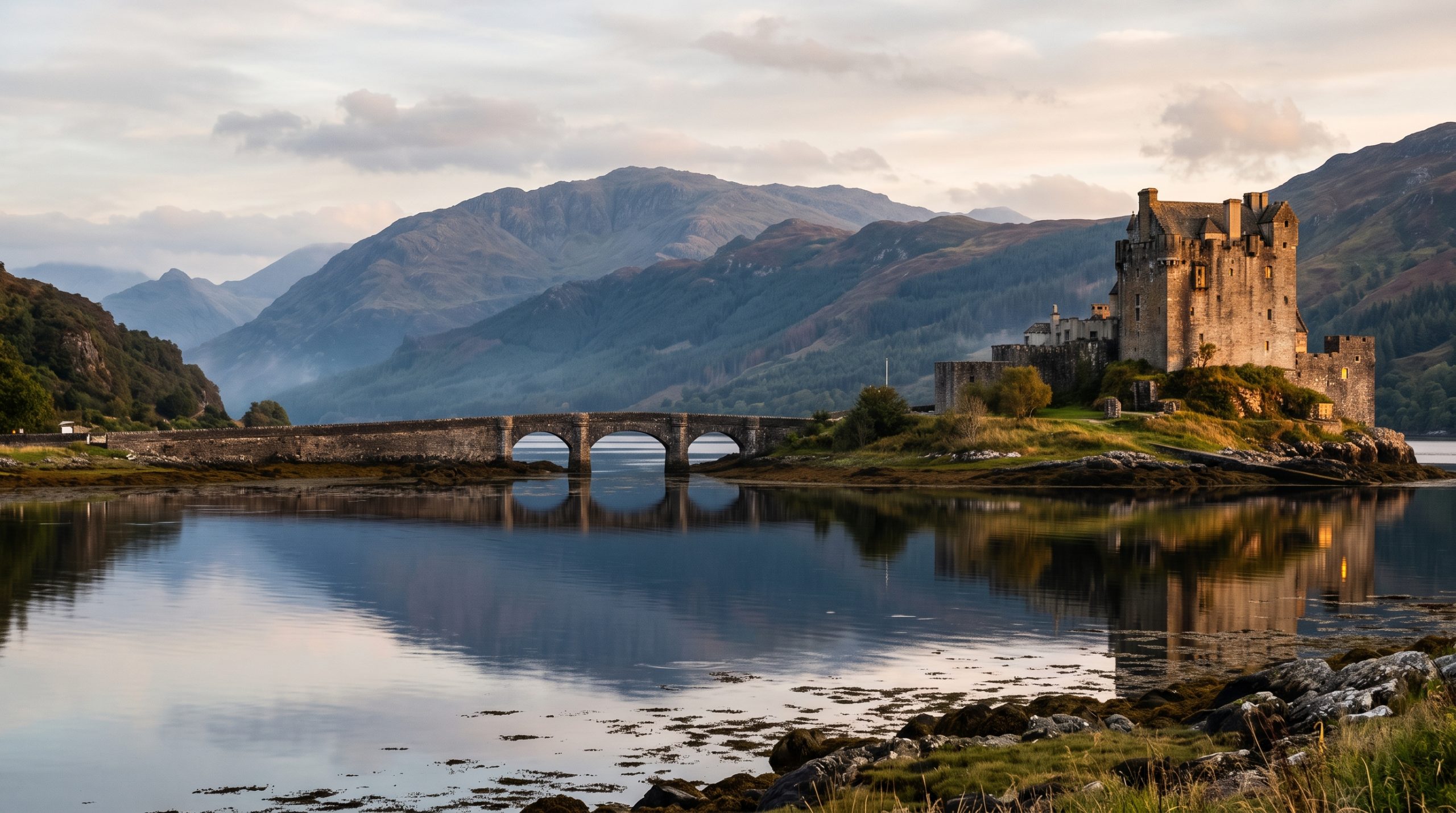
Through the summer the castle takes its last visitors at five and closes the doors at six. Weddings start at seven. That single hour is the whole logic of getting married at Eilean Donan, and it decides the fee you pay, the light you get, and the reason the coach tours are somebody else’s problem by the time you walk the bridge.
Eilean Donan is not a wedding venue that happens to open to the public. It is one of the most photographed castles in Scotland, sitting a few meters off the A87, the road every car and coach heading for Skye has to use, and it is run as a charity by the Conchra Charitable Trust. Getting married inside it means hiring it, and the trust publishes what that costs, which is more than most Scottish castles will do.
What follows is the practical version. Two fees, one evening hour, the four months when that hour opens out into a whole day, and what the arched stone bridge is like to cross in a long dress.
Two hire fees and a seven o’clock start
Hiring Eilean Donan for a wedding currently costs £1,400 for a party of fewer than ten people in total, and £1,650 above that. Ceremonies happen in the Banqueting Hall. From spring through autumn they start around seven in the evening, after the castle has closed to visitors. From November through February, any hour of the day can be arranged.
The A87 runs past the door, and so do the coaches
The car park in front of the castle was built with coach bays, which tells you everything about the daytime rhythm here. Eilean Donan is not a destination people drive to and linger at. It is a stop on a route, and the route runs to Skye. Coaches arrive when their itinerary says they arrive, not when the light is nice.
This is why the usual advice fails at this particular castle. Arriving early works at a place where the crowd builds slowly through the morning. It works much less well where tickets are sold only on site, only on the day of the visit, so there is no advance-booking system smoothing arrivals into slots. In high summer the doors open at nine, and the first hour after opening is the thinnest window of the day, but the shore in front of the castle is public ground and it is rarely empty of somebody with a camera.
We will say the unpopular thing too. The famous roadside frame, the one on every Highland itinerary, is flat at midday and taken from a spot with parked cars in it. It is not the reason to marry here. The reason is the hour after six, when the last visitor crosses back over the bridge and the island belongs to your ceremony.
| Time of year | Doors close to day visitors | Ceremony hour in practice |
|---|---|---|
| February to late March | 4pm, last admission 3pm | Evening, once the doors close |
| Late March to April | 6pm, last admission 5pm | Around 7pm |
| May to September | 6pm, with doors open from 9am in high summer | Around 7pm |
| October | 6pm, dropping to 4pm in the last week | Around 7pm, earlier late in the month |
| November to 22 December | 4pm | Any hour by arrangement |
| January | No published visitor hours | Any hour by arrangement |
Guests arrive from half past six for a seven o’clock ceremony. That is a narrow door, and it is the single most common reason an Eilean Donan timeline goes wrong: people plan the getting-ready hour as though the castle were available all afternoon, then discover the whole day has to be built around thirty minutes of arrivals.
Bridge, steps and cobbles in a long dress
The walk itself is short. The castle sits less than half a mile from Dornie village, and from the visitor center it is a level few minutes to the water before the arched stone bridge begins. The bridge is stone, slightly humped, and not uniformly smooth where the arches meet. A narrow heel finds every joint. Most couples cross in flats and change in the courtyard, which takes ten seconds. Three sea lochs meet at that point, so the bridge is the windiest ground on the island: a long veil needs a second pair of hands on the crossing, and we plan for that rather than discovering it. There is a cafe and there are toilets at the visitor center, which matters more than it sounds at half past six in October.
Which way the light arrives off three sea lochs
Loch Long comes in from the northeast past Dornie. Loch Duich runs away to the southeast under the Five Sisters of Kintail. Loch Alsh opens west toward Kyle of Lochalsh, and that is where the low sun goes. Every decision about the ceremony hour follows from that one piece of geography.
It means a seven o’clock start in June is not a compromise. It is close to the best hour of the day. By the time your guests carry glasses out into the courtyard, the sun is still well up and traveling down Loch Alsh, and at this latitude the light holds long past ten. Late August is better still, because seven has moved toward proper golden hour rather than sitting in front of it. By the last week of September, seven o’clock is already dusk, which flips the whole day: exterior frames have to happen before the ceremony rather than after, and the timeline gets built backwards from the vows instead of forwards.
Mornings work the opposite way. In midsummer the sun comes up over Dornie and up Loch Long, so it front-lights the bridge side of the castle early. In spring and autumn it rises to the southeast behind the Kintail ridge, and the castle stays in cold blue shadow well after sunrise on paper. That lag is the thing nobody accounts for. If you want a morning on the shore before the doors open, we time it against the ridge rather than against the sunrise time, and the difference can be forty minutes. You can see how western light behaves against these walls, and how the film handles that long slow fade down the loch, in our published elopement stories and films.
November to February, when the hour is yours to pick
Between November and February the castle will arrange a ceremony at any time of day, because the daylight is too short to do otherwise. The visitor season pauses after 22 December and there are no published visitor hours again until February, so a midwinter wedding here is not squeezed in after the crowds. There are no crowds.
The trade is obvious and worth stating plainly. Sunset in December comes in the middle of the afternoon, so a one o’clock ceremony puts you in the courtyard with drinks at the warmest light the day will offer, and everything is over by dark. Weather arrives off the Atlantic from the west, which is also where the view is, so a bright winter afternoon at Dornie is genuinely spectacular and a gray one is very gray. Some couples want the long northern evening and will take the crowds that come with it. Others want the island to themselves at noon in November. Tell us which of those two you actually are and we will shape the day around it, or point you at the month that fits it better. If you are still choosing between Highland locations, our destination elopement guides compare how each one behaves through the year.
Four meters of wall: the Banqueting Hall and the Billeting Room
Ceremonies take place in the Banqueting Hall, the largest room in the castle, which seats roughly seventy. It has a Canadian timber ceiling and the proportions of a room built long before anyone thought about wedding photographs. Afterwards the drinks reception moves to the Billeting Room, where the walls run over four meters thick under a barrel-vaulted ceiling, and when the weather allows people spill out into the private courtyard with their glasses while we work with the two of you. Hiring the castle gives you and your guests exclusive access to that interior and that courtyard.
Walls that thick change how the rooms photograph. Windows are set deep, so daylight arrives as a narrow shaft across stone rather than a wash across a room, and the falloff is fast and beautiful if you are working with it rather than fighting it. This is the argument for the courtyard in the half hour after the ceremony. It is also the argument for booking a light that still exists when the vows end, which brings you back to the calendar in the table above.
The rooms also decide how two of us work. There is exactly one hall, and it is not large. With a photographer and a filmmaker on the same day, one of us takes the far end of the Banqueting Hall on a long lens while the other works close from the side aisle, so neither appears in the other’s frame and nobody is stepping backwards over a chair leg. The wind is the other reason two people help here. Vows spoken indoors are clean, but anything said on the bridge or in the courtyard is competing with air moving across the mouth of three lochs, so audio goes on the people rather than on a stand near them. Our experiences and what each one covers are set out in full, from the Adventure at $4,900 with one dedicated photographer or filmmaker, to the Expedition at $7,900 with both working together and professional audio for the vows.
The M10, the schedule and a registrar open half-days
Scotland is straightforward about this, and much easier than most American couples expect. Both of you complete a marriage notice, form M10, and send it to the registrar for the district where the marriage takes place. For Dornie that is the Highland Council registration office at Kyle of Lochalsh. The legal window is a minimum of twenty-nine clear days before the date and a maximum of three months, though the official guidance notes ask for notices about ten to twelve weeks ahead, and that is the target we plan to.
If your ceremony is led by a religious or belief celebrant rather than a council registrar, one of you has to collect the marriage schedule in person from that office before the day. You, your celebrant and two witnesses sign it during the ceremony, and it goes back to the registrar within three days. The Kyle office opens in part-day blocks rather than full weekdays, and not every day of the week, so collection is a slot to be reserved in the itinerary and not an errand to improvise on the drive over. We build it into the timeline as a fixed point, the same way we treat a ferry. Our guide to planning an elopement covers the paperwork sequence in more depth.
Permit fees, the castle hire, the celebrant and your accommodation are paid by you directly. The research, the timeline, the location design and the logistics around all of it are ours, in every destination we work in, with team travel included.
Common questions
Does the hire fee change if we bring guests?
Yes, but only at one threshold. The castle charges one rate for a total party of fewer than ten people and a higher one above that, currently £1,400 and £1,650. Our own fee does not move with guest numbers at all. Guests affect access, transport and the shape of the timeline, not what we charge.
Can we get married outside, on the bridge or in the courtyard?
The ceremony itself takes place in the Banqueting Hall. The courtyard is where the drinks reception spills out when the weather is kind and where a great deal of the portrait work happens, and the bridge is the frame everyone recognizes. So the exterior is very much part of the day, just not the part where the schedule gets signed.
Why is the ceremony at seven in the evening?
Because the castle is open to the public until six through the main season, and your ceremony needs the building empty. Guests arrive from half past six and the ceremony starts around seven. It is the reason a wedding here feels private in July, which almost nothing else about Eilean Donan does in July.
Which registrar handles a marriage at Eilean Donan?
The Highland Council registration office at Kyle of Lochalsh, eight miles west of the castle on the A87. That is where your M10 notices go and where the marriage schedule is collected if a celebrant is leading the ceremony. Its opening is part-day rather than all week, so we timetable the collection deliberately.
Is the castle ever quiet in daylight?
In November, December and January, yes, and completely so. In the main season the honest answer is the first hour after opening, which is nine in high summer, and even then the public shore has people on it. If daylight privacy matters more to you than a long evening, say so early and we will look at the winter dates.
Booking a date at Dornie
Castle dates and our own calendar are separate bookings, and the castle is the tighter of the two, so it is worth settling the date before anything else. Our Scotland calendar is currently open across 2027, 2028 and 2029. Send us the date you have in mind and roughly what you picture, and you will have a reply and our initial brochure within a day, then a tailored proposal covering the timeline, the light, the registrar run and what each experience covers. A signed contract and a thirty percent retainer start the planning. Everything happens in writing, at whatever hour suits your time zone. When you are ready, Check Your Date.