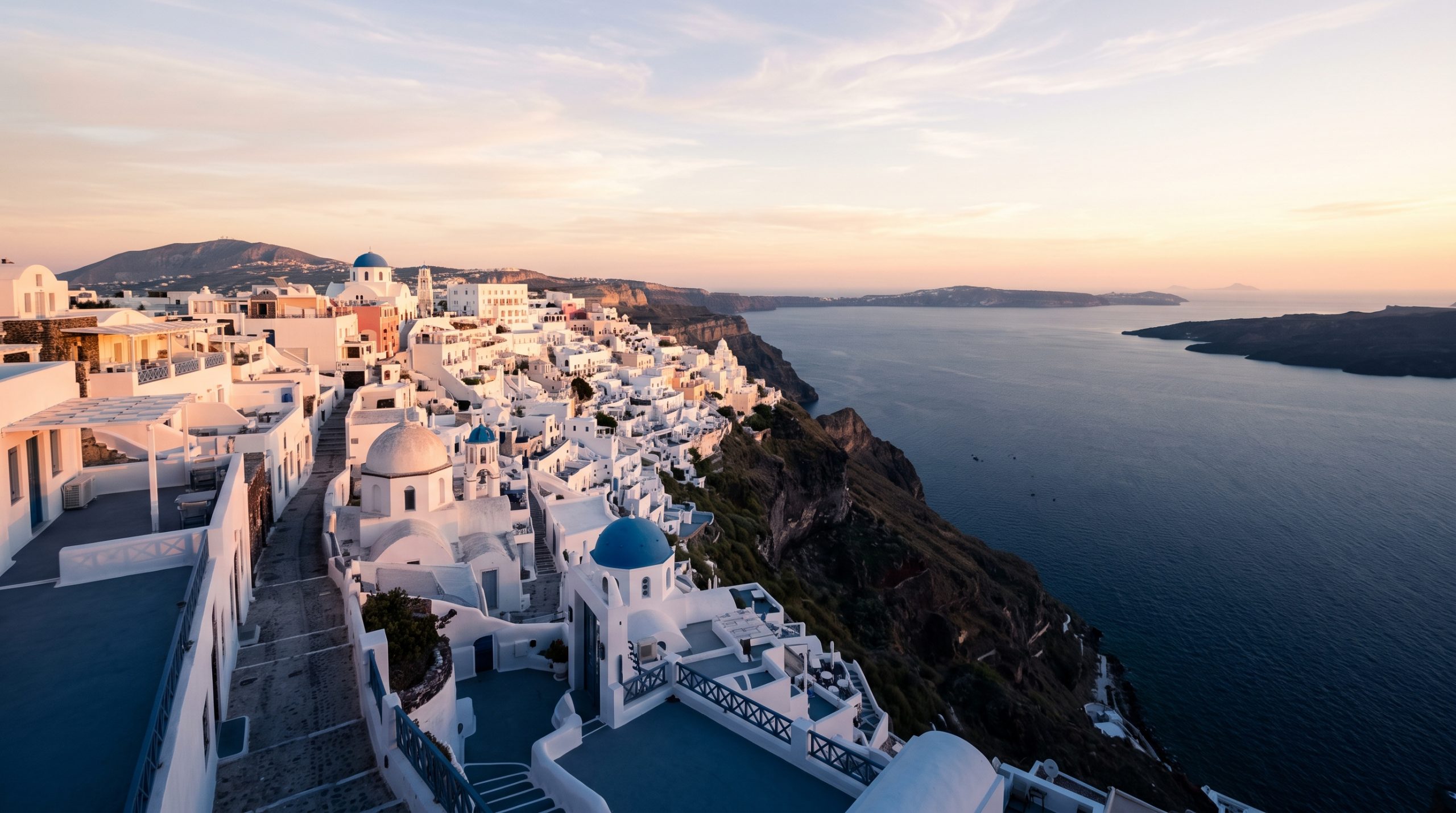
The marble path above the three blue domes is empty at ten to six on a May morning. One delivery scooter, two cats, a man hosing down a terrace. Sunrise lands at 06:11 mid-month, and for the forty minutes after it the whitewash on the caldera side turns the color of the inside of a shell, with the sun behind your shoulder and low enough to reach into every doorway in the village.
Twelve hours later the same path is a slow-moving line of people. Santorini now caps cruise arrivals at 8,000 passengers a day, a limit set by the island’s mayor, Nikos Zorzos, and a large share of them are pointed at the castle ruins for the evening. The sun that was behind you at dawn is now in front of the lens, out over open water, and every white wall you wanted lit is turned away from it.
So couples write to us asking whether to hold the ceremony at sunrise or sunset in Oia, and expect us to say sunset, because sunset is what Oia sells. We do not.
Sunrise, and the margin is not small
Sunrise. Every classic view in Oia faces the caldera, which means it faces west. At dawn the sun sits behind the camera and the village is lit; at dusk it sits in front of the camera and the village is a silhouette. Mornings are also calmer and close to empty. Sunset is the better spectacle and the worse ceremony hour.
Oia is built facing the sunset, and that is exactly the problem
The village runs along the northwest lip of the caldera. Terraces, pool decks, churches, the windmills at the tip: they all look west, toward Thirasia and the open Aegean. That orientation is why the place is famous, and why the evening light works against you rather than for you.
Point a camera at the domes at 20:30 in July and you are shooting into a light source. The sky holds detail and the buildings do not. You can expose for one or the other, which is why so many Oia sunset pictures are silhouettes against an orange wash, and why they all look alike.
Turn that around at 06:12 and the geometry flips. The sun comes up over the low ground on the island’s north side, behind the village, and rakes across the caldera face from behind you. Whitewash takes warm light beautifully, and blue domes need direct sun to read as blue at all. You can see what that looks like across our published elopement galleries and films, where the morning frames are the ones with depth in them.
We are not going to pretend the Oia sunset is overrated as an event. It is genuinely one of the great ones, and the fifteen minutes of blue hour afterward, when the village lights come on down the cliff, is worth staying out for. It is simply a poor hour to be standing somewhere quiet exchanging vows, because at that hour nowhere in Oia is quiet.
Month by month in Oia: sun times, conditions and pressure
Sunrise and sunset below are for the middle of each month at Oia’s latitude, in local Greek time. Times move by up to twenty minutes within a month, so read them as the shape of the year. We build the real timeline to your exact date.
| Month | Sunrise / sunset | Conditions | Crowds in Oia | Our verdict |
|---|---|---|---|---|
| January | 07:29 / 17:26 | 114 mm of rain across 11 days; slopes green | None | Lovely and largely shuttered |
| February | 07:06 / 17:59 | 81 mm across 10 days; cold wind off the caldera | None | For couples who want the island alone |
| March | 06:29 / 18:25 | Clocks go forward; the greenest weeks of the year | Very light | Underrated, if you pack layers |
| April | 06:45 / 19:52 | Warming fast, still green, rain thinning out | Building | A strong shoulder month |
| May | 06:11 / 20:18 | 22°C days, meltemi not yet established | Moderate | Our first choice |
| June | 05:59 / 20:38 | 14 hours 39 minutes of daylight at the solstice | Heavy | Earliest sunrise of the year |
| July | 06:12 / 20:36 | 28°C; meltemi at full strength | Peak | Sunrise or nothing |
| August | 06:36 / 20:09 | 28°C; meltemi at full strength | Peak | Sunrise or nothing |
| September | 07:00 / 19:26 | 25°C; about one rainy day in the whole month | Easing after mid-month | Our close second |
| October | 07:25 / 18:42 | Clocks go back on the last Sunday | Light from mid-month | Excellent right up to the change |
| November | 06:55 / 17:10 | Sun peaks at 35° above the horizon; rain returning | Very light | Soft light from dawn to dusk |
| December | 07:22 / 17:04 | 12 rainy days; 9 hours 40 minutes at the solstice | None | Short, low, quiet, entirely workable |
The greenness in the winter and spring rows is not decoration. Santorini gets 114 mm of rain in January, roughly four and a half inches, then next to nothing from June through September, which average about one rainy day each. The slopes and the low basket-pruned vines stay green only as long as that water lasts, and by July the island is the color of dust. For a green foreground under the caldera you are looking at March, April and early May, and no other part of the year.
The meltemi keeps a daily timetable
The meltemi is a dry northerly that funnels down through the Cyclades in summer. It appears from June through September, peaks in July and August, and typically blows at force 5 to 6 with the capacity to climb well above that. The detail that matters for a ceremony is not the strength but the schedule: it builds through the afternoon, tops out in the late afternoon and early evening, and eases off overnight.
Read that against the table. An August ceremony at 20:09 sits inside the windiest hour of the windiest month. The same ceremony at 06:36 sits in the calmest air of the day. Veils, loose hair, a long train and a floral crown all behave differently in those two hours. So does audio. On an Expedition day the filmmaker is recording vows on lapel mics, and wind is the one variable a microphone cannot be argued out of. Morning is when the air is still enough to hear you.
What the sun actually does between December and June
At Oia’s latitude the midday sun reaches 77° above the horizon on June 21 and only 30° on December 21. That single number reshapes the whole day. In late June the sun sits nearly overhead from mid-morning to mid-afternoon: flat, hard light with shadows straight down under the eyes, and nothing to be done about it except work at the ends of the day. In late December it never climbs past thirty degrees, so the light stays raking and directional all day. December gives you nine hours and forty minutes of daylight and almost all of it is usable.
The setting point moves too, and further than most people expect. In late June the sun goes down at an azimuth of about 300°, west-northwest, well out past Thirasia over open water. By December it sets at about 241°, southwest, in a completely different part of the sky. A terrace with the sun dropping into frame in July has it well off the edge in October. This is why we scout by date rather than by location list, and why the caldera-view suite a hotel photographed in high summer may not line up in the month you are coming.
One thing stays remarkably constant. The soft window, from the horizon up to about six degrees, runs close to forty minutes in every month of the year here. Forty minutes in May, forty minutes in December. That is the real working window for vows, and it is short. It is also the strongest argument for a photographer and a filmmaker working at the same time rather than one person switching jobs. Somebody is wide on the landscape while somebody else is close on your hands, and in forty minutes there is no second pass. Our guide to planning an elopement goes into how we shape a day around a window that tight.
Four dates on the Oia calendar are fixed. The earliest sunrise of the year, 05:59, falls in the second week of June. The latest sunsets, around 20:40, run through the last ten days of June. The latest sunrise, about 07:33, arrives in the final days of October, just before the clocks go back. December 22 is the shortest day, sunrise 07:26 and sunset 17:07.
July and August, and the better months on either side
If your date is open, we would not put you in Oia in July or August. Daytime highs sit at 28°C, about 82°F, the meltemi runs at its hardest through the exact hours most couples picture getting married in, and the cruise cap that protects the island still allows a great many people onto a village with paths two meters wide. Sunrise gives you the morning outright. The rest of the day is a negotiation.
We would move you to May. Days sit around 22°C, roughly 72°F, sunrise is 06:11 and sunset 20:18, the meltemi has not settled into its summer pattern, and there is still green on the slopes from the winter rain. If May does not work, late September is our close second: 25°C, about one rainy day in the whole month, a civilized 07:00 sunrise, and a village that visibly empties after the middle of the month. October holds up beautifully until the clocks change, at which point sunset falls off a cliff from around 18:30 to around 17:30 overnight.
If your date is already fixed in high summer, none of that is a problem to solve. It is a shape to build to. We anchor on the 06:36 sunrise, put the ceremony and the caldera work in the first two hours of light, keep the middle of the day in shade, and take the evening somewhere with the same view and a fraction of the footfall. Imerovigli, Skaros and Finikia all look at the same volcano. Tell us your date and we will tell you honestly what that month gives you.
How the Oia morning still works under grey cloud
Weather planning here is not optimism, it is a document. Before anyone flies, your timeline carries a named alternative for each block of the day, chosen by wind direction, and a ceremony hour allowed to move an hour either way without anything else falling over. When the meltemi is northerly, the sheltered side of the rim is a different place. When cloud sits on the caldera at dawn we go low, to Ammoudi and the water, where flat grey light is an advantage.
Two seasonal access points get written in at the same time. Boat movements across the caldera are wind-dependent through the summer, so anything on the water carries a land-based twin. And aerial work over Santorini runs under Hellenic Civil Aviation Authority rules, which means operator registration and an approved flight plan, confirmed before the film is designed around it rather than after. Winter has its own arithmetic: much of Oia’s hospitality runs on a season, so accommodation and the celebrant get locked in earlier, and with 12 rainy days in a December the alternatives get more attention, not less.
Coverage runs as a full day with either a photographer or a filmmaker, a full day with both, or several days across one or more destinations, and the shapes and figures are all on the pricing page. Team travel is included wherever in the world you take us. For how Santorini compares with the other places couples weigh against it, our destination guides are the place to start.
Common questions
Is sunrise in Oia genuinely empty, or is that just something photographers say?
Genuinely quiet. The main paths carry deliveries, a handful of joggers and a few other photographers between first light and about eight in the morning. Compare that with the evening, when the island’s 8,000-passenger daily cruise cap is largely spent on the same square kilometer of village.
What time do we need to be in position for a sunrise ceremony in Oia?
Roughly thirty minutes before the sun clears the horizon, so 05:40 in mid-May, 06:05 in mid-August and 06:55 in mid-October. Civil dawn gives real working light before the sun itself appears, and that pre-sunrise light over the caldera is often the best of the morning.
Can we do sunrise portraits and a sunset ceremony on the same day?
Yes, and in the shoulder months it is a good use of a full day. In mid-September there are twelve hours and twenty-six minutes between sunrise and sunset, which is enough for a dawn start, a long rest through the middle, and an evening somewhere quieter than the castle.
Is August too windy for an outdoor ceremony in Oia?
Not in the morning. The meltemi builds through the afternoon and peaks in the late afternoon and early evening, then eases overnight, so a 06:36 August ceremony sits in the calmest air of the day while a 20:09 one sits in the roughest.
How much rain should we plan for if we come in September?
Very little. September averages about one rainy day in the whole month, and daytime temperatures run around 25°C, roughly 77°F. It is the month we recommend most often after May, and the crowd pressure drops noticeably once the middle of the month passes.
When do the clocks change in Greece, and does it affect our ceremony time?
They go forward on the last Sunday in March and back on the last Sunday in October. That October change moves sunset from about 18:30 to about 17:30 overnight, so a late-October date needs the timeline written to the correct side of that Sunday.
Do we need permission to fly a drone over the caldera?
Aerials in Greece run under Hellenic Civil Aviation Authority rules, with operator registration and an approved flight plan for the area. We confirm the permission and the time window first, then design the film around what is actually cleared.
Do we have to be legally married in Greece to have our ceremony in Oia?
No. A legal civil ceremony is registered through the Municipality of Thira, and the apostilled and translated paperwork needs to reach them weeks ahead rather than days. Plenty of couples instead handle the legal side at home and keep the Oia morning entirely for the vows they actually wrote.
Choose the Oia hour first; let the date follow
Pick the hour first. Once you have decided you want the village to yourselves and the light on your faces rather than behind them, the month almost chooses itself, and the rest is arithmetic we are happy to do. We are eight people, currently taking 2027, 2028 and 2029, and there is always a second camera on the ground.
We handle the planning in writing so nothing depends on matching time zones. Send the form, and you get a reply and our first brochure back within 24 hours, then a proposal built around your date, then a contract and a 30% retainer, at which point the planning starts properly. Tell us the morning you have in mind and we will tell you exactly what the sun will be doing.