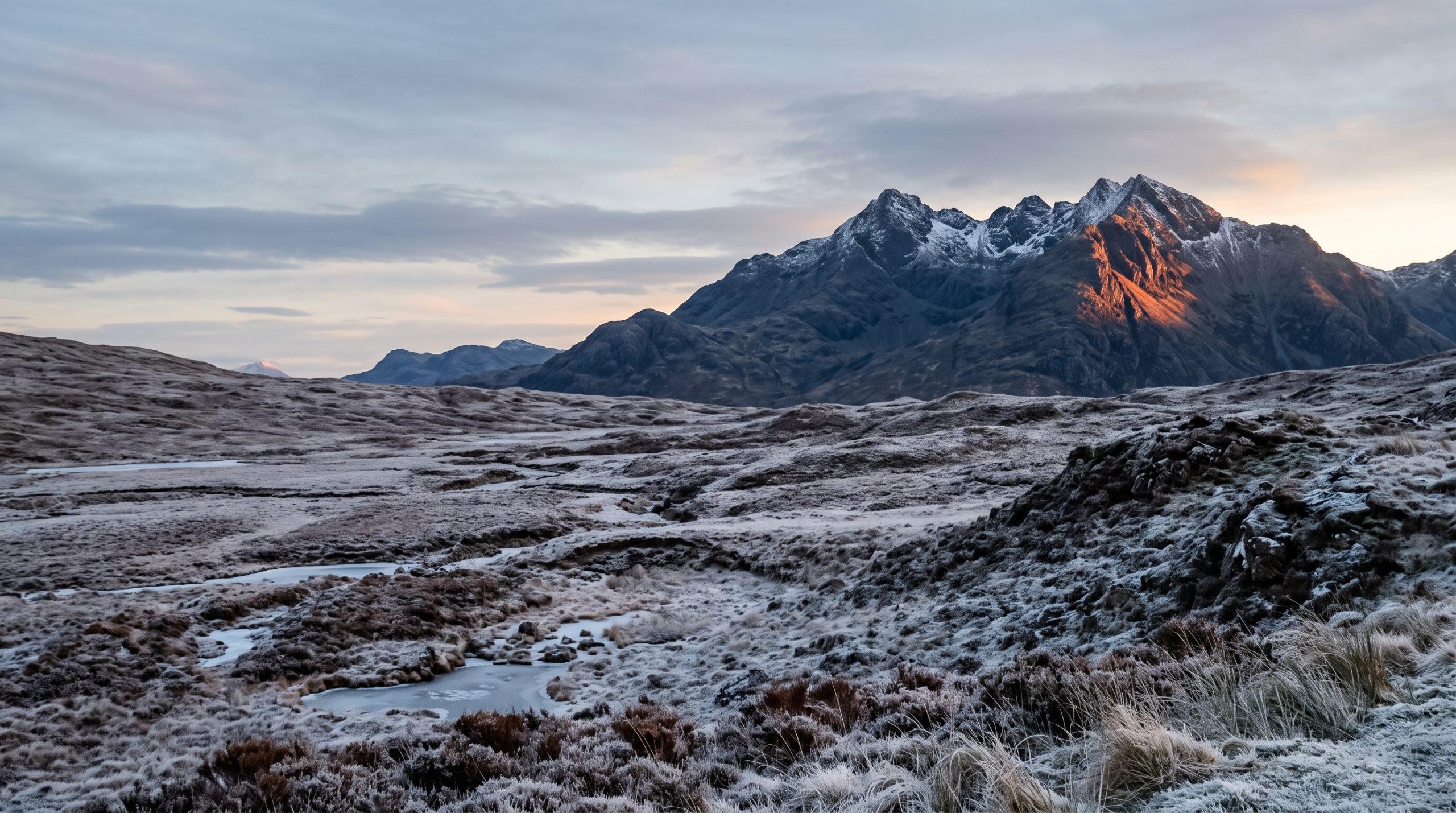
On 22 December the sun clears the horizon at Portree at 09:05 and sets at 15:42. That is six and a half hours of usable daylight, and the shortest day of the year here runs 6 hours and 36 minutes. That one number decides everything else about a winter elopement on Skye: how many locations you get, when you stand up and say your vows, how far you can sensibly drive between one headland and the next.
The other half of the trade is quieter. The Quiraing car park holds roughly seventy cars and fills by late morning right through the summer. In the second week of January it does not fill at all. You walk out onto the col with the whole Trotternish escarpment to yourselves, and the only things you are working around are wind and light.
What follows is the arithmetic of that, month by month, plus the fortnight we would book if the date were ours to pick.
The winter fortnight we would book
The second half of February. By 20 February, Portree sees sunrise at 07:43 and sunset at 17:35: close to ten hours of light, with the sun still low all day, ground drier than January, and the hills empty until Easter. For a true 4pm sunset, take the fortnight before Christmas instead.
November to March, month by month
Light times below are for Portree, mid-month, in GMT. Temperatures follow the Met Office long-term averages for Skye, where the coldest months run to daytime highs of about 7°C, mid-forties Fahrenheit, with nights close to 2°C.
| Month | Light (mid-month) | Conditions | Crowds | Our verdict |
|---|---|---|---|---|
| November | 08:07 to 16:10, eight hours | Mild, wet, the first big Atlantic systems | Emptying fast after October | Strong, and warmer than people expect |
| December | 09:00 to 15:40, under seven hours | Around 7°C by day, dark by teatime | Quietest car parks of the year | Book it for the 4pm sunset |
| January | 08:55 to 16:14, seven and a quarter hours | Wettest month on the Skye average | Nobody on the trails | One or two locations, no more |
| February | 07:58 to 17:22, nine and a half hours | Drier than January, snow shows on the tops | Still quiet, pre-Easter | Our pick, second half |
| March | 06:42 to 18:27, nearly twelve hours | Light returns at five minutes a day | Coach traffic back near Easter | Good early, busy late |
If a couple wrote to us with a completely free choice and wanted four locations in one day, we would move them off the first three weeks of January. The reason is not the look of it. Low January light on wet basalt is some of the best this island produces. The reason is that January averages around 222 mm of rain, the wettest month of the Skye year, and a mid-January day gives you 7 hours 19 minutes from first light to last. Late February hands back two full hours of daylight and costs you nothing in atmosphere.
And if January is the date already, because of a birthday or a leave rota or the week you met, it works. It works by doing less. One landscape, one sheltered second location, vows placed in the middle of the light rather than at the end of it. We would far rather build you a good January day than talk you into a February one.
Sunrise after nine, sunset before four
A December day on Skye is not a short day with a golden hour bolted to each end. It is one long, low, slow-burning hour that happens to last from breakfast to mid-afternoon. That changes how we build the timeline. In June we chase two narrow windows. In December we simply protect the daylight and refuse to waste any of it on the road.
Here is how a solstice-week day actually runs on the Trotternish side of the island.
- 08:14: first usable civil light. You are already at the location, not leaving the cottage.
- 09:05: sunrise. The east-facing cliffs get the warm side of it first.
- 10:30 to 12:00: the walking and the wider frames, while the ground is brightest.
- 12:39: solar noon, and the sun is still only nine degrees up. Vows anywhere in this window look like early evening anywhere else.
- 15:42: sunset, and the drive back begins in the dark.
- 16:32: civil light gone. Dinner somewhere with a fire.
Distance is the real cost. The Storr path is 3.8 km there and back and takes about an hour and a quarter without stopping, which is a fifth of the December light. Neist Point sits roughly an hour from Portree on single-track sections that you will not want to rush in the dark. So we pick two places that share a road, and we put the drive at the front of the day.
This is also the season where two people working at once stops being a luxury and becomes arithmetic. With under seven hours of light, a photographer who steps back so a filmmaker can get the same moment costs you real frames. Our Expedition coverage puts a dedicated photographer and a dedicated filmmaker on the same hour, working the same vows from different angles, and in December that is the difference between a full story and a partial one. The detail of each coverage option is set out in one place.
A sun that never climbs past nine degrees
At this latitude the midwinter sun reaches about nine degrees above the horizon at its highest, and spends all but roughly three and a half hours of the solstice day below six degrees. Six degrees is the elevation photographers describe as golden. That is the entire technical argument for winter here: the light you would wait until 9pm for in July is the light you get at lunchtime in December.
Direction matters as much as height. Through the winter the sun rises in the southeast and sets in the southwest, never swinging north of due east or west the way it does in June. The east-facing walls of Trotternish, the Storr pinnacles, Kilt Rock, the Quiraing terraces, take the first warm light and hold it. The west coast, Neist Point, the Coral Beaches, Elgol looking across to the Cuillin, takes the last of it. That geometry writes the running order of the day, and it flips completely between summer and winter.
For film, the low angle does something you cannot fake. Backlit rain, long shadows moving across grass, faces lit from the side rather than from above. Compare a June frame and a February frame in the films and galleries we have published and the difference in the shadows is the first thing you notice. By 20 February the sun climbs to about twenty-one degrees, which is bright enough to feel like spring and still low enough to model a face properly.
Ferries, single-track roads and the Easter switch
Winter access to Skye is simpler than people fear, as long as you know which of the three routes is actually running.
The Glenelg to Kylerhea turntable ferry, a six-car turntable boat that shuttles across every twenty minutes, runs between Easter and October only. It is not an option for a February date, and because Easter itself moves by up to three weeks from year to year, the return date moves with it. The Mallaig to Armadale crossing drops to a reduced winter timetable from mid-October until late March, with fewer sailings a day and less slack if a connection slips. The Skye Bridge carries traffic all year and depends on no timetable at all, which is why almost every winter day we plan begins with a drive over it.
Parking is charged at the honeypots year round, and the hours matter in December. The Quiraing car park is Highland Council pay and display, £3 for up to three hours or £5 for up to six, charged between 8am and 6pm, by card or the RingGo app. In June you can arrive at 4am for nothing. In December the charging window covers the entire day of light, so the fee is simply part of the day. The Old Man of Storr is £6 for up to six hours and £7 for up to twelve, coins or contactless. The Fairy Pools car park at Glen Brittle, run by the Outdoor Access Trust for Scotland, is £8 for a car.
Aerials run on paperwork rather than luck. Drone work needs the operator to hold current UK Flyer and Operator IDs, plus permission from whoever owns the ground, so we confirm both before we design a single shot around a drone. Where it is legal and sensible, the winter light makes it worth the admin. Our destination guides go further into how the access side of Scotland works.
Wind direction picks the location
Nobody on Skye plans a February day around sunshine. We plan it around wind direction, which is forecast reliably enough three days out to be genuinely useful, and we write both versions of the day before anyone flies.
In a southwesterly, the classic Skye wind, the west coast headlands take it full in the face and the eastern side of Trotternish sits in the lee. Loch Fada, the lower Storr slopes, the Lealt gorge and Kilt Rock all stay workable. Swing it to a northeasterly and the whole thing inverts: Neist Point, Waterstein and the Coral Beaches become the sheltered choice. When it is simply grey and still, we go inland to Sligachan and Glen Brittle, or to the low hummocks of the Fairy Glen at Uig, which works in almost anything because nothing there is exposed.
The ceremony hour moves too. Because the sun sits low from breakfast until dark, vows can shift ninety minutes in either direction without changing how the photographs look. That flexibility exists only in winter, and it is the reason a front passing through at eleven does not cost you your ceremony. We also hold a plan for the day being beautiful and calm, which happens more often than the island’s reputation suggests, and that plan involves more walking.
Tell us the week you are thinking about and the kind of morning you actually enjoy, and we will tell you honestly what that week gives you and where we would stand. Send Us a Message with your dates.
Twenty-nine days, and why a February date starts in autumn
Scots law sets a minimum of 29 days’ notice to the registrar before the date of the marriage, and notice cannot be given earlier than three months before it. Registrars themselves ask for the forms ten to twelve weeks ahead. For a late February wedding, that clock starts in autumn. We handle the research, the timeline and the location permissions; you pay the actual government and landowner fees. Our planning fundamentals walk through the order of it all.
Common questions
Is there enough daylight to elope on Skye in December?
Yes, for one or two locations rather than four. The solstice gives 6 hours 36 minutes of sunlight, and usable civil light runs from 08:14 to 16:32, which is over eight hours. The constraint is driving time, not light quality, because every hour of a December day looks like a summer evening.
Can we count on snow in our February photographs?
No, and we would not build the day around it. Snow shows on the Cuillin and the Trotternish tops first and often clears within days as the next Atlantic system arrives, while low ground averaging around 7°C rarely holds it. We plan a February day that works on green and wet, and treat a white ridge as a bonus.
How busy are the Old Man of Storr and the Quiraing in January?
Quiet enough to change your plan on the morning. The Quiraing’s seventy or so spaces fill by late morning in summer; in January you choose your spot. Charging still applies from 8am to 6pm, and the Storr path stays open, so the walk is the same 3.8 km it always is.
What happens if a front lands on our date?
We move within the day rather than cancelling it. The ceremony hour shifts, we switch to the sheltered side of the island according to wind direction, and both options are written into your timeline before anyone lands on Skye. In practice, weather changes which frames we get, not whether we get them.
Can we see the northern lights during a winter elopement on Skye?
The dark hours are certainly there. At the solstice the sun is below the horizon for more than seventeen hours. What nobody can promise is a clear sky in the wettest season of the year, so we treat aurora as something to stay up for rather than something to plan around, and we never let it shape the day itself.
How far ahead do we need to give notice for a Scottish winter date?
The legal minimum is 29 days before the ceremony, but notice can be lodged up to three months ahead, and registrars ask for it ten to twelve weeks out. For February dates we start the paperwork conversation in the autumn, alongside accommodation, which is the genuinely limited resource on a small island.
If your date is already fixed
Most couples come to us with a date attached to something that cannot move, and a hard month is a design problem rather than a compromise. Tell us the week and we will build the day the light in that week can actually deliver, or tell you plainly which fortnight would serve you better. The whole planning process stays written and easy to revisit: you send the form, we reply with a brochure inside 24 hours, and a tailored proposal follows. Our current availability runs across 2027, 2028 and 2029, and February fills from the winter before. Check Your Date.