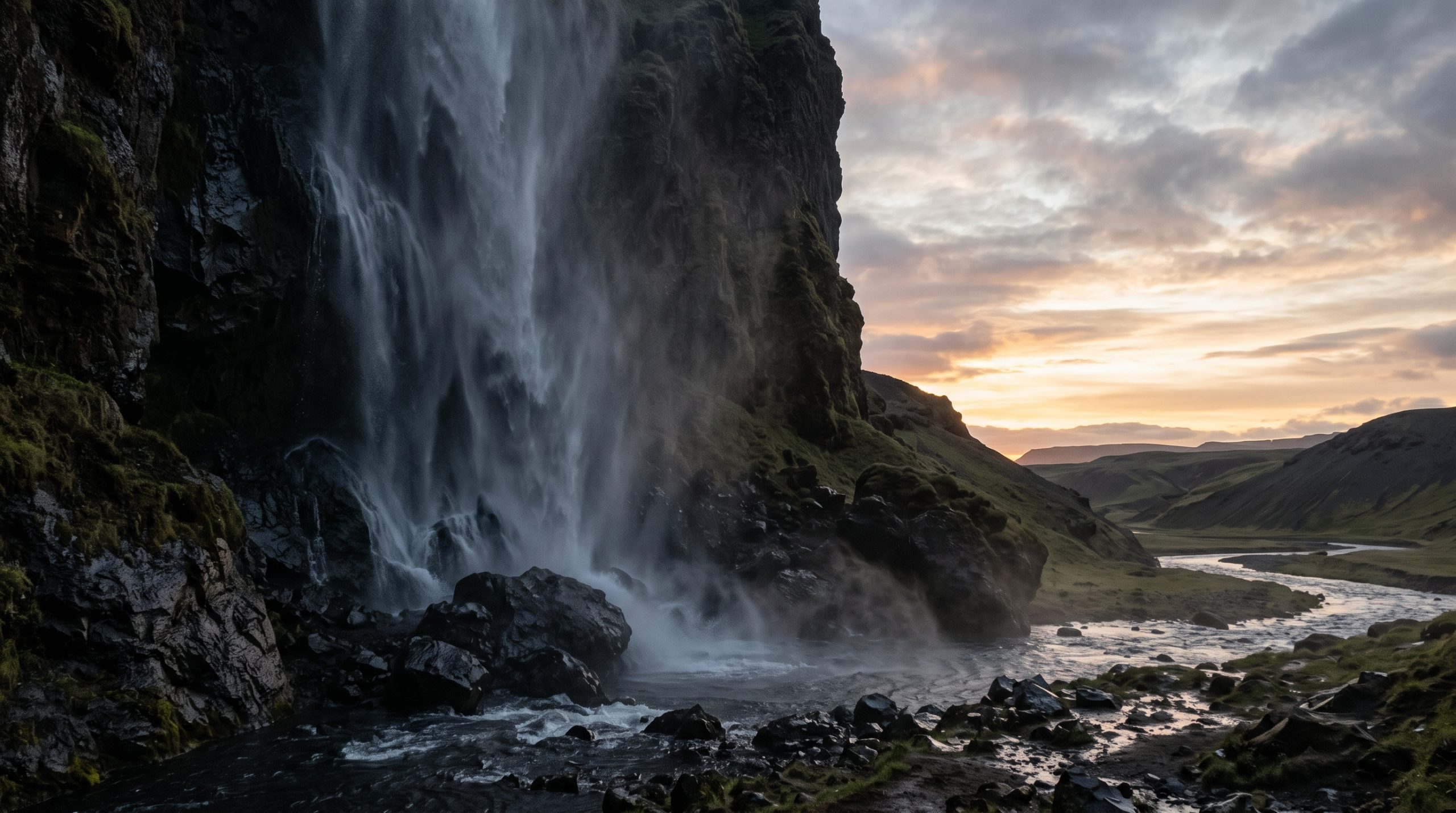
On June 21 the sun at Skógafoss sets at ten minutes to midnight, in the north-northwest, directly behind the cliff the waterfall pours over. The sunset is real. It just happens somewhere you cannot see from the base of the falls.
By half past six that evening the sun has already swung past due west and gone behind the escarpment. The 60 meter curtain of water in front of you then sits in flat, colorless shade for the next five hours while the plain behind your shoulders keeps glowing. Couples ask us for a sunset ceremony at Skógafoss more often than for any other hour, and from May to August it is the one hour we gently argue with.
The fix costs nothing. It is a different hour, or a different month, and both of them are better than the thing people are picturing.
The sun leaves Skógafoss long before it sets
Skógafoss faces south, set into a 60 meter cliff. Between the spring and autumn equinoxes the sun sets north of due west, behind that cliff, so direct light leaves the waterfall hours before sunset. In June the last sun on the face is a little after 6:30pm. Sunset is nearly midnight.
South-facing wall, northwest sunset
Skógafoss points south. It drops 60 meters off the old sea cliff at Skógar, 25 meters wide, into a gravel bowl that opens toward the coast. That aspect is the reason it throws rainbows in the middle of the day when almost nothing else on the south coast does. It is also the reason the evening does not behave.
Iceland stays on GMT the whole year, so there is no clock change to reason around. At Skógafoss the sun crosses due south at roughly 1:20 in the afternoon, and everything else follows from that. From late March to late September the sun sets north of due west, which means its final hours are spent behind the escarpment, lighting the cliff top and the plain and none of the water.
A June day at the falls runs like this.
| Time on June 21 | Where the sun is | What that does to the falls |
|---|---|---|
| 2:55am | Rising, north-northeast | Behind the eastern shoulder. Falls in soft shade, plain already lit |
| 10:45am | Southeast, climbing past 42 degrees | The ground-level rainbow window closes |
| 1:20pm | Due south, about 50 degrees up | Full sun on the face, hardest contrast of the day |
| 4:00pm | Southwest, dropping back under 42 degrees | The bow returns, low enough to stand in the spray |
| 6:30pm | Due west | Last direct sun on the face |
| 11:50pm | Setting, north-northwest | Falls have been in shade for five hours |
Late August behaves the same way with the numbers pulled inward. The sun crosses behind the cliff at about 7pm and sets a little after 9, and those two hours in between are exactly the ones that look, on paper, like the best light of the day. The order we work in, and why the timeline gets built before the location list is finished, is set out in our guide to planning an elopement.
The rainbow keeps its own hours
A rainbow always sits 42 degrees out from the point directly opposite the sun. Push the sun higher than 42 degrees and the whole arc drops below your horizon. At Skógafoss in late June that is true from about 10:45 in the morning until 4 in the afternoon. Outside those hours, with the sun in the southern half of the sky and behind you, a bow stands in the spray.
There is a way around the midday gap, and it is the staircase. Thirty or forty steps up you are looking down into the spray instead of across it, so the arc that was hiding below your horizon comes back, low and close and inside the water cloud rather than in front of it. As the sun swings west through the afternoon, the bow slides over to the eastern side of the falls.
None of this survives a gray day, and plenty of days here are gray. That is not the loss it sounds like. Under flat overcast the water reads clean white against black rock with no contrast to fight, color goes deep in the moss, and a dress holds the detail that direct midday sun burns straight out of it. Our published galleries and films will show you what both versions of this place look like when they are finished, the bright morning and the soft gray one.
527 steps, and what the spray does to a dress
From the car park to the base is a two to three minute walk on level gravel. That is the entire approach, and it is why Skógafoss ends up in so many plans. Wedding clothes handle it without a thought. Wear the shoes you want to be photographed in.
The spray is the part worth planning. At what feels like a polite distance you will be damp within a couple of minutes, and closer in the air is simply water. A silk hem takes on weight and stops moving once it is soaked, so if there is a silhouette you care about, we take it before we walk in, not after.
The staircase up the eastern side is 527 metal steps, scored for grip, with a handrail on one side. Ten to thirty minutes depending on how fast you climb. In wedding clothes it comes down to hands and hem: one hand belongs on the rail, which leaves exactly one for the dress, so long trains get carried and we are the ones carrying them. Most couples climb in boots and change at the top, which takes about four minutes and no dignity at all. The viewpoint at the top looks down the Skógá and out across the Skógar plain to the coast, with the Westman Islands sitting on the horizon on the clearest days. That platform is also where the Fimmvörðuháls crossing begins, 22 kilometers over to Þórsmörk, so there are walkers with serious packs coming through it at all hours.
Coaches, the car park and the hour nobody is there
South coast coaches out of Reykjavík work this stretch between roughly 10 in the morning and 4 in the afternoon, which is precisely the window when the sun is on the face of the falls. Parking is no longer free. Since May 2027 a car pays at the enlarged lot, currently around 1,000 ISK, through a parking app rather than a machine, and at recent exchange rates that is a few dollars.
Arriving early genuinely works here, which is not true of every famous place. A campsite sits beside the falls, so there are always a few people about, but at 5am in July that means a handful of tents and maybe two other photographers rather than a full lot, and the bowl is big enough to swallow a handful of people. By 10 it is a different location entirely, and no amount of patience buys back a clean wide frame.
The evening we build instead
The evening does not get thrown away. It gets moved.
Seljalandsfoss, the next major waterfall west along Route 1, faces the other way. It sits in shadow through much of the day and takes its best light in the late afternoon and evening, which is the light Skógafoss has just handed back. Running the two in one day gives you the falls in the morning while the face is soft and the lot is empty, the middle of the day somewhere sheltered, then west for the hour Skógafoss cannot give you.
Or stay at Skógar and go up. The cliff top holds light long after the bowl below has lost it, and the Skógá above the falls drops through a string of smaller cascades along the Waterfall Way with nobody on that path in the evening. Kvernufoss, in the next gully behind the Skógasafn museum, has its own small car park and a fraction of the visitors.
The bowl at the base matters more than it sounds, because it is wide. A waterfall 25 meters across gives two people working together somewhere to stand: one in close with a long lens, one back across the gravel going wide, neither in the other’s frame and neither waiting a turn. The roar is constant and it has no interest in your vows, so sound gets planned as its own problem rather than hoped for. We mic close, we set the words themselves a few steps out of the loudest air, and we keep the full weight of the water for the wide frames. Photography and film here come from one team on one plan, not a photographer and a separately hired videographer who arrive in the car park as strangers at dawn. One full day with a dedicated photographer or filmmaker starts at $4,900; the Expedition, with both on the ground together, at $7,900. What sits inside each of those is laid out on our pricing page.
Months when a Skógafoss sunset is real
From the autumn equinox to the spring equinox the sun sets in the southern half of the sky, and every sentence above changes sign. In mid-October the sun is around five degrees up at 5pm, arriving from the west-southwest, straight into the bowl. That is a genuine sunset on the face of the waterfall, with the bow standing in the spray while it happens.
February goes further. The sun never climbs more than about fifteen degrees off the horizon all day, so the entire short day behaves like one long low hour, and the coaches are thinner. What you trade is daylight and driving time, and that is easier to work with than it sounds: a February day hands you a few usable hours instead of eighteen, which makes the timeline simple and turns the choice of a second location into the only real decision. Weather alternatives and a backup shape for the day are built in from the start, in Iceland more than anywhere. Our destination guides go month by month if you are still choosing a season.
So the fit question is not whether you like waterfalls. It is which hour you are willing to own. Skógafoss in July at 5am gives you scale, quiet and soft even light, and asks you to be awake for it. If 5am is not your idea of a good morning, tell us that in your first message, because there is a version of this day that starts at four in the afternoon in mid-October instead, and it is arguably the better film.
Common questions
Do we need permission to get married at Skógafoss?
For the legal act you need an Icelandic officiant. Civil ceremonies are performed by district commissioners and their legally trained representatives, and that authority applies inside Iceland, so the paperwork runs through that office rather than anything you carry from home. For the site itself, a small private ceremony and a setup with chairs and amplified sound are two different requests. Permit research is part of every experience we run: we confirm in writing what your particular plan needs at Skógafoss before you commit to a date, and any government, landowner or venue fees are paid by you directly.
Can you record our vows over the noise of the falls?
Yes, with the spot chosen for it. A few steps back and off to the side of the bowl, the roar drops far enough for close mics to hold a voice, and the Expedition adds professional audio for vows where conditions allow. When the wind is funneling down the gorge we move the words up to the sheltered ground above rather than fighting it, and keep the full falls for the wider frames.
How wet will the dress get at the base of Skógafoss?
Wet. You get sprayed standing well back, and the last thirty meters in is effectively rain. Order of operations solves it. We take the dry frames first and walk in afterward, and the soaked part of the plan goes at the end of a block so that nothing later in the day depends on a dry hem.
Is there anywhere to change out of hiking boots near the falls?
The campsite next to the falls has toilets and showers, and the museum car park a few minutes away is the quieter option. In practice the car is the changing room and the tailgate is the table. We build the timeline so the change happens once, at the point where it costs you nothing.
Is 5am in July really quieter than 9pm?
By a wide margin. Late evening in high summer is still full daylight, so people keep arriving until the light finally goes near midnight. At 5am the lot is close to empty and stays that way until the first coaches around 10. The falls are in shade at both hours. Only one of them is empty.
Getting your hour right at Skógafoss
The day here turns on one decision, and it is what time you are standing in the bowl. Get that right and the 527 steps, the spray, the coaches and the parking app are all just logistics we handle around you. We currently have Iceland elopement dates available through 2027–2029, and all of it happens in writing: you send us the shape of the day you want, we reply within 24 hours with a first brochure, and a tailored proposal follows. Highlights reach you in 5 days, the full gallery or film in 3 weeks. Tell Us Your Story, and tell us which hour you would rather be standing there.