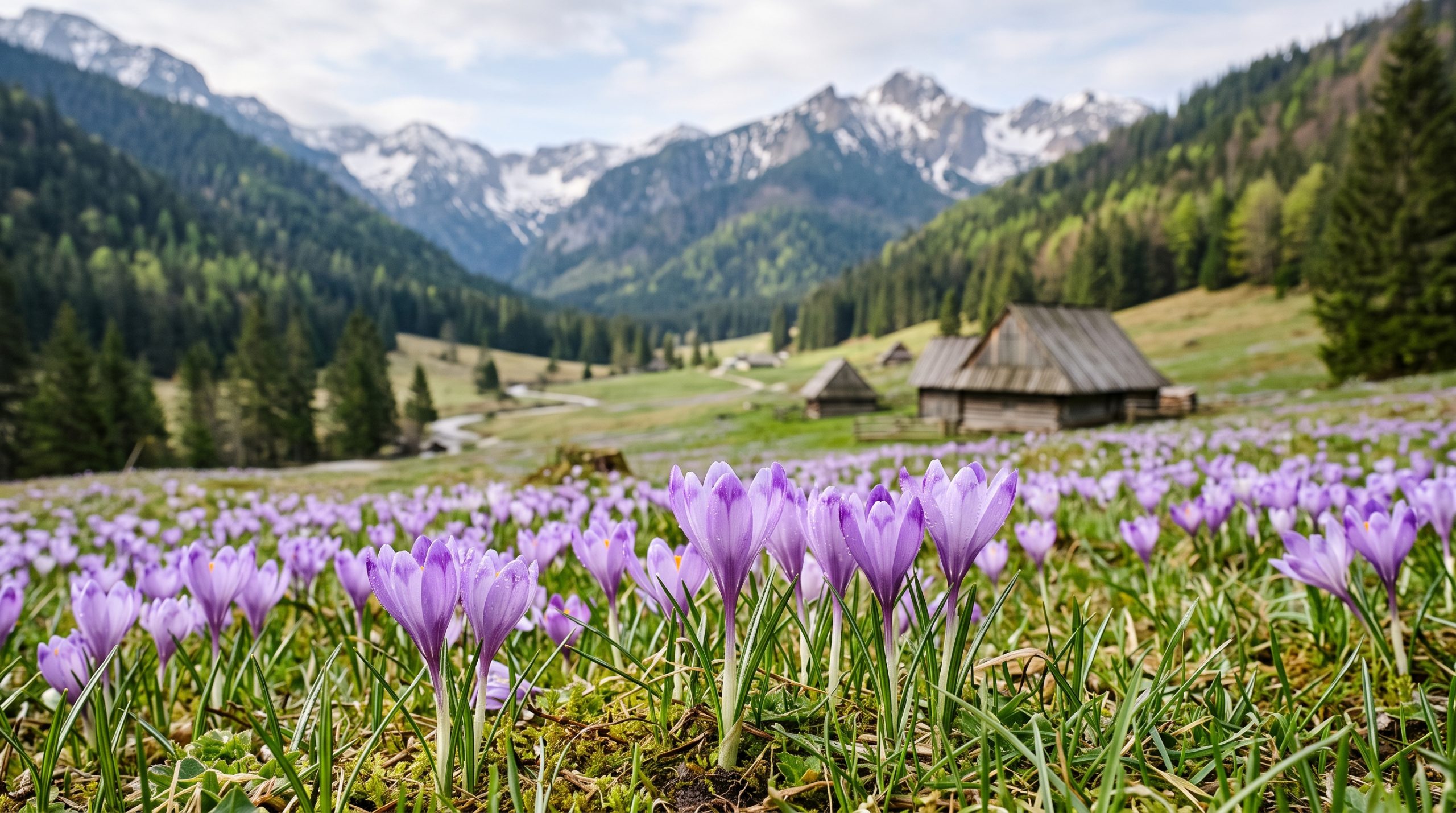
The Tatra National Park publishes one short line about wedding photography on its own site, and it decides more about a day in Dolina Chochołowska than any forecast will. While the pictures are being made, you do not step off the trail and you do not fly a drone. On the most photographed meadow in Poland, during the fortnight the crocuses are out, that line is the entire creative brief.
Polana Chochołowska sits at 1146 metres, 7.5 kilometres from the car park at Siwa Polana. The walk in takes about two hours, the first 3.5 kilometres on asphalt and the rest on a gravel road beside the Chochołowski stream, climbing a little over 250 metres in total. That part of the day is identical in April and in October.
Everything else about those two months is different: who else is standing on the grass, how long the sun stays on it, and whether the purple you came for is out, over, or three weeks early.
Yes, with two permits and a two-hour walk
Yes, with paperwork. The park charges 250 zł for a wedding photography day and requires the director’s written consent for filming, and registrar-led civil ceremonies are allowed only at a small number of designated spots. The meadow itself is 7.5 kilometres up the valley from the Siwa Polana car park, roughly two hours on foot.
What the walk in is like in wedding clothes
Siwa Polana lies about 10 kilometres from Zakopane, in the commune of Kościelisko, with a paid car park at the valley mouth and buses running out from town. The ticket point sits at the entrance. The meadow behind it runs roughly 900 metres long and up to 350 metres wide, with shepherd huts along the edge selling sheep’s cheese, and almost everyone walks straight past it. It is worth knowing about, because it is a genuine crocus meadow a few minutes from the car, and for couples who do not want the two-hour approach in both directions it changes what a morning can be.
From the ticket point the road is asphalt for 3.5 kilometres to Polana Huciska, about an hour at a walking pace, flat enough that you barely register the climb. Gravel starts at Huciska and runs on to Polana Chochołowska. In wedding clothes this is the gentlest long approach we know in the Polish Tatras: no scrambling, no exposure, nothing you need a free hand for. What it does instead is work fine grit into a hem and put every puddle from the last shower directly under your feet. We plan for boots as far as Huciska and a change there, or a change on the meadow, and we carry the clothes.
Two things shorten the walk. The Rakoń electric train covers the asphalt stretch to Polana Huciska roughly every half hour, and horse carriages run all the way to the meadow. A carriage arriving at the polana is a better piece of film than a car park will ever be, and it puts an hour back into the middle of the day.
Why the meadow takes the sun late and loses it early
Dolina Chochołowska runs broadly north to south, and the meadow lies in the floor of it with ridges standing hundreds of metres higher on either side. The sun crosses this valley rather than travelling along it. In practice the light arrives over the eastern wall well after the sunrise time in your weather app, and it goes behind the western wall well before the printed sunset. A sunrise app tells you when the sun clears the horizon. It does not tell you when it clears a ridge.
So we time from the terrain instead. The high ground at the head of the valley, up towards Grześ, Rakoń and Wołowiec, catches light long before the grass does, and that gap is worth a good half hour of frames where the tops burn and the meadow is still blue. Then the line of sun comes down the slope and crosses the polana, and that is the ceremony hour. Crocus flowers answer to warmth: in the cold before the sun reaches them they sit shut, and the famous purple carpet reads grey-brown. Anyone who has walked up in the dark for a crocus frame has learned that the expensive way.
The one line in the park’s photography rules
A wedding photography day inside the Tatra National Park is charged at 250 zł for the day, and it carries the two conditions that shape the pictures: stay on the trail, no drone. The park also asks every visitor to admire the crocuses from the path, under a campaign it has run for years named Ani kroku(s) dalej, and on the busiest meadow in the country that request has real weight. Filming is a separate matter again. Moving pictures in the park need written permission from the director, applied for in advance, and it is not the same application as the photography day.
So the working strip is the width of a trail and the film gets made from the ground. That is less limiting than it sounds on a meadow this size, because a path crossing an open polana gives you depth in three directions at once. It does change how two of us stand. On a linear track a photographer working close and a filmmaker working long from further up the road stay out of each other’s frames without either one hiding behind a tree, which is the whole reason photo and film sit on one team here rather than two freelancers introduced to each other in a dark car park. Sound flips as you climb: for most of the way the Chochołowski stream is right beside you, lovely to stand next to and loud in a microphone, and on the open polana the problem becomes wind moving across grass. We record vows where the ground gives us the chance.
Ground like this photographs as scale rather than detail, which is worth seeing before you commit to it. Our published elopement stories and films show what a wide valley floor does with two small figures in it, and how a day looks when the photographer and the filmmaker worked side by side instead of taking turns. A full day here with one photographer or one filmmaker starts at $4,900, and the two-camera day is set out on our pricing page. The park fees are yours to pay. The research, the applications and the timeline are ours.
April: two weeks of purple, and everyone else who wants it
The flower is Crocus scepusiensis, and the regional tourism board puts the bloom at roughly two weeks from the first days of April, moving earlier or later with the amount of snow the winter left behind. That is the average, not a promise. In one recent spring the shelter on the meadow was already reporting large groups of flowers in the last week of March, thickest in the upper part of the polana while the rest was still coming, and the upper meadow does tend to run ahead of the lower.
Which means a date chosen a year out is a bet, and we would rather say so plainly than sell you a fortnight nobody controls. It also means the plan cannot rest on the flowers. We build an April day here around the meadow, the stream, the shepherd huts and the light, and treat a full bloom as a gift on top.
The crowd is more predictable than the flowers. From the first days of April the polana draws visitors in numbers the tourism board itself describes as a siege, and on a fine April Saturday “set off early” is not enough on its own, because the first walkers leave the car park before dawn and the carriages start soon after. Two moves work. A weekday rather than a weekend, and the knowledge that the crowd pools around the shelter and the flattest part of the grass. Vows fifteen minutes further along the trail, in the first hour of direct sun, are a completely different experience of the same morning. If your date is fixed and it falls in the middle of the bloom window, tell us and we will shape the hours around where the people are not.
October: the same track, and the valley back to its own scale
We will not oversell the color. This is a spruce valley, so the forest holds its dark green all autumn and there is no maple display to photograph. What changes is the grass, pale and cropped after a summer of grazing, the angle of light on the ridges, and the number of people on the road. Dolina Chochołowska is the largest valley in the Tatras at over 35 square kilometres, and in October it feels like it.
The geometry tightens as the year goes on. A lower sun clears the eastern ridge later and drops behind the western one sooner, so the window of direct light on the meadow floor is shorter in October than in April. We plan around that rather than fight it, with a later start, one long unbroken block in the middle of the day, and the ridges instead of the grass for the last of the light. Nobody is standing in the frame you want.
The building 7.5 kilometres in matters more than couples expect. The PTTK shelter on Polana Chochołowska is the largest in the Polish Tatras, open all year, with 121 beds in rooms of two to fourteen, a drying room, and a buffet serving from 08:00 to 20:00. On a cold October day that is a warm room, a hot plate of something and somewhere to leave a bag before the walk down. Some routes on the ridges above close for winter. The valley floor does not.
Registrar, chapel, or vows on the grass
A civil ceremony conducted by a registrar can take place inside the Tatra National Park, but only at a small number of spots the park has designated for it, and only with the director’s written permission, applied for in advance on a form. That is why the ceremony place and the permit get settled in the same conversation instead of one after the other. Polish law then sets a fixed additional fee of 1,000 zł for taking vows outside a registry office building, on top of the 84 zł stamp duty for the marriage certificate, and the registrar has to agree to the location as well.
There is a chapel on the meadow, dedicated to St John the Baptist, where Mass is said. It is a working mountain chapel rather than a venue with a booking form, and anything sacramental runs through the parish rather than the park.
The third route is the one most couples flying in from the United States end up choosing: handle the legal formalities where they are simplest, at home or at a registry office, and keep the meadow for the words you actually want to say out loud. That is not a compromise, and it lifts a layer of paperwork off a valley that already has two. Our guide to how to plan an elopement sets out the order these decisions belong in.
Common questions
Will the crocuses actually be out in the second week of April?
Often, not always. The bloom runs about two weeks from the first days of April and shifts with the winter snowpack, and the upper part of the polana can be ahead of the lower. In one recent year there were already large groups of flowers in the last week of March. We plan the day so an early or late bloom changes what we photograph, not whether the day works.
Can we ride up instead of walking the 7.5 kilometres?
Partly. The Rakoń electric train covers the 3.5 kilometres of asphalt to Polana Huciska about every half hour, and horse carriages go the whole way to Polana Chochołowska. A carriage is the one way to arrive at the meadow without walking, and it films beautifully. We often build the walk into one direction and the ride into the other.
Do we need a park permit if it is only the two of us and one photographer?
Yes. The Tatra National Park charges 250 zł for a wedding photography day anywhere inside its boundary, and that permit also covers park entry for the couple and the photographer. If a filmmaker is with us, filming needs separate written permission from the park director. We prepare both applications as part of planning.
Can our film include drone shots over Polana Chochołowska?
No, and it is better to know that before you picture it. The park’s photography rules exclude drone use, so a film made here is a ground film: long lenses down the valley road, the stream, the walk out across the meadow, the ridges behind you. We fly drones in destinations where it is legal and appropriate, and this valley is not one of them.
Is there anywhere to change out of hiking boots on the meadow?
The PTTK shelter is the only building of its kind up there, open all year with 121 beds and a drying room, and the buffet runs from 08:00 to 20:00. A room booked for the day gives you somewhere indoors to change, warm up and leave a bag. Otherwise the change happens outside, and we plan the timing and the shelter for it.
Choosing between the purple and the quiet
April is a bet on a two-week window with company on the meadow. October gives you the same valley almost to yourselves, with a shorter run of light and nothing riding on luck. Both begin at the same car park and cover the same 7.5 kilometres. If you are still comparing valleys, our destination elopement guides cover the rest of the ground we work.
Tell us which of those two mornings sounds like yours, or send the date you already hold and we will tell you honestly what this valley tends to be doing that week. The full planning trail stays written and easy to revisit, at whatever hour suits you, and your first reply and brochure arrive within 24 hours. We are currently taking Tatras elopement bookings for 2027 through 2029, and we would start with the permits and the light. Tell Us Your Story.