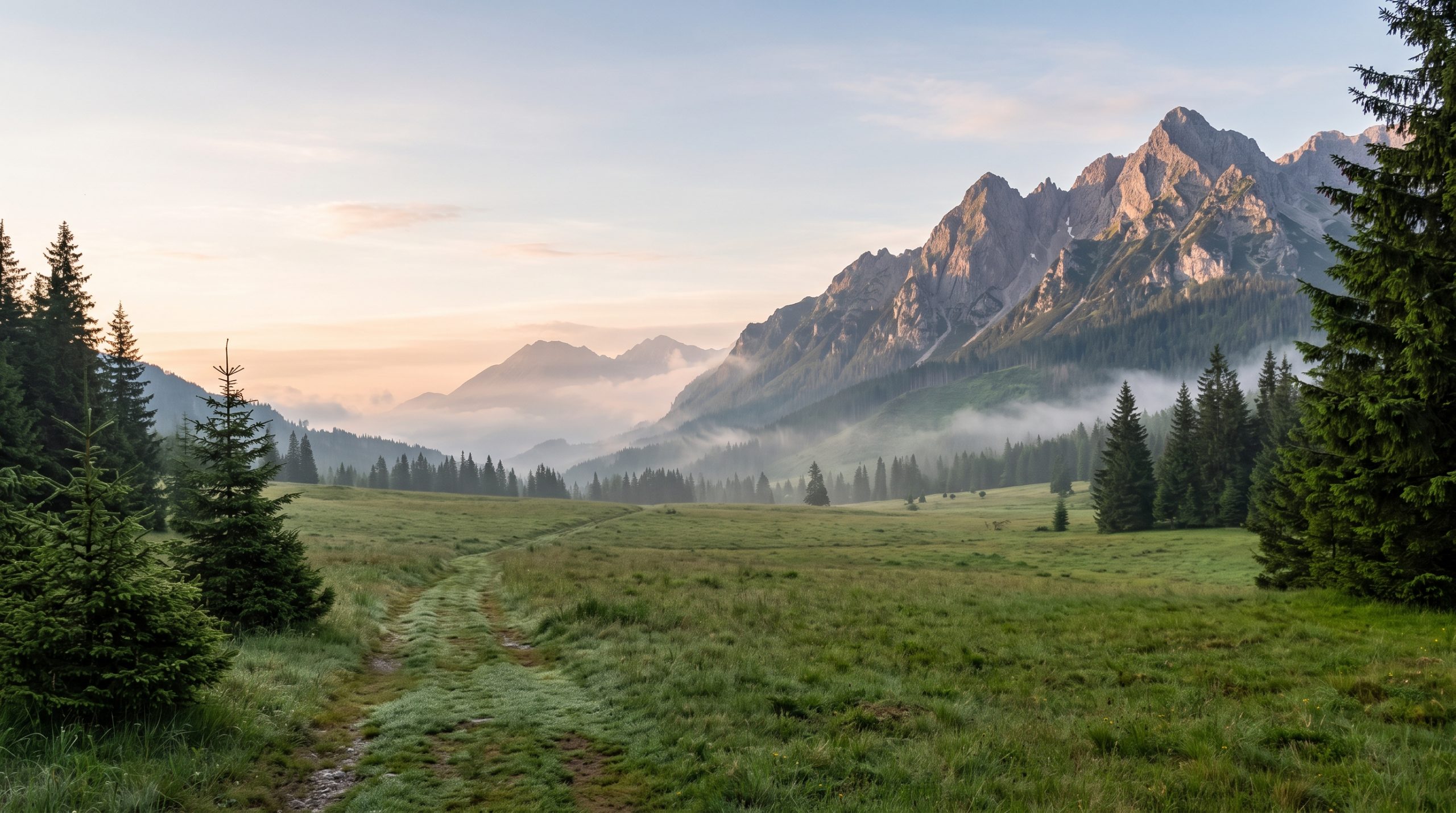
The Tatra National Park keeps a short list of places inside its boundary where a registrar may legally marry you. One entry on that list is Rusinowa Polana, and the park is precise about the spot: at the ławostoły, the heavy wooden bench-and-table sets on the meadow’s edge. Those are the same tables where every hiker who walks up from Wierch Poroniec drops a pack and eats a sandwich.
That single detail shapes an entire day here. The walk in is 3.2 kilometers of gravel road and 141 meters of climb, roughly an hour, which is why the meadow is full of families by mid-morning. The view is a 120 degree sweep across the High Tatras, from Hawrań and Murań on the left round to Gerlach at 2,655 meters and Rysy at 2,501 meters, the highest ground in Poland.
So the question is never whether Rusinowa Polana is beautiful. It is whether you are standing at those tables at the hour when they are empty and the light is doing something, or at one in the afternoon in July when the panorama hazes over and there is a line of walkers waiting on the bench you are standing at.
An hour up a gravel road, 141 meters of climb
Rusinowa Polana lies between 1,170 and 1,300 meters in the Tatra National Park, an hour’s walk from the Wierch Poroniec car park on 3.2 kilometers of graded gravel with 141 meters of ascent. It is one of a handful of places in the park where a registrar may conduct a legal ceremony, at the wooden bench tables.
Forty parking spaces decide your morning
The standard start is Wierch Poroniec, about 25 minutes by car from Zakopane on the Morskie Oko road, with the lot on the right just past the small roundabout. It holds around forty cars. That number, not the walk and not the weather, is the thing most likely to reorganize a plan, because on a July Saturday those spaces are gone early and the overflow parking sits back along the road toward Nowy Targ.
Charges here are levied for the day rather than by the hour, so a 4am arrival and a 3pm departure cost the same as a lunchtime stroll. Everyone on the trail also needs a park entry ticket, on every route, including the stretches where nobody is sitting in a booth. An adult single ticket is currently 11 zł with a reduced rate of 5.50 zł, and the park has nudged these up most springs, so treat the figure as a floor rather than a fixed price. Tickets are sold online through the park’s own site and through the SkyCash and mPay apps, which is worth doing the night before rather than joining a line at the kiosk with a dress over your arm.
There are two other ways in. Palenica Białczańska is the Morskie Oko trailhead, and the overwhelming majority of people there turn left onto the asphalt toward the lake; the blue trail turns right and climbs steadily through beech forest for about an hour, a harder walk on a stonier surface but a much quieter one. Zazadnia, at 959 m on the same road, is the traditional pilgrim start toward the sanctuary at Wiktorówki, and the park’s own route from Zazadnia over the meadow and Gęsia Szyja down to Palenica Białczańska measures 8 kilometers end to end. We use that last one when a couple wants the day to be a real traverse rather than an out-and-back, and we cover the shape of days like that in our destination elopement guides.
One thing to settle early: dogs are not permitted on this trail, so if a dog is part of your ceremony, this is not the meadow and we will find you a spot outside the park where it is.
Light comes in over Hawrań and leaves the grass first
Stand at the tables and you are facing broadly south, with the Belianske Tatry away to your left and the high Slovak peaks running along the horizon in front of you. The meadow itself tilts east, sitting under the Gęsia Szyja ridge, and that geometry is the whole reason the hour matters.
In the morning the sun arrives from your left, over and behind the Hawrań and Murań ridge. The peaks in front of you come up edge-lit and slightly flattened, while the grass you are standing on takes warm light early and holds it. That is a ceremony hour: the meadow glowing, the mountains cool and blue-grey, the tables empty because almost nobody has walked up yet.
Evenings invert it. The sun drops behind the ridge at your back, and the grass loses direct light noticeably before the mountains do, so there is a stretch when Gerlach and Rysy are still holding warm light and you are standing in soft shade. Vows read in that window photograph beautifully and film beautifully, and it is our preferred slot for couples who would rather not set an alarm for the small hours. What it costs you is solitude, because the meadow empties late.
Midday we avoid. Not because it is unpleasant, but because the panorama goes hazy, the light is straight down, and you will have walked an hour for a frame that looks like everybody else’s. The candid version of the famous view is this: it is the finest thing in the Polish Tatras you can reach in an hour on flat shoes, and it is a mediocre photograph for about five hours in the middle of every summer day.
The bench tables where a registrar can actually stand
If you want the marriage to be legally concluded on the meadow, there is a defined process and it is not onerous. A ceremony with an officer of the registry office is allowed at designated spots inside the park, Rusinowa Polana among them, and it needs written permission from the park’s director, applied for through an online form. The park asks that you book the date with the registry office first and then apply for the permission, in that order. The park’s fee for making the place available for a ceremony is 2,500 zł, separate from the registry office’s own statutory charge for marrying you away from its premises.
Photography and film in the park are a separate piece of paper. Professional work needs the director’s written permission, and for weddings the park sets a flat fee of 250 zł gross per shooting day. The permission carries real conditions: no stepping off the marked trail, and no drone. That last one matters for anyone imagining an aerial pullback over the meadow, and we would rather tell you now than at 5am. Here, the film is built on the ground, with movement, long lenses across the grass and the ridge line doing the work aerials would do elsewhere. Where drone footage is legal, safe and sensible, it is part of what we deliver; on this meadow, under this permit, it is not.
Two more details from the permit rules that change logistics. Applications for filming go in at least a week ahead, while photographing a family celebration on a trail needs about two days, so the film side sets the deadline. And the park does not issue permits to drive in for wedding photography, which means the walk applies to you, to us, and to every guest, with no exceptions bought at any price.
If you are not bringing a registrar, the paperwork shrinks to almost nothing: park tickets and the photography permission. A private ceremony with your own celebrant, your own words and the legal signing handled at home is how many couples do this, and it is the version that leaves the hour free to be chosen for light rather than for a civil servant’s diary. Our guide to planning an elopement walks through how that sequencing usually runs.
What 3.2 kilometers feels like in a dress
Better than you expect, with two caveats. The trail is a wide forestry road with a firm gravel surface and no scrambling, no exposure and no steps to negotiate, which is exactly why it works for guests who would never manage a Tatra ridge. It is also coarse gravel, and it holds standing water after rain, so a hem that reaches the ground will collect dust in August and mud in October.
What we do in practice is simple. You change at the car park, walk up in boots with the dress carried or the hem held, and swap shoes at the top while somebody holds a jacket. There is no building on the meadow set up for changing, and the shepherds’ huts are working structures, not facilities, so plan the switch at the car. Sheep have been grazed here for centuries, and the cultural grazing restored in the 1980s means that in season you hear the bells before you see the flock, and the path has hoofprints in it. A hem you do not mind lifting is the right hem for this walk.
Wind is the other planning input. The meadow is open, roughly 100 hectares of it, and a long veil on a breezy afternoon is either the best frame of the day or a fifteen-minute wrestling match. We tell you which it is likely to be a couple of days out, and we always have a sheltered position ready along the spruce edge.
When the peaks are inside cloud
Some mornings the High Tatras simply are not there. It happens often enough that any honest page about this meadow has to say so, and it is not the problem it sounds like.
Rusinowa Polana has a foreground worth having: glacial granite blocks sitting in the grass, the surviving shepherds’ huts from what was once a settlement of twenty buildings, the ragged spruce edge and the sheep. In low cloud we work close and let the mountains stay a rumor. If the weather is genuinely heavy, the sanctuary at Wiktorówki is about ten minutes downhill on the blue trail, and the walk over to Polana pod Wołoszynem or up to Gęsia Szyja gives us different ground within the same permit and the same hour. Snow changes the timings rather than the plan; this is one of the more forgiving winter walks in the park, and it simply takes longer.
Two of us working a hundred hectares
Space is the reason this meadow is kind to a photographer and a filmmaker working the same ceremony. There is enough of it that we can stand 40 meters apart on the same vows and never appear in each other’s frames, which is not true at the Morskie Oko chapel or on a narrow ridge. Sound is the harder problem here, because open grass gives wind nothing to break on and the sheep bells are constant, so audio gets planned around the spruce edge and body-worn mics rather than hoped for. You can see how the meadow and the ridge line actually render, in stills and in film, in our published elopement stories. Highlights reach you five days after the day itself, and the full gallery or film within three weeks.
Coverage comes two ways for a day like this. The Adventure, from $4,900, puts one dedicated photographer or one dedicated filmmaker on the meadow with you; the Expedition, from $7,900, sends both, working together, with professional audio for the vows where conditions allow. Team travel to Poland is included in either, and what each one covers is set out on our experiences and pricing page.
Common questions
Can we legally get married on Rusinowa Polana, or only hold a symbolic ceremony?
Legally, yes. Rusinowa Polana is one of the designated spots inside the Tatra National Park where a ceremony with a registry office officer is allowed, specifically at the wooden bench tables. You book the date with the registry office first, then apply for the park director’s written permission. The park’s fee for the place is 2,500 zł.
Can anyone drive up to the meadow for the ceremony?
No. The park states plainly that it does not issue vehicle permits for wedding photography, so the 3.2 kilometers from Wierch Poroniec is walked by everyone, us included. The upside is that the gradient is gentle, 141 meters of climb spread over the whole distance on a graded road, which is why guests in their seventies manage it comfortably.
Can we bring our dog up there with us?
Not on this trail. Dogs are excluded from the route to Rusinowa Polana, as they are from most of the park’s trails. If your dog is part of the ceremony, tell us early and we will build the day on ground outside the park boundary where that is welcome, with the Tatra skyline still behind you.
Can you fly a drone over Rusinowa Polana for our film?
Not under the park’s wedding photography permission, which excludes drone use and stepping off the trail. We plan the film here as a ground film, and it is a strong one, because the meadow gives us depth to move through. If aerials matter enormously to you, say so early and we will look at legal airspace elsewhere in your week.
Where do we change out of hiking boots and into shoes?
At the Wierch Poroniec car park for clothes, and on the meadow for shoes. Nothing up there is set up as a changing space, so the practical version is boots up, shoes carried, a quick swap at the tables with a jacket held as a screen, and boots back on for the descent. Fifty minutes down is easier on ankles than on hems.
What happens to our plan if the Tatras are covered in cloud that morning?
We shoot the meadow instead of the horizon, and we still have a day. The granite blocks, the huts, the sheep and the forest edge carry the frames when the peaks do not, and Wiktorówki sits ten minutes below if we need a change of scene. Our timeline for this location always carries a second window, usually the following evening, and you will know the plan the day before.
Sheep bells, and the road back down to Zakopane
The version of this day we like best starts in the dark at Wierch Poroniec, reaches the tables while the grass is still wet, holds the ceremony with nobody else on the meadow, and drifts through the morning as the first hikers arrive and lose interest in you. By ten you are walking down. By eleven you are eating in Zakopane in a dress, which is a good hour of the day in its own right.
If a pre-dawn start is not your idea of a good morning, tell us and we will build the evening version instead, or tell you honestly which month gives you the longest, softest light for the shape of day you want. We keep the planning in one written thread: send the form and you will have our reply and an initial brochure within 24 hours, and We currently have Tatras elopement dates available through 2027–2029 now. Tell Us Your Story and we will tell you exactly how your date sits with the light on this meadow.