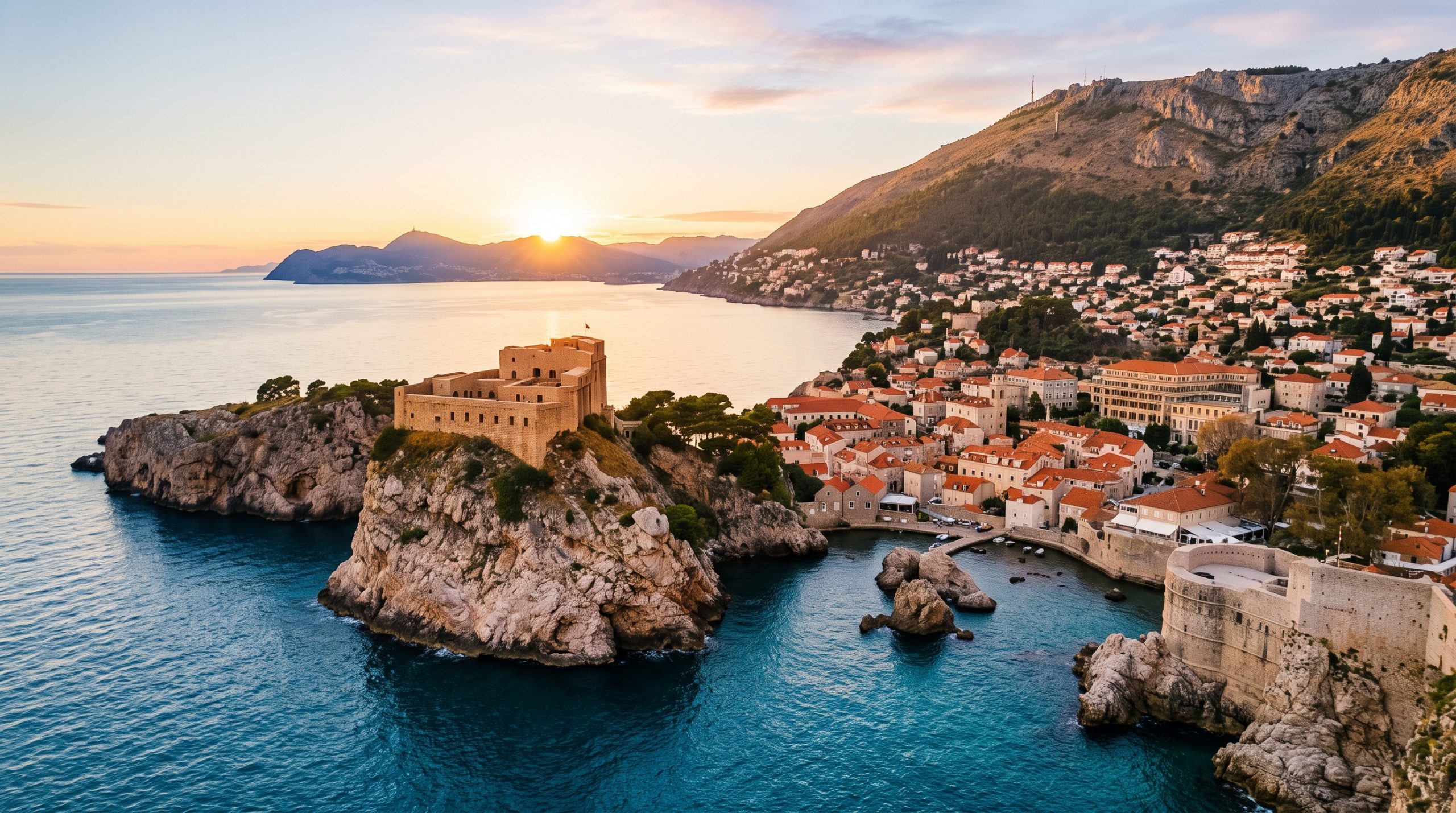
The first cabin of the Dubrovnik cable car leaves the lower station at nine in the morning. In late June, the sun is up by quarter past five. That gap is the most useful thing anyone can tell you about eloping above the Old Town, because it means the best light on Srđ belongs to whoever arranged a different way up.
Fort Lovrijenac has the reverse problem. It stands on a rock 37 metres above the water, west of the walls and facing them, which makes it an evening place. In high summer the public gate closes while the sun is still well above the sea.
Both are real ceremony locations rather than viewpoints you drop into between lunch and a boat trip. Neither behaves the way its opening hours imply. What follows is how the two forts work across one day, who you have to ask, and what the climb up each is like in clothes you flew here with.
Two forts, one clock
Both work, at opposite ends of the day. Srđ stands 412 metres directly behind the Old Town and takes first light while the city below is still in shade. Fort Lovrijenac sits on a 37 metre rock west of the walls, facing them, so it comes alive in the last hour of sun. Pick by hour, not by view.
Two hundred steps up from Tabakarija
From Pile Gate it is a short walk down past the small harbour at Tabakarija, and then the climb starts. More than two hundred stone steps rise up the outside of the rock to the entrance, where the inscription cut above the door reads Non bene pro toto libertas venditur auro: freedom is not sold for all the gold in the world. There is no step-free route to the top. No lift, no ramp, no back way in.
In wedding clothes this matters more than the step count suggests. The treads are old limestone, polished by a few centuries of feet, and shallower in places than your eye expects. A long dress needs one hand on the hem the whole way up, which leaves you one hand for everything else. Almost everyone we work with climbs in trainers or boots with the real shoes in a bag, then changes at the top where there is a parapet to lean on. We build that swap into the timeline instead of pretending it takes no time.
A City Walls ticket also admits you to Lovrijenac, which is the route most visitors take, and bought on its own entry currently runs around fifteen euros. In high summer the gate opens at eight in the morning. Those two facts decide whether you want to be inside the fort during opening hours at all.
Where the sun actually comes from at each fort
Srđ is not beside the Old Town. It is directly behind it, 412 metres of limestone rising within about a kilometre of the walls. In June the sun comes up in the north-east, which is to say straight up behind that ridge, so the printed sunrise time has very little to do with when light reaches the rooftops. On the floor of the Old Town you are waiting well over an hour past sunrise for direct sun. On Lovrijenac’s terraces, a little further west, you are still waiting most of an hour.
That is a fact to schedule around rather than a problem to fix. A six o’clock ceremony at Lovrijenac in July happens in open shade: even, soft, cool, with the walls opposite still grey. Some couples love exactly that, and it is the quietest the fort will ever be. Others want the stone to look the way it does in every photograph they have saved, and that means evening.
Evening is where Lovrijenac earns its reputation. The sun goes down over open water in every season, west-north-west in June, close to due west in September, well round to the south-west in December. From the upper terrace the last hour of sun crosses the cove and lands flat on the city walls, Bokar in the foreground and Minčeta on the skyline, the whole face of the Old Town going warm while you stand with the sea behind you. In late June that hour does not start until around half past seven, with the sun down at about twenty-five past eight. In December the same light happens mid-afternoon and it is gone by half four.
Which brings up the awkward part. In June and July the fort’s public closing time falls before the sun reaches the sea, so a ceremony in the light everyone comes here for, in the season most couples travel, needs the fort to be yours rather than open. On Srđ it is the other way round. The cable car runs late into the evening in high summer, which makes the sunset end of the day straightforward and the sunrise end the one that takes planning.
| What matters | Fort Lovrijenac | Srđ summit |
|---|---|---|
| Getting up | More than 200 steps from the lane below Pile Gate | Four minutes in the cable car, or by road round the ridge |
| Earliest access | Gate opens at eight in high summer | First cabin at nine, road open at any hour |
| Its best hour | The last hour of sun, arriving over the sea | First light, with the Old Town still in shade below |
| Who holds the ground | Society of Friends of Dubrovnik Antiquities | Cable car company, the fort, open hillside behind |
| What moves the plan | Festival calendar and the public closing time | Wind, and the cable car’s season and hours |
The nine o’clock cable car, and the hour before it
The lower station sits at Petra Krešimira IV 10a, opposite the fire station, five to six minutes on foot from Pile Gate and seven to nine minutes uphill from Buža Gate. Cabins leave every fifteen minutes from nine in the morning, or sooner when enough people are waiting, and the ride takes about four minutes each way. For an afternoon or an evening on the summit, that is the whole of the logistics.
Sunrise is a different job. Nothing is running at five in the morning in July, so we go up by road while it is still dark, dress in a bag, coffee in the car. It is a long loop round the back of the ridge compared with the four minutes the cabin takes, and it buys you a summit with nobody else on it and the light coming over the ridge line while the city below is still blue.
The top is also bigger than it looks from the cabin. Behind Fort Imperial, the Napoleonic-era fort built between 1806 and 1816, a graded track runs 1,300 metres north-west along the ridge to Fort Strinčjera at about 400 metres above the sea. It is not steep. It passes through pockets of forest and past pens of animals, and ten minutes along it you cannot hear the upper station at all. That track is where we hold vows when the terrace by the restaurant is filling up, and it is level enough to walk in almost anything.
Who to ask before you stand anywhere
Lovrijenac is not a public square. The fort and the City Walls are in the care of the Society of Friends of Dubrovnik Antiquities, and a ceremony inside with nobody else present means arranging exclusive use with them for an agreed window, at a fee they set. We do that research and handle the correspondence. The fee itself is yours to pay, as venue and landowner charges always are.
The fort has a second life as a stage. It is the open-air theatre where Hamlet is played during the Dubrovnik Summer Festival, and at the height of the season its calendar is committed to the festival before anybody else gets to ask. So whatever your date, checking the fort against it comes first. There is no sense designing an evening around a courtyard that is holding a rehearsal.
Srđ is less simple than it looks, because the ground changes hands within a few hundred metres. The plateau around the upper station belongs to the cable car company. Fort Imperial is a monument with a museum inside it. The ridge behind is open hillside. We confirm in writing which piece of ground you will be standing on and who holds it before the timeline is built, so that nobody is negotiating anything at six in the morning.
The legal side runs on its own track and is not tied to either fort. Plenty of couples we work with sign the paperwork at home and hold the ceremony here with someone who matters to them speaking the words, and plenty do it the Croatian way with a registrar. Both are good answers. Our notes on how to plan an elopement walk through the difference, and once we know your date and your nationality we will tell you which route makes your day simpler.
Cruise mornings, the wind off the ridge, and the fallback at sea level
The honest version of the crowds: Lovrijenac in the middle of a July day is busy and the light is flat, which is the worst pairing a famous place can offer. Because entry comes bundled with the walls ticket, a good share of everyone who walks the walls that morning crosses over afterwards. Arriving early works on the summit, but it does not really work here, since the gate opens at eight and the terraces sit in shade anyway. The answer is not an earlier alarm. It is the shoulder season, or the fort to yourselves in the evening.
Srđ is kinder. The pressure there lands in the first cabins after nine and again in the hour before sunset, and it stays within a couple of hundred metres of the upper station. Walk the graded track and you leave it behind.
Weather moves two things here. The bura comes down off the ridge in the cold months, dry and hard and straight across the summit, and the jugo arrives from the south-east with swell and warm grey air. Cable car hours and season shift through the year and the cars can stand down when the wind is up, so from November to March we plan the summit by road and treat the cabin as a convenience rather than the plan. At Lovrijenac the sheltered option is directly underneath you. The cove and the harbour at Tabakarija sit at sea level in the lee of the rock, at the bottom of the same steps, and they photograph well on a day when the upper terrace is no fun to stand on.
Some couples love a half past three alarm and some genuinely do not. Tell us which you are in your first message, and we will either build the whole day backwards from the evening at Lovrijenac or point you at the months when first light on Srđ arrives closer to seven than to five.
Standing room for two cameras on three terraces
Lovrijenac is built as three terraces at three different heights, which is unusually generous when two people are working at once. Our filmmaker can hold a wide frame from the upper level, walls behind you and sea beyond, while the photographer works a couple of metres from your face on the terrace below, and neither appears in the other’s shot. Very few places above a city hand you that. Wind is the real constraint up there rather than room, so vows are recorded close, on the lee side of the parapet, and which terrace you stand on gets decided that evening by the way the air is moving.
Photography, film and planning come from the same team of eight, not from a photographer and a videographer introducing themselves to each other in the car park. The Adventure covers a full day with one dedicated photographer or one dedicated filmmaker from $4,900, and the Expedition puts both on the ground together from $7,900 with professional audio for the vows, with the rest of the detail on our coverage and pricing page. To see what this light does once it is on a screen, spend ten minutes in our galleries and films.
Common questions
Does the cable car run early enough for a sunrise ceremony on Srđ?
No. The first cabin leaves at nine in the morning, which in summer is roughly four hours after sunrise. For a sunrise ceremony we drive up the back of the ridge instead, time the arrival to the light, and come down for breakfast before the first cabins reach the top.
Can we hold a private ceremony inside Fort Lovrijenac during opening hours?
Not a private one. During opening hours anyone holding a valid ticket can walk in, and most people arrive with a City Walls ticket that already covers entry. Vows with nobody else on the terraces mean exclusive use of the fort for an agreed window, arranged with the Society of Friends of Dubrovnik Antiquities.
Is there anywhere to change out of walking shoes at either fort?
There is no changing room at Lovrijenac. Couples dress where they are staying and swap footwear at the top of the steps, which takes a minute and is worth putting in the timeline. On Srđ the upper station has a restaurant beside it, so the summit is the easier of the two for a quick change.
Can guests who cannot manage two hundred steps still be at the ceremony?
Not at Lovrijenac, which has no step-free access at all. Srđ is the answer for a group with mixed mobility, since the cable car covers the climb in about four minutes and the ground around the upper station is level. Tell us who is coming and we will pick the fort that includes everybody.
Does the sun set behind the Old Town when you are standing at Lovrijenac?
No, and that is the fort’s best trick. The sun drops over open water on the seaward side, so the last hour of light crosses the cove and hits the city walls square on. You face lit stone with the sea behind you, which is the reverse of what most city viewpoints give you.
A day that starts on the ridge and ends on the rock
The shape that gets the most out of these two forts is long and unhurried. Up the road to Srđ before first light for vows on the ridge track behind Fort Imperial, breakfast down in Gruž, then most of the day off your feet. Late afternoon you climb the steps at Tabakarija, and the last hour of sun does the rest. Two ceremony spots, one date, about fifteen hours between them in June.
Our Croatia calendar is currently open across 2027, 2028 and 2029, and everything between us happens in writing. You send your date and what you want the morning to feel like, we reply with a brochure and then a proposal built around this coastline rather than a template. If Dubrovnik is one of several places you are weighing up, our destination guides are the place to compare them. When you are ready, Check Your Date.