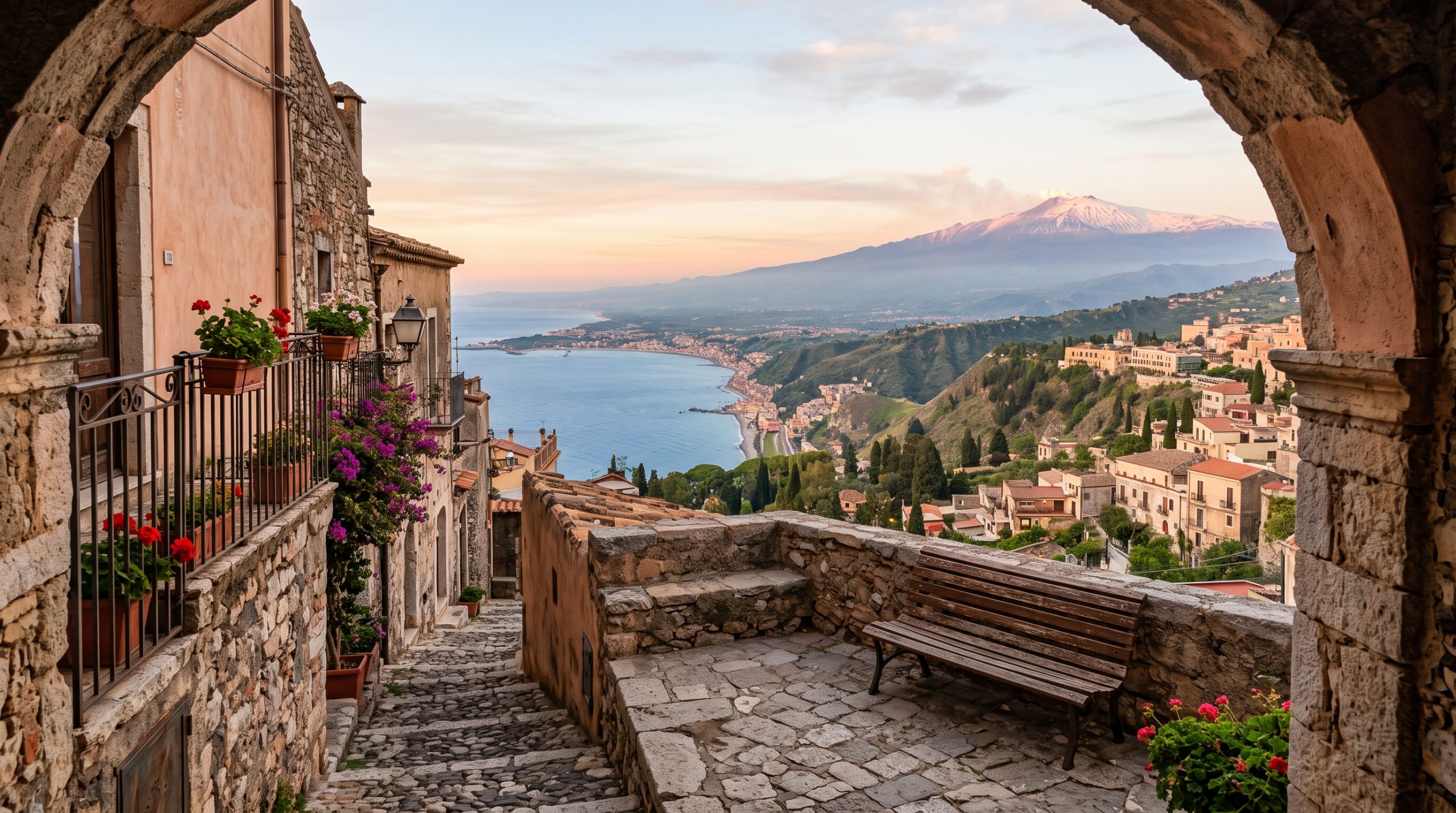
Piazza Sant’Antonio was laid in 1954, and whoever laid it set white stone against black lava in a mosaic that runs the full width of the square. At ten in the morning you barely notice it under all the feet. At twenty past six, with the sun still low over the Ionian and the square empty except for a van unloading bread, the two stones separate and the whole floor turns into pattern. That is why we get couples up here before breakfast.
Castelmola stands a little over 500 meters above the sea, on the rock above Taormina, and it is reached by one road. Not one main road. One road. The SP10 leaves Taormina as Via Leonardo da Vinci, switchbacks up past the Madonna della Rocca sanctuary, and ends in the village.
What that single road does to a day is the whole story of eloping here. It sets when you arrive, when everybody else arrives, and how long the belvedere belongs to you.
The village at the end of the SP10
Castelmola is a hill village a little over 500 meters above Taormina, reached by roughly five kilometers of switchbacks on the SP10. Couples elope here for the first hour of light, when the belvedere facing Etna and the Bay of Giardini Naxos is empty. Cars stop at the square, and everything beyond the arch is walked.
Driving up: five kilometers, twenty minutes, one arch
Mapping apps promise eight minutes from Taormina. Ignore that. The SP10 climbs its five kilometers in switchbacks, with a low wall on the drop side and oncoming traffic that expects you to reverse a car length, and a sensible driver takes fifteen to twenty minutes over it. The Interbus service from Taormina’s bus terminal to the Piazza Sant’Antonio stop covers the same ground in about a quarter of an hour, which makes it a fine way to visit the village and a poor way to reach a ceremony at first light, because the first bus of the morning runs long after the light we came for. So we drive, and we leave earlier than you think we need to.
The road ends at the village. Cars and the bus both stop at the edge of it, by the square, and everything past that point is on foot. From Piazza Sant’Antonio a short stone stairway climbs to the old arch that marks the entrance to the historic center, and through the arch the street narrows to about the width of two people walking abreast, paved in the same lava as the square.
In a dress, that stairway is nothing. A dozen steps, a hand on the wall, done. The thing worth knowing is what the lava does underfoot: it polishes, and for the first hour after rain it is glassy, so we change shoes at the car rather than on the square in front of the bar tables. A long train picks up street dust rather than mud, which shakes out far more easily than sand or wet grass. There is no trailhead here and no hike. Car to ceremony is about four minutes at a walk. If you want an actual climb, the footpath up from Taormina takes most people three quarters of an hour of continuous uphill, which is a good morning in sneakers and a miserable one in silk.
Sunrise lands on the whole village at once
Castelmola is a summit, not a slope, and that is the difference between this and every other viewpoint around Taormina. There is nothing east of you but 500 meters of air and then the Ionian Sea. When the sun clears the horizon it does not creep across the village the way it works its way down Taormina’s enclosed streets. It arrives everywhere at the same moment, side-lighting the whole square off the water while the terraces below are still blue.
Where it arrives from travels a long way across the year. In late June the sun comes up in the northeast, over the Calabrian coast across the strait, lighting the northern face of the village and putting open sea behind you in the frame. In December it rises in the southeast, out of water past the Bay of Giardini Naxos, and the light comes up the same axis as the view down to Taormina. Both are good. They are not the same photograph, and if you already have one of them in your head it is worth telling us which, because the month decides it and nothing else does.
Etna is the other half of the sky, about thirty kilometers away to the west-southwest. That bearing matters more than couples expect. In the morning the volcano is front-lit, so it reads clean and detailed, snow still on the cone through spring. By early afternoon it flattens into sea haze and stays flat. Then in the weeks around the winter solstice the sun goes down in the southwest, close to Etna’s flank, which is the one stretch of the year when sunset and volcano sit in the same frame from the belvedere. In summer it sets in the northwest, behind the higher ground at your back, and the village loses direct sun a good while before the time your phone calls sunset.
The practical version: do not plan an evening ceremony on the belvedere expecting warm light on your faces. The belvedere faces away from the sunset. What it gets at that hour is soft blue shade with a lit landscape beyond the wall, which is genuinely beautiful and is a completely different look from the dawn frames. Both shapes of day sit in the galleries and films in the stories we publish, and once you have seen the two side by side the choice usually makes itself.
The hours the village is yours, and the hour it stops being
Castelmola is genuinely quieter than Taormina, and unlike Taormina, arriving early actually solves it. Down at the Teatro Antico or on Isola Bella, early buys you a few minutes. Up here it buys you two hours.
Before eight the square belongs to residents, a couple of dogs and that bread van. Groups start coming up the SP10 mid-morning, by bus and minivan out of Taormina, and by lunch the belvedere wall is a row of phones. That is the honest picture of the middle of the day, and it is not the photograph anyone travels here for. The light is overhead, the haze has taken Etna, and the village that felt like a village at seven feels like a viewing platform at one. It clears again in the evening, later than you would guess, because sunset drinks up here are a serious local institution.
The single road is also an advantage, because you can hear it. The first vehicle of the day downshifting through the switchbacks below the village is an audible ten-minute notice, and we set the running order around that sound rather than around a guess.
Marrying here: the comune, the square and the paperwork
Two separate questions get tangled together, so we untangle them. The first is the marriage itself. A legal civil marriage in Italy is conducted by a comune, and for American couples the paperwork runs on both sides of the Atlantic: a sworn declaration made at an Italian consulate before you travel, and a statement of no impediment made in front of a US consular officer once you are in Italy, valid for six months from the day it is signed. It is a sequence rather than a difficulty. The order matters more than the effort.
Plenty of couples sign the legal paperwork at home in their own county and treat the ceremony in Sicily as the ceremony, with a celebrant and their own words. In a village this size that is often the calmer route, and nothing about the day looks any different.
The second question is the ground you stand on. Piazza Sant’Antonio is a public square, and a small group standing on it exchanging vows needs nobody’s permission. We would rather say that plainly than hedge it the way most pages do. It changes the moment you add furniture. Chairs, an arch, a table, amplification, anything that occupies the square rather than passes through it, becomes a request to the comune of Castelmola with a lead time attached. Churches are a separate conversation with the parish rather than with the town hall, and the church of San Giorgio on the square, built around 1450 and dedicated to the village’s patron saint, has a barrel-vaulted entrance porch behind a wrought-iron gate that is also the best sheltered corner in the village when a shower comes through.
Permit research and the logistics that follow from it sit inside every experience we run, alongside the timeline, the location design and the weather alternatives, while the fees themselves stay with you. One dedicated photographer or one dedicated filmmaker for a full day is The Adventure, from $4,900, a photographer and filmmaker working the day together is The Expedition, from $7,900, team travel to Sicily is included in both, and the rest of what each one holds is set out on our pricing page.
Two of us working a street four meters wide
Our photographers and filmmakers come from one team, which in a village this compact is less a philosophy than a floor-space problem. Inside the arch there is not much room. A photographer stepping back to frame the street is standing exactly where the filmmaker wants to be, so we split the village rather than the moment: one working the length of the street, one on the square, trading places at the arch. The belvedere wall is a single line, and two people cannot both shoot along it without one appearing in the other’s frame, so we agree the halves before you walk out. Sound is the other reason we like the early hour here. The breeze comes up the eastern face as the day warms, and vows recorded at seven in the lee of a wall sound like vows instead of weather. Aerials over an inhabited village run on permission and a time window, so we confirm both before any of the film is planned around them.
Early risers, small groups and a long lunch
Castelmola suits couples willing to trade a lie-in for an empty square, and couples who would rather stand somewhere with residents and a bread van than somewhere built for weddings. It suits small numbers. Six people fit through the arch and along the streets comfortably. Twenty turn the morning into an operation of parking, timing and a street that still has to work around you. Our fee does not move with guest count, but guests move everything else, so tell us the number early and we will build access, permits, transport and the timeline around it.
It is a harder fit if someone in your group cannot manage a dozen stone steps and a street that tilts, or if the picture in your head is vows at sunset with the light on your faces. Both have answers. There are places on the way up the SP10 and around Taormina below that face west and hold the last of the day, and a first-light ceremony in the village followed by a west-facing hour later on is a shape we build often. Tell us which of the two you actually want, and if the month you are circling fights it, we will say so and name the weeks that do not. Our destination guides cover the wider region, and if you are earlier in the process than that, how eloping actually works is the better place to start.
Common questions
Is the drive up to Castelmola difficult in a rental car?
It is slow rather than difficult. A narrow mountain road, switchbacks, low walls, and vehicles coming down that expect you to reverse a car length. Allow fifteen to twenty minutes from Taormina for the five kilometers, take the mirrors seriously, and ask the rental desk for the smaller car.
Do we need a permit for a ceremony in Piazza Sant’Antonio?
A small group standing in the square and exchanging vows does not need permission. Bringing chairs, an arch, a table or amplification into a public square does, and that request goes to the comune of Castelmola with a lead time. We research it as part of planning, and any fee is paid by you.
What time do the tour groups reach the village?
Mid-morning, coming up from Taormina by bus and minivan, building to a full square around lunch. Before eight you will have the belvedere and the streets more or less to yourselves, which is why our Castelmola timelines start in the dark.
Is there anywhere to change out of walking shoes?
There is no changing room in the village, so it happens at the car, parked at the edge by the square rather than a hike away. Most couples arrive dressed and simply swap shoes there. The lava paving inside the arch stays slick for about an hour after rain, so flats go on for the walk in.
Can we really see Etna from Castelmola, or is it usually hazy?
You can see it from the belvedere, roughly thirty kilometers to the west-southwest, and the morning is when it reads clearly. Haze builds through the day and softens the cone by early afternoon. Spring mornings with snow still on it are the strongest, and around the winter solstice the sun sets close to its flank.
Where a Castelmola day ends up
The shape we keep returning to: leave Taormina in the dark, park at the edge of the village before the sky changes, ten quiet minutes to find your breath and your shoes, vows as the sun comes off the sea, then an hour in the streets while they are still empty. Breakfast about the time the first bus pulls in. The middle of the day belongs to you rather than to us, and we pick the film back up late in the afternoon somewhere that still holds light. Almond wine has been made in this village since the 1940s, and it is the traditional thing to raise up here.
Highlights reach you five days after the day itself, the full gallery or film three weeks after. Everything before that is in writing, which suits the time difference: your inquiry comes to us, we reply with an initial brochure inside 24 hours, a tailored proposal follows, and planning begins once the contract is signed and a 30% retainer is paid. Dates are currently open across our 2027, 2028 and 2029 Sicily seasons.
Tell us the date you are circling and which Castelmola you want, the six-in-the-morning one or the aperitivo one, and we will send back a day built around it. Start Your Story.