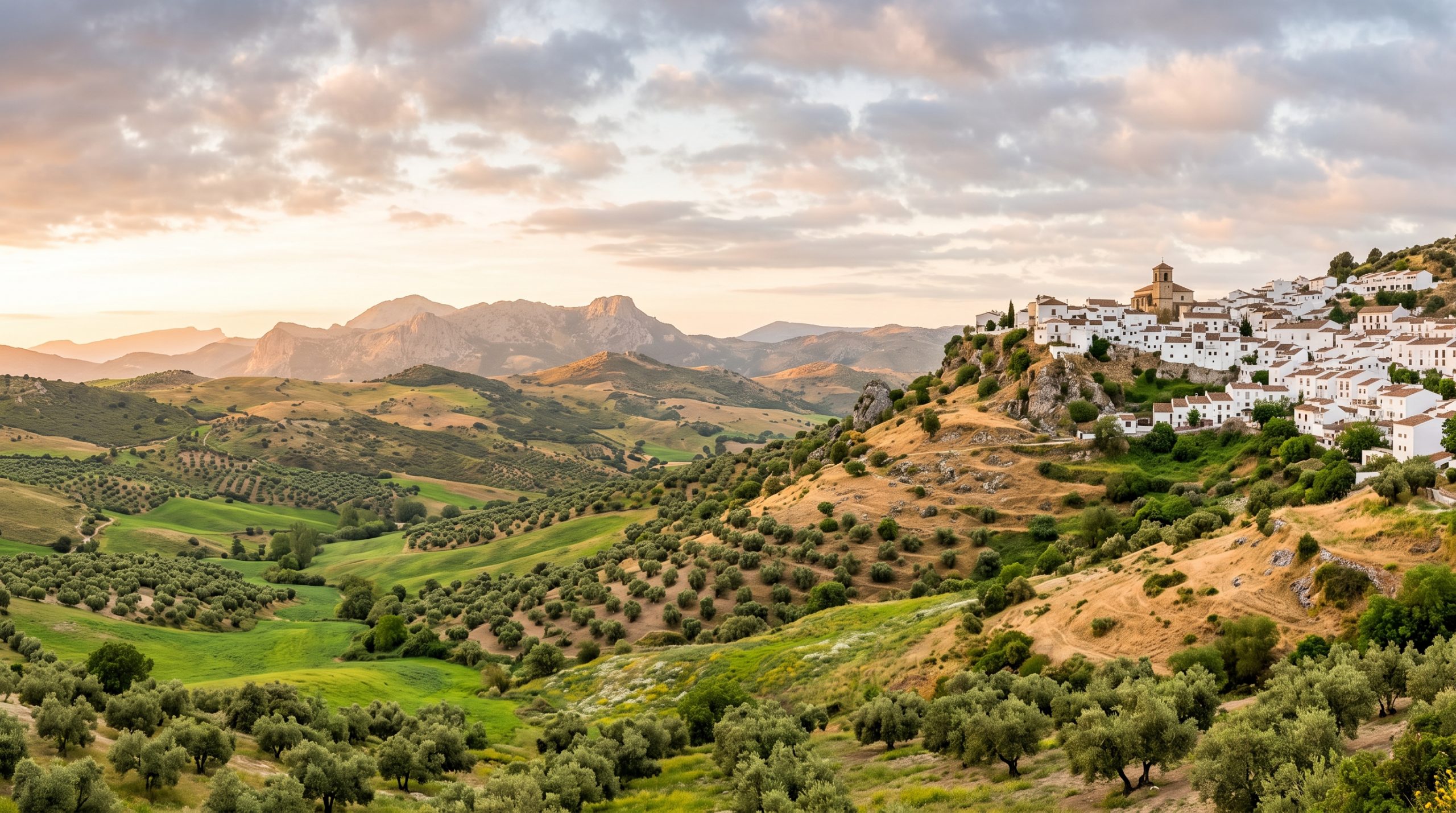
Stand on the lip of the Ronda gorge at seven in the morning in late December and the sun will not climb above about 30 degrees all day. The light stays long and raking from the moment it clears the ridge until it drops behind the Serrania. Come back in the third week of June and the same sun is 77 degrees overhead by lunchtime, hard and vertical, with nine hours of it to sit through before anything softens.
That is the whole argument about when to elope in Andalusia, and it has very little to do with whether a month is pleasant for a holiday. Seville’s driest month, July, averages around 2.2 mm of rain across two rainy days and daytime temperatures near 36 degrees Celsius. Ronda, less than a morning’s drive inland and up, takes 806 mm of rain a year against Seville’s 520 mm. One region, two entirely different planning problems.
Below is the year as we actually work it: sunset times, sun angles, the windows that open and shut in a fortnight, what closes and when, and the months we would gently move you off if your calendar allows it.
The Andalusian fortnight we would take first
The last two weeks of May. Semana Santa and the Feria are behind you, the rain has largely stopped, the sun sets in Seville around 21:25, and midday is still a few degrees short of its June angle. Mid-October is the close second, with lower light and thinner crowds at every gate.
Andalusia month by month, with the numbers
Sunset times are for Seville on the 15th. Noon sun angles are for Ronda on the 21st, and they hold within a degree across the region, since almost all of Andalusia sits between 36 and 38 degrees north.
| Month | Conditions | Light | Crowds | Our verdict |
|---|---|---|---|---|
| January | Ronda highs near 14 C, lows near 4 C; inland averages around 8 C | Sunset 18:28, noon sun 33 degrees | Quietest month at the Alhambra | Underrated for mountains |
| February | Cold mornings inland, orange trees flowering in Seville | Sunset 19:02, noon sun 43 degrees | Still very quiet | Our winter pick |
| March | Green hills, unsettled fronts, wildflowers starting | Sunset 19:30, noon sun 53 degrees | Low until Holy Week lands | Good, check the Easter date |
| April | Warm days, real rain still possible | Sunset 20:57, noon sun 65 degrees | Semana Santa and Feria fill the cities | Beautiful, busiest fortnight |
| May | Dry, warm, comfortable at altitude | Sunset 21:25, noon sun 73 degrees | Caminito del Rey slots go weeks ahead | The best two weeks |
| June | Hot inland, sunflowers coming up around Carmona | Sunset 21:46, noon sun 77 degrees | Building fast everywhere | Early June works |
| July | Seville near 36 C, about 2.2 mm rain; Ronda 11.6 sunshine hours a day | Sunset 21:44, noon sun 74 degrees | Peak, and Alhambra slots sell out early | Coast and altitude only |
| August | Hottest and most humid on the coast | Sunset 21:17, noon sun 66 degrees | Spanish holiday month | Dawn and late evening |
| September | Heat easing after the first week, sea still warm | Sunset 20:33, noon sun 54 degrees | Busy at the Caminito again | Strong second half |
| October | Warm days, first Atlantic fronts | Sunset 19:48, noon sun 43 degrees | Thinning through the month | Excellent, book mid-month |
| November | Mild, wetter, snow arriving on the Sierra Nevada | Sunset 18:14, noon sun 33 degrees | Very low | Good for quiet villages |
| December | Wettest month: 120 mm and 14 rainy days in Ronda, 79 mm in Seville | Sunset 18:07, noon sun 30 degrees | Lowest of the year | Best light, shortest day |
Four windows that open and close in a fortnight
Andalusia does not have one dramatic season the way an Arctic destination does. It has a handful of short events that are worth building a date around, and a couple of crowd windows worth building a date away from.
Orange blossom in Seville. The azahar comes out for roughly three weeks around the turn of February into March, and the scent through the Barrio de Santa Cruz is the single most Sevillian thing we know. The date moves with the winter, so we treat it as a bonus rather than a fixture, and we plan the day so it works either way.
Sunflowers around Carmona. From June, the farmland east of Seville turns yellow, and Carmona is about half an hour from the city. The window depends on when each field was sown and when it is cut, so we scout in the weeks before rather than promising a specific field on a specific afternoon.
The Sierra Nevada lift season. The base at Pradollano sits at just over 2,100 metres, with chairs running above 2,900. Recent seasons have opened between the last weekend of November and mid-December and run into the second half of April, and a strong opening day has meant nine lifts turning, including the Al Andalus and Borreguiles gondolas. Snow cover in the south of Spain is a probability, not a promise, so we always hold a plan that works on bare ground at 2,000 metres.
Semana Santa and the Feria. Holy Week runs 29 March to 5 April in 2027, 21 to 28 March in 2028, and 9 to 16 April in 2029. The Feria de Abril opens about two weeks after Easter Sunday and runs a week, which in 2028 puts it in the middle of April. Both are extraordinary to witness and both make Seville and Granada difficult places to move a small wedding party through. If you want either as a backdrop, tell us early and we will build the day in the villages and come into the city for one hour.
July and August, and what we do instead
This is the honest part. In July, the sun in Ronda is above 30 degrees from 09:57 until 18:55, which is close to nine hours with nowhere soft to put a camera. Seville sits near 36 degrees Celsius. The gorge at the Caminito del Rey can pass 35 degrees at midday. Nothing about that is unworkable, but it does compress the good hours to the two at each end of the day, and it means an afternoon ceremony inland is the one thing we would talk you out of.
If your calendar is genuinely open, we would move you to the second half of September or to mid-October. The sea off Cadiz and Almeria is still warm, the noon sun has dropped from 77 degrees to 43, and every gate you want to walk through is easier to book.
If your date is fixed in high summer, that is a shape, not a problem, and we build for it. First light in mid-July arrives around 07:14 in Seville, which is a real ceremony hour and a beautiful one. Then a long gap through the middle of the day while everyone eats and swims and no one is being photographed. Then the coast or an olive terrace from 20:00 until the light goes near 21:44. Two locations, one day, and 14 hours of daylight to choose from rather than nine.
What the sun does at 37 degrees north
The thing that changes photographs here is not temperature, it is angle. At the June solstice the noon sun in Ronda reaches 77 degrees. At the December solstice it barely touches 30. That difference reshapes a day more than any weather forecast will.
In high summer, the usable light is two blocks separated by a long, hard middle. In December the whole day is usable, and the low-sun window at the end is actually longer: the sun takes about 40 minutes to fall the last six degrees to the horizon in December, against roughly 34 minutes at the equinoxes. That is a small number with a large effect. It is the difference between a comfortable last sequence and a scramble.
What it costs you in winter is total length. Seville gets 9 hours 36 minutes of daylight in mid-December and 14 hours 43 minutes in mid-June, a swing of more than five hours. A December day is beautiful and it is tight, and a tight day is exactly where two people working at once stops being a luxury. Our photographer and filmmaker cover the same vow from different angles in the same 40 minutes, rather than taking turns and losing half of them. You can see how that plays out across a finished day in our elopement stories and films, where the winter days look nothing like the June ones.
Gates, gorges and lifts: what is open when
Seasonal opening hours matter more in Andalusia than seasonal weather, because the best light in winter falls after the gates shut and the best light in summer falls long before they do.
- The Alhambra. The complex opens at 08:30 all year. General areas close at 18:00 from 15 October to 31 March and at 20:00 in summer, with last entry an hour before. In mid-December the Granada sun sets at 17:58, so the closing hour and the golden hour are the same hour. In mid-June, sunset is 21:35 and you are outside the walls long before it. The Nasrid Palaces run on timed slots in half-hour intervals, and summer slots go weeks ahead.
- Caminito del Rey. Closed every Monday for maintenance, plus 1 January and 24, 25 and 31 December, on a shortened timetable from late October. Entry is ticketed and currently around 10 euros. It is a bird sanctuary, so drones and tripods both need written permission from the management rather than good intentions, and we handle that research as part of planning.
- Sierra Nevada. Lifts generally run from the end of November into the second half of April. Outside those months the high ground is walking country, and a clear crest above Granada is a genuinely good bet in October and May.
- Mountain villages. Grazalema, the Alpujarras and the pueblos blancos stay open all year, which is why our November and February couples usually end up there.
Permit research and the logistics around all of this sit inside every experience we run, alongside destination design and a timeline built around light and real travel time. The coverage and pricing page sets out what each shape of day includes. If you already have a month in mind, Check Your Date and we will tell you what that month actually gives you.
How the Andalusia backup is built before you arrive
December in Ronda averages about 120 mm of rain across 14 rainy days. Read that the other way and it is 17 days that are not, which is why we plan winter dates here with confidence rather than crossed fingers. What we do not do is hope.
Every date gets a written plan before anyone lands: a primary location, a wind-and-cloud alternative within a short drive, and a ceremony hour that can move by 90 minutes without breaking anything else in the day. Andalusia makes this unusually easy, because the weather systems are genuinely local. The sierra above Ronda can be sitting in cloud while the Guadalquivir valley is clear, and the same drive that takes you from 806 mm of annual rain to 520 mm takes about as long as a slow lunch.
Drone footage runs where it is legal, safe and appropriate, which in practice means we confirm the permission and the window before we design the film around aerials rather than after. On an Expedition day, professional audio for the vows means wind on an exposed rim is a technical problem we have already solved, not a reason to move indoors. Our destination guides go deeper on individual locations, and the planning fundamentals cover the paperwork side.
Common questions
What is the hottest month in Andalusia, and can we still elope then?
July and August. Seville averages near 36 degrees Celsius in July with about 2.2 mm of rain, and inland the sun sits above 30 degrees for close to nine hours. It works if you build the day around a 07:14 sunrise and an evening that runs until 21:44, on the coast or at altitude.
Will Semana Santa or the Feria clash with our dates?
Holy Week falls 29 March to 5 April in 2027, 21 to 28 March in 2028, and 9 to 16 April in 2029, and the Feria de Abril opens roughly two weeks after Easter Sunday for a week. Both fill Seville and Granada. We plan those weeks around the villages and use the cities for one hour.
Is there reliable snow for a winter elopement in the Sierra Nevada?
Lifts generally run from late November into the second half of April, with the base at just over 2,100 metres and chairs above 2,900. Cover in southern Spain varies year to year, so we treat snow as a probability and always hold a plan that looks just as good on bare high ground.
How early is sunrise if we want to elope at first light in June?
Around 07:02 in Seville in mid-June, which means leaving your accommodation near 06:00. Late October is the gentlest first light of the year, with sunrise slipping to about 08:41 in the last week before the clocks change.
When is the Alhambra quietest, and can we photograph there at sunset?
November to February are the quietest months. General areas close at 18:00 from mid-October to the end of March, and Granada’s mid-December sunset is 17:58, so winter is the only time the closing hour and the low sun overlap. In summer you are out by 20:00 with 95 minutes of daylight left.
Does rain ruin a December elopement in Ronda?
No. December averages 120 mm across 14 rainy days there, which leaves 17 that are not, and December also has the lowest, longest light of the year. We hold a sheltered alternative within a short drive and a ceremony hour that can move by 90 minutes.
How far ahead should we book a May date in Andalusia?
May is the fortnight everyone wants, so it goes first. Our Andalusia calendar is currently open across 2027, 2028 and 2029, and planning starts once the contract is signed and the 30 percent retainer is paid. Coverage shapes and figures live on our pricing page.
Choose the month first; the venue becomes easier after that
Most couples write to us with a place. The couples who end up with the best day usually start with a month, because the month decides the light, and the light decides everything else. Tell us the fortnight you are considering and what you want the day to feel like, and we will tell you honestly what that fortnight delivers in Andalusia, or which one delivers it better.
Our Andalusia calendar is currently open across 2027, 2028 and 2029. The whole planning process stays written and easy to revisit, from the first message to the finished film, and you will have a reply and an initial brochure within 24 hours. Tell Us Your Story and we will start with the calendar.