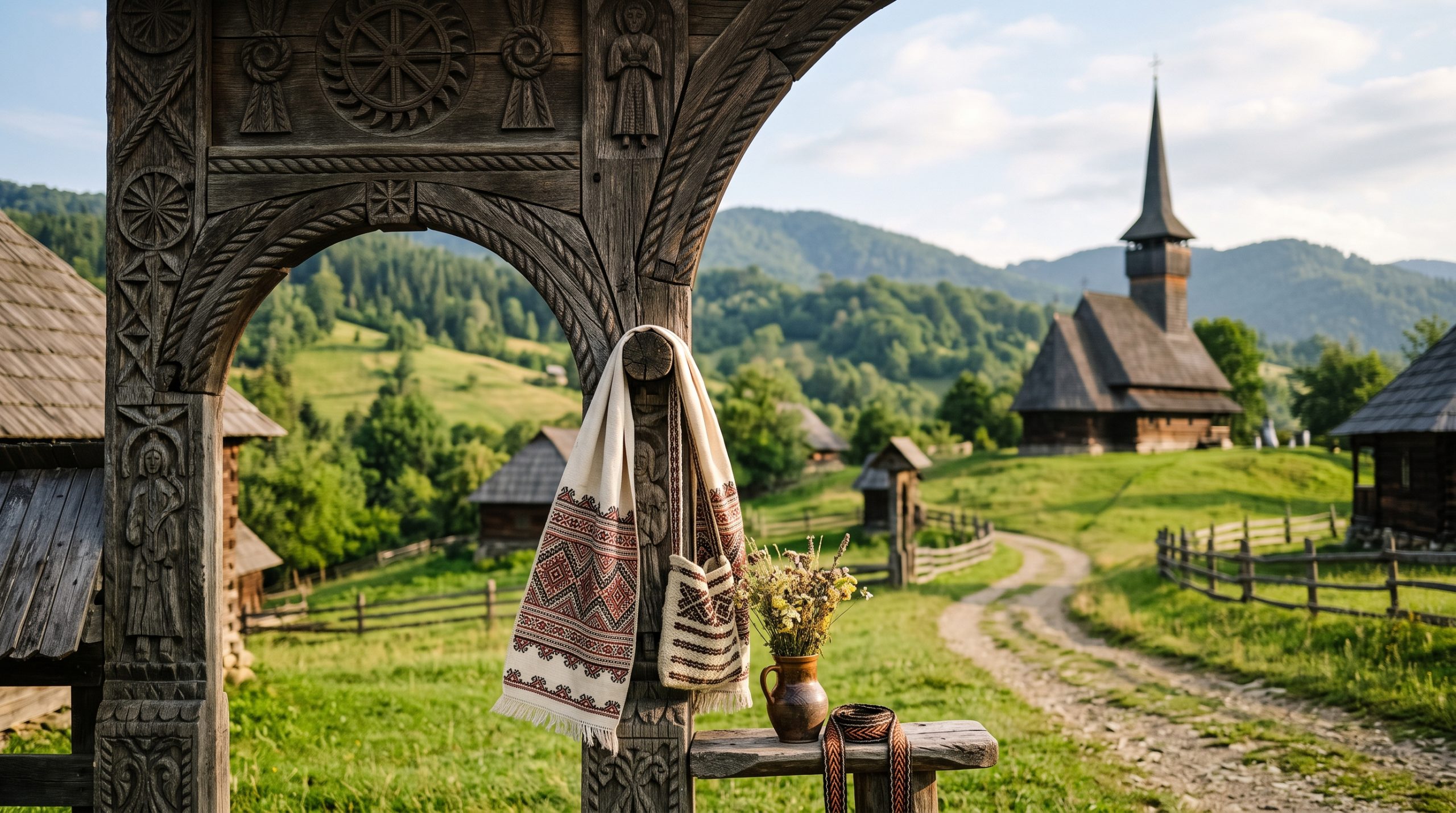
In a Maramureș courtyard, before anyone walks to the church, the nașă lifts a braided colac over the bride’s head and breaks it. Pieces go to whoever is close enough to catch them. Nobody explains it, because everyone in the yard learned what it meant before they could read.
Most English-language lists of Romanian wedding customs stop at the description. A fir tree gets carried through the village. The bride is spirited away from the party and bought back. The hora goes round until the accordion player needs a rest. What the lists skip is what each one is for, and which of them hold up when the wedding is two people and a valley rather than two hundred people and a hall.
This is that version. What the customs carry, which ones we build into an elopement day in the north, and the law and geography that decide the order of your hours.
Which Romanian customs still work when there are only two of you
Most of them survive. The nași, the colac broken over the bride’s head, bread and salt at the door and the first hora all need two people and a couple of witnesses, not a guest list. What needs a village is the village-scale material: the fir tree paraded street by street, and the bride’s ransom.
Nașii: the two people the day is built around
Ask a Romanian to explain the nași and they will not describe a job on a schedule. The nași are the godparents of the marriage, spiritual parents rather than attendants, and the couple usually chooses an older married pair already respected for how they have handled their own marriage. They stand in the ceremony, hold candles, and carry parts of the ritual nobody else may touch. Then the wedding ends and they are still your nași, for decades, the pair you go to when something has gone sideways.
This is the biggest difference from an American wedding party. Bridesmaids and groomsmen are chosen out of affection and stand down at midnight. Nașii are chosen for judgment, and the appointment is permanent.
It fits an elopement almost perfectly. A civil marriage in Romania needs at least two witnesses, so marrying legally here means bringing two people anyway. Name one married couple, give them the signature and the older role at once, and a guest list of two starts to mean something.
The cununie: crowns, one cup, and three circles round the table
Romanian law fixes the order before anyone gets a say in it. The Civil Code states that the religious celebration of a marriage may only take place after the civil marriage, so the town hall comes first and a church ceremony on its own carries no legal weight.
If you are marrying legally in Romania, the paperwork runs on its own clock. You file a marriage declaration in person at the primărie, and the ceremony can only follow after a 10-day period during which your names are posted publicly. You need at least two witnesses on the day, an authorized interpreter if you do not speak Romanian, and a certificate of no impediment, the certificat de cutumă, from your own embassy. A medical certificate from a Romanian doctor is also required, and it expires quickly, so it is the last thing you collect. Plenty of couples sign at home instead and keep Romania for the ceremony itself, a normal choice we cover in our guide to how an elopement is actually put together.
The religious service is called the cununie, from the crowns. Two crowns are held above the couple’s heads by the nași, and that gesture, rather than a spoken promise, is the moment the marriage is made. There are no vows in the Orthodox rite. Instead the couple drinks wine from a single cup, hands joined, and the priest leads them three times around the table at the front of the church while the crowns stay up. Those three slow circuits are the first steps taken as a married couple, a walk with no end point.
Two things worth knowing early. The Orthodox Church does not perform marriages on fast days, during fasting seasons or on major feasts, and because much of that calendar moves each year the Romanian Patriarchate publishes the unavailable dates in advance. Great Lent and the Christmas fast are the two long blocks. The cununie is also a sacrament, and the parish decides who receives it, so most visiting couples plan a ceremony led by their own celebrant and keep the crowns, the cup and the circles as its shape. Tell us which of those elements matter and we will build the hour around them.
The colac, the salt and the horincă at the gate
The colac is that decorated braided bread, and the nașă breaking it over the bride’s head is a blessing dressed up as chaos. The crumbs are meant to bring fertility and prosperity, which is why people reach for them. Bread and salt at a doorway is the older cousin of the same idea, a wish for a household that never runs short. In Maramureș the small glass poured at the gate is horincă rather than pălincă, the local plum spirit under its local name, handed over before a word of business is done.
These three transfer to a two-person day completely intact. They were never about numbers.
Bradul, strigături, and why Maramureș keeps the loudest version
Bătutul bradului is the one that surprises people. A fir tree is dressed with ribbons and carried through the village as a sign of fertility and long life, and in Maramureș it is still done properly rather than as a nod to the past. The same region turns out in full traditional costume, not one person in it but the whole guest list, and the strigături, the shouted rhyming couplets fired at the couple across the yard, are still composed on the spot.
Maramureș also holds the buildings. Eight of its wooden churches were inscribed by UNESCO in 1999: Bârsana, Budești, Desești, Ieud, Plopiș, Poienile Izei, Rogoz and Șurdești. They were raised from thick logs in the eighteenth and nineteenth centuries, when Orthodox communities were barred from building in stone, and the answer was a narrow tower pushed as high as the carpentry allowed. Dozens more in the valleys carry no listing at all.
| Custom | What happens | What it carries | With two of you |
|---|---|---|---|
| Nașii | A married couple is chosen to stand with you | Spiritual parents and lifelong guides, not a one-day title | Works, and the same pair can be your legal witnesses |
| Colacul | The nașă breaks a braided bread over the bride’s head before the walk to church | Fertility and prosperity, scattered to everyone within reach | Works with four people in a courtyard |
| Pâine și sare | Bread and salt offered at the door | A household that never runs short | Works anywhere, including a doorstep at 6am |
| Hora | An open circle dance led by lăutari, joined by anyone who wants in | The community closing around the marriage | Needs bodies. Two fiddlers and six dancers is the honest floor |
| Bătutul bradului | A fir is dressed and carried through the village | Fertility and long life | Keep the dressed fir, drop the procession |
| Furatul miresei | Friends take the bride from the party, the groom buys her back | Comic relief the whole room is in on | Needs a party. Leave it out |
All of this photographs unusually well, and not for the obvious reason. Hand-woven wool and hand-stitched linen hold shadow in a way modern fabric does not, so low side light at 6am in a courtyard does most of the work. Our published galleries and films show you what that looks like finished, which is a better thing to judge us on than any description here.
What the drive between the Iza and the Vișeu really costs
Cluj-Napoca is the busiest airport in the country outside Bucharest and where most couples land. From there it is roughly 180 km north to Sighetu Marmației. Baia Mare sits far closer to the villages but its schedule is thin, so the usual answer is Cluj, a night in the city, and the drive north the next morning.
| Leg | Route planner says | Plan on | Where the gap comes from |
|---|---|---|---|
| Cluj-Napoca to Sighetu Marmației, about 180 km | Around 3 hours | 4 hours | Two lanes the whole way, the climb over Pasul Gutâi at 987 m, and 50 km/h village limits one after another |
| Baia Mare to Sighetu Marmației | Just over an hour | 1 hour 30 | The same pass from the northern side, shared with logging traffic that sets the pace |
| Sighet out to the Iza valley churches | 20 to 40 minutes each | Double it | The doors are locked and a custodian opens them, so the visit is arranged ahead rather than simply timed |
| Borșa east into Bucovina over Prislop Pass | About 2 hours | 3 hours | DN18 tops out at 1,416 m with steep ramps, and nobody drives it without stopping |
The warning is about ambition, not road quality. Cluj to Sighet and back inside one day, with three wooden churches in the middle, is technically possible and thoroughly not worth doing. You spend eight hours in a car for forty minutes at each building, and the light you drove for arrives while you are still on the DN18.
Two smaller things the map will not tell you. Romanian weddings overwhelmingly happen on Saturdays and Sundays, so a village church on a weekend already belongs to somebody else, while a Tuesday hands you the whole valley. And the Iza roads still carry horse carts, a genuine pleasure to drive behind for two minutes and a schedule problem at minute fifteen. Prislop is worth crossing for its own sake, on a day with nothing waiting at the far end, and never as a shortcut. If you are weighing the north against other regions, our destination guides are the place to start.
Putting a ritual on the clock
Romania sits on the western edge of its time zone, so the summer evenings run absurdly long. On the longest day of the year in Sighetu Marmației the sun clears the ridge around 05:25 and does not set until roughly 21:27. By 20 September that has tightened to about 07:08 and 19:27. Those are two different timelines. June gives you two separate hours of good light with a wide gap between them, which suits a morning of preparation, an afternoon off and a late ceremony. A late-September day is short enough to hold everything in one continuous run.
The schedule we build works backwards from the customs you actually want. Dressing and the colac go early in a courtyard, because that is when the low side light exists and when a village is most itself. The ceremony hour is placed where it competes with nobody else’s Saturday. Travel between valleys goes in the flat middle of the day, when you lose nothing by being in a car. Anything with a fiddle in it goes last.
Having a photographer and a filmmaker from the same team matters more here than in most places, and the reason is the road. Two of us means two vehicles, so one can be at the next church confirming the custodian has arrived while the other is still with you in the first courtyard. It also means a second full set of bodies and lenses on the ground in a valley where the nearest camera shop is 180 km away in Cluj. Team travel is included worldwide, so getting both of us to Sighetu Marmației is not a separate line. Coverage runs from a single day with one of us to a multi-day route across regions, and each shape is set out on our pricing page. Highlights reach you within 5 days, the full gallery or film within 3 weeks.
Aerials are a confirmation, never an assumption. Romania sits inside the European drone framework and the Romanian Civil Aviation Authority registers operators, which is paperwork done weeks ahead rather than on arrival, and flying above a listed church needs the agreement of whoever holds its keys. We settle both before an aerial shot is written into a film. To have a week checked against the church calendar and the light, Check Your Date and we will come back with what is genuinely possible.
Common questions
Can we have an Orthodox church wedding in Romania if we are not Orthodox?
The cununie is a sacrament and the parish priest decides who receives it, so no planner can promise it. Romanian law also fixes the sequence, since a religious celebration can only follow the civil marriage. Most visiting couples hold a ceremony led by their own celebrant, beside or inside a wooden church where the parish agrees, keeping the crowns, the cup and the three circles.
Do we need nași if nobody else is coming?
A civil marriage in Romania requires at least two witnesses, so marrying legally here means bringing two people regardless. Traditionally the nași are a married couple taking on a permanent role rather than a ceremonial one. Couples eloping usually name a single pair, often parents, and let them carry both the legal signature and the older meaning.
How late does the light last in Maramureș in June?
Very late. On the longest day in Sighetu Marmației sunrise falls around 05:25 and sunset around 21:27, so a ceremony at 19:00 still has two hours of usable light after it. By 20 September the same place runs roughly 07:08 to 19:27, a tighter day and an easier one to keep inside one valley.
Is it appropriate for Americans to wear Romanian traditional dress?
Yes, if you buy it from the person who made it and wear it the way it is meant to be worn. An ie is hand-stitched, and the woman who sells you one will tell you which pieces belong together. Many couples wear their own clothes with a single Maramureș piece added, which reads as respect rather than costume.
Can we film aerials over a wooden church?
Sometimes, and it rests on two separate permissions. The Romanian Civil Aviation Authority registers drone operators and a registration issued outside the EU does not carry over, so that is arranged weeks before the trip. Above a listed church you also need the parish or custodian to agree. We confirm both before planning any part of the film around aerial footage.
Should we fly into Cluj or Baia Mare?
Cluj-Napoca for almost everyone. It is the busiest airport in the country outside Bucharest, which gives far more choice of connection, and it leaves about 180 km of two-lane road to Sighetu Marmației. Baia Mare is much closer to the villages but its schedule is thin. Landing at Cluj, sleeping there and driving north the next morning beats doing both in one day.
Carrying one of these home with you
The customs that last are the portable ones. A colac broken in a courtyard, a glass of horincă at a gate, three slow circles walked with your hands joined: none of them needs a hall, and all of them mean something the moment you understand what they are for. Tell us which ones you want and which region of Romania draws you, and we will say honestly which week of the year gives you the version you are imagining. We keep the whole planning thread in writing, with a reply and an initial brochure back within a day, and Our calendar currently covers 2027 through 2029. Start Your Story.