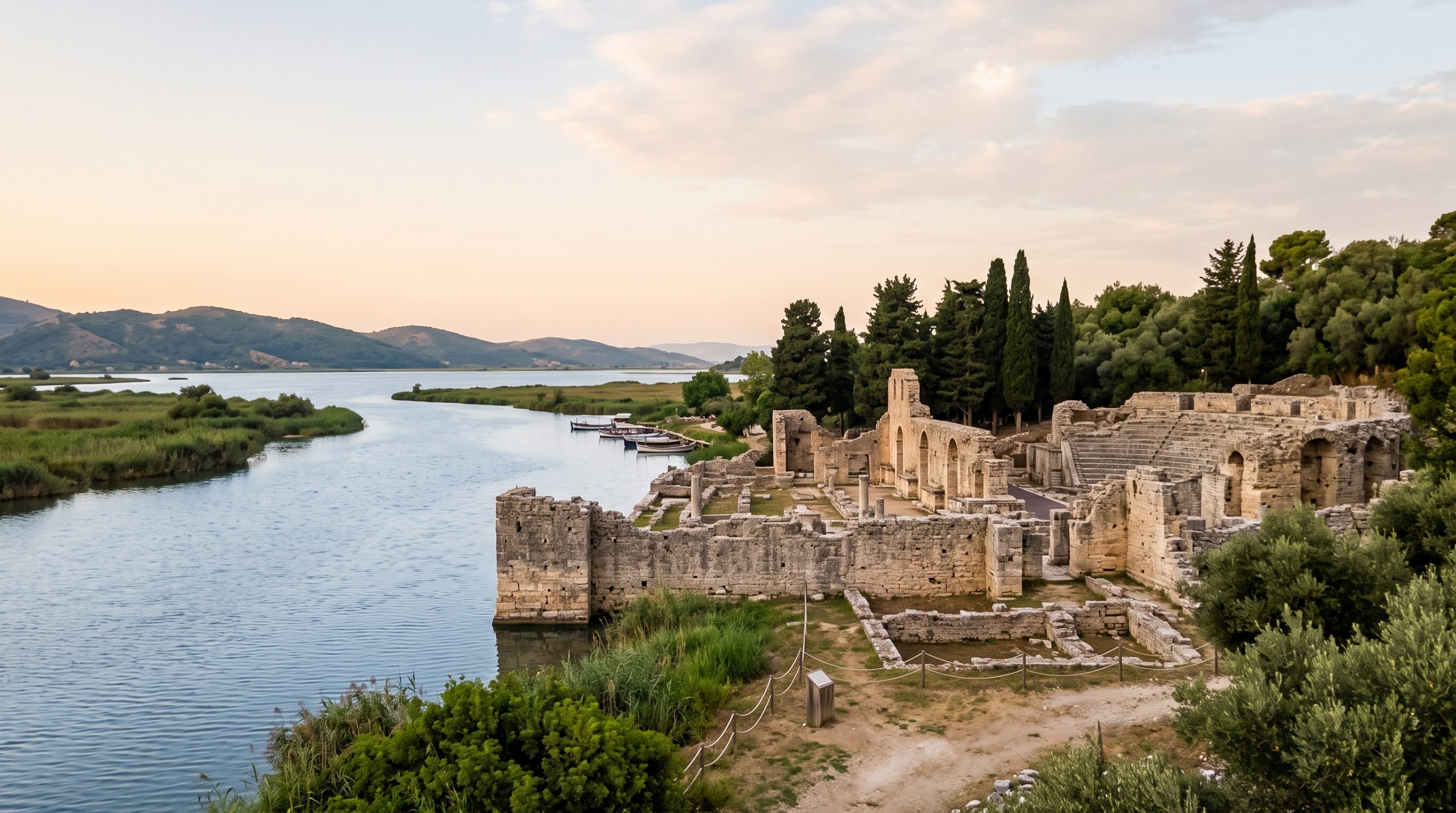
On 21 June the sun comes up over the Corfu channel at 5:12 in the morning, and the gate at Butrint does not open for another three hours or so. That gap is the first thing we raise with couples who write to us about marrying inside the ruins. The light you have seen in photographs of the Greek theatre, low and coming in sideways through the oaks, arrives before the ticket desk does.
None of that makes a ceremony here unworkable. It makes it a planning problem with a very specific shape, and the shape is worth knowing before you fall for a photograph. Butrint is not a venue with a rate card. It is a World Heritage property of 8,622 hectares, listed as a cultural monument under Albanian law in 1948, with the surrounding forest brought into conservation in 1981 and the ancient city inscribed by UNESCO in 1992 as the first Albanian archaeological site to be listed.
So there are two permissions in play. They come from two different bodies and they run on two different clocks. Here is how each one actually works.
Two permissions, and only one of them belongs to Butrint
Yes, in two separate steps. The legal marriage is registered at an Albanian Office of Civil Status on an eleven-day announcement clock. Permission to hold the ceremony itself inside the archaeological site sits with the Butrint Management Foundation, which administers the World Heritage property. Neither approval depends on the other, and both are worth starting early.
Two permissions make Butrint more detailed than it first appears
The paperwork is not complicated. It is simply slow in one place and geographically awkward in another. The eleven-day announcement means you both have to stand in front of a civil status clerk nearly two weeks before you sign anything, and the affidavit that Americans need is issued only by the embassy in Tirana, which sits 177 kilometers from Butrint in a straight line and a good deal further by road. That is the whole difficulty. It is a logistics puzzle rather than a legal obstacle, and it is entirely solvable if you know about it in month one rather than month six. Our guide to planning an elopement covers the same decision in general terms; below is the Albanian version of it.
The Albanian marriage file alongside the Butrint permission
This is the chain for two American citizens marrying in Albania, drawn from what the U.S. Embassy in Tirana publishes for its own citizens. Collect it in this order, because two items sit inside a window that starts running the moment they are issued.
- Passports, plus a photocopy of the biographic page for each of you. Nothing to arrange, but the copies are asked for, so make them at home rather than hunting for a print shop in Saranda.
- Divorce documentation, if either of you has been married before. A certified copy of the decree, carrying an apostille, with an official translation. This is the item that most often lengthens a timeline, so start it before you start anything else.
- A certified copy of each birth certificate, issued within the last three months, with an apostille attached. The three-month window is the single hardest constraint in the whole process. It is not the apostille that expires, it is the certificate underneath it.
- Official Albanian translations of your foreign documents. The embassy’s guidance is explicit that translation accompanies the apostilled originals.
- The Affidavit of Eligibility to Marry in the Republic of Albania. Albanian authorities want proof that no impediment exists to the marriage. No United States authority issues such a certificate, so the U.S. Embassy in Tirana issues this affidavit instead, in person, at its standard notary fee of 50 dollars. Payment is taken in cash, in dollars or lek, or by major credit card.
- Two witnesses. They must be physically present when the marriage is registered, and they cannot be related to either of you.
- The announcement at the Office of Civil Status. At least eleven days before the planned marriage, you both appear at the office in the municipality where the registration will take place. Butrint sits in Vlorë County, at the southern end of the country.
- The signing. Both of you and both witnesses appear before the civil status clerk to sign the marriage record. It goes into the national civil status register and the certificates are issued.
One line of that list carries more weight than the rest. The birth certificate has to be under three months old on the day it is used, which means it cannot be ordered when you first get engaged and it cannot be ordered the week before you fly.
Work back from the Butrint ceremony hour through both permissions
Two numbers matter: the legal minimum, which is what the law will accept, and the comfortable minimum, which is what we build a timeline against. They are not the same, and the difference is not padding.
| Step | Legal minimum | What we plan to |
|---|---|---|
| Divorce decree, apostilled and translated | In hand before the announcement | Started as soon as the date is held |
| Birth certificates ordered | Issued within 3 months of use | Ordered around 8 weeks out, apostilled immediately |
| Affidavit at the embassy in Tirana | Before the office visit | Built into the arrival leg as its own travel day |
| Announcement at the Office of Civil Status | 11 days before the marriage | Day 14 or earlier, in country |
| Signing with two witnesses | On or after day 11 | The morning before the Butrint day, not the same morning |
| Access request for the archaeological site | No published deadline | In motion months ahead of the date |
The practical read of that table is that an Albanian legal marriage wants you in the country for roughly a fortnight, with one of those days spent at the far end of the country. The Butrint costs and processing windows below are a point-in-time reference, not a promise of future tariffs.
The details that catch people out
None of these are dramatic. They are just the things nobody mentions until they have already cost someone a rearranged week, and they are the reason we ask about paperwork in the first exchange rather than the fifth.
The three-month clock on the birth certificate. Couples reliably do one of two things: order the certificate the day they decide on Albania, so it is five months old and useless by the ceremony, or order it three weeks out and discover the apostille is still moving through a state office. Order it roughly two months ahead and apostille it the day it lands.
Tirana is not an errand. The affidavit is issued at the embassy in the capital, and the capital is at the opposite end of Albania from Butrint. This is a full day of travel with an overnight either side, and it is worth treating as part of the trip rather than something to squeeze in on the way south.
Witnesses cannot be family. This one catches small elopements hardest. If the only two people you are bringing are your sister and his brother, you do not have witnesses. You have two guests and a problem. Friends, a celebrant, a local fixer, an unrelated travel companion all work; a sibling does not.
The office keeps office hours. The announcement and the signing both require the two of you standing in a civil status office on a working day. Neither can be done from a hotel in Ksamil, and neither happens at the weekend.
Butrint runs on its own timetable, not yours. The site opens in the morning and closes at or near dusk, with last entry set well before closing, and the summer and winter timetables are different. In late June the sun is up at 5:12 and down at 20:11. In late December it rises at 6:57 and is gone by 16:19. The gate does not open at first light in either season, so a sunrise ceremony among the ruins is not a thing a standard ticket buys you. Everyone in your party pays ordinary admission, currently 1,000 lek a head for adult foreign visitors, which has been roughly ten euros at the rates of the past few years.
The surfaces are the exhibit. The orchestra floor of the Greek theatre is boarded over to protect what is underneath, so what reads in a photograph as a natural stage is in fact a conservation surface. The baptistery’s mosaic pavement, laid in the sixth century, is the reason a great many people come at all. Anything involving staging, scattering, heavy furniture or a lot of feet in one place needs to be raised in advance rather than improvised on the day.
Midday belongs to the boats. Saranda is a short crossing from Corfu, and a large share of Butrint’s crowd steps off those ferries and onto coaches. Between late morning and mid-afternoon in summer the paved streets and the theatre are busy, and honestly, they are not especially photogenic at that hour either. The light is flat and overhead and the ruins go grey in it. The first hour after opening and the last two before closing are the whole game.
Keep the legal signing at home and the Butrint ruins for the ceremony
A large number of the couples we work with in Albania sign at a courthouse or a county office at home, in ordinary clothes, weeks before they fly. Then they come to Butrint and hold the ceremony that actually means something to them. We want to be clear that this is not a downgrade or a workaround. For a lot of people it is simply the better plan.
What changes: the eleven-day announcement disappears, the Tirana journey disappears, the three-month birth certificate window disappears, and you no longer need two unrelated witnesses standing in a municipal office in Vlorë County. Your trip shrinks from a fortnight shaped by opening hours to a week shaped by weather and light. You can also stop thinking about whether a document translated in Ohio will satisfy a clerk in southern Albania.
What does not change: anything at all about the day. You still write your own vows and read them to each other with the Vivari Channel below you. You still walk the streets of a city that has been continuously occupied through Greek, Roman, Byzantine, Venetian and Ottoman hands. The film is the same film. Nobody at Butrint asks to see a marriage license, and nobody watching your ceremony will know or care which piece of paper was signed in which country.
If you do want the legal act in Albania, it works and it is recognized at home. An Albanian marriage certificate travels back to the United States on an Albanian apostille, issued through the Ministry for Europe and Foreign Affairs. Our destination guides set out how Albania compares with the rest of the Adriatic and Ionian coast, and how the legal decision usually falls once couples see both routes side by side. Tell us which route you are leaning towards and we will build the calendar around it. Send Us a Message.
What we coordinate for Butrint, and what remains your legal file
This guide helps you plan the Butrint process; it is not legal advice. Rules change and circumstances differ, so confirm the detail with the relevant registry office or your own consulate before you book flights. We do not file paperwork, we do not sign anything on your behalf, and we do not present ourselves as an authority on Albanian family law.
What we do is everything around it. We research the permit position for the ground you want to stand on and tell you what the request will involve. We hold a date against the civil status office’s working days rather than against a wishlist. We build the timeline so the ceremony hour lands when the site is quiet and the light is doing something, which at Butrint in shoulder season usually means the last ninety minutes before the gate closes. We hold a weather alternative on the Ksamil side of the channel, fifteen minutes north, for the days when the Ionian sends rain across the border.
On an Expedition day a dedicated photographer and a dedicated filmmaker work the same hours as one team, which matters more at Butrint than at most places. The ceremony window is short, the site is linear, and you cannot ask a theatre full of visitors to wait while one person changes lenses. One of us holds the wide frame and the acropolis line, the other stays close for the vows. You can see how that reads in finished work across our published galleries and films, which is the fairest way to see what a second camera on the ground actually adds. Coverage starts at $4,900 for one full day with a dedicated photographer or filmmaker, and the rest of the range sits on our pricing page.
Team travel to Albania is included, in every direction, with no long-haul surcharge attached to the fact that Butrint is a long way from most of our couples. Highlights reach you five days after the date. The full gallery or film follows within three weeks.
Common questions
Can you legally get married inside Butrint National Park?
The legal act of marriage in Albania is registered before a clerk at an Office of Civil Status, not on site. What you can hold inside Butrint is the ceremony, with access requested from the body that manages the property. Most visiting couples sign at the office and celebrate in the ruins.
Who do you ask for permission to hold a ceremony at Butrint?
The Butrint Management Foundation administers the World Heritage property under the Integrated Management Plan approved in 2020, with oversight from the Albanian ministry responsible for culture. Butrint publishes no wedding package and no venue tariff, so any request is made and judged on its own terms, weighed against conservation and visitor flow.
How long do we have to be in Albania to get married there?
Plan on about two weeks. You both have to appear at the Office of Civil Status at least eleven days before the marriage, then return with two witnesses to sign the record. Add a separate day at the embassy in Tirana for the affidavit, at the other end of the country.
Do we need an apostille on our US birth certificates for Albania?
Yes. The U.S. Embassy’s guidance is a certified copy of each birth certificate issued within the last three months, carrying an apostille, with an official translation. The three-month window runs on the certificate itself, so order it roughly two months before the date rather than the moment you get engaged.
Can our families be our witnesses in Albania?
No. Witnesses must be present in person when the marriage is registered and cannot be related to either of you. Siblings, parents and cousins are out. Unrelated friends, travel companions or a celebrant work, and it is worth confirming who is filling those two chairs early rather than the week before.
What does it cost to bring our group into Butrint?
Standard admission applies to everyone, currently 1,000 lek per adult foreign visitor. That is the entry cost only. Government, venue and landowner permit fees, wherever they apply, are paid by you directly, while the research and the logistics behind them are part of what we handle.
When is Butrint quiet enough for a ceremony?
The first hour after opening and the last couple of hours before closing. Midday in summer brings the Corfu ferry traffic and the coaches from Saranda, and the overhead light flattens the ruins anyway. Shoulder season afternoons are the reliable answer, and that is where we push most Butrint timelines.
Putting a Butrint date on paper
The order that works is unglamorous and it works every time. Fix the date first, because the light and the crowd pattern decide it. Then decide the legal route, at home or in Albania. Then the documents, in the sequence above. Couples who do it the other way round spend the whole planning period reacting to a certificate they ordered too early.
Everything with us happens in writing, asynchronously, across whatever time zones you and we are in. You send the inquiry form, we reply with an initial brochure within 24 hours, and a tailored proposal follows once we understand the date and the shape of the day. A signed contract and a 30 percent retainer open the planning. We are currently booking 2027, 2028 and 2029, which is comfortably enough runway for an eleven-day announcement and a birth certificate ordered at exactly the right moment. Check Your Date.