San Gimignano will marry you between 09:30 and 14:00 from the first of April to the end of September, and between 11:00 and 14:00 for the rest of the year. Those are the hours the comune publishes for civil ceremonies, and they are the single most useful thing to know before you plan anything else here.
It means the ceremony cannot sit at the hour the stone goes warm. The light people picture when they picture this town arrives long before the register opens and long after it closes. So we build the day in two halves around a legal middle, and once that is settled, San Gimignano turns into one of the more straightforward towns in Tuscany to marry in properly.
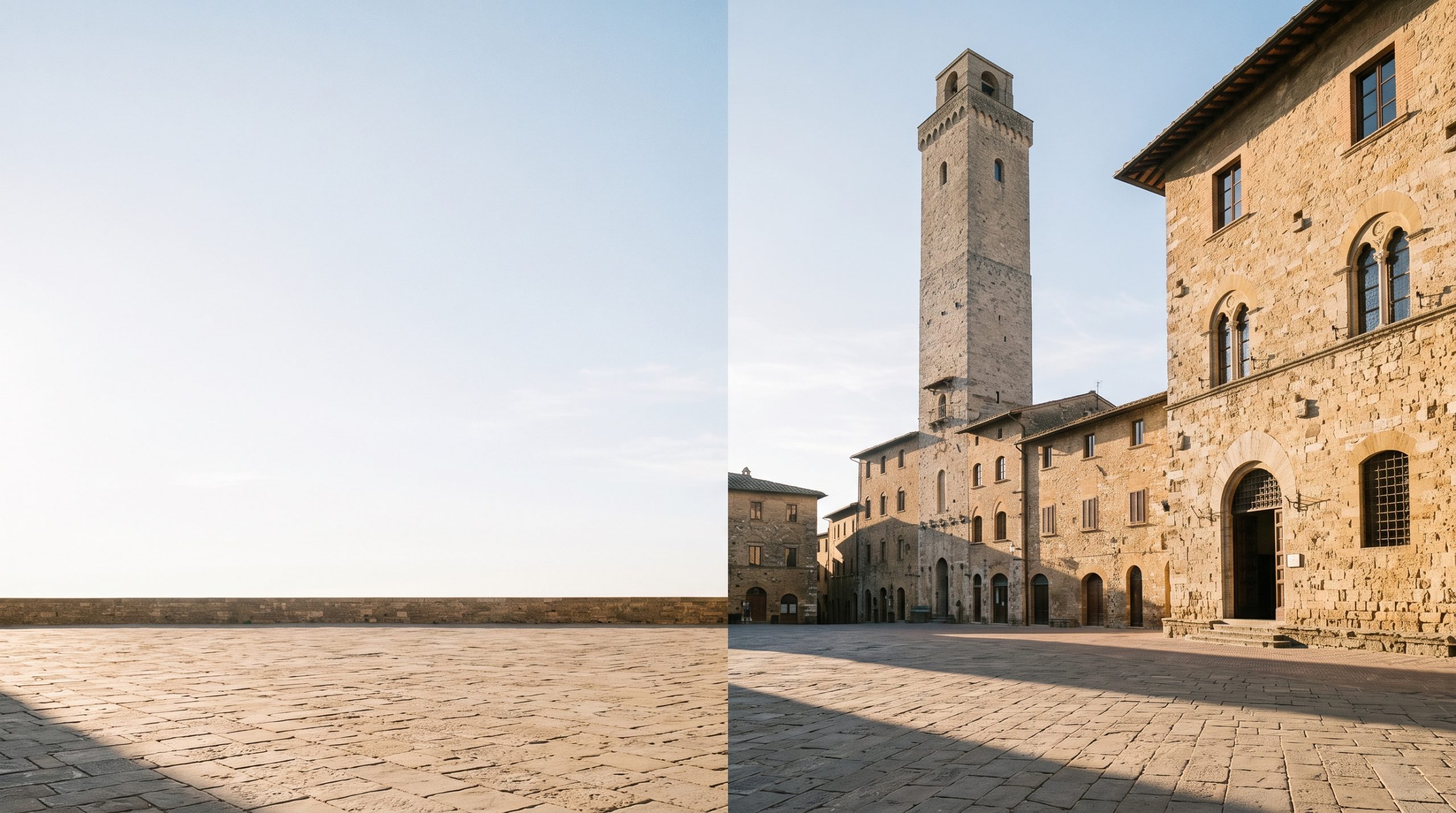
The other thing worth knowing is what 06:00 feels like. Fourteen towers survive inside the walls, the tallest of them Torre Grossa at 54 meters over Piazza del Duomo, and at that hour the sun has reached its top third while the paving below is still blue. We have stood in an empty Piazza della Cisterna then and heard nothing but a shutter and a delivery trolley on brick.
The hour we ask couples to book
Ask for the first slot the town offers: 09:30 between April and September, 11:00 between October and March. The municipal window closes at 14:00 either way, so an early ceremony keeps the whole afternoon free, leaves room for a second run of portraits in the last hour of sun, and puts your vows in before the coaches arrive.
Three rooms that hold a marriage register
The comune celebrates civil marriages in three named places. The Sala di Dante inside the Palazzo Comunale, the courtyard of the same palazzo, and the museum complex of the Conservatorio di Santa Chiara, where the Sala Fieschi, the exhibition rooms and the internal garden are all listed as ceremony space. A quick ceremony in the municipal offices is the fourth route, and the one couples take when the celebration itself is happening at a villa in the hills. The published hours cover non-holiday days, so if you have a Sunday in mind it is a question for us to put to the office rather than an assumption to build a week of travel on.
Fees are set by council resolution and turn on citizenship rather than on how far you have flown. In the Sala di Dante two foreign nationals currently pay 1,100 euros and two non-resident Italians pay 400, and the ceremony is free if either of you is a resident of the comune. The palazzo courtyard sits in a higher band than the room. Those figures are revisited most years, so read them as the shape of the cost rather than a quote you can hold.
Two pieces of paperwork catch people out. Publication is the first: you publish where you live rather than here, then two Sundays and three clear days have to pass before a date can be fixed, and foreign nationals bring a nulla osta from their own authority. The second is easy to miss. The comune has a dedicated form for photography and filming at a civil ceremony, filed with the rest of the marriage paperwork, which means our names go in weeks ahead rather than being explained at the door.
The Sala di Dante is a room with a table and a row of chairs, not a hall with sightlines. There is one strong angle down the middle and one from the side wall, which is precisely the problem when a photographer and a videographer have never worked together before that morning. Ours have. The filmmaker takes the side and stays long, the photographer owns the center line and the signing, and neither appears in the other’s frame because they settled it over the timeline weeks earlier. Hard plaster and a stone floor make a short civil ceremony read louder and thinner than it was, so a mic on the celebrant and a recorder near the register is the difference between a silent film of a formality and four minutes you can listen to in ten years.
One full day with a dedicated photographer, or with a dedicated filmmaker instead, starts at $4,900, and one day with both of them working the same room starts at $7,900, with the assigned team’s flights and accommodation already inside those numbers. The full coverage detail sits on the pricing page. Couples adding Volterra, a Chianti morning or a day in the Val d’Orcia run it as a multi-day Odyssey and we build the proposal around the route.
What the towers do to the light
This is the part almost every page about San Gimignano gets wrong, and it is worth being blunt about. Inside the walls there is no golden hour at ground level. The town sits on a ridge with three and four story facades pressed against narrow streets, so when the sun is low it lands on tower tops and upper plaster and leaves the paving in shade. The light in the piazzas at 06:30 is beautiful and it is entirely bounced, warm ochre reflected down onto faces from the walls above.
That bounce is the reason we like the place so much. It is soft, it is directional because the streets are canyons, and it flatters a white dress instead of blowing it out. In mid-June the earliest sunrise here is around 05:35 and the latest sunset falls just after 21:00, which gives an enormous working day at both ends. In May the sun comes up close to east-northeast and goes down at roughly west-northwest, so the outer faces of the walls and the ground below them are where the direct low light actually lives.
Practically, that shapes a whole day. First light belongs to the gates, the wall line and the streets on the eastern side. The middle of the day belongs to the ceremony, because that is when the register is open anyway and when the piazzas are flat and busy in equal measure. The last two hours belong to the fields and vineyards outside the walls, where the towers become a skyline behind you and the sun is unobstructed until it sets. You can see how that bounced morning light and that open western evening actually render in our galleries and films, which is more useful than any description of it.
Cars stop at the gates, and the walk up is real
The historic center is pedestrian, so every version of this day starts on foot from a gate. There are four paid public car parks. P1 Giubileo, on the south side, is the big one at 305 spaces, and its daytime rate runs 2 euros for each of the first two hours, then 1.50 an hour, capped at 7 euros in 24 hours. Between 20:00 and 08:00 the cap is 1 euro, which is the cheapest thing about a sunrise start anywhere in Tuscany. P2 Montemaggio is closer to the walls with 153 spaces and costs more, 3 euros for the first hour and a 15 euro daily ceiling. P3 Bagnaia Superiore adds another 90 spaces when the first two fill.
From April to October a Citybus line links P1 to the center for 1 euro per person return, and from June to September the year-round town line stops at Porta San Giovanni and Porta San Matteo rather than running through the middle. Useful for guests. Less useful for a bride, because timetables and a 09:30 register do not always agree.
Here is the part nobody writes down. From Porta San Giovanni up to Piazza della Cisterna is a continuous climb on stone and brick, and Piazza della Cisterna itself is laid in herringbone brick that has been settling since the Middle Ages. A long hem collects grit on the way up. A narrow heel finds every gap between bricks. Nothing about it is difficult, but it is a warm ten minutes in structured clothing, and it is the reason we push couples hard toward a room inside the walls: you dress where you sleep, you walk downhill to the register, and the only thing being carried up the hill is our gear and your shoes.
The coaches, and the four hours before them
The four hours between first light and the first coach are the whole reason we start when we do. Honest version: from late morning to mid-afternoon the main streets are a slow-moving queue, the well in Piazza della Cisterna has a rotating audience on its steps, and no amount of skill makes that look private. Unlike some places, though, arriving early genuinely is enough here. The town belongs to residents and overnight guests until the first groups reach the gates, and it hands itself back in the evening once the day trips have gone. That is a real gift, and it is why we would rather have you tired at 05:40 than waiting for 16:00 to improve.
Where we go when the piazzas fill
Three moves, all of them within a few minutes of Piazza del Duomo.
- The Fonti Medievali, reached by a short steep descent along Via delle Fonti and out through Porta delle Fonti. The town’s medieval public springs sit under a run of stone arches outside the walls, shaded and quiet when everything above them is not. The descent is the reason to bring flat shoes and the arches are the reason to go anyway.
- The Rocca di Montestaffoli, the old Florentine fortress just past Piazza delle Erbe. Free to walk into, planted with olive trees, one surviving turret you can climb, and the clearest view of the towers you will get without a ticket.
- The Vernaccia vineyards and ridge tracks immediately below the walls, which is where the evening film gets made. Wide, open, west facing and empty at the hour the town is not.
Weather moves the plan rather than canceling it. Rain sends us to the arched cover at the Fonti and the arcades in the center, both of which read better wet than dry, because the stone darkens and the plaster saturates. Wind sends us off the Rocca, which is exposed, and down into the hollow at the Fonti, which is not. Aerials are their own conversation in a walled UNESCO center, so we scope them on the vineyard ground outside the walls and confirm what is permitted long before any part of the film depends on them.
Fit matters more than it sounds. San Gimignano is a walking, eating, small-ceremony town, and it suits couples who want a morning of streets and a table that runs late over couples who want a single enormous view. If what you actually picture is empty landscape with no one in it, tell us, and we will pair a San Gimignano morning with a Val d’Orcia dawn or say plainly which region fits you better. Our destination guides are the fastest way to compare regions, and the planning fundamentals cover the paperwork sequence that sits behind all of it.
Common questions
Can we have our legal ceremony at sunset in San Gimignano?
Not through the comune. Civil ceremonies finish by 14:00 all year, and start no earlier than 09:30 from April to September or 11:00 from October to March. Anything outside those hours has to be checked with the demographic services office. Couples who want words at sunset marry legally in the morning and hold a symbolic ceremony in the evening.
Do we need permission to photograph and film inside the ceremony room?
Yes, and it is straightforward. The comune has a specific request form for photography and video at a civil marriage, submitted with the rest of the marriage paperwork. We handle the research and the sequencing of it as part of planning, and the permit fee itself, where one applies, is paid by you.
How early do we actually have to start to have the streets to ourselves?
Be in position at first light. In mid-June that means sunrise around 05:35, so we are walking at about 05:00 and shooting the wall line before the town wakes. In November the same quiet arrives after 07:00, which is one of the strongest arguments for a winter date here.
Is there anywhere to change once we are inside the walls?
There is no public facility for it, and the center is closed to cars, so a room inside the walls does the job that a car does elsewhere. We build the timeline so you dress at your accommodation, walk downhill to the register, and come back to the same room between the ceremony and the evening.
Can we get married on 15 August or 1 May?
No. The comune does not celebrate marriages on 1, 6 and 31 January, Easter Sunday or Easter Monday, 25 April, 1 May, 15 August, 1 November, or 8, 25 and 26 December. Several of those are the exact dates couples pick for the summer, so we check your date against the list before anything else gets planned.
One day here, 05:40 to the last table
The shape we come back to: dressing in a room inside the walls before dawn, the eastern streets and the gates while the towers hold the only direct sun in town, breakfast, the register at 09:30, an hour in the quiet lanes on the way back, then the whole hot middle of the day off. Late afternoon we go out through a gate into the vineyards and stay until the light leaves, and dinner is somewhere with a long table and nothing booked after it.
Highlights reach you five days after that, and the full gallery or film three weeks after. Everything before it happens in writing: you send the form, we reply with the brochure inside a day, a tailored proposal follows, and planning opens once the contract is signed and the 30 percent retainer is in. Our current Tuscany availability runs across 2027–2029 now, and the first thing we will do with your message is check whether your date clears the comune’s calendar. Tell Us Your Story.