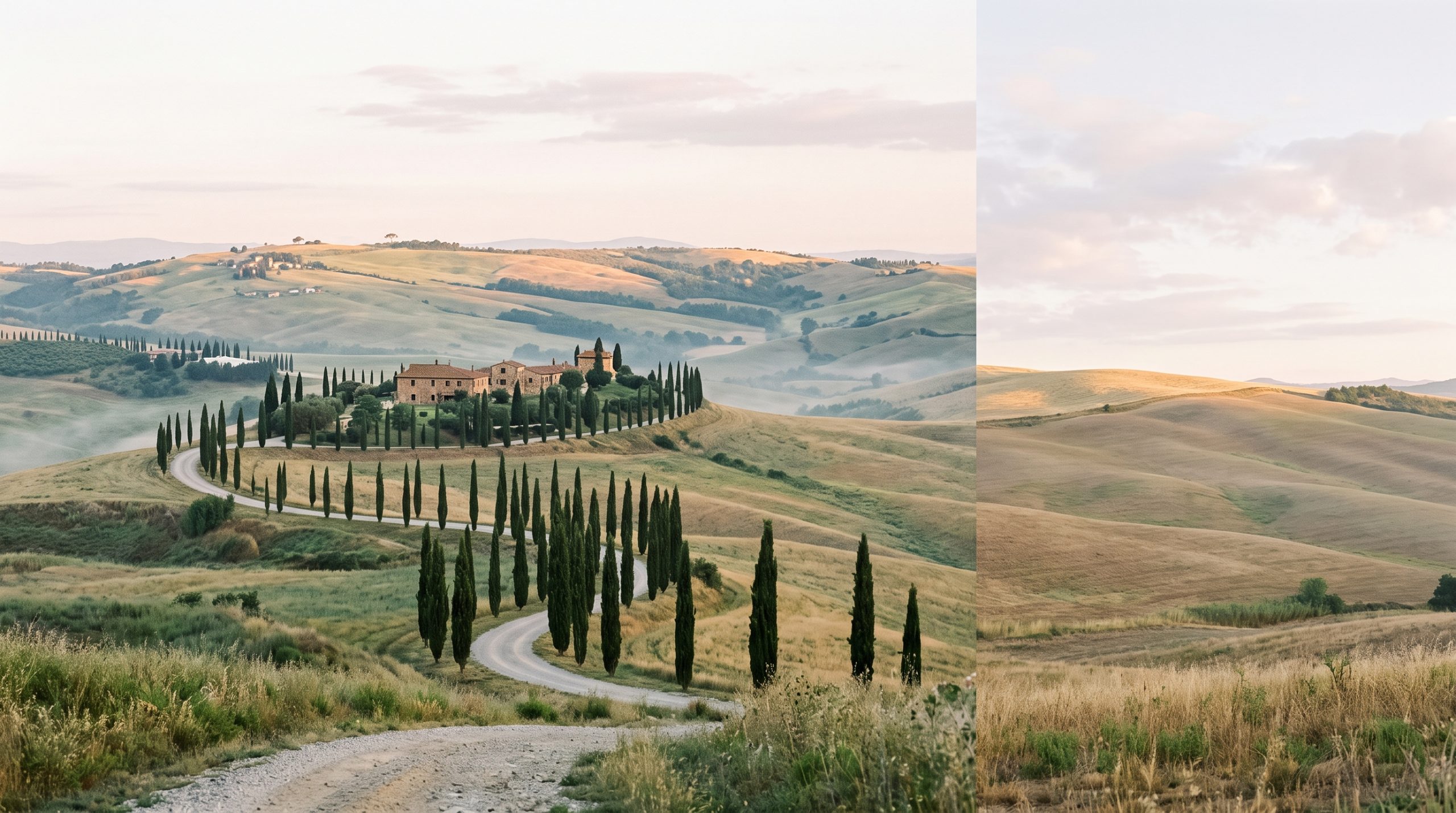
The two pull-outs on the road below Podere Baccoleno hold five cars between them, three in one and two in the other. Almost everything about planning a ceremony here follows from that number.
The curve of cypresses is the farm’s driveway. It climbs to a house that one family has worked for around sixty years, across roughly 250 hectares of wheat and clay, and there is a sign on the gate that says as much. The photograph you have seen a thousand times was made from the hillside opposite, standing on a path worn into the grass by everyone who came before. Nobody laid that path. It is a working field.
Half the captions online file this under Val d’Orcia. It isn’t. The Val d’Orcia begins well to the south, and Baccoleno sits 6 km out of Asciano in the Crete Senesi, the clay country southeast of Siena. What follows is what it actually takes to stand on that ridge and marry each other: who you ask, what the walk is like in the clothes, and the hour of the day that earns the drive.
Who says yes, and who signs the register
The cypress drive, the farmhouse and the hills on either side are private farmland, so permission for a ceremony comes from the family who own Baccoleno rather than from any park office. The legal marriage is separate: an officer of the comune registers it in a room the comune has designated. Most couples do both, in that order.
Five parking spaces, a grass path, and a hem
Piazza del Campo in Siena is only 21 km away, and the drive still takes about fifty minutes, because the route runs out on the Lauretana through Arbia and Asciano and then onto smaller roads heading south toward Chiusure. Montepulciano is 32 km off, which makes Baccoleno a realistic morning from either base. There is no official car park. You stop on the verge where others have stopped, you keep the gateway clear, and you do not drive down the avenue unless you are staying at the farm, because the avenue is somebody’s front door.
From the road it is a two minute walk up onto the flank of the opposite hill, on grass tracks made by feet rather than by anyone with a plan. In a dress, two minutes is still two minutes of dry seed heads and thistle at hem height in July, and after a wet spell the clay comes with you in pads on the soles. Carry the shoes you want to be married in and change at the car, because there is nothing at the top: no bench, no shade, no water, no bathroom. The nearest of all of that is Asciano, 6 km back the way you came.
The ground itself is easy. There is no scramble and barely any climb, which is why this location works for couples who would rather not spend their morning gaining altitude, and for guests who are coming along and not built for a ridge walk.
What the low sun does to the cypress shadows
Nothing here casts shade except the cypresses, and they cast it sideways. That is the whole light story. The ridge is bare clay and crop with a line of trees drawn across it, so with the sun anywhere near the top of the sky the scene is one flat tone and the curve barely registers. Bring the sun down to within a hand’s width of the horizon and every tree lays a long shadow out across the field. Then the drive reads twice: once as trees, once as stripes.
Sunset is what the place is known for, and it earns the reputation. It is also when five parking spaces become the constraint on your evening. Dawn does the same work on the same shapes, and in late June the sun is up before six, which is early enough that the hill belongs to you. The trade is honest: you move quickly, the crop holds dew, and the walk up is wet.
By mid-morning in summer the heat starts lifting off the clay. The classic frame is a long lens from the opposite hill, and compression stacks up everything floating in the air between you and the house, so haze shows in the picture before you feel it on your skin. If the day is going to be hot, the crisp version of this view exists in the first ninety minutes after sunrise and the last hour before sunset, and not in the middle.
Blue hour is the one nobody plans for. Ten minutes after the colour has gone the clay keeps a faint blue, a window or two shows in the farmhouse, and the cypresses become black shapes with nothing else in the frame. It photographs beautifully and it films poorly without light we bring, which is a decision made in advance rather than in the dark on a verge.
At one in the afternoon in July, this is one of the flattest views in Tuscany. That is not a criticism of the place. It is a reason to build the day at both ends and spend the middle of it somewhere with a roof.
The evening tripod line
The crowd at Baccoleno is a sunset crowd. It arrives in the last hour of light and leaves in the dark, which means the usual advice to come early is, for once, genuinely enough: on most mornings the verge is empty. Late spring and high summer soften that at the edges, and two or three tripods somewhere along the path on a June Saturday is normal. It changes very little. The worn grass runs along the flank of the hill rather than gathering at one spot, so stepping a short way in either direction moves the farmhouse against the ridge behind it and gives you a different composition from the person forty metres away. We plan a ceremony hour here, not a ceremony minute.
How the ridge photographs, and how two cameras fit on it
Understand what kind of picture this is and the day plans itself. At the focal lengths that make the curve sing, the two of you are small: this is a landscape with a couple in it, and it is one of the few places where being tiny in the frame is the point. So we build the close work elsewhere in the same hour, on the farm track, against a wall, in the grass with the ridge soft behind you, and the wide frames carry the place. You can see how that pairing resolves in the finished galleries and films in our stories. Highlights reach you within five days and the full gallery or film within three weeks.
Two people working at once is a physical question on a hill this exposed, and it comes down to spacing. The path is narrow but it is long, so a photographer can hold the compressed frame from one position while a filmmaker drops thirty or forty metres along the same contour and shoots across the curve without either of them appearing in the other’s work. Sound is the real variable, because there is nothing to break the wind up here, and vows spoken on the crest of a bare clay ridge can arrive as air rather than words. We set the vows a little down the slope, in the lee, with the audio close in. One full day with a dedicated photographer or a dedicated filmmaker starts at $4,900, the version where both work the ridge together starts at $7,900, and multi-day shapes across the Crete Senesi and beyond are quoted on the plan itself. The rest of the detail sits on the coverage and pricing page, including the fact that travel for the team is already in the number.
Asking the family, and asking the comune
There is no park authority here and no council window with a form. The avenue belongs to the farm, the farm belongs to a family, and the fields on both sides are their crop. That makes the permission question unusually simple and unusually personal at the same time, because the answer to whether you may stand somewhere for twenty minutes and say something to each other comes from people whose harvest you are standing in.
So we ask, in writing, in Italian, and we have the answer before there is a timeline. What is welcome on that hillside has tightened and loosened over the years as visitor numbers grew, and the informal paths are not a right of way. Asking is not a courtesy we perform after the plan exists. It is the piece of research the plan is built on.
Staying at the farm changes the conversation entirely. Baccoleno is eight apartments with kitchenettes, a garden and an indoor pool, and guests use the avenue because it is the way home. If the frame you keep returning to is the one from inside the cypresses rather than across the valley, that is the route to it, and we will tell you so early enough to book it.
Air is its own question. Signs on the farm’s land are explicit that overflight is not welcome there, and that call belongs to the owners rather than to us. Where the answer is yes, aerials are part of what we deliver. Where it is no, the film gets built from the ground and from public land further out, and the loss is smaller than you would guess, because that curve reads best from roughly the height of a person standing on the opposite hill anyway.
The legal marriage happens in a different building. In Italy a civil marriage is registered by an officer of the comune in a place the comune has formally designated for the purpose, and privately owned rooms qualify only where the comune has taken them on as a separate register office. In practice that means the signing sits in Asciano or Siena, on the comune’s calendar and with witnesses, while the ceremony on the ridge is entirely yours to write. Fees are set by each comune and are generally higher when neither of you lives there. We work out which office, which room and which order, and the sequence of documents two Americans need before any of it can be booked. The groundwork is laid out in our guide to how eloping abroad actually comes together.
When the combine comes
The field is the picture, and the field is a crop. Wheat here runs green from late in the year through spring, gold in early summer, and then one day a combine crosses it and the gold is stubble. Autumn ploughing turns the whole flank grey-brown, which in low sun photographs better than most people expect. None of that is a problem to be solved. It is a variable that moves a week or two either way with the weather, so we pick the month around the field you want instead of promising you a colour.
Beyond the crop, the thing that moves a plan here is water in the clay. Crete Senesi clay does not drain, so after a wet spell the walk is heavy and the same two minutes takes twice as long in the shoes that matter. We move the walking to the firm ground, keep the ceremony where footing is reliable, and hold the alternatives in the same half hour of driving. Site Transitoire, Jean-Paul Philippe’s stone sculpture on a hilltop above Leonina, sits on the Siena side of Asciano and frames the city instead of a farmhouse, and the last stretch to it is on foot. Chiusure and the abbey at Monte Oliveto Maggiore give you stone walls and somewhere with a roof. Bosco della Ragnaia is about nine minutes away by car. Those are the pieces we shuffle when a morning arrives wrong, and there is more on the region in our destination guides.
Common questions
Can we drive down the cypress avenue at Baccoleno?
Not unless you are staying at the farm. The avenue is the private driveway of a working agriturismo, signed as private property, and visitors park on the verge above it. Guests of the farm use it as a matter of course, which is one reason couples who want frames from inside the cypresses book a night or two there.
Is there anywhere to change out of walking shoes?
Only your car. There is no car park, no building and no bathroom at the viewpoint, so we plan the change of shoes and the last look at a hem into the timeline at the verge. Asciano, 6 km back, is where coffee, a bathroom and a florist exist.
Can we fly a drone over the cypress drive?
Signs on the farm’s land make clear that flying over it is not welcome, so aerials there depend on the owners agreeing, and that is asked and answered before we build the film around it. Where the answer is no, we plan the aerial work from other ground in the Crete Senesi.
Do we need a permit from the Comune di Asciano for a ceremony on the hill?
A private, non-legal ceremony on private farmland is a matter for the landowner rather than the comune. The comune’s role is the legally registered marriage, which has to take place in a room it has designated for the purpose, on its own calendar, with fees it sets and which are usually higher for non-residents.
Will the wheat still be gold in July?
Sometimes, and only early. The harvest date moves with the season, and once the combine has been through, the flank reads as pale stubble with the cypresses very dark against it. That version has its own quality. If gold matters more than a specific date, tell us and we will aim the week at it.
Does the light really justify a 4am alarm?
On a clear morning in June, yes. The verge is empty, the sun is up before six, the shadows do the work, and you are eating breakfast in Asciano by the time the first visitors of the day arrive. On a hazy morning we would rather use the evening, and we decide that from the forecast the day before.
Putting a dawn in the calendar
Baccoleno suits couples who like the idea of being awake before the valley is: a short walk, an hour when the light is doing something specific, a farm waking up behind you, and Asciano for breakfast afterwards. If early mornings are not who you are, say so, and we will build the day toward the evening or tell you honestly which month makes the field look the way you have been picturing it.
From the first reply onward, the whole process stays in writing, so there is nothing to schedule. Send your dates and what you have in mind, and you will have a reply and our brochure within 24 hours. Our current Tuscany availability runs across 2027–2029, and planning begins once the contract is signed and the 30% retainer is paid. Check Your Date and we will tell you what that morning could look like.