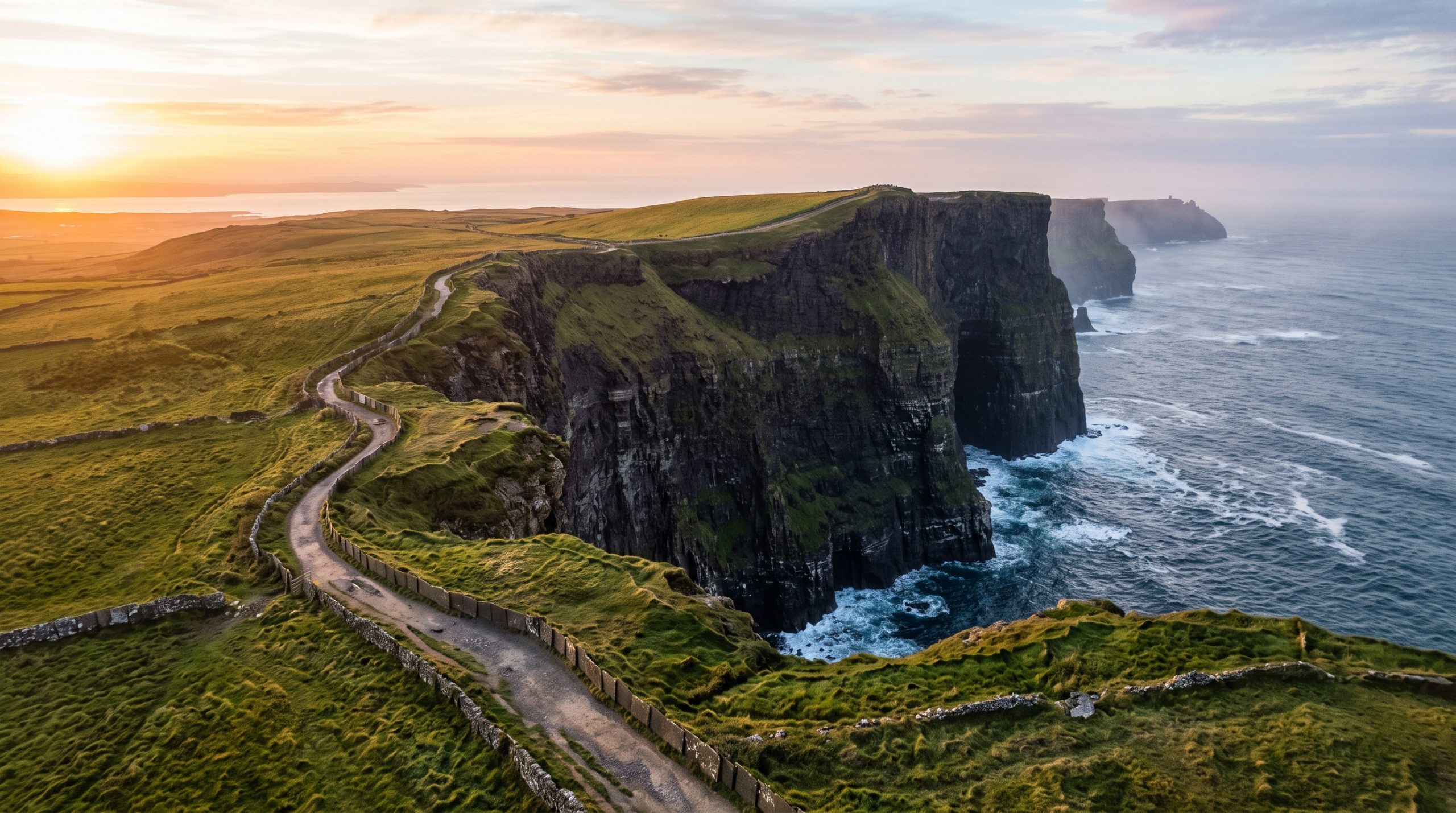
The gate at the Cliffs of Moher opens at eight in the morning. In the middle of October, the sun comes up about ten minutes later. Those two numbers, twenty minutes apart, are the reason a first-light ceremony works cleanly here in one part of the year and needs a different shape in every other part.
The cliff line runs roughly fourteen kilometres from Doolin in the north down to Hag’s Head in the south and reaches 214 metres at its highest point. What has opening hours is the managed part: the car park, the visitor centre, the 800 metres of paved path, the viewing platforms and O’Brien’s Tower, run by Clare County Council as the Cliffs of Moher Experience.
So this is the operational side of a sunrise ceremony on the Clare coast. Which hour the gate turns, which months put the sun in front of it, what the trail map still draws that you cannot currently walk, and what Ireland asks for on paper before anyone says anything binding at half past eight in the morning.
The gate, the sun and the twenty-minute answer
Sunrise access at the Cliffs of Moher is a matter of matching your month to the gate. The Cliffs of Moher Experience opens at 08:00 from March to October and 09:00 from November to February. Only from the middle of October until the clocks go back does sunrise fall after opening, which puts you on the clifftop before the sun.
Sunrise by month, against the hour the gate opens
Sunrise moves a long way through the year here, because west Clare sits far enough west that the clock runs behind the sun. Midsummer sunrise is a little after five. On the first of January it is nearly nine. Opening hours move too, in monthly steps rather than a smooth curve, so the gap between the two swings from twenty minutes to three hours.
| Month | Gate opens | Sunrise, start to end of month | Which comes first |
|---|---|---|---|
| January | 09:00 | 08:50 to 08:20 | Sun, by 10 to 40 minutes |
| February | 09:00 | 08:20 to 07:25 | Sun, by up to 95 minutes |
| March | 08:00 | 07:25 to 06:30, then back to 07:25 when the clocks go forward | Sun |
| April | 08:00 | 07:15 to 06:05 | Sun, by one to two hours |
| May to August | 08:00 | 06:05 down to 05:10 at solstice, back to 06:45 | Sun, by two to three hours |
| September | 08:00 | 06:45 to 07:35 | Sun, and closing the gap |
| October | 08:00 | 07:40 to 08:30, back to 07:30 once the clocks go back | Gate, for about three weeks mid month |
| November | 09:00 | 07:35 to 08:25 | Sun, by 35 to 85 minutes |
| December | 09:00 | 08:25 to 08:50 | Sun, by 10 to 35 minutes |
Two useful things fall out of that table. The first is the October window. From roughly the second week of the month until the clocks go back on the last Sunday, sunrise lands between about 08:00 and 08:30, so an 08:00 ticket has you on the paved path while the sky is still going through its best colours. It is also the one stretch of the year with both ends of the day inside opening hours: mid October sunset is around 18:45, and the site stays open until 19:00.
The second is the turn of the year. In the first ten days of January, sunrise is about 08:50 against a 09:00 gate, so you are ten minutes behind the almanac. At this latitude in winter that costs very little, because the sun climbs slowly and holds a low angle for well over an hour. The site’s own advice is to avoid the peak window of 11:00 to 16:00, and in January you are back down the hill long before it starts. The Experience opens every day except 24, 25 and 26 December.
Book the earliest timed slot online rather than paying at the gate, and book it as soon as your date is fixed. Admission covers the car park, the exhibition and O’Brien’s Tower. Tickets are not refundable, but they can be amended through the link on the booking confirmation, which matters more than it sounds on an Atlantic coast in October.
Where the light lands at dawn, and where it does not
Here is the part most sunrise plans get wrong. The cliffs face the Atlantic, which is to say they face west. At dawn the sun comes up behind you, over Burren farmland, and the rock faces stay in shadow. The tall gold wall of layered stone that sold you on this place is an evening picture. It is not a morning one, and no amount of early rising changes the geometry.
What dawn gives you instead is better for a ceremony. Colour in the sky over open water, wet grass, stone walls holding the light sideways, the Aran Islands flat on the horizon, and a path with nobody else on it. Wind at that hour is usually the day’s quietest. The seabird colonies on Goat Island are loud from the platforms in spring and summer, and the cave the site points out to the south, the one from Harry Potter and the Half-Blood Prince, reads as pure black.
High summer inverts the problem. In June the site closes at 21:00 and the sun does not set until after 22:00, so the last hour of light happens outside the site entirely. In mid October and again in midwinter, sunset falls inside opening hours, which is why couples who want both ends of the day tend to end up in those months. You can see how this coastline actually reads in a finished frame, and how a film built at that hour moves, in the galleries and films we publish.
What the trail map still draws that you cannot walk
Route planners and printed guides still show a continuous coastal path from Doolin to Hag’s Head, thirteen or fourteen kilometres of clifftop walking. That line is the single biggest gap between the map and the ground here, and it is why the old advice about walking in before opening no longer holds.
| Section | What the map shows | Where it stands now |
|---|---|---|
| Liscannor and Hag’s Head to the Experience | 6 km southern trail | Fully closed, no access from either end |
| Doolin to the Experience | 8 km northern trail | Open from Doolin as far as Surfer’s Path only, roughly 500 m, with no route through to the site |
| Inside the Experience | Visitor centre and platforms | About 3.5 km of walking: 1 km north past O’Brien’s Tower on path resurfaced in 2027, and a 1.5 km round trip south to the Southern Viewing Platform |
Clare County Council publishes the current state of each section on the official coastal walk page, and we read it again before we lock a route rather than trusting a map. What it means in practice is simple: your morning starts at the gate on the R478, on foot from the car park, and the whole ceremony plan lives inside those 3.5 kilometres. That is ample ground for a first hour of light.
Notice, solemnisers and the address on the form
Ireland’s paperwork is straightforward, and it is slower than most couples expect. Anyone marrying in Ireland must give a registrar at a Civil Registration Service at least three months’ notice, and that applies to civil, religious and secular marriages alike. You cannot marry until the three months have passed, so the notice, not the flights, is what sets the earliest possible date.
Both of you attend the notification in person, sign a declaration and pay a non-refundable notification fee of 200 euro. In some registration areas the notification can be started online, and a postal form can be requested and returned by post or email. The registrar then issues the Marriage Registration Form, which works like a licence and stays valid for six months from your intended date. Move the date inside that window and the form can be amended. You also need two witnesses aged eighteen or over, and they can be two members of our team if you are travelling alone.
Who marries you matters more than the venue does. State registrars perform civil ceremonies in a registry office or in a venue the registry office has approved, Monday to Friday, and generally only within their own county. A dawn ceremony on a clifftop, on a Saturday, is instead the work of a solemniser nominated by a religious or secular body and listed on the state’s Register of Solemnisers. The place itself has to be open to the public and have an address that can be written on the form, and the Cliffs of Moher Experience has one, Eircode V95 KN9T.
Site permission is a separate track from the marriage paperwork. Filming and photography requests at the cliffs go to the Experience team, and we submit ours in writing well ahead of your date. Permit research and logistics are ours; any government, venue or landowner fee is paid by you directly. If you are working out the order of all this, our planning fundamentals cover the sequence. Our fee does not change with guest count: guests change access, permits, transport and the timeline, not the price.
Aerials over a protected seabird coast
The cliffs are a Special Protection Area, protected under the Wildlife Act and the EU Birds and Habitats Directives, and that protection rules out drone use through the bird nesting season from April to September. Outside that season, flying here needs specific permission from the site rather than a general assumption. Every camera drone flown in Ireland is flown by an operator registered with the Irish Aviation Authority.
So we confirm the season, the permission and the window before we design a single aerial into your film. Drone footage is part of every experience where it is legal, safe and appropriate, and where it is not, the film is built from the ground. On a 214 metre cliff, that is not the compromise it sounds like.
Two vehicles, one gate: how we run the morning
A mid October morning here runs something like this. We leave your base in Doolin, Liscannor or Lahinch in the dark, around 06:45. We are at the entrance off the R478 by 07:35, sitting in the car with the heater on, because the car park opens with the site and not a minute earlier. That twenty minutes of waiting is not romantic, and it is exactly what the morning needs.
Through the gate at 08:00 with the pre-booked slot. Sunrise happens while we walk, and the vows go at about 08:30, deliberately half an hour after opening rather than adjacent to it, so a slow start at the gate takes nothing off the ceremony. O’Brien’s Tower and the northern kilometre from around 09:00, when the light is still low and the path is still yours. Back down and away by 10:15, an hour ahead of the site’s own peak window. Breakfast in Doolin after you are married is one of the better things this itinerary does.
That timeline holds because photography, film and planning come from one team of eight, not two vendors who introduce themselves in the car park. On a morning this compressed, one of us walks ahead to see which side of the headland the wind has taken while the other stays with you, and two sets of gear are on the ground, so nothing hinges on one camera in salt air. On The Expedition a dedicated photographer and filmmaker work the same hour together, with audio for the vows where conditions allow. Team travel to Clare is included, and what a morning like this costs is set out on our pricing page.
We hold a second location inland on the Burren limestone, and a plan for moving that amendable ticket, because west Clare weather does what it likes. If the cliff hour is not going to give you anything, we move it rather than spend it. Tell us the month you are considering and we will tell you where sunrise sits against the gate that week: Send Us a Message. Other destinations are laid out the same way in our destination guides.
Common questions
Can we get onto the Cliffs of Moher before the visitor centre opens?
The car park and the paved clifftop paths open with the Cliffs of Moher Experience, at 08:00 from March to October and 09:00 from November to February. The coastal trail approaches that once let walkers arrive earlier are closed for path works, so the morning starts at the gate.
Which weeks let us stand at the cliff edge before the sun is actually up?
From about the second week of October until the clocks go back at the end of the month. Sunrise then falls between 08:00 and 08:30, behind the 08:00 opening. The first ten days of January are the next best thing, with sunrise near 08:50 and the gate at 09:00.
Do we need permission for a ceremony on the clifftop?
The site is managed by Clare County Council, and filming and photography requests go to the Cliffs of Moher Experience team. We put ours in writing well ahead of your date. Legally, the place has to be open to the public and have an address for the paperwork, which the site does.
How far ahead do we have to give notice to marry in Ireland?
At least three months before your date, to a registrar at a Civil Registration Service, with a non-refundable notification fee of 200 euro. The Marriage Registration Form you receive stays valid for six months from your intended date. We plan backwards from that three month floor, not from your flights.
Can we walk in from Doolin or Hag’s Head for a first-light ceremony?
Not at present. The 6 km southern section from Liscannor and Hag’s Head is fully closed, and the Doolin path runs only about 500 metres to Surfer’s Path with no route through to the site. The walking that is open is the 3.5 km inside the Experience.
Will we get drone footage over the Cliffs of Moher?
Not between April and September, when the nesting season protection for this Special Protection Area rules drones out. Outside that season it depends on specific permission from the site, which we confirm before building any aerial into your film rather than promising it first.
Is sunrise or sunset better for photographs at the Cliffs of Moher?
Evening light hits the cliff faces, morning light does not, because the coast faces west. Dawn buys you an empty path instead. In mid October and midwinter both sunrise and sunset sit inside opening hours, so a single day can hold the vows at first light and a second walk at dusk.
Choosing the month before you choose the date
Most couples arrive here with a date and then try to make the light fit it. Working the other way round is easier, and October is not the only answer, just the tidiest one. Send us the window you have and what you want the morning to feel like, and we will come back in writing with the sunrise times, the gate hours and an honest read on whether that week gives you the ceremony you are picturing. It all happens in writing, with a reply and an initial brochure within a day, then a tailored proposal, a signed contract plus the 30% retainer before planning begins. Our planning calendar is open for 2027, 2028 and 2029: Check Your Date.