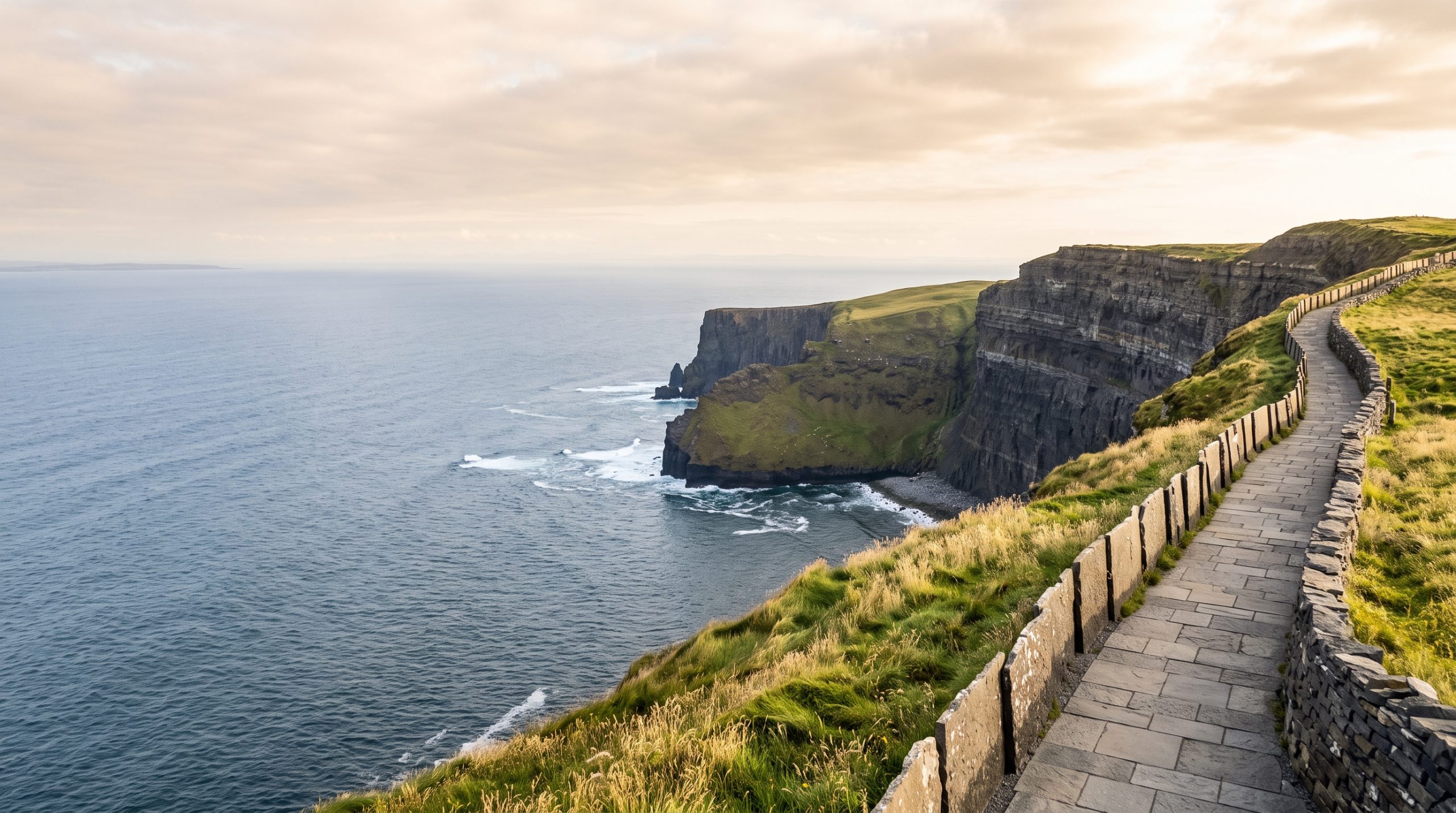
The paved path along the cliff top runs 800 metres, and between 11am and 4pm most of it is busy. We have been up there at eight in the morning with the car park half empty, and again at half past six on a July evening with the coaches gone and the light coming in low off the Atlantic. Both hours are available to you, and the paperwork that makes the vows legally binding is identical either way.
Ireland is one of the few countries in Europe where a marriage can be legally solemnised outdoors, in the open, with the sea behind you. There is no waiting period to sit out on Irish soil and nothing to move here for. What the state asks for instead is three months of notice, one appointment in person, and a single form that gets signed on the cliff top and handed back to a registrar within a month.
That last item is where the planning actually sits. Below is the chain in the order you will need it, the timings counted backwards from your ceremony hour, and the details that decide whether the morning runs to time.
Yes, and the outdoor rule is what makes it work
Yes. A marriage at the Cliffs of Moher can be fully legal, solemnised outdoors by a celebrant on the state register of solemnisers. You give a Civil Registration Service at least three months notice, pay the non-refundable notification fee of 200 euro, attend one appointment in person, and sign the Marriage Registration Form with two witnesses present.
The hard part is not the cliff; it is the legal-location rules
Rate it fiddly. Nothing in the Irish chain is hard to satisfy and nothing in it can be hurried. The element that catches American couples is not a document at all: both of you attend an appointment in person at a Civil Registration Service office before the ceremony, which means the trip starts a few days earlier than you might have planned. The rest is paperwork you can deal with from your own kitchen table.
The rule that decides whether vows on the cliff top count is a rule about the place. A legally binding ceremony can be held outdoors as long as the venue is open to the public and clearly identifiable by an address. A private garden, or a patch of ground nobody can name, will not do. The Cliffs of Moher visitor site clears that bar comfortably, which is why the cliff-top ceremonies you have seen photographed are the real thing rather than a re-enactment held for the camera.
Who stands in front of you matters just as much. A civil ceremony led by a state registrar takes place in a registry office or a venue approved for that purpose, which rules out the cliff top. For an outdoor marriage you engage a solemniser from the state register instead, religious or secular. Secular celebrants, humanist among them, have been registered since 2012, and their ceremonies carry full legal weight. Marriage in Ireland is open to same-sex couples on identical terms, with the same notice period, the same form and the same register.
Then there is the site itself. The Cliffs of Moher Experience, the council-run visitor operation on the cliff top, takes ceremony requests through a wedding enquiry form on its own website, and dates are finite rather than infinite. Capacity is capped at 30 guests. If the people you love are travelling in together, coach groups of ten or more have to be booked with the site at least 72 hours ahead. Our destination elopement guides go further into how the Clare coast sits inside a wider week; what follows is the part with deadlines attached.
Build the Irish legal file before choosing the cliff ceremony
Order matters, because one item here is issued by an office thousands of miles from Clare and everything after it waits on that office. Registrars generally want the original and a colour photocopy of each document, so make the copies at the same time you gather the originals.
- A long-form birth certificate each. A birth certificate issued outside the EU may need an apostille or legalisation before an Irish registrar accepts it as authentic, so this is the first thing to order and the only step that depends on an office you cannot walk into. The apostille is added by the authority in the country that issued the certificate, never in Ireland.
- Passports. Valid, for photo identification, with a colour copy of each.
- Proof of address for both of you. Whatever the registrar names when you make contact, and it is worth asking rather than guessing.
- Papers that close any earlier marriage. A final divorce decree, or the certificates a registrar asks a widow or widower for, originals plus colour copies. If the divorce was granted outside Ireland, ask the Civil Registration Service what it needs before you post anything.
- Confirmation of immigration status. Because neither of you is a citizen of Ireland or an EU member state, the registrar will ask you to confirm your status, and an interview can form part of the appointment. It is held in English or Irish; if you would rather use another language, you provide the interpreter.
- The notification itself. Couples living abroad can ask a Civil Registration Service for a postal marriage notification form, complete it and return it by post or email. It has to be with the registrar at least three months before the date, with the 200 euro notification fee, which does not come back.
- The Marriage Registration Form. Issued to you at the in-person appointment once the registrar is satisfied there is no impediment. It works like a licence, and it carries a window: if the marriage does not take place within six months of the date of marriage given on the form, you need a new one and the whole notification is repeated.
- The signed form, going back. Immediately after the ceremony it is signed by both of you, your two witnesses and the solemniser, then returned to a registrar within one month so the marriage can be registered. Any Civil Registration Service will take it, not only the office that issued it. No certificate exists until the marriage is registered.
Work back from the solemniser and site availability
Two dates govern everything: the day your notification lands with a registrar, and the day you sit down in front of one in person. Here is the legal minimum against the timeline we would actually work to.
| Step | Legal minimum | What we plan to |
|---|---|---|
| Birth certificates and any apostille ordered | No deadline set | Before anything else, up to a year out when an apostille is involved |
| Notification with a Civil Registration Service | Three months before the ceremony date | Six months, so a slow mail run changes nothing |
| In-person appointment, form issued | At least five days before the ceremony | Four or five days ahead, built into the start of the trip |
| Ceremony inside the form’s window | Within six months of the date on the form | Date fixed before notification, so the window never becomes a factor |
| Signed form back to a registrar | Within one month of the ceremony | The following working day, while you are still in the country |
The in-person appointment is the pivot. Couples who post their notification from home still attend a registrar before the wedding, at least five days ahead or earlier if that office asks, sign the declaration there and collect the form. Plan a Saturday ceremony and you are flying in around the Monday or Tuesday, which is no hardship on the Clare coast and gives you two mornings on the cliffs before the one that counts.
The visitor site’s clock then decides the ceremony hour. From May to August it opens at 8am and stays open until 9pm. March, April, September and October run 8am to 7pm. November through February it is 9am to 5pm, and the site closes for 24, 25 and 26 December. Quiet hours sit outside the 11am to 4pm peak, which is the same reason a February ceremony is a lunchtime affair and a June one can wait for the evening.
We will be straight with you about high summer, though: in late June the sun does not drop into the Atlantic here until well after that 9pm close, so the very last light of the day belongs to coastal ground outside the visitor site rather than to the paved path. That is a planning decision, not a disappointment, and it is one we make with you months ahead. Fees and processing windows can move. Treat the figures here as a planning snapshot and reconfirm them with the issuing office before you file.
Six details worth getting right before you book flights
Order the certificates first, the flights second. The apostille is the one step running on somebody else’s clock. Everything else in the chain moves at the speed you move.
Both of you attend the appointment, and it is not a formality. The registrar issues the Marriage Registration Form at that appointment and not before, which is why we build the arrival day around it rather than around the ceremony.
The form has a six-month life. Move the wedding outside that window and you begin the notification again, fee included. Fix the date early and the problem never arises.
Notification can be given at any registration office in the country. It does not have to be the district you are marrying in, which is genuinely useful when your route runs through Dublin or Shannon before it reaches Clare. Confirm which office you are attending before you book where you sleep.
Closing time sets your ceremony hour, not sunset. A November ceremony on the cliff top happens inside a 9am to 5pm day. Nobody enjoys discovering that in October.
Do not fly home with the signed form in your case. It goes back to a registrar within a month, and the simplest version is a stop at a Civil Registration Service on your way out of the country. Ask your solemniser how they usually handle it, because many will do it for you.
Send us the month you are thinking about and the shape of day you want, and we will tell you what the light does at that hour, which offices sit on your route, and where the sheltered ground is if the wind arrives. Check Your Date and we will come back in writing within a day.
Marrying at home and keeping the cliff-top ceremony
A lot of the couples we work with in Clare complete the legal marriage at home and hold the ceremony here. This is not a lesser version of the day and we would never present it that way. It is the version that suits couples who want the vows written by hand, read by a friend or a parent, with no register to sign and no office to attend on the Tuesday.
What changes is short: no notification, no three-month clock, no 200 euro fee, no appointment, no Marriage Registration Form, and no requirement that whoever leads the words is on the state register. That last one opens up the ceremony itself, because the person speaking can be anyone you trust.
What does not change is longer. You still book the site and you still live inside the 30-guest cap. The hour still gets chosen for the light and the crowds. The coverage, the timeline and the delivery are identical, and so is the way the film sounds when the vows are the ones you wrote rather than the ones the state requires. Our notes on how to plan an elopement assume nothing about which route you take.
What we handle and what stays in your name
We plan the day around the constraints above. That means holding your date against the site’s availability, coordinating the ceremony hour with the light rather than with whatever slot is left, researching the permissions the location needs, and carrying a sheltered alternative inland for the morning the wind decides to run the show. Photography, film and planning come from one team of eight, so there is a second camera on the ground and a colleague in reserve. One full day with a dedicated photographer, the same day with a photographer and filmmaker working together, or several days across more than one location: what each shape includes is set out on our coverage and pricing page.
Two witnesses have to be present and both have to sign the form the moment the ceremony ends. If you are marrying with nobody else there, raise that with your solemniser early. It is also where having two of us on the ground earns its keep: a photographer and a filmmaker means two adults standing with you rather than one, whether or not either of us ends up signing, and it means one pair of eyes can stay on the light and the clock while the other stays on you.
Delivery is fixed and it does not drift. Highlights land five days after the ceremony, the full gallery or film three weeks after. If you want to see how this coast actually reads on film before you commit to a plan, our published stories, galleries and films are the honest version, cloud and all.
What stays with you is the paperwork itself and the fees attached to it. Government, venue and landowner permit fees, the celebrant, accommodation, and any unusual transport are yours; the research and the logistics behind them are ours. This guide is practical planning help, not legal advice. Confirm the final requirements with the registry office or your consulate before booking travel.
Common questions
Can you legally get married at the Cliffs of Moher, or is it only symbolic?
Both are possible. A ceremony led by a solemniser on the state register, in a place open to the public and identifiable by an address, is a legally binding marriage in Ireland. A ceremony led by a friend or family member is not, and plenty of couples choose that on purpose after marrying at home.
How far in advance do we have to give notice to marry in Ireland?
At least three months before the ceremony date, to a registrar at a Civil Registration Service. The fee is 200 euro and it is not refundable. We work to six months, because ordering certificates from another country is the slowest part of the chain and the one nobody controls.
Do we have to live in Ireland before we can marry there?
No. Ireland does not ask you to move here or wait out a residency period. It asks for the three months notice, an appointment in person before the date, and the documents the registrar names when you first make contact.
Does our US birth certificate need an apostille?
Possibly. A birth certificate issued outside the EU may need an apostille or legalisation before an Irish registrar will accept it, and the office that issued the certificate is the one that adds it. Ask your registrar what they want, then order both at once.
Do we need witnesses if we are eloping with nobody else there?
Yes. Two witnesses have to be present, and they sign the Marriage Registration Form immediately after the ceremony along with you and your solemniser. Bring it up with your solemniser when you book them, because they will have a usual way of handling it.
Can a registrar marry us outdoors on the cliff top?
No. A registrar’s civil ceremony takes place in a registry office or a venue approved for the purpose. Outdoors on the cliff top, the ceremony is led by a solemniser from the state register, which is the route almost every couple marrying at the Cliffs of Moher takes.
Will our Irish marriage be recognised when we get home?
Once the signed form reaches a registrar and the marriage is registered, you can order a state marriage certificate, and that certificate is the record you will be asked for. If an agency at home wants it authenticated, that is an apostille, and in Ireland apostilles are issued by the Department of Foreign Affairs.
What happens if the weather closes in on the ceremony morning?
We plan for it from the beginning. The ceremony hour moves inside the day, the coastal ground is chosen against the wind direction, and there is inland ground in the Burren held in reserve where the weather is not the loudest thing in the frame. Nothing about the legal side is affected by any of it.
Choosing your hour above the Atlantic
The Clare coast is generous to couples who plan the hour rather than the day. Get the notification in early, pick the light you actually want, and the legal part becomes a twenty-minute exchange on a cliff top with the Aran Islands sitting out on the water behind you. We are booking 2027, 2028 and 2029, we work entirely in writing from the first message to the last delivery, and we reply inside a day. Tell Us Your Story and tell us which month you are picturing.