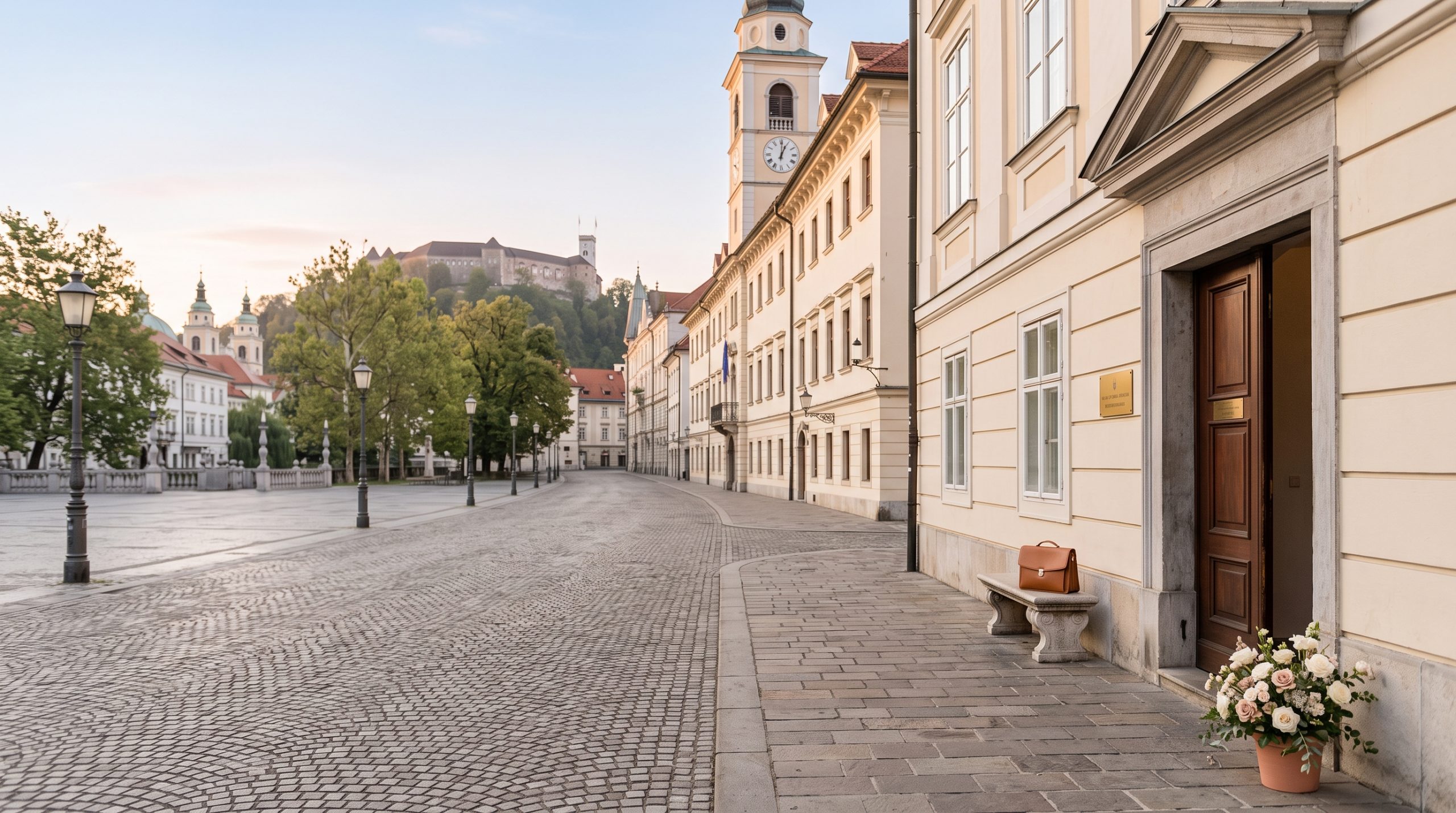
Bled Island has ninety-nine steps from the boat landing to the church door, and the local tradition is that the groom carries the bride up all of them. What nobody puts on the postcard is that the file making the marriage legal is not held on the island at all. It sits with Upravna enota Radovljica, the administrative unit fifteen minutes down the valley, and that office decides where you may stand, at what hour, and on what terms.
Slovenia is genuinely open to foreign couples. Two Americans with no connection to the country can marry here, and the requirement list is shorter than most of Europe. The work is in the sequence: certified records from your home state, an apostille on each one, a sworn translation into Slovenian, and a file lodged in person with the right administrative unit. Three to six weeks of paperwork, most of it happening at your kitchen table.
Below is the full chain, in the order you actually have to move through it, plus the handful of places where it snags. We plan Slovenian days around this office calendar all year, so the sequencing here comes from doing it rather than from reading about it.
What Slovenia asks of two foreign nationals
Two foreign nationals can marry in Slovenia without living there first. Each of you supplies a birth record and proof that nothing prevents the marriage, apostilled at home and translated into Slovenian. The file is lodged with the administrative unit covering your ceremony location, and that office sets the date, the place and any costs. Allow six weeks for documents.
The paperwork is manageable; the lead time is the real issue
Slovenia sits in the comfortable middle. There is no residency test, no waiting period you have to spend inside the country, no faith requirement. What there is, is a chain of four or five documents that each have to be produced in the right order by the right office, and a calendar that belongs to the state rather than to you.
The genuinely fiddly part sits on the American end, not the Slovenian one. Slovenia asks for confirmation from the country of your nationality that there is no impediment to your marrying abroad, and the United States does not operate a central register that issues such a thing. That one document causes more delay than the rest of the file combined, and it is the first item to raise with the administrative unit that will hold your papers.
Same-sex couples marry under exactly the same provisions. Slovenia legalised same-sex marriage in 2022, and the document list, the office and the procedure are identical.
We are photographers and filmmakers, not lawyers. Rules change and individual circumstances differ, so confirm the detail with the administrative unit that will hold your file, or with your own consulate, before you book flights.
Every document, in the order you have to get it
Order matters here, because one of these has a shelf life and one of them cannot be started until the others exist. Work down the list rather than in parallel.
- Certified copies of both birth records. From the vital records office of the state that issued them, not a photocopy and not the decorative certificate the hospital handed your parents. Order two copies of each while you are there; a spare has saved more than one timeline.
- An apostille on each birth record. This comes from the Secretary of State of the state that issued the certificate. A county clerk’s certification is a different stamp and it will not stand in for an apostille. Because the United States is party to the Hague Convention on the abolition of legalisation, the apostille is sufficient on its own and no consular legalisation step follows it.
- Proof that there is no impediment to the marriage. Slovenia wants confirmation from your own country that you are free to marry abroad. With no federal register behind it, this document is assembled rather than ordered: a sworn affidavit of eligibility to marry, notarised and then apostilled by the state where you signed it. Ask the administrative unit for the exact form it accepts before you pay for anything, and produce this one last, because it is the item with a validity window on it.
- Documentation ending any earlier marriage. A final divorce decree, apostilled and translated on the same terms as everything else. If a name changed along the way, carry the document that shows the change so the names on the file agree with the names in the passports.
- Sworn translation into Slovenian. Everything above goes to a court-appointed interpreter, a sodni tolmac on the Ministry of Justice register. A translation certified by a service at home does not substitute for one. Have the interpreter translate the apostille as well as the page underneath it.
- Passports, in person. The file is lodged at the administrative unit and the date is agreed at the same visit. Bring originals of everything, and if you need a particular document back afterwards, say so as you hand it over rather than a month later.
Two of those steps run on other people’s clocks: the state vital records office and the Secretary of State. Neither is a place where charm speeds things up, which is why we treat the mailing dates as fixed points in the plan and build everything else around them.
Turn the ceremony date into a three-to-six-week file
Here is the arithmetic without optimism. The real minimum assumes every document arrives correct the first time and nobody is away. The right-hand column is what we actually build a Slovenian date around, because a document that arrives a week late does not cost you a week, it costs you the next slot the office has.
| Step | Real minimum | What we plan to |
|---|---|---|
| Certified birth records ordered | Under a week online | Three weeks |
| Apostille from the issuing state | A few days in person | Three weeks |
| Affidavit of eligibility notarised, then apostilled | One week | Two weeks |
| Courier to Slovenia | Three days | One week |
| Sworn translation into Slovenian | Two working days | One week |
| File lodged and date agreed with the administrative unit | One appointment | Months ahead of the date |
Three weeks is achievable if the steps overlap cleanly. Six weeks is comfortable. We plan to six and hold the date itself considerably further out, because the administrative unit’s calendar is the one part of this nobody can accelerate.
Why the upravna enota, not your venue, sets the hour
Slovenian marriages are conducted by administrative units, and the law puts the geography in their hands. Each unit lays down its own official premises and marries couples there at least one day a week during official hours, with its own official times set aside on Saturdays. That is the default route, and it is the uncomplicated one.
Anything outside those rooms or those hours is a decision the unit makes rather than a booking you place. Units can allow a marriage away from official premises or outside official time, and when they do, they issue a decision that charges the costs of going out to the couple. Bled Island is available on that basis, and so is a meadow above Lake Bohinj, but the availability runs through the administrative unit rather than through the venue, and the amount is set locally.
The practical consequence is a light problem. An official Saturday slot might land at eleven in the morning, which on Lake Bled in July is the hour the coaches unload and the water goes flat and white. Because a photographer and a filmmaker work as one team on our Expedition days, that legal half-hour gets covered from two angles without anyone being asked to repeat a vow for the camera, and the real light, the hour after the last pletna boats stop crossing, stays free for the frames you will hang on a wall. You can see how that split plays across a full day in our published stories and films.
One more thing belongs to the office rather than to you: the language. The ceremony is conducted in Slovenian, and where a spouse does not understand Slovenian a court interpreter forms part of the arrangement, drawn from the same Ministry of Justice register as the translators. Raise it at the same visit where you lodge the file, because the interpreter has to be available on your date as well, and that is a second calendar quietly attaching itself to your morning.
Where the chain snags
None of these are dramatic. All of them move dates.
- The eligibility affidavit produced too early. It is the one document with a window on it, and a couple who assembles the whole file eight months out will find that this page has aged out while the birth certificates have not. Produce it last, once the ceremony date is fixed.
- A county stamp mistaken for an apostille. County clerks certify plenty of things. The apostille is a specific instrument issued at state level, and swapping one for the other means starting that document again from the beginning.
- Translations arranged at home. A certified English-to-Slovenian translation bought online is not the same thing as a translation by a court-appointed interpreter on the Ministry of Justice register. Arrange the translation after the documents land in Slovenia, not before they leave.
- Assuming the venue can hold the registrar. A hotel, a castle terrace or an estate can hold the room and the catering. Only the administrative unit can hold the marriage, and those two calendars are separate until you make them agree.
- Treating the Saturday as open. Administrative units set specific official times on Saturdays. It is a slot inside a day, not the whole day, and it is the reason we ask for the office confirmation before we build the timeline rather than after.
Witnesses are simpler than people expect. Slovenian law asks that a witness has legal capacity, which in practice means an adult who can sign for themselves, and it does not ask about nationality or how long they have known you. Bring their passports to the appointment along with your own.
Requirements and costs described here were correct at the time of writing and are worth re-checking with the office that issues them.
Married at home, ceremony on Bled Island
A good share of the couples we work with in Slovenia sign the legal paperwork at a courthouse at home, quietly, weeks before they fly. This is not a downgrade and we would say so if it were. It removes the apostille chain, the sworn translations and the administrative unit’s calendar in one move, and it hands the hour of the ceremony back to you.
What changes: a celebrant or a friend leads the words instead of a maticar, and nothing anyone says has to follow a prescribed formula. What does not change: everything else. The pletna crossing before the first tour boat, the ninety-nine steps, the bell inside the church that couples ring three times, the fifty hairpins of the Vrsic Pass on the drive out to the Soca valley afterwards. That pass opens later in spring than most planners assume, so an April date gets built low, around Bohinj and the Radovna valley, and it loses nothing by it.
Where we would push back is on Bled itself in high summer at the middle of the day. The lake is beautiful and it is also the busiest square kilometre in the country between ten and four in July, and the classic viewpoint above the island is a queue for a railing. That is a scheduling fact, not a reason to go elsewhere. Move the same locations to the first hour after sunrise, or into the last half hour of light, and you get the identical view with nobody in it. Inside Triglav National Park the same discipline applies for a different reason: access and permissions are tighter, ticketed sites like Vintgar Gorge run to a season and a timetable, and knowing which of those we can shoot inside and which we work around is most of what location design means here.
Legal route or ceremony route, the planning underneath is identical: destination and location design, a timeline built around light and honest travel times, permit research and logistics, and a weather alternative held within a short drive of every position. Our guide to how an elopement day is put together covers the shape of it, and the destination guides work through it region by region.
What a day with us costs, and what sits inside it, is set out on the pricing page, with team travel to Slovenia already inside the number.
Tell us the month you are looking at and whether you want the marriage itself in Slovenia or only the ceremony, and we will come back with what that means for the office calendar and for the light. Send Us a Message.
Common questions
Can we get married in Slovenia if neither of us lives there?
Yes. Slovenia does not ask foreign couples to establish residence first. Both of you supply a birth record and proof that there is no impediment to the marriage, apostilled and translated into Slovenian, then lodge the file in person with the administrative unit covering the place you want to marry.
Do our US documents need an apostille or a consular stamp?
An apostille. The United States is party to the Hague Convention, so the apostille is sufficient on its own and no further consular legalisation follows. It comes from the Secretary of State of the state that issued the record, not from a county office and not from a federal one.
Who is allowed to translate our documents into Slovenian?
A court-appointed sworn interpreter, a sodni tolmac, on the Ministry of Justice register. A translation certified by an agency at home will generally be sent back. Have the interpreter translate the apostille itself as well as the document sitting underneath it, and arrange the work once the papers are in Slovenia.
Can the ceremony happen on Bled Island, or only at the administrative unit?
Both are possible, on different terms. Administrative units marry couples at their own official premises on set days and at set Saturday times. Anywhere else, whether that is the island or a meadow above Bohinj, is a decision the unit issues, and it charges the costs of going out to the couple.
How many witnesses do we need and who can they be?
Two. Slovenian law asks only that a witness has legal capacity, meaning an adult able to sign for themselves. There is no nationality requirement and no rule about how well they know you. Bring their passports to the appointment where you lodge the file.
Is same-sex marriage legal in Slovenia?
Yes. Slovenia legalised same-sex marriage in 2022. Same-sex couples marry through the same administrative units, with the same documents, the same apostille and translation route, and the same rules about official premises and official hours.
Is it simpler to marry at home and hold the ceremony in Slovenia?
For many couples, yes. Signing at home before you fly removes the apostille chain, the sworn translations and the office calendar in a single step. The day in Slovenia then looks the same, runs on your hour instead of the registrar’s, and the words belong entirely to you.
What we carry, and what stays in your name
We hold dates against the administrative unit’s availability, build the timeline backwards from the light rather than forwards from breakfast, research the permits and landowner permissions your locations need, and keep a weather alternative within a short drive of every position on the map. We do not file your paperwork, sign anything on your behalf or give legal advice, and you would not want us to.
We keep every planning decision in writing so the process works across time zones. You send the form, a reply and an initial brochure come back within 24 hours, then a tailored proposal, then a signed contract and a 30% retainer, and planning begins. Highlights reach you in 5 days and the full gallery or film in 3 weeks. Our Slovenia dates are currently open across the 2027–2029 seasons.
Send us the date you have in mind, or the two you are weighing, along with the valley you keep coming back to, and we will tell you plainly what the office calendar allows and which month gives you the mountain you are picturing. Check Your Date.