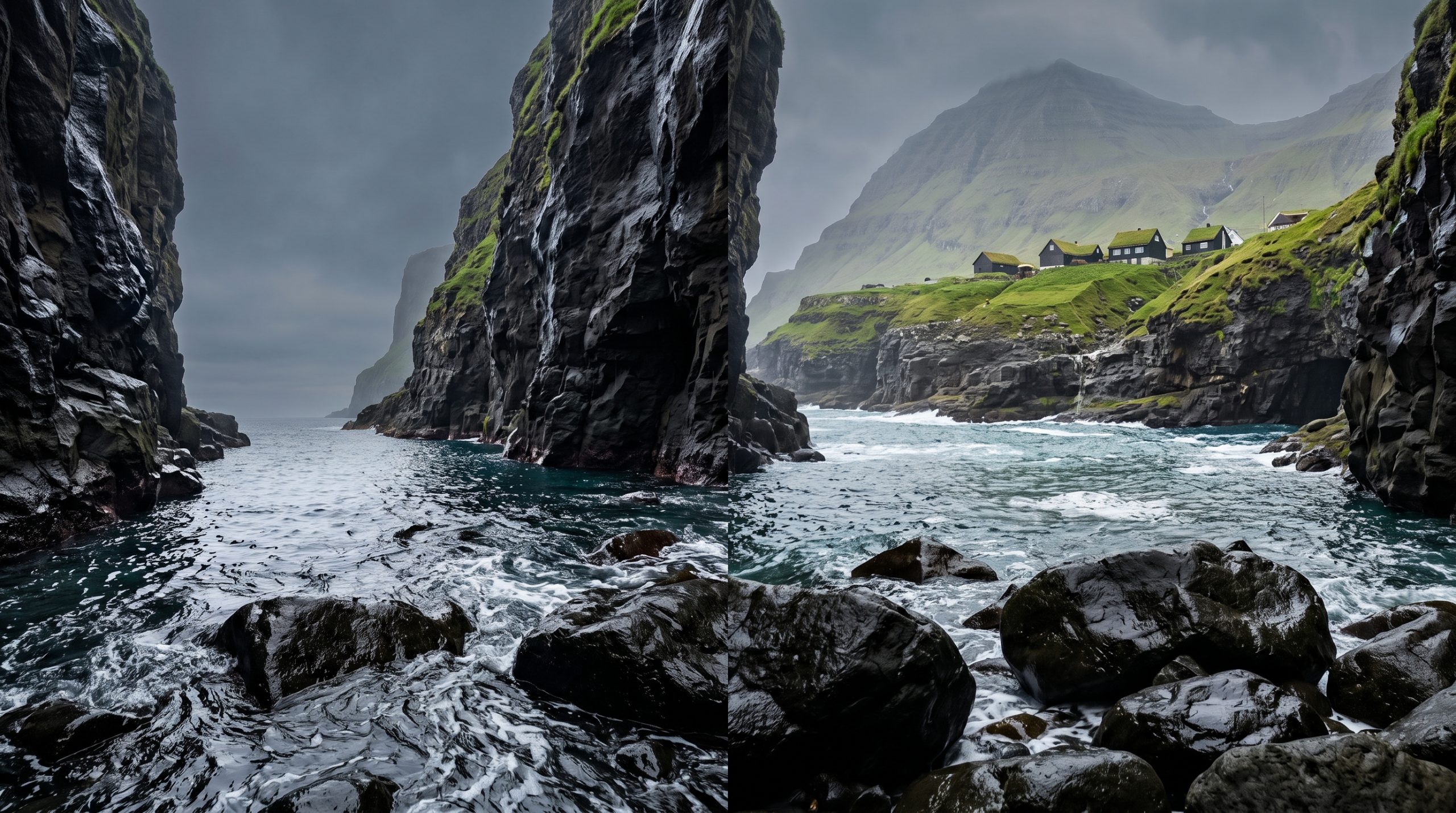
The stone steps into the gorge at Gjógv have a rail running down them that has nothing to do with walking. It is a track. Boats were hauled up it into the village when the sea got too big to leave them floating in the cut, and the rail is still there, bolted to the rock beside your feet on the way down.
That cut is the whole reason to bring a ceremony here. Two hundred metres of it, walls on both sides, opening north at the open Atlantic with the west wall of Kalsoy across the water. The village wrapped around it holds fewer than 50 people in timber-walled houses under turf roofs, and it is the last settlement on the north end of Eysturoy. The road arrives, and then it stops.
You can drive up from Tórshavn in about an hour and be standing at the head of the gorge five minutes after you park, on tarmac the whole way. What takes actual planning is the rest of it: which weeks of the year the sun reaches the water at the bottom, how loud that water is when there is north swell running, and the four weeks of notice the paperwork wants before anybody says a vow.
The gorge, the steps and the tarred path
Gjógv is a village of fewer than 50 residents at the northern tip of Eysturoy, roughly an hour by road from Tórshavn. Its harbour is a 200-metre gorge cut into the cliff, reached by a stone staircase and a tarred path along the rim. Vows happen at the gorge. The legal notice goes through Tórshavn, at least four weeks ahead.
Over Gjáarskarð, and the road that ends at the village
The drive north is straightforward until the last part. You climb toward the pass at Gjáarskarð, under the shoulder of Slættaratindur, which at 880 metres is the highest mountain in the Faroes, and then the road tips over the top and drops toward the sea. That final descent is narrow. It is a proper road and it is fine to drive, but it is not a road for hurrying, and it is not a road you want to be reversing along in a hire car at the exact moment your timeline says you should be at the gorge. We build twenty spare minutes into the drive as a matter of course.
Park at the designated area on the edge of the village and walk in. The lanes belong to the people who live here, and there are few enough of them that a strange car parked outside a kitchen window is noticed. From the parking to the head of the gorge is a short, flat walk, and then the tarred path runs out along the rim to the point where the walls open to the sea.
In wedding clothes, this is one of the kindest locations in the Faroes. A long dress survives the tarred path without a hem full of mud, which is not true of Saksun or the walk in at Trælanípa. The stone staircase down into the cut is the one place that asks something of you: the treads are uneven, they stay damp at the bottom where the spray reaches, and a full skirt needs one hand free and someone else carrying the back of it. Boots to the top of the steps, then change, is the pattern that works. Heels are pointless below the rim and perfectly fine above it.
Why the sun only reaches the bottom in high summer
This is the part almost every page about Gjógv skips, and it decides your ceremony hour. The gorge runs north from the village to the sea, so its long axis points at the only stretch of horizon the sun visits at the very top of the year. Gjógv sits above 62 degrees north. Around midsummer the sun rises well round to the northeast and sets well round to the northwest, and for those few weeks the low evening light swings into the seaward mouth of the cut and runs the length of it, down the walls and onto the water. The nights in that window never go properly dark either, so the useful hours stretch far past the point where most timelines have run out.
The rest of the year the sun tracks across the south, low, and the village is ringed by mountains on that side. The gorge holds its own shade. That is not a problem, it is simply a different location: in April, September and October the light lives up on the rim, on the turf roofs and on the sea beyond the walls, and the bottom of the steps becomes the cool, dark, sheltered place you go for something quieter. We plan those months around the rim and the village, and we plan late June and July around the water.
Grey is the normal weather, and the honest thing to say is that grey suits this place better than blue. Wet black basalt against white water in full sun is a brutal contrast to hold in one frame. Under cloud, the walls go soft and green at the top and the whole cut reads as one thing. You can see how both versions look in our published galleries and films, which is the fastest way to know whether the way we see a place like this matches the way you do.
Standing at the bottom: room, wind and the sound of the swell
The floor of the gorge is not a stage. It is a narrow landing at the end of a staircase with rock rising on both sides, and two people carrying cameras cannot stand side by side down there without appearing in each other’s work. So they do not. One of us works close, on the steps and the landing, and the other stays high on the rim with the long lens and the wide frame, and we trade positions on a signal rather than at fixed times. Because photography and film come from the same team here, that choreography is settled weeks before the day instead of being negotiated on the morning by two strangers who have never worked the same ground.
Sound is the other thing the walls do. Swell arrives in the cut and the noise stacks up between the rock faces, which is glorious to stand in and unhelpful for vows. We put the exchange at the head of the gorge or on the sheltered turn of the lane, where a lapel mic can actually hear you, and take the water for everything that does not depend on words. Our team travel is inside the price in every destination, so the assigned photographer and filmmaker arrive the day before and walk the ground while there is still time to change the plan. A full day with one dedicated photographer or one dedicated filmmaker starts at $4,900, a day with both working together starts at $7,900, and the full detail of what each covers sits on one page.
What needs paying for here, and what does not
Two different permissions get muddled on most pages about the Faroes, so here they are separately.
Access first. The village lanes, the stone steps and the tarred path along the gorge have no ticket office and no booking system. Nobody sells you the gorge. Faroese outfield above the villages is privately owned, though, and the path that climbs from Gjógv up onto the mountain crosses it, so a fee is collected at the gate for that walk. It is small, currently 50 kroner a head, and it goes into a box or by transfer rather than to anyone standing there. Paying it is not optional and it is the clearest signal you can send in a village of this size that you understand where you are.
Then the marriage itself. Civil ceremonies are conducted by the municipality in Tórshavn, and the notice has to reach them no later than four weeks before the date you want. Two details catch couples out. The enquiry must come from the two of you rather than from a planner or a photographer writing on your behalf, and the marital status certificate they ask for is only valid for four months, which means the paperwork has a window rather than a deadline. Weeks 34 to 36 are busy enough that six weeks of notice is asked for instead of four. Two witnesses sign the register, and if you are travelling as two, the municipality can arrange staff to witness at the town hall.
Plenty of couples handle the legal side at home before they fly and treat Gjógv purely as the ceremony, which is a perfectly good answer and takes the clock out of the day. Either route works, and both are covered in our planning fundamentals. Permit research and the correspondence around it are part of what we do; the government and landowner fees themselves are yours to pay.
What we change when the sea comes up
The cut faces north, which is the direction the biggest swell arrives from. When it is running, the bottom of the steps is wet and extremely loud, and that is the day we take the ceremony to the head of the gorge, or into the shelter of the lanes where the turf roofs sit low against the hill. The two spots sit one flight of steps and a two-minute walk apart, which is why swell here moves the ceremony rather than the date.
Cloud sits on Gjáarskarð more often than it sits on the village, so we drive up earlier than the timeline strictly needs and use the spare time in the village rather than on the pass. If the whole north coast is socked in, Funningur at the head of the fjord below the pass and Elduvík on the east side are both close enough to reach and still finish before the light goes.
The other direction to expand into is upward. The clifftop path out toward Ambadalur is around 7 kilometres in a loop and takes most people two to three hours, and it ends at a view of Búgvin, the largest sea stack in the Faroes, with puffins working the cliffs from roughly May into August. That walk is not a dress walk. We carry the clothes, you walk in boots and a shell, and you change behind the rise where the wind drops. Couples who want that as well as the gorge need a longer shape than one day, which is what the Odyssey exists for, and it is worth saying so in your first message. More destination detail lives in our destination guides.
The couple this village fits
Gjógv suits people who want a ceremony inside something rather than in front of something. There is no panorama here to stand against; the gorge closes over you and the horizon is a slot of grey sea at the end of it. If what you actually want is the wide open Faroese view with a waterfall in it, say so and we will build the day somewhere that gives you that instead. And if you want the gorge in the one window when sun reaches the water, tell us and we will tell you honestly which weeks to aim your dates at.
Common questions
Can we be legally married in the gorge itself, or only in Tórshavn?
The civil ceremony is conducted by the municipality in Tórshavn, so plan on the legal formality happening there or at home before you travel. The vows, the readings and the part you will remember all happen at Gjógv, and that needs no permit.
Do we have to pay the 50 kroner fee if we only go down into the gorge?
That fee covers the path climbing from the village up onto the privately owned outfield. The lanes, the stone steps and the tarred path along the gorge do not carry a charge. If your timeline includes the higher ground, budget it per person and bring cash.
Is there anywhere in Gjógv to change out of hiking boots?
There is a guesthouse and a small café in the village, and if you are staying the night the room solves it. Otherwise the honest answer is the back of the car at the parking area, which is where most changes happen, five minutes from the head of the gorge.
How early do we need to arrive to have the gorge to ourselves?
Gjógv does not get the volume that the famous roadside stops on Vágar get, and visitors thin out sharply either side of the middle of the day. Early morning is quiet. Late evening in June and July is quieter still, and it is also when the light is doing something, so that is where we aim.
Will you fly the drone over the gorge?
We include aerial footage where it is legal, safe and appropriate, and we confirm the local position before the film is built around it. In a village of fewer than 50 people we also fly sparingly, at the seaward end rather than over the roofs.
Holding a date at the north end of Eysturoy
Our current Faroe Islands availability runs across 2027–2029, and a date at Gjógv is worth pinning early if you want the summer weeks when light reaches the water. Tell us the window you are thinking about and roughly what you want the hour to feel like, and we will come back with a timeline built around the light and the swell. We handle the planning in writing, at whatever pace works for you, at whatever pace suits you: your enquiry gets a reply and our brochure within 24 hours, a tailored proposal follows, and planning begins once the contract is signed and the 30 percent retainer is paid. Highlights reach you 5 days after the day itself, the full gallery or film within 3 weeks. Tell Us Your Story.