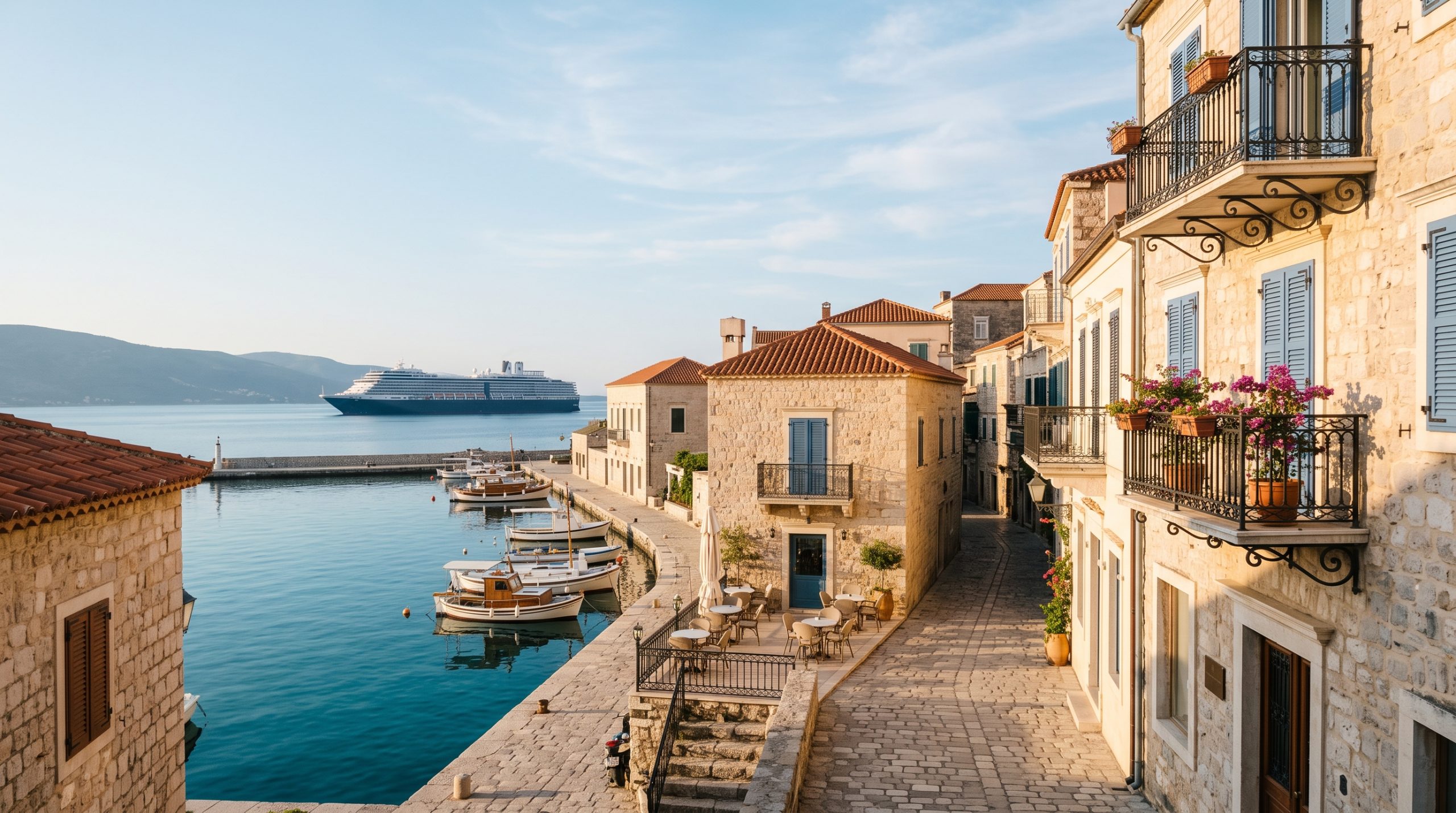
Fira at seven in the morning belongs to the bakery vans and one man hosing down the steps. By half past ten the same lane above the caldera moves at the speed of a queue, because the ships at anchor have been running tenders since eight. Nothing about the place changed in three hours. The calendar did.
Cruise schedules are public. They are published by the harbor that has to find a berth for each ship, they go up long before most couples settle on a date, and they are the single most useful planning document nobody reads. Learn to read one and you can trade a Thursday for a Tuesday, or one hour for another, and stand in a famous place with it more or less to yourselves.
This is how we read them when we are building a day, which numbers actually govern the crowd, and where the printed schedule and the real street disagree.
The four numbers that decide a quiet date
Read four numbers on the port authority’s own calendar: how many ships, their combined berth capacity, the arrival and departure hours, and whether they dock or tender. Berth capacity beats ship count. Then plan the ceremony for the hours before the first gangway drops or after the last one lifts.
Port authorities publish it, aggregators only copy it
Every cruise port of any size has an authority that allocates berths, and that authority publishes what it has allocated. The Dubrovnik Port Authority is unusually open about it: its measures hold the number of cruise passengers to roughly 8,000 a day in most cases, and out of 243 cruise days in the year only 18 are expected to exceed that figure. The same page notes that around forty call requests were refused in a single season. That is a governing body telling you, in advance, which days are the heavy ones.
Alaska works the same way. Juneau’s first ship of the 2028 season was slated to dock on April 27, and that date was public long before the summer. The aggregator sites that mirror these schedules are fine for a first look, and they are usually where you will land from a search, but the harbor’s own listing is the one that gets corrected when a call is canceled or a berth is reassigned.
What you want off the page is not the ship’s name. It is the arrival and departure times, whether the vessel is alongside or at anchor, and the lower-berth capacity, which is the honest headcount before you add crew and the passengers sleeping two to a sofa bed.
Berth capacity, not ship count: the same 8,000 in two different ports
Santorini runs a hard daily ceiling of 8,000 cruise passengers. It came in for 2027 and tightened for 2028: where the port previously assumed each ship would arrive around 80 percent full, it now counts every vessel at 100 percent of its berths. One 3,000-berth ship therefore books 3,000 of the day’s 8,000 places whether or not those cabins sell. For you, that math cuts both ways. A single-call day is genuinely light. Three mid-size ships can fill the ceiling and still look modest on a calendar that only lists three lines of text.
Juneau publishes a different shape of rule, and it is the most useful weekday fact in Alaska. A five-ship daily limit is already in force, and from 2028 the town works to a daily cap of 16,000 cruise passengers, with 12,000 on Saturdays. Saturday is the lightest day of the week by regulation, not by luck, with 4,000 fewer berths permitted in town than on a Tuesday.
Bar Harbor sits at the other end of the scale. Voters there set a limit of 1,000 cruise passengers coming ashore per day in 2022, and it has held since. That is smaller than the manifest of one mid-size ship, in the town that most people use as their way into Acadia. The cap does the crowd management for you, which frees the date to be chosen on light and weather instead.
Greece added a passenger levy on top of the caps, up to 20 euros a head in high season for Santorini and Mykonos and 5 euros at ports such as Corfu, Rhodes and the Cretan harbors. Your wedding does not pay it. What it does is nudge itineraries around inside the season, which is one more reason to check the calendar for your specific week rather than trusting last year’s pattern.
Where the calendar lies
A cruise calendar is accurate about ships and misleading about people. The gap is where the planning happens.
An arrival time for a docked ship is close to the truth. An arrival time for a ship at anchor is a starting gun. Tenders shuttle for well over an hour, sometimes two, so the number of people ashore climbs steadily through the morning rather than arriving in one block. We treat any anchorage call as a window, not a time, and we never schedule vows inside it.
The departure hour lies in your favor. Passengers have to be back aboard before the ship sails, and the last tender or the last shuttle bus runs earlier than the printed sailing time, so a small town starts emptying while the calendar still says the ship is there. A viewpoint listed as busy until six in the evening is often clear by five, which is exactly when the light in most of these places starts to be worth using.
Then there is the distance between the gangway and the headline view. Coaches load, then drive, so the famous overlook fills up well after the ship’s arrival time. Both numbers are real. Plan on the arrival time, because the day a road is clear is the day the coaches arrive early, and use the buffer as a bonus rather than a budget.
Two more things the page will not tell you. Calls get canceled and added, especially in shoulder season when weather reroutes an itinerary, so a schedule read in January is a strong indication rather than a promise. And the caps quoted above are ceilings, not forecasts: Dubrovnik’s 18 heavy days out of 243 is the whole point of looking at the actual list instead of the maximum.
Five ports, five different quiet days
The rule that governs the crowd is different in every harbor, so the tactic changes with it.
| Port | The rule that shapes the day | How it changes the date we pick |
|---|---|---|
| Santorini | Daily ceiling of 8,000 cruise passengers, counted at full berth capacity from 2028 | Hunt for single-call days, then put the caldera hour at sunrise regardless |
| Juneau | Five ships a day maximum, 16,000 passengers Sunday to Friday, 12,000 on Saturdays | Saturday first, then any day the published list shows fewer than five hulls |
| Bar Harbor | 1,000 cruise passengers ashore per day, set by referendum in 2022 | Pick the date on Acadia weather and tide, not on ships |
| Dubrovnik | Most days held near 8,000 passengers, with only 18 of 243 cruise days above it | Find which 18, avoid them, and work the Old Town before the walls open at 8am |
| Geirangerfjord and Nærøyfjord | Zero-emission requirements for the World Heritage fjords phasing in from 2028, largest ships to 2032 | Plan as though ships still call, and choose the hour rather than the year |
How we build the day once we know your ships
Before we fix a single hour, we pull the port calendar for the whole week around your date. Then the timeline is built so that nothing that matters sits next to a gangway. Vows go at first light or in the last hour of the evening. The exposed, famous ground goes before the first arrival window opens. The sheltered valley, the working harbor, the walk nobody photographs, all of that goes in the middle of the day when the town is at its fullest, and it is often where the best frames of the day come from anyway. You can see how those two ends of a day read in our published stories and films.
Buffers are not padding, they are the plan. A road that is clear at six is a coach convoy at half past nine, so we hold a second location within a short drive and decide between them on the morning. Aerials run on their own permission and their own time window, and we confirm both before a film is designed around them.
This is also where having a photographer and a filmmaker on the same team stops being a nicety. On a day with a tight quiet window, one of us can be at the second location checking whether the light and the coach park have gone the way we expected, while the other stays with you. Two sets of gear, two vehicles when the driving justifies it, and a team of eight means there is always a colleague in reserve. Our coverage options and what is included in each are set out on the pricing page, and team travel is included worldwide, so a port that needs one more flight leg does not change the fee.
If you already have a week in mind, send it to us with the port you are drawn to and we will read that week’s calendar properly before anyone commits to a date. Our destination guides are a good place to narrow the shortlist first, and the planning fundamentals cover the paperwork side that runs in parallel. Send Us a Message with the dates you are weighing up.
Common questions
Which day of the week is quietest in Juneau?
Saturday, by rule. From 2028 the daily ceiling is 16,000 cruise passengers Sunday through Friday and 12,000 on Saturdays, on top of a five-ship daily limit. That is 4,000 fewer berths permitted in town. We still read the specific week, because a four-ship Wednesday can be lighter than a full Saturday.
Does Santorini’s 8,000-passenger cap mean the caldera is quiet now?
It means there is a ceiling, not that the island is empty. For 2028 the port counts every ship at 100 percent of its berths rather than the 80 percent it assumed in 2027, so one 3,000-berth vessel takes 3,000 of the day’s places. A single-call day combined with a sunrise ceremony is the quiet you are actually after.
Can we hold a ceremony in Dubrovnik’s Old Town on a two-ship day?
Yes, if the hour is right. The Port Authority holds most days near 8,000 cruise passengers and expects only 18 of 243 cruise days to go above that. Even on a heavy one, the lanes belong to residents and delivery carts until the city walls open at 8am, so we work early and are clear of the main route before the first coaches reach it.
Why does a tender port feel busier than its schedule looks?
Because one printed arrival time becomes a rolling stream ashore. Passengers land in tender loads across an hour or two, so the flow keeps building long after the calendar says the ship arrived. We treat a tender call as an arrival window and put everything that matters before it opens.
Will Norway’s fjord rules thin out the ships in Geiranger by 2027?
Plan as though the ships are still coming. Zero-emission requirements for the five World Heritage fjords, Geirangerfjord and Nærøyfjord among them, phase in from 2028, while the largest cruise vessels have until 2032. For a 2029 date in the fjords, the hour you choose matters far more than the regulation.
Our date is already fixed and the port looks busy. What can still be changed?
The hours, the order and the ground. Vows at first light, the exposed viewpoint before the first gangway, somewhere sheltered while the town is at its fullest, and portraits again once the last tender has gone. Tell us the date and we will build the day around what the calendar says for that week.
Picking your date before the lines publish theirs
We are booking 2027, 2028 and 2029, which for most of these ports means you are choosing a date before the schedules for that season are finalized. That is the better position to be in. It lets us pick the week on light, weather and the rules a port has already committed to, then check the calls as they appear and adjust the shape of the day rather than the date.
Everything with us happens in writing, on your schedule. Send the form and you will have a reply and our initial brochure within 24 hours, with the ports you are considering already looked at. Check Your Date.