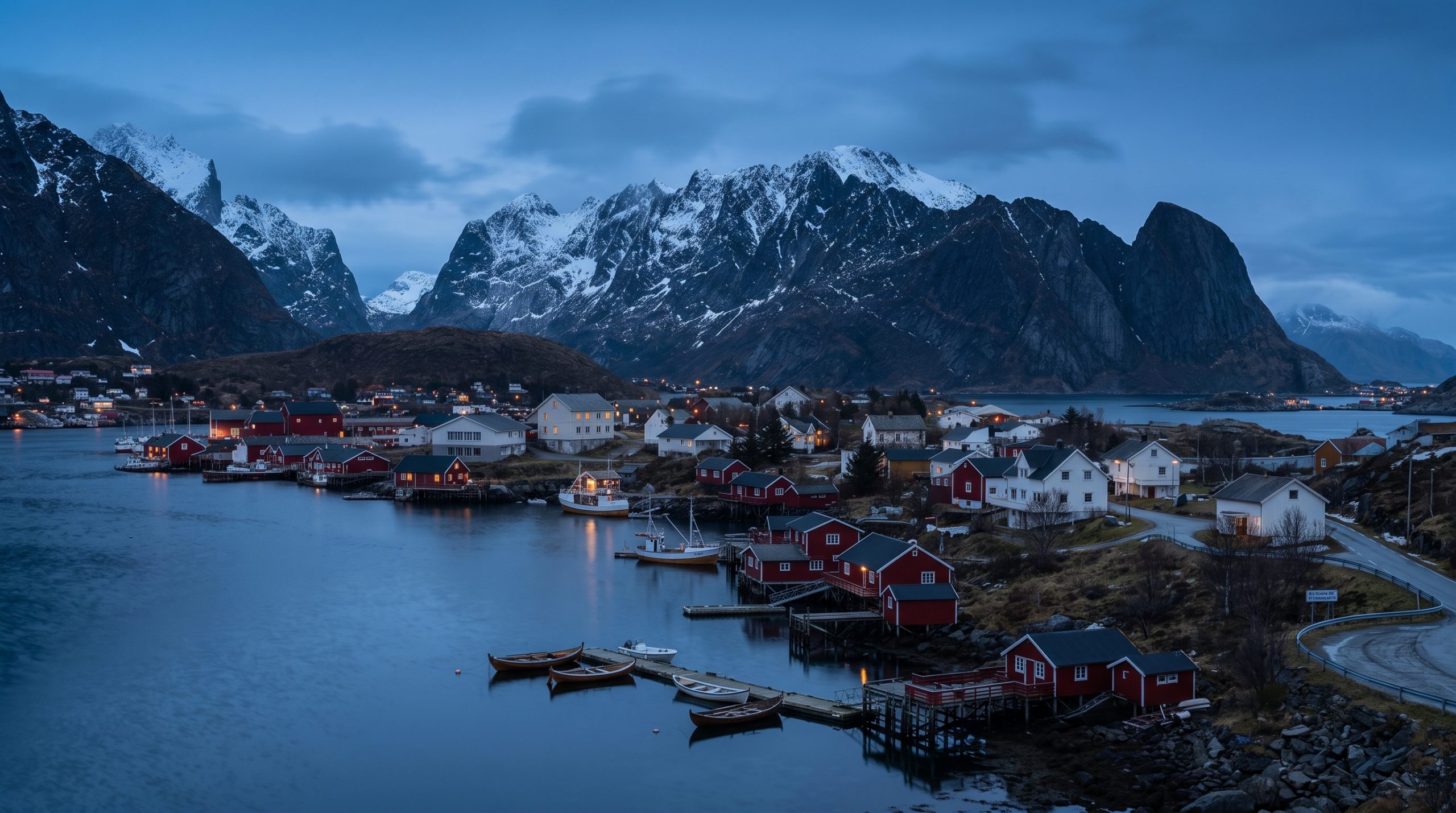
The E10 starts in Luleå in northern Sweden, crosses the border near Narvik, then island-hops out through Lofoten until it runs out of land. The last thing it does is drop into a village with a one-letter name, Å, on Lofoten’s southwestern point. Asphalt becomes a car park, and everything after that happens on foot.
Most couples arrive at Å at the end of a research spiral that began with Reine and Hamnøy. Those two photograph well and roughly everyone with a camera knows it. Å is ten kilometers further down the same road, past the Moskenes ferry quay and Sørvågen, and those ten kilometers change the day completely. A working fishing station instead of a viewpoint. Red boathouses on a cape pushed out into Vestfjorden, cod drying on racks up the slope behind them, and a family who owns the ground you want to stand on.
What follows is the practical shape of a ceremony out here: where the sun lands and the hour the ridge takes it away, who has to say yes before you stand between the boathouses, how the village fills and empties through a summer day, and which month gives you the one you are picturing.
Kilometer zero of the E10
Yes, you can say vows at Å. It is a privately owned fishing station village in Moskenes Municipality at the end of the E10, so permission starts with the landowner rather than a park office. A legal Norwegian wedding is performed by the municipality, and couples from abroad first need a marriage license issued by the Norwegian Tax Administration.
Ten kilometers past Reine, then the last stretch on foot
There are two honest ways in. The car ferry from Bodø into Moskenes takes somewhere between three and a half and four hours on the direct crossing, while the sailings that call at Værøy and Røst on the way take considerably longer. Outside summer the timetable thins to a couple of departures a day, which makes that crossing the least flexible thing in the whole plan. The alternative is to fly into the islands and drive. From the ferry quay at Svolvær it is roughly 130 kilometers of E10 to Å, on a road that is narrow and slow, with a queue behind every motorhome in July.
Reine is the last name most people recognize, and it sits 10 kilometers back up the road with the Moskenes ferry quay and Sørvågen in between. Stay anywhere in that stretch and you are a quarter of an hour from the ceremony.
Å itself is walk-in. The road ends in a car park and the village opens up beyond it, compact enough that everything is a few minutes apart on foot. In wedding clothes that matters more than the short distance suggests. The ground between the buildings is gravel and worn stone that stays wet long after rain. The quay planking has gaps that a narrow heel will find on the first step. Wind off the fjord gets under a long skirt with no warning at all. Couples who walk in wearing boots with the dress in a bag, then change in a rorbu inside the village, have a far better first hour than couples who cross that car park in heels.
Our flights, accommodation and travel are inside the price in every destination we work in, so whether the team comes in on the Bodø ferry the night before or drives down from Evenes is our logistics to solve rather than a line on your invoice.
Twenty-two degrees of sun, and a ridge in the way
Å sits between crags, ringed by mountain and sea, and that single fact governs the light more than any sunset table will tell you. At this latitude the sun tops out around 46 degrees above the horizon on the longest day of the year, about 22 degrees at the equinox, and by the second week of October it manages roughly 15 degrees at its highest, shortly before one in the afternoon. Ridges standing a few hundred meters above the village finish that arithmetic long before the sky darkens. The useful question at Å is never what time the sun sets. It is what time the mountain takes the sun off the quay.
Direction shifts fast across the season as well. In late August the sun comes up in the northeast, close to 55 degrees on the compass, crosses the south and goes down in the northwest well after nine in the evening, which means an August ceremony can be held late with light still working on the water. By mid-October it rises in the east-southeast, tracks low over the fjord and drops in the west-southwest during the afternoon, so an October ceremony wants the middle of the day and nothing else will do.
Midsummer deserves its own paragraph, because this is where expectation and geometry part company. Visit Lofoten puts the midnight sun between 28 May and 14 July, with exact dates shifting from village to village along the islands. At solar midnight, around one in the morning, the sun sits barely a degree above the horizon and it sits due north, which in a place with mountains at its back means the disk itself is out of sight from the harbor. What you get instead is pink light creeping along the peaks across Vestfjorden while the boathouses stand in deep blue shade, and it is a stronger frame than the sun would have been. If the picture in your head is the sun resting on the sea at midnight, that is an outer west-facing beach rather than Å, and we would rather tell you that now than at half past midnight.
At the other end of the year the sun stays below the horizon from the start of December to the start of January, and Lofoten’s dark stretch is short compared with anywhere further north. A December ceremony is not black, it is blue, with a long slow twilight either side of midday. We plan those days around two or three hours of usable light and let windows, lamps and interiors carry the rest.
Working two cameras between the boathouses
Å is tight. The lanes between the boathouses are a couple of arm-spans across and the quays are narrower still, so a photographer and a filmmaker who met that morning spend the hour stepping into each other’s frames. We come as one team from one company with the geography already divided: the filmmaker on long lenses from the far side of the harbor while the photographer works close, then the two of them trade. The other thing this cape does is move air, and wind off Vestfjorden takes vows audio apart, so on an Expedition the microphones go on you and we set you with a boathouse wall at your back instead of open water. The clearest way to judge any of this is to look at the films and galleries we have published from days like it. Highlights reach you within five days, the full gallery or film within three weeks.
Who says yes: a family, a kommune, a tax office
Å is not public land with a booking form. It grew as a fishing station of the classic Lofoten kind, where the station owner held the land and most of the buildings on it. Johan Ellingsen arrived in 1843 and built the place up, and generations of Ellingsens have owned and run it since. A great deal of what you are looking at in the photographs of Å is still someone’s property. Norway’s right of access is generous across open country and it does not extend to the ground between a family’s boathouses, so the first conversation about a ceremony here is with an owner rather than an office. That conversation is ours to have, and it goes better in February than in June.
The legal side is separate, and simpler than most pages make it sound. Civil weddings in Norway are carried out by the municipality, and Å belongs to Moskenes Municipality. Before any officiant can marry you, the Norwegian Tax Administration has to issue the marriage license, the prøvingsattest, confirming there is nothing standing in the way. It is valid for four months, which sets the whole rhythm of your paperwork: not months too early, and not the week before. Couples from abroad supply a certificate of no impediment from home, or proof of civil status where their country does not issue one.
A ceremony in the municipality’s own room during ordinary hours is free of charge, and that holds for couples who do not live in Norway. Ask for a different place or a different hour and the municipality sets a fee and tells you what it is. Many couples sign the legal papers with the kommune and keep the real ceremony for the cape at Å, with someone they love reading the words out. We do the research, write the requests and track the documents; the fees themselves sit with you, along with celebrant and accommodation. The order it all happens in is laid out in our guide to planning an elopement.
Aerials have a boundary of their own out here. Lofotodden National Park covers a large part of the outer side of Moskenesøya, taking in Kvalvika, Bunes and Ryten, and drones stay grounded inside it unless special permission has been granted. Norway also caps open-category flying at 120 meters above the ground. We establish which side of that boundary a shot sits on, and whether permission is realistic, before any part of the film depends on it.
The ferry pulse, and the hours nobody else wants
Å does not fill steadily through the day. It fills in pulses, because almost everybody in it arrived on a boat or a coach that came in together, and in high summer the Moskenes ferry runs close to ten sailings a day. An hour after one docks, the car park is full and there are people in every lane. Two hours later the village can be close to empty. Arriving early is genuinely enough here, which is not true of the stone staircase up Reinebringen ten kilometers back, so in July we tend to place ceremonies before nine in the morning or after eight at night. In the shoulder months the quays are often yours at any hour you like.
Racks, wind, and the month you choose
Two things about the Lofoten calendar that no brochure prints. From the winter fishery into spring, the racks on the slopes are loaded with drying cod and the whole village smells of it, not faintly. Some couples find that the most alive thing about the islands and others would rather it were not in the memory of their vows, and both of those are fair. The second is weather. This is a cape at the outer end of an archipelago, and the wind here arrives with an opinion.
So we plan in pairs. Every ceremony spot on the exposed side of the cape has a sheltered partner five minutes away between the buildings, and if the fjord goes white the day moves to Sørvågen or back to Reine, both inside that ten-kilometer stretch, so the timeline flexes instead of falling over. If what you truly want is empty sand with nobody on it, that is a different location and a climb over a saddle rather than a walk from a car: the Kvalvika and Ryten car parks start at 100 kroner, and the hike is the point. One full day at Å with a dedicated photographer or filmmaker starts at $4,900, a day with both of them working the village together starts at $7,900, and everything else about coverage lives on our pricing page. Guest numbers change access, transport and permissions rather than the fee.
Tell us which of those two days you are actually imagining, the 4am blue hour on an empty quay or a slow eleven o’clock with breakfast in the village, and we will build the one you mean or tell you honestly which month makes it likelier. Other corners of the islands are worth a look too, and our destination guides are the place to start.
Common questions
Do we need permission to hold a ceremony in Å?
There is no government permit for a small private ceremony on Norwegian ground, but Å is a privately owned village and the ground between the boathouses belongs to the family that runs the station, so we ask in advance and agree a place and an hour. The legal marriage itself is a separate matter, handled by Moskenes Municipality with a marriage license from the Norwegian Tax Administration.
Can we fly a drone at the end of the E10?
Sometimes, and not everywhere. Lofotodden National Park takes in much of the outer side of Moskenesøya, including Kvalvika, Bunes and Ryten, and drones are not allowed inside the park without special permission. Norway also caps open-category flying at 120 meters above ground. We confirm the boundary and the permission first, then design the aerials around what is actually available.
Is there anywhere in Å to change out of hiking boots?
Only if you have booked a room. There is no public changing space, so couples take a rorbu in the village or a cabin down the road in Sørvågen, and we build the timeline so you change indoors a few minutes from the ceremony spot rather than in the car park at the end of the road.
Can you actually see the midnight sun from Å?
The sun does not set in Lofoten between roughly 28 May and 14 July, but at solar midnight it sits about a degree above the horizon and due north, and Å has mountains in that direction. The light lands on the peaks across Vestfjorden rather than in front of you. For the sun sitting on the water, we move to an outer west-facing beach for that hour.
What if the Bodø ferry does not sail the day before?
We travel in at least a day ahead and treat the winter timetable as the fixed point it is, with a flight route through Leknes or Evenes held in reserve. If your guests are on that crossing, we shape the timeline so a late arrival moves the hour rather than the date.
Holding a date at the end of the road
Our current Lofoten availability runs across 2027–2029. Write to us with the dates you are weighing up and the kind of day you have in mind. You get a reply and a first brochure within 24 hours, then a tailored proposal, and once the contract is signed and the 30 percent retainer is in, planning begins. All of it happens in writing, at whatever hour suits your time zone. Check Your Date and we will tell you what the light is doing at the end of the E10 that week.