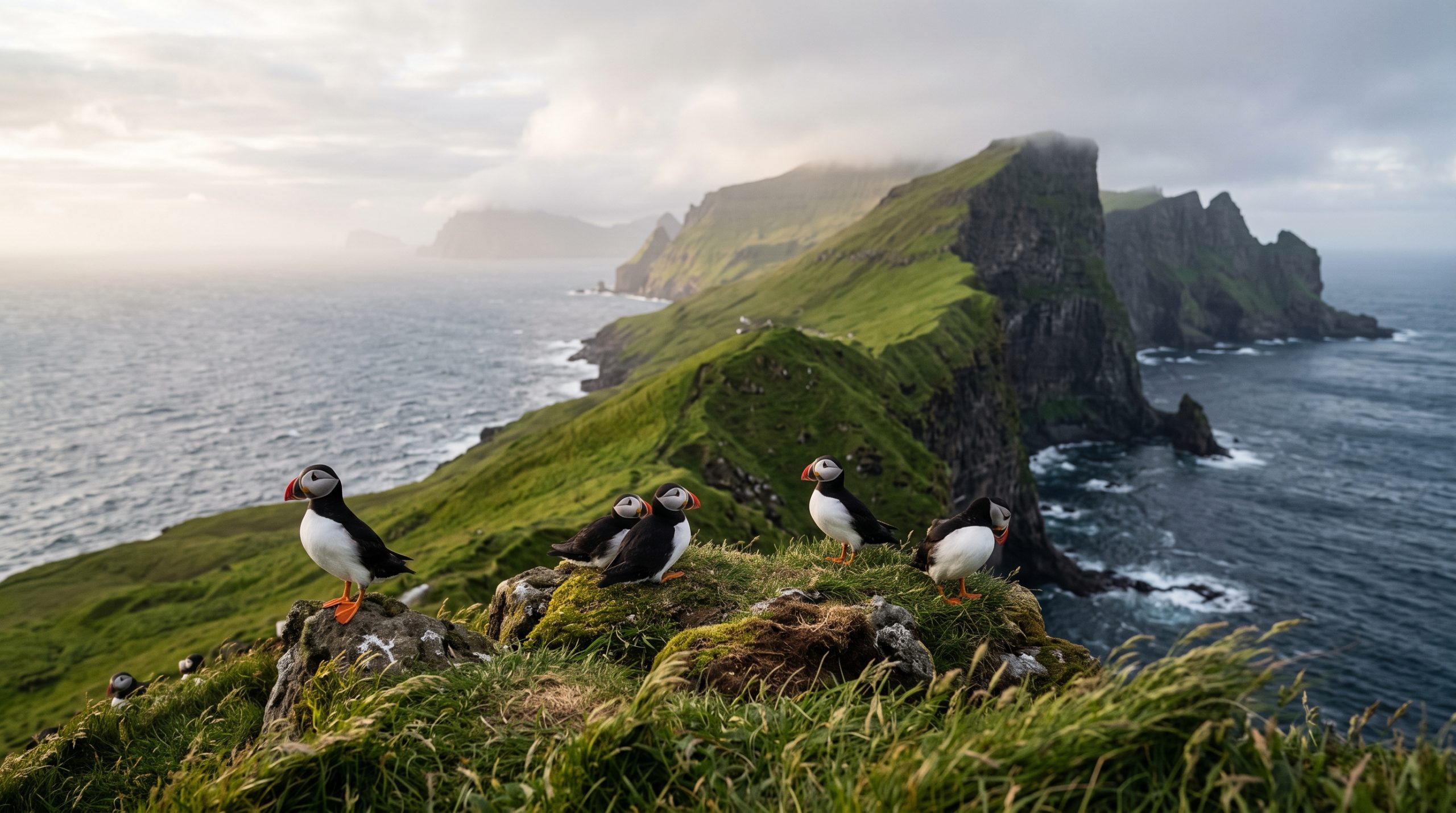
The first boat out of Sørvágur leaves at 09:30 and ties up at Mykines at 10:15. The gate to everything beyond the village opens at 10:00. Those fifteen minutes are why a Mykines wedding day has to be designed rather than hoped for, because the island runs on a timetable that has nothing to do with when the light is good.
Puffins come ashore here from late April and are gone again by the first days of September. The island is open to visitors from 1 May to 31 August, walking beyond the village is guided only and permitted between 10:00 and 17:00, and the ferry from Vágar makes three return crossings a day in high summer. Those four facts decide almost everything else.
What follows is the season as we plan it: which weeks hold the birds, what the sun does at each end of that window, and where the paperwork has to happen for the marriage to be legally binding.
Why we book the last ten days of June
The last ten days of June. The colony is settled and feeding, the 1 May to 31 August season is fully open, sunrise lands near 3:40am and the sun does not set until about 11:25pm. July holds more birds and more people. June gives you the longest evening back on Vágar after the last boat in.
The season month by month, and the months the island is shut
Sunrise and sunset below are for Mykines itself, on local clock time, and move a few minutes either side of the date given.
| Month | Puffins | Access | Light | Our verdict |
|---|---|---|---|---|
| April | First birds ashore late in the month | Guided season not open until 1 May, ferry on its reduced April timetable | 15 April: 06:08 to 20:57 | Vágar, not Mykines |
| May | Colony filling week by week | Season opens 1 May, three return crossings daily | 15 May: 04:37 to 22:20 | Quiet boats, thinner slopes |
| June | Settled, paired, feeding | Full timetable, guided walking 10:00 to 17:00 | 21 June: 03:39 to 23:27 | Our pick, the last ten days |
| July | Peak activity, chicks below ground | Full timetable, fullest boats of the year | 15 July: 04:13 to 23:00 | Best birds, most company |
| August | Strong to mid-month, sliding after | Season ends 31 August | 15 August: 05:34 to 21:35 | First half, and the best evenings |
| September | Colony back out to sea | Guided walking closed from 1 September | 15 September: 06:56 to 19:55 | Somewhere else in the Faroes |
| October to March | At sea | Winter pattern on the route, no guided season | 21 December: 09:56 to 15:02 | Vágar and the bigger islands |
From September through April we would talk you out of building the day around Mykines, and we would say so before you booked flights. The walking season closes on 31 August, the route beyond the village goes with it, and the ferry drops to a winter pattern built for the thirteen people who live there.
That is not the same as skipping the Faroes. September still gives you thirteen hours of daylight mid-month and a low sun that flatters the west coast of Vágar. Gásadalur and the Múlafossur waterfall, the cliff at Trælanípa above Sørvágsvatn, the long walk in to Fjallavatn, the empty houses at Víkar: open, quieter than July, and none of them need a boat. One detail that catches couples out: the seasonal bus to Gásadalur runs only from mid-May to late August, so a shoulder-season day there is a rental car day. If your date is already fixed in October, send us the date and we will send back a shape for it. Our destination guides cover the same ground island by island.
How narrow the puffin window really is
Narrower than most guides admit at one end, wider than couples fear at the other. Birds start arriving in the last days of April, the colony builds through May, and the busiest weeks on the slopes run from late May to the end of July while adults ferry sand eels to chicks underground. From about the third week of August the numbers slide, and by early September the cliffs hold no puffins at all.
The dates move. Puffins come ashore only to breed, so a hard winter out on the Atlantic pushes arrival later and a mild one pulls it forward, by a week or two either way. What we can say honestly is that between the last week of May and the end of July, walking the guided loop in reasonable weather and seeing hundreds of them is close to a given, and in the second half of August it becomes a real coin toss on numbers.
If the birds are thin, the day is not diminished. What you stand in is a grass ridge falling into the North Atlantic, drystone walls the landowners still rebuild by hand, black roofs and grass roofs in a village of seventy houses, and a horizon with nothing between it and Iceland. Stay on the trail regardless, because the burrows are underfoot, and the 10:00 to 17:00 rule exists so the colony gets quiet hours at both ends of the day.
Three ferries, one guide, and the ten-to-five rule
The crossing takes 45 minutes. From 1 May to 31 August the public transport company runs three return trips a day, leaving Sørvágur at 09:30, 13:30 and 17:30, and leaving Mykines at 10:15, 14:15 and 18:15. Bookings for the whole summer open in early February, and in practice those seats, not the trail, limit how many people are on the island on any given day. Tickets can be changed or canceled up to 24 hours before departure for a refund.
Beyond the village you walk with a guide, and the fee goes to the landowners’ fund that maintains the trails and the stone walls. It is DKK 400 a person booked online by the day before, or DKK 500 paid on arrival, with children under fifteen free. At recent exchange rates the online price is around sixty US dollars. The public walk starts from the schoolyard and takes two to three hours, north through Grótvalaportrið, along the cliff edge past the Óli Rama viewpoint, and out to Á Rógvu above the largest puffin colony in the country. Those groups run fifteen to twenty people. Private walks with the island’s guides exist too, and that is the version we ask for, because vows shared with eighteen strangers are a different thing entirely.
Two consequences worth reading twice. The 13:30 boat leaves you under three hours before the trail closes, so a first-boat departure is the only relaxed version of a Mykines day. And the 17:30 crossing only makes sense if you sleep on the island, since walking beyond the village stops at 17:00, though the village, the harbor steps and the cafe are yours in the evening light.
The boat sails when conditions at the pier allow it, which is why the landowners refund the hiking fee in full on days it does not run. The helicopter serves Mykines on set days year round, but it is island transport on a small aircraft rather than a charter, so we plan on the boat and treat the flight as a bonus.
What the light does at 62 degrees north
Here is the awkward truth about midsummer on Mykines. On the solstice the sun climbs to 51 degrees above the horizon, and at both ends of the permitted window, 10:00 and 17:00, it is still sitting around 38 degrees up. The entire legal walking window in late June is high sun. That gives you hard-edged green, a violently blue sea and puffins lit like a wildlife documentary, which is a real look and a good one. It is not golden hour, and anyone selling you golden hour on those cliffs in June is selling something.
The soft hours do arrive. At 21:00 on the solstice the sun is 11 degrees up and swinging into the northwest, by 22:00 it is down to 5, and it sets at 23:27. Those hours belong to Vágar, which is why we split the day: island in the middle, west coast in the evening, ceremony hour wherever the two of you can hear each other.
This is also the strongest argument for the first half of August. By mid-August the sun is at 9 degrees by 20:00 and sets at 21:35, so the 18:15 boat has you back in Sørvágur at 19:00 and driving into warm light rather than waiting four hours for it. December is another proposition entirely: five hours of daylight, a noon sun under five degrees above the horizon, and a closed trail.
Both versions, high summer and late season, are easier to judge from finished work than from description, so our galleries and films are the honest reference point. Highlights reach you five days after the day itself, and the full gallery or film lands within three weeks.
The season is also the clearest argument for two of us working at once. You get one guided loop, inside one seven-hour window, with a boat home that does not wait. There is no second pass at the ridge. A dedicated photographer and a dedicated filmmaker on the same route means the vows are photographed and filmed as they happen, rather than staged again afterward for the camera that missed them.
When the wind turns southwest
Mykines is the westernmost island in the country and takes the Atlantic first, so the honest planning assumption is that the crossing is the fragile part of the day, not the walk. We build every Mykines day with a second version already written: one Vágar plan for a west wind, one for a southerly, drive times measured rather than guessed, agreed with you weeks before anyone flies.
Cloud is material, not a problem. The island can be clear while Sørvágur sits under gray, and a ridge with weather moving across it films better than blank blue sky. What we move is the hour. If the pier is workable at 09:30 but the forecast turns at four, we run the island first and put the evening somewhere sheltered.
Aerials work the same way. Over a nesting seabird colony the drone stays in the bag. It flies where it is legal, safe and appropriate, which in practice means the Vágar coastline and the valleys, and we confirm that before it goes into the plan rather than after.
Whether the vows can be legal on Mykines
The paperwork for visiting couples is handled by Tórshavnar kommuna, the municipality of the capital, and that is what decides where the legal ceremony can realistically sit. You send a Notice of Marriage to the municipality’s marriage office no sooner than four months before your date, with passports and a marital status certificate that must be less than four months old on the wedding day.
American and Canadian couples cannot obtain a marital status certificate at all, and the municipality knows it: a single status affidavit, or a marriage search letter covering five years, is accepted instead. Documents not in English need an authorized translation, and you get written confirmation once everything is approved. Two witnesses sign the register on the day, with names and addresses sent in advance. Afterward you are handed an international marriage certificate in Faroese and English.
So, the practical answer to the question in the title. The vows, the rings and the reading can absolutely happen on Mykines, inside the guided window, with the colony below you. The signing sits with the municipality, a drive plus a 45-minute crossing away, so couples do one of two things: handle the legal side at home and treat the Mykines day as the wedding, or sign in Tórshavn on a weekday and take the first boat out the next morning. If you are traveling as a two, say so early and we will build the witness question into the plan instead of solving it on the pier. Both routes are laid out in how to elope, and we will tell you which one your dates favor.
Send us the month you are looking at and we will tell you what the light and the boats do that week. Check Your Date.
Common questions
If we come in the first week of August, will there still be puffins?
Almost certainly, yes. The colony holds through the first half of August and only thins noticeably from around the third week, so the first week is a strong bet rather than a gamble. It also buys you a sunset near 22:15 instead of near midnight, which makes the evening half of the day easier to shape.
Can we get to Mykines for sunrise?
Not as a day trip. The first boat leaves Sørvágur at 09:30, the trail beyond the village opens at 10:00, and in late June sunrise is at 3:40am. For first light on the island itself you stay overnight in the village, where the evening and early morning hours are still yours. Otherwise we take sunrise on Vágar and give Mykines the middle of the day.
What happens to our day if the Mykines ferry is canceled?
We move to the version we already wrote, and it is a good day rather than a consolation. The hiking fee is refunded in full when the boat does not sail, the Vágar alternatives sit twenty to forty minutes from the harbor, and because the timeline is built around light rather than one place, the ceremony hour relocates.
Do we have to walk with a guided group on our wedding day?
A guide is required beyond the village between 10:00 and 17:00, and the public walks usually carry fifteen to twenty people. Private walks with the island’s own guides are available, and that is what we arrange, so the vows are not happening in the middle of a tour group. The fee to the landowners is the same either way.
We can only travel in September. Is the Faroes still worth it?
Yes, just not on Mykines. Guided walking closes on 31 August, so we would take you to Gásadalur, Trælanípa above Sørvágsvatn and the northern islands, with thirteen hours of daylight in mid-September and low light most of the day. Fewer visitors, more weather, and a film that looks nothing like July.
Can you fly a drone over the puffin colony?
No, and we would not ask to. Over nesting birds the drone stays down. Aerials are flown over the Vágar coastline and valleys where it is legal, safe and appropriate, confirmed while the timeline is written rather than on the morning.
How far ahead do we need to commit to a date?
Ferry seats for the whole summer go on sale in early February, and the best version of a June or August wedding day is a first boat out with the guided walk booked behind it, so we like to be planning by the fall before. We are currently taking dates in 2027, 2028 and 2029. Coverage, what is included and the 30% retainer that starts the planning are set out on our pricing page.
Getting your date onto the right boat
Pick the week first, because on Mykines the week decides the birds, the light and whether the trail is open at all. Then the boat, then the paperwork, then the shape of the day. We work through all of it in writing, in your own time zone, and you will have a reply and an initial brochure within a day of writing to us. Tell Us Your Story.