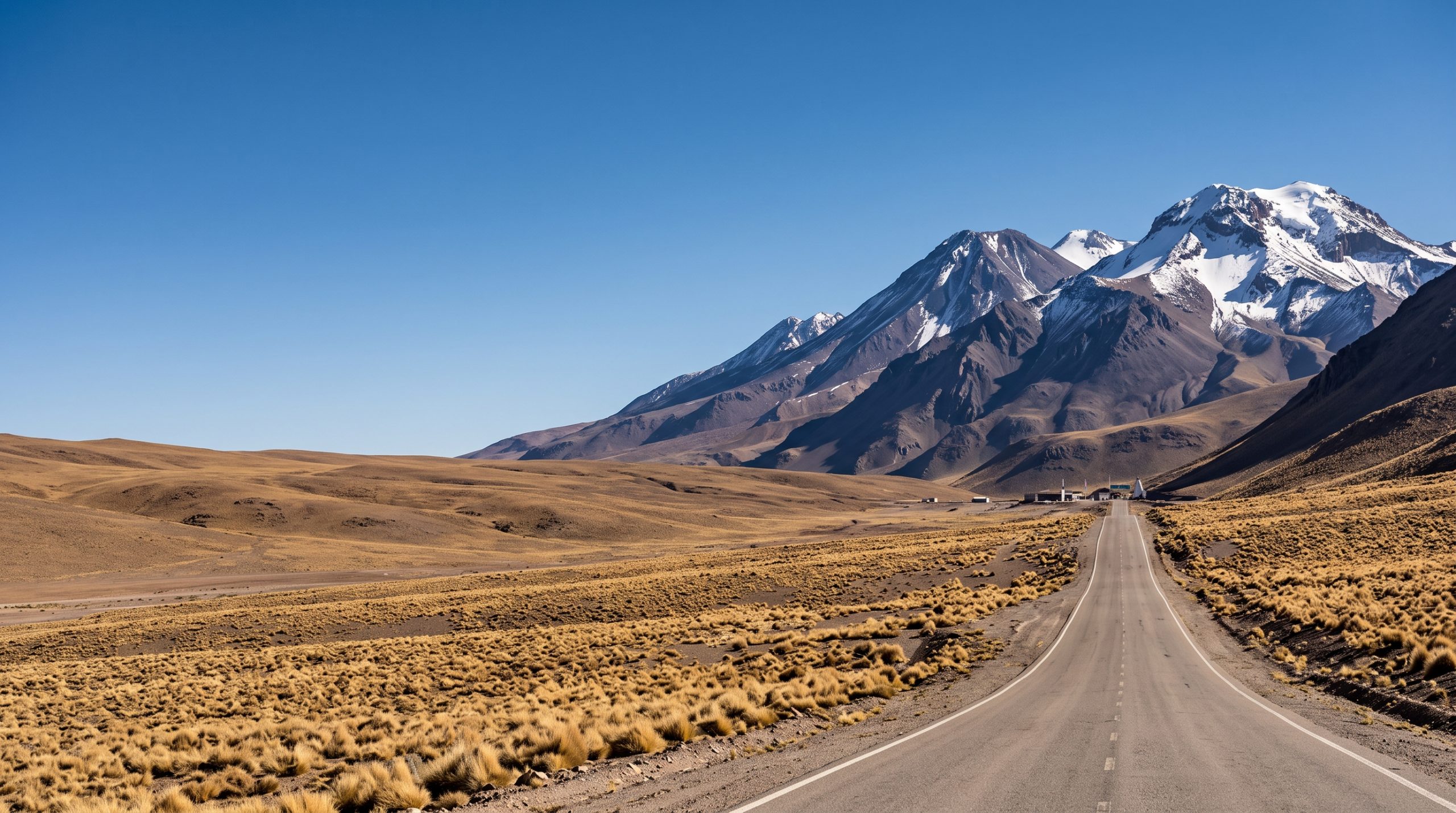
Los Libertadores is a high-mountain border crossing whose operating status can change with season, snow and road conditions. The official daily border-status notice, not an old seasonal timetable, is the number we plan around. A published opening window can also be interrupted by weather, so an elopement itinerary never puts the ceremony on the far side of a same-day crossing.
This is what crossing between Chile and Argentina is actually like. Not difficult. Governed. Two governments, four counters, a permit your rental company has to issue before you leave home, and in some months a clock that jumps an hour the moment you drive east. Couples who plan for all of that cross in a morning and marry in the afternoon. Couples who treat a border as a line on a map lose a day of the trip to a queue.
We are eight photographers and filmmakers working as one team, and a two-country trip is one of the more common shapes we build. Here is what we check before we put a border in the middle of a timeline.
The border is a clock, not a line
Crossing between Chile and Argentina on an elopement trip means planning around three things: the hours the border complex actually works, a cross-border permit your rental company arranges before you fly, and a clock that changes in some regions and not others. Get those three right and the crossing costs you a morning, not a day.
The three corridors couples actually use
Chile and Argentina share dozens of official crossings. Three of them carry almost every elopement trip we plan, and they behave nothing like each other.
| Corridor | Crossing | Surface | What governs the hours |
|---|---|---|---|
| Santiago to Mendoza | Los Libertadores, also called Cristo Redentor | Paved, through a tunnel at around 3,200 m | Operating hours and status vary by season and weather; check the official daily notice for the travel date |
| Osorno or Puerto Varas to Bariloche | Cardenal Antonio Samoré | Paved end to end | Daytime only, and in winter the weather on the pass has the final word |
| Torres del Paine to El Calafate | Río Don Guillermo in Chile, Cancha Carrera in Argentina | Gravel access road | Opens at 8am, closes in the evening |
| Cochrane to Bajo Caracoles | Rodolfo Roballos | Gravel, remote, no services | Daylight, and never a ceremony day |
Los Libertadores is the only one of the four that behaves like a highway. Santiago sits about three hours from the complex, the road is paved the whole way, and both countries process you through the integrated crossing at high altitude. When the official status lists continuous operation an evening crossing can work, but snow and road closures can suspend that plan entirely, so we check the live status rather than treating any seasonal schedule as permanent.
Cardenal Antonio Samoré is the gentler option and the better drive: paved from Entre Lagos in Chile, over a pass a little above 1,300 meters, then down through forest and lakes into Villa La Angostura, roughly 100 kilometers in total. It is a daytime crossing, not a 24-hour one. In winter, snow on the pass decides the shape of your afternoon, which is why we treat the Lake District as a late-spring-to-autumn region and say so early rather than late.
The far south is the crossing most of our couples make. Torres del Paine to El Calafate, or the reverse, runs through Río Don Guillermo at Villa Cerro Castillo on the Chilean side and Cancha Carrera on the Argentine side, and the complex opens at 8am. That single fact rearranges more elopement mornings than anything else on this page, because first light in a Patagonian summer arrives hours before eight. If you want the Paine towers at sunrise and the Perito Moreno ice front the next day, you sleep on the Chilean side, shoot at dawn and cross afterwards. There is no version of that morning that starts in Argentina. Our destination guides go region by region if you are still deciding which end of Patagonia you want.
The paperwork your rental company starts before you do
A rental car does not cross this border on goodwill. Officers on both sides want to see that the owner of the vehicle has authorized the trip and that the insurance follows the car into the other country. In practice that is two documents: a notarized authorization to take the vehicle abroad, and additional liability cover valid on the far side. Both live in the car’s document folder, and you will be asked for them.
The fee is scaled to the length of the rental. Chilean companies commonly price the Argentina permit at around 130 US dollars for a rental of up to fifteen days, and roughly double that past fifteen days. Individual rates move and each company words it differently, but the shape of the cost has been stable for years.
The timing is what catches people. The permit is prepared with the car’s documents and handed over when you collect the keys, which means it has to be requested at the moment you book, not mentioned at the counter. Put it in the booking in writing, then ask again a week out. Landing in Punta Arenas and deciding over breakfast to drive to El Calafate is the one version of this that genuinely does not work.
Keep the small slip Chilean immigration hands you on entry, too. Hotels ask for it at check-in, and non-residents who can produce it are not charged the 19% Chilean room tax. You get a fresh one each time you re-enter the country, so a trip that crosses twice collects two. The rest of the pre-trip admin, the order it happens in and what we handle for you, sits in our guide to how to elope step by step.
An hour that exists in one country and not the other
Argentina stays on UTC-3 all year. Mainland Chile sits on UTC-4 and moves to UTC-3 for the southern summer, from the first Sunday of September to the first Saturday of April. The exception is the Magallanes region, which includes Punta Arenas, Puerto Natales and Torres del Paine: it holds UTC-3 permanently and never changes.
Two things follow. Between Torres del Paine and El Calafate the clock never moves, in any month, which is one reason that corridor forgives a slow start. Between the Chilean Lake District and Bariloche from April to September it does move, and it moves against you eastbound: an afternoon you have planned in Chilean time lands an hour later on Argentine clocks, with the border complex that much closer to closing. Sunset does not care which watch you are reading, and neither does the officer at the barrier.
Gravel, wind, and the thirty-three kilometer hour
Route planners assume tarmac. Patagonia does not always supply it. The most honest number we know belongs to the approach to Paso Rodolfo Roballos: 100 kilometers of gravel out of Los Antiguos, driven in three hours. Thirty-three kilometers an hour, sustained, on a road with no shortcut and nowhere to buy a coffee.
Roballos is a genuinely beautiful crossing, running almost entirely through parkland, and we would happily build two travel days around it. It is not a ceremony-day route, and nor is any other remote gravel pass. If a crossing has one officer, no fuel and a washboard surface, it belongs on a day with nothing behind it.
The paved corridors lie less, but they still lie. Add time for the fuel stop you cannot skip, for the coach that reaches the barrier ninety seconds ahead of you, for the crosswind that makes an open steppe road slower than its speed limit in a high-sided vehicle, and for the roads inside Torres del Paine, which are gravel throughout. Our working rule is simple: plan paved sections at the route planner’s number plus a quarter, and plan gravel at half the speed it promises. When a day finishes early, that is an hour of extra light you did not expect. When it does not, the ceremony still starts when we said it would.
What crosses with us, and what has to be approved twice
Some things travel with the team. Others restart from zero the moment you change country, and knowing which is which is most of the job.
Aerials
Chile and Argentina both allow drone work, and neither recognizes the other’s approval. In Chile the authority is the DGAC: the aircraft goes on its remote aircraft register, and pilot credentials run for twelve months before they need revalidating. In Argentina it is ANAC: registration in the national aircraft register, remote crew authorization, third-party liability cover, and a standing distance of five kilometers from any airport, aerodrome or heliport. Above the aviation approval sits the landowner or the park authority, and that second layer is usually the slower one.
We fly drone where it is legal, safe and appropriate, and we confirm both halves of the chain, aviation and land, before we design a sequence that leans on an aerial. When one side of the border says yes and the other says not here, that day’s film is built from the ground and you will not feel the loss. The films and galleries in our recent stories are the honest answer to what these two countries look like cut together.
The food in your day bag
Entering Chile you complete a sworn declaration, and unprocessed plant and animal products stay on the other side of the line: fresh fruit and vegetables, dairy, meat, seeds, nuts and dried fruit, plants and cuttings. Declare anything you are unsure about and the officers work through it with you. At Villa Cerro Castillo, Carabineros, the investigations police, the agricultural service and Customs all sit in the same complex, which is exactly why the stop is quick when the bag is clean. Eat the apple in the car. Buy the picnic on the side you plan to eat it.
How we build a day with a barrier in it
First rule: the ceremony hour is never next to the border hour. If you are marrying on the Argentine side, we cross the day before and sleep there. A border inside a wedding morning turns an ordinary queue into a problem, while a border on a travel day is scenery and a stamp.
Second: every timeline holds a weather alternative on the same side of the border as the original. Both Patagonias change their minds faster than any plan, and a backup that requires re-crossing is not a backup. We also keep the ceremony away from the last two hours a complex is open, so a slow line never becomes a decision anyone has to make in a hurry.
Third, we run two vehicles on crossing days whenever the geography allows. With a dedicated photographer and filmmaker working together, one of us can be on the ceremony ground reading the light while the other is still clearing customs, and the day stops depending on a single car. A second full set of bodies, lenses and audio matters more here than almost anywhere else, because the nearest replacement for a failed card reader is a border and a domestic flight away. There are eight of us, so there is always a colleague in reserve.
Two countries in one trip is usually an Odyssey rather than a single day, since the crossing deserves hours that are not borrowed from the ceremony. What each experience includes, and how the days are counted, is set out on our pricing page. Team travel is included worldwide, flights and accommodation for the assigned team, with nothing added for a second country. Highlights reach you five days after the last frame, and the full gallery or film in three weeks.
Send us the route you have in mind, even if it is two town names and a month, and we will tell you which crossing fits it and which one we would quietly move. Send Us a Message and we will come back with the honest version.
Common questions
Can we take a rental car from Chile into Argentina?
Yes, with a cross-border permit that only the rental company can issue. It comes as a notarized authorization to take the vehicle abroad plus liability cover valid in the other country, and it is priced by the length of the rental. Request it when you book. It cannot be produced at the counter on the morning of the drive.
What time does the border open between Torres del Paine and El Calafate?
The Chilean complex, Río Don Guillermo at Villa Cerro Castillo, opens at 8am and closes in the evening, with a closing hour that has been extended in recent years and shifts by season. Cancha Carrera handles the Argentine side. Aim for a mid-morning crossing and never plan around the final hour.
Do the clocks change when we cross into Argentina?
Sometimes. Argentina is UTC-3 year round. Mainland Chile is UTC-4, moving to UTC-3 from the first Sunday of September to the first Saturday of April. Magallanes, which covers Puerto Natales and Torres del Paine, stays UTC-3 always, so the southern corridor never changes the clock while the Lake District does from April to September.
Can our filmmaker fly a drone on both sides of the border?
Where it is legal, safe and appropriate. Chile approves through the DGAC and Argentina through ANAC, and neither accepts the other’s paperwork, so both are confirmed separately along with permission from the landowner or park authority. We settle that before a sequence is designed around an aerial, and we always hold a ground-based version.
Should we cross the border on the morning of the ceremony?
We would rather you did not. Two governments and four counters on a wedding morning is a variable with no upside. Crossing the day before costs one night of accommodation and buys back the entire morning, which is why nearly every two-country timeline we build sleeps on the ceremony side.
What can we not carry into Chile?
Unprocessed plant and animal products: fresh produce, dairy, meat, seeds, nuts and dried fruit, plants and cuttings. You fill in a sworn declaration at the complex, so declare anything borderline and let the officers decide. Shopping on the Chilean side after the crossing is faster than arguing over a box of raspberries.
How far ahead should we plan a two-country elopement?
We are booking 2027, 2028 and 2029. Rental permits are requested at the moment the car is booked, and accommodation on both sides of the border needs the same lead time. Once a contract is signed and the 30% retainer is paid, planning starts and we begin building the crossing into the timeline.
Two countries, one timeline
A border is not the interesting part of an elopement, and with the hours, the permits and the clocks handled in advance it stops being a story at all. It becomes a drive, a stamp, and a different set of mountains by dinner. Tell us the two countries, the month and the kind of morning you want, and we will reply within 24 hours with our brochure and a first read on which crossing serves the day. Everything runs in writing, at whatever hour suits your time zone, so you can read it, sleep on it and answer when you are ready. Start Your Story.