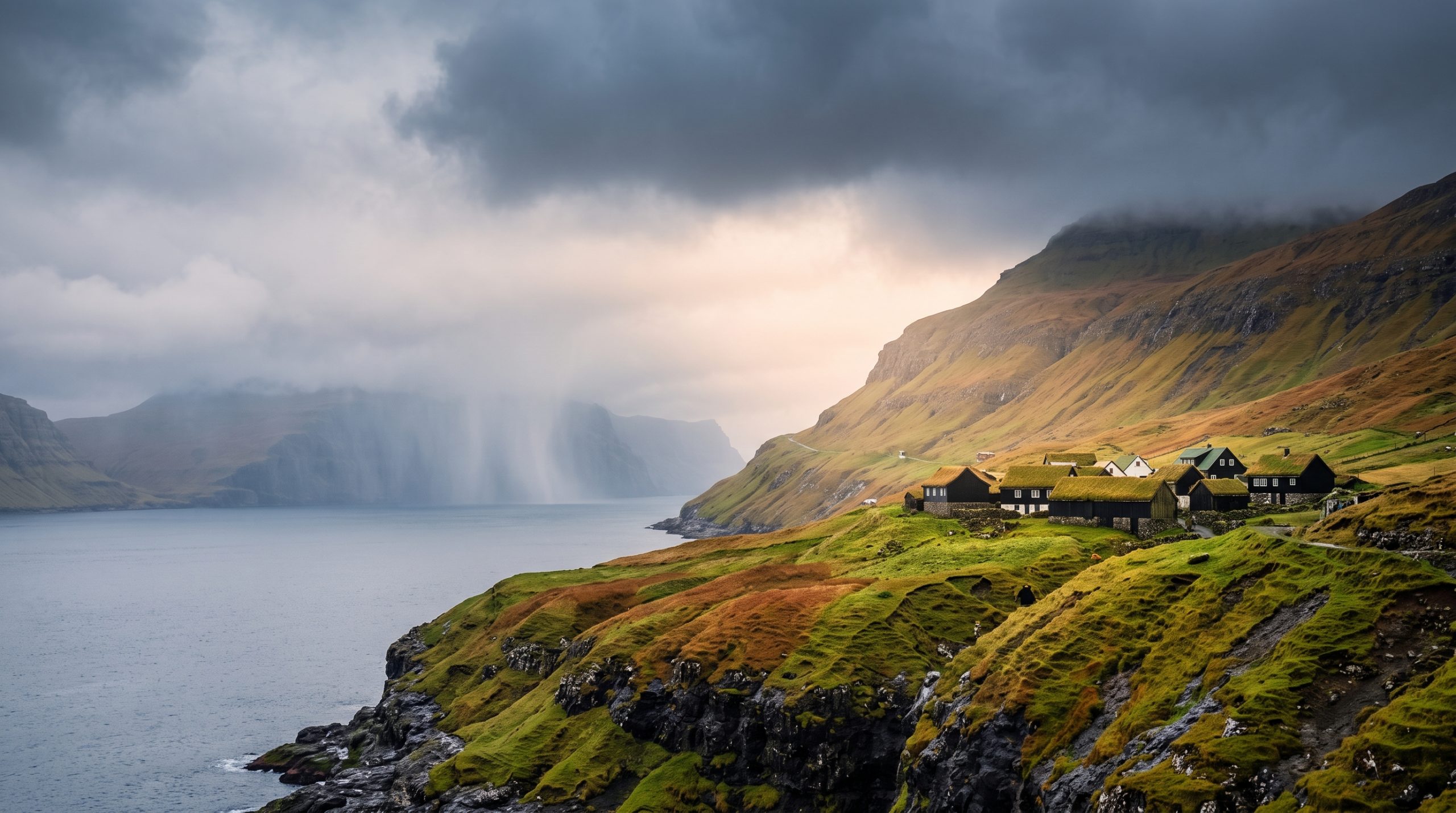
On 15 June the sun comes up over Tórshavn at 3:37 in the morning and stays up until 23:18. Nineteen hours and forty-one minutes. That single figure decides more about a Faroese elopement than anything else, because it means nothing forces the day into a shape: vows at nine in the evening in full light, a walk out to a headland afterward, and the film still rolling as the sky goes copper toward midnight.
Then there is the other half of the Faroes. The 1991 to 2020 standard normals from the Danish Meteorological Institute put Tórshavn’s annual mean temperature at 7°C, about 45°F, under skies that are overcast much of the year. June is the driest month on that record at roughly 57 mm of rain, around 2.2 inches. December is the wettest at about 135 mm. Eighteen islands alone in the North Atlantic do not do settled weather, and any page that promises you otherwise is selling something.
What follows is the calendar we actually work from. Every month carries a real daylight figure, the weeks we would move a date out of are named along with where we move them to, and the last section sets out what we do when the forecast turns two days before your vows.
Why we push almost every Faroese date into June
June is the month we book. Mid-June brings close to twenty hours of daylight, the lowest rainfall in the Tórshavn record, and Mykines open to visitors since 1 May. We aim for the first three weeks, when the light is at full length but ferry and guide schedules have not yet reached their summer peak.
The Faroese year, month by month
Daylight figures are for the 15th of each month at Tórshavn, sunrise to sunset.
| Month | Daylight | Conditions | Crowds | Our verdict |
|---|---|---|---|---|
| January | 6h 07m | Mean 4.2°C, rain on around 22 days | None | Aurora window, very short working light |
| February | 8h 54m | Coldest month, nights near 1.7°C | None | Snow on the tops, aurora still live |
| March | 11h 40m | Passes 12 hours at the equinox | Quiet | Last aurora chances, good light returning |
| April | 14h 45m | Wind easing, showers frequent | First arrivals | Long days, Mykines only on limited service |
| May | 17h 38m | Driest stretch of the year begins | Building | Strong. Mykines opens 1 May |
| June | 19h 41m | Driest month, around 57 mm | Busy, not yet peak | Our first choice |
| July | 18h 48m | Warmest with August, mean 11°C | Peak | Excellent, but book gates and guides early |
| August | 16h 03m | Highs near 13°C | Peak to 31 August | Real darkness returns for night work |
| September | 13h 02m | 12 hours at the equinox, grass turning | Falling away fast | Our second choice |
| October | 10h 06m | Rain climbing toward winter levels | Very quiet | Low sun all day, no queues anywhere |
| November | 7h 08m | Wettest stretch, first snow up high | None | Aurora season opens, tight light window |
| December | 5h 14m | Wettest month, about 135 mm | None | Workable with two cameras and short drives |
The table is the shortcut. If you are earlier in the process than choosing a week, how we plan an elopement covers what a day like this contains before you commit to a month.
The windows that open and shut
Mykines is the one date that genuinely constrains a Faroese timeline, because it is the only island here with a published start and finish. Scheduled ferry connections from Sørvágur run through the summer, 1 May to 31 August, with limited service in April and September and nothing dependable across the winter. That is a 122-day season, and the puffins are ashore inside it.
Numbers on the slopes are heaviest around midsummer. We treat that as a likelihood rather than a fixture: birds ashore in good numbers on most days from late May into early August, thinner at either end, always subject to what the sea is doing that morning. One more thing about the island matters for an elopement specifically. Walking beyond the village in the evening is permitted only with a certified Mykines guide, so an evening on Mykines is an arrangement made weeks ahead, not a decision anyone makes at 8pm.
The aurora runs on the opposite calendar. Visit Faroe Islands points at November to February, sometimes into March, when the nights are long and dark enough, and notes that aurora hunting here is not a crowded pursuit. Summer is out entirely because there is too much light in the sky. We never sell it: on a clear, cold night in that window with real solar activity you have a genuine chance, plenty of Faroese winter nights are cloudy, and the honest plan is to cover a complete day and treat green sky as the extra it is.
Autumn color works differently here than almost anywhere our couples have been, because the islands have next to no trees. The turn happens in the grass. Through late September and October the hillsides move from green to rust and straw, the sun sits low enough to be useful from breakfast onward, and the summer traffic has gone home. First snow shows on the high ground while the coastal villages are still green, the ridge below Víkartindur at 700 meters being a fair marker for it. Location detail by island lives in our destination elopement guides.
The weeks we ask couples to move, and where we move them to
Late November through January. Not because those months are ugly, because they are not. Because of arithmetic.
On 15 December the sun clears the horizon at 09:45 and is gone by 14:59, which is five hours and fourteen minutes, and on the solstice its highest point of the day is only about four and a half degrees above the horizon. December is the wettest month of the year, January brings rain on around 22 days, and Mykines is closed to scheduled traffic. Add one ferry crossing or one long tunnel drive to that and the usable part of your day is very small indeed.
Where we move it, in order. Mid-September first: thirteen hours of daylight, sunrise 06:51 and sunset 19:53, the summer crowd gone, the hillsides turning, and the Mykines ferry still on limited service. Late February into March second, if what you are really after is snow on the summits and a chance of aurora, with 8 hours 54 minutes of light on 15 February and 11 hours 40 minutes by 15 March.
If your date is already fixed by an anniversary, a family window, or the only two weeks you can both leave work, we will not spend a single email trying to move you off it. We build that month differently instead. Locations at village scale and short driving distance from each other, vows near solar noon rather than at a golden hour that does not exist, one strong exterior and one interior with the door open to the weather. Send us the date and we will tell you precisely what that day can hold.
What the sun actually does at 62 degrees north
Tórshavn sits on the 62nd parallel, south of the Arctic Circle, so there is no midnight sun here whatever the brochures imply. What you get instead is arguably better on film. Around the solstice the sun drops only just below the horizon and the sky never reaches full darkness, so the warm hour is not an hour at all. It is a slow four-hour bleed from gold into blue and back out again, with nothing in it that forces you to stop working.
Angle matters as much as length. Even at midsummer noon the sun reaches only around 51 degrees here, so there is none of the hard overhead light that makes a midday ceremony difficult in Utah or Tuscany. A noon vow exchange in June is entirely workable. In December the sun rises in the southeast, tracks the southern sky barely clear of the ridgelines, and sets in the southwest by three in the afternoon. Everything looks like sunrise, and west-facing coasts such as Gásadalur get less of that light than the map suggests.
Season is also where working as one team stops being a talking point. In June a single photographer has room to work slowly and repeat things twice. Inside a five-hour December window your vows happen once, and a photographer and filmmaker who planned the same twenty minutes together in advance both come away with it. That is the practical difference between our one-specialist day and our two-specialist day, and you can see how each looks in the finished films and galleries in our published stories.
Gates, ferries and guided ground
Faroese land law allows owners to charge for access across their land, and after tourism roughly doubled in less than a decade, many of them now do. Roads and village paths stay free. The common charge at the well-known sites is 200 DKK a person, about thirty dollars at the six-and-a-half kroner to the dollar we have been seeing lately, at places including the Trælanipa cliff above Sørvágsvatn, the lagoon at Saksun and the Dunnesdrangar sea stacks. Landowners describe the fees as compensation for disturbance to farming and wildlife, and one side effect is that somebody is looking after the path.
Seasonal access, in the order it hits a timeline: Mykines on scheduled sailings 1 May to 31 August with limited shoulder service either side; evening ground on Mykines with a certified guide only; guided routes elsewhere running on published summer schedules; and the high mountain roads, which follow conditions rather than a calendar, which is why we build winter days on low ground and coastline. We check all of it against your date before proposing a single location, then check again the week you fly.
Permit research, landowner contact and the logistics of getting a team to a gate at four in the morning are ours. The fees themselves, along with celebrant, accommodation and anything unusual on the transport side, stay with you, and our coverage and pricing page sets out exactly where that line falls.
How wind direction shapes the island plan before you fly
The Faroes are narrow and steep, and that is the thing that saves you. Average wind sits somewhere between 10 and 20 km/h across the year and climbs in winter, but the number that matters is the drive time between opposite coasts. In a westerly, the east-facing side of the same island can be nearly still, and the road between the two is often twenty minutes through a tunnel.
So the plan is written as pairs, before anyone gets on a plane. Gásadalur and Múlafossur, which face west straight into the weather, pair with the sheltered inlet at Saksun and the east-coast village of Gjógv. The exposed plateau above Sørvágsvatn pairs with turf-roofed Tinganes in Tórshavn, where rain becomes texture instead of a problem. Every block in your timeline has an alternative attached to it and a wind direction that triggers the switch.
The ceremony hour moves as well. In June, shifting vows from 6pm to 10pm costs you nothing whatsoever, since there is still light at midnight. In February, shifting by four hours is the entire day, so we set a narrower window and hold two options on either side of it. Aerials need both a legal window and air calm enough to fly, so drone work is planned as an opportunity rather than sold as a certainty. Check Your Date and we will tell you what your specific week in your specific year tends to do.
Common questions
Will it rain on our elopement day in the Faroe Islands?
At some point, probably, and it is not the problem it sounds like. Tórshavn averages around 57 mm of rain in June and about 135 mm in December, and Faroese showers tend to cross the islands in twenty minutes rather than settling in for the afternoon. We pair locations by wind direction and keep enough slack in the timeline to move an hour.
Can we plan the day around puffins on Mykines?
Partly. Scheduled ferry connections run 1 May to 31 August, with limited service in April and September, and the birds are ashore in their best numbers around midsummer. Walking beyond the village in the evening requires a certified Mykines guide, so we arrange that far ahead and keep a mainland alternative for the morning the sea has other ideas.
Is December too dark for a Faroe Islands elopement?
It is short rather than dark. On 15 December the sun is up from 09:45 to 14:59 and never climbs far above the ridgelines, which hands you sunrise light for five straight hours. We keep locations close together, put the vows near midday, and work with a photographer and filmmaker covering the same moment at once.
How much daylight will we have in mid-September?
Thirteen hours. On 15 September the sun rises at 06:51 and sets at 19:53, with a long low evening at the end of it. September is our second choice after June: the summer traffic has gone, the hillsides are turning rust and straw, and the Mykines ferry is still running a reduced service.
Do we have to pay landowners to reach the locations we want?
At several of them, yes. Faroese land law lets owners charge for access across their land, commonly 200 DKK a person at well-known spots such as Trælanipa, Saksun and Dunnesdrangar, while roads and village paths remain free. We do the research and make the arrangements, and the fees themselves are paid by you on the day.
Can you film the northern lights during our elopement?
In the right months, sometimes. Visit Faroe Islands puts the season from November to February and occasionally into March, and it needs a clear night, real solar activity and darkness away from village lights. We never build a day around it. We cover the whole day properly, and if the sky opens after dinner we are ready for it.
Bringing us a date, or letting us find you one
There are eight of us, four photographers and four filmmakers, and we are booking 2027, 2028 and 2029. Photography, film and planning come from the same team, so whoever builds your timeline around a 3:37am sunrise is standing on the headland with you when it happens. Team travel is included worldwide, which means the flights and beds for your assigned team are already accounted for.
If you have a week in mind, send it and we will tell you honestly what that week does with light, wind and access. If you have a season and no date at all, tell us how you want the day to feel and we will pick the week for you. We handle the planning in writing so nothing depends on matching time zones, at whatever hour suits you, and our first reply with the brochure comes back inside 24 hours. Tell Us Your Story.