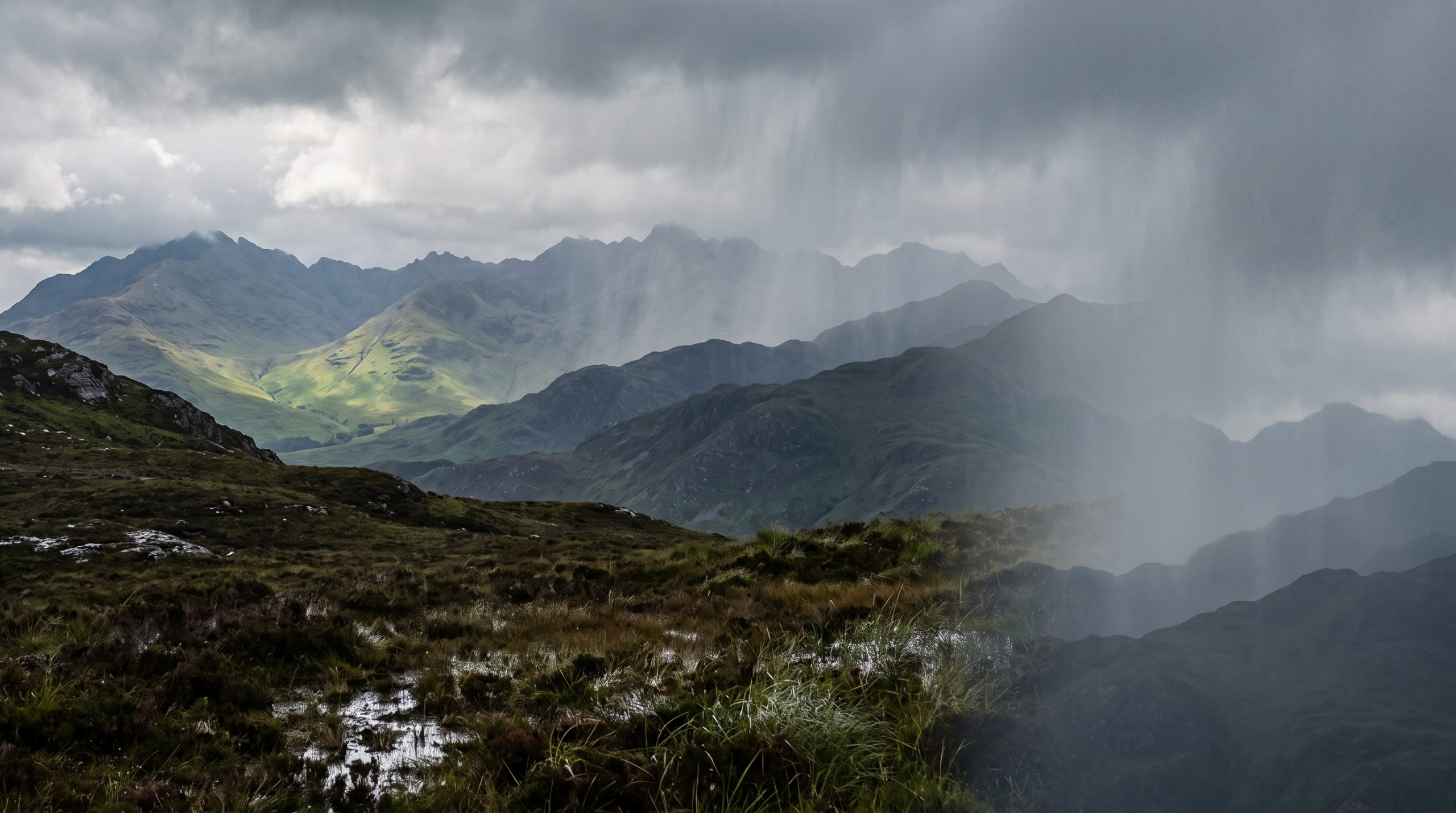
Rain is not the problem on Skye. The problem is planning as though rain were an event rather than the ordinary condition of a Hebridean day. We have sat in the Quiraing car park at four in the morning in June with water running down the windscreen, watched the cloud peel off the ridge at ten past five, and worked twenty minutes of light on the terraces that no clear forecast would ever have delivered.
That is the shape of this island. In mid-June the sun comes up over Trotternish at about 04:25 and does not set until 22:25, so you have eighteen hours in which to find the good twenty minutes. In late December the entire day runs six hours and forty-two minutes, and all of it is low, raking light, because the sun never climbs more than about nine degrees above the horizon.
What follows is the month-by-month picture, the light figures we plan against, and what we actually do on the morning the forecast changes its mind.
The Skye weather window we would take first
Mid-May into the first half of June is the window we reach for. Spring is the driest and brightest stretch of the Skye year, mid-May already carries sixteen and a half hours of daylight, the hills have gone green, and the worst of the midges has not started. It also hands us the longest workable evening of any month.
Twelve months on Skye, with daylight, highs and our verdict
Daylight figures below are for the middle of each month at Portree, and average daily highs come from the Met Office long-term averages for Skye. The warmest months sit near 16 °C, which is about 61 °F, so this is a place for layers in July as much as in March.
| Month | Daylight (mid-month) | Average high | Visitors | Our verdict |
|---|---|---|---|---|
| January | 7h 20m | 6 °C | Almost none | Noon sun at 12 degrees, empty roads |
| February | 9h 30m | 6 °C | Very quiet | Best odds of snow on the Cuillin |
| March | 11h 47m | 8 °C | Building | Snow above, a full day’s light below |
| April | 14h 20m | 10 °C | Easter spike, then calm | Bright, dry, no midges yet |
| May | 16h 35m | 13 °C | Busy from mid-month | Our first choice |
| June | 18h 00m | 15 °C | Full | Longest light, earliest alarms |
| July | 17h 21m | 16 °C | Peak | Warm, wetter than May, shared trailheads |
| August | 15h 16m | 16 °C | Peak | Heather, and company everywhere |
| September | 12h 49m | 14 °C | Thins after mid-month | Best trade between light and crowds |
| October | 10h 23m | 11 °C | Quiet | Bracken color, huge skies, wetter |
| November | 8h 01m | 8 °C | Empty | The month we would move |
| December | 6h 39m | Close to January’s | Empty | A six-hour day, all of it golden |
Heather, snow on the Cuillin and the return of dark skies
Four things on Skye run on windows narrow enough to build a date around, and none of them arrives on a schedule you can hold a supplier to.
Heather. The moor goes purple from roughly the first week of August into the first half of September. The peak moves by a week or two from year to year depending on how the summer has run, so if the color matters to you we aim for the middle of the window rather than its edges, and we plan a second location that does not depend on it.
Snow on the Cuillin. The ridge tops out just under 1,000 meters and holds snow most reliably in February and March, with patches lingering in the high corries into April. A white Cuillin behind a couple standing on the Sligachan bridge, fifteen minutes from Portree, is one of the best frames on the island, and it is a February frame far more often than a Christmas one.
Bracken and birch. Skye’s autumn is not a forest autumn. It is moor: bracken turning rust, grass going gold, and the last of the birch in the sheltered glens, mostly through the second half of October.
Dark skies. From about the start of May until the middle of August, the sky above Skye never reaches full astronomical darkness. Around the summer solstice, civil twilight runs from 03:16 to 23:38 and the sun never drops more than nine degrees below the horizon, so there is no night to speak of. Aurora and star frames belong to the other half of the year, and we treat them as a bonus on a clear, active night rather than something we schedule. If you want the odds in your favor, come between September and March, stay several nights, and let the film we plan stand up without them.
Why we would move a November date
November is the one month we would gently steer somewhere else. Eight hours of daylight with the noon sun barely 14 degrees up sounds like a photographer’s gift, and the light genuinely is beautiful; the trouble is that this is the wettest, grayest stretch of the year, the bracken color has gone, and the snow line has not arrived. You get the short day without the reward that makes short days worth it.
Three weeks earlier, in mid-October, you get ten and a half hours, rust on every hillside and the same emptiness. Six weeks later, in the second half of January, you get the lowest sun of the year and a real chance of white ridges. If November is the only month you have, say so and we will build it around the sheltered east coast and the middle of the day, which is exactly what we do with it.
Where the sun rises here, and why 41 degrees matters
The sunrise point on Skye swings almost a hundred degrees across the year, and that single fact reorganizes the whole day. In mid-June the sun clears the horizon at about 41 degrees, well north of east, which puts first light down the length of the Trotternish escarpment and lights the Quiraing terraces and the Old Man of Storr from the side. In December it rises at about 136 degrees, deep in the southeast, and the same cliffs stay in shadow while the Cuillin and the Elgol shoreline get the whole show.
The length of the warm window changes just as much. The sun sits in the lowest six degrees of sky for roughly 45 minutes either side of a mid-September day, about an hour at midsummer, and around 80 minutes on a late-December afternoon, when it never gets high enough to go hard at all. Practically, that means a June ceremony can sit at 21:00 with an hour of soft light still to run and a walk out in twilight, while a December ceremony sits close to 13:00 and the entire six-and-a-half-hour day behaves like one long golden hour.
A wet October on Skye and a bright June morning produce two completely different films, and both are worth looking at before you choose a month. Our galleries and films from days like these show what the island actually gives you in each kind of weather. Highlights reach you five days after the day itself, and the full gallery or film three weeks later.
What is actually open, and when
Skye is reachable all year, which is unusual for an island this far north. The Skye Bridge from Kyle of Lochalsh never closes, and the Mallaig to Armadale ferry sails year round on a reduced winter timetable. The small turntable ferry from Glenelg to Kylerhea is a warm-season operation that stops for the winter, so we never write it into a plan between November and March.
- The Elgol boats across to Loch Coruisk run from spring into autumn and go on the sea state that morning, so we treat them as a bonus leg rather than the spine of a day.
- The Quiraing road between Staffin and Uig climbs high, narrow and exposed. In winter we put the ridge in the middle of the day when the road is at its clearest, and keep Staffin Bay at the bottom as the alternative.
- The busiest trailheads now charge for parking, and the Storr, the Quiraing and the Fairy Pools car parks fill early from May onward. Coaches tend to arrive mid-morning, which is the hour we are already driving away from.
- On the mainland approach, the A87 through Glen Shiel is the all-season road in. The high Applecross pass is a fair-weather route and we plan spring and winter arrivals around Glen Shiel instead.
Walking times matter as much as opening times here. The Storr path climbs 45 to 60 minutes from the car park to the pinnacles, the Fairy Pools sit about 20 minutes in from the road, and Talisker Bay is a 25-minute walk that is far better within an hour or two of low water. Those numbers set your alarm, not the sunrise time. The wider sequence of paperwork and planning is laid out in our guide to eloping abroad, and month-specific notes sit in our destination guides.
How the wet-weather day is already built before you arrive
Rain itself rarely costs us a frame. Wet rock on Trotternish goes black and glossy, and a squall clearing off the Cuillin is better than a flat blue sky. What actually costs us is a low cloud base and the wrong wind. When the base drops under 400 meters, the Old Man of Storr is inside the cloud while Staffin Bay, at sea level, is perfectly workable, which is why we read the mountain forecast rather than the town forecast.
So every Skye day we plan carries a wind-direction map before anyone gets on a plane. In the prevailing southwesterly we work the east-facing coast: Staffin Bay, Brothers’ Point, the Fairy Glen above Uig, which sits in a hollow and barely notices the weather. When the wind swings northeast, the west opens up and we go to Neist Point, Talisker Bay or Coral Beach north of Dunvegan. The ceremony hour is written as a movable hour, with a first choice and a second, and both are agreed with you weeks ahead so that nobody is making decisions at breakfast.
This is where working with a photographer and a filmmaker from the same team stops being a nicety. In a December window that is barely six and a half hours long, or in a fifteen-minute clearance on a wet June morning, there is no time to shoot stills and then repeat the moment for the camera. Both people work the same minutes, on the same plan, in the same weather. Because there are eight of us, there is always a second camera on the ground and a colleague in reserve, and travel for the assigned team is included wherever the month sends us. Both shapes of coverage, one full day with a single photographer or filmmaker and one full day with both working together, are set out on our pricing page.
Tell us the month you are circling and what kind of morning you actually want, and we will tell you honestly what that month tends to do on Skye and how we would shape the day around it. Check Your Date.
Common questions
Will rain ruin our Skye elopement photos?
No. Wet rock, moving cloud and shafts of light through a squall are what Skye looks like at its best. The conditions that limit us are a cloud base below about 400 meters, which hides the Storr and the Quiraing, and a strong wind on an exposed clifftop. Both have sheltered alternatives fifteen to thirty minutes away.
Which month gives us the best chance of a dry day on Skye?
Late spring. April through June is the driest and brightest part of the Skye year, and showers there tend to pass in an hour rather than settling in all day. October through January is the wettest stretch, with longer fronts that ask for a movable ceremony hour.
How early do we need to get up for sunrise at the Quiraing in June?
Very early. Mid-June sunrise at Portree is around 04:25, the drive to the Quiraing car park takes about 40 minutes, and we want to be in position while the light is still building. That means leaving around 03:15. The reward is a ridge you have almost entirely to yourselves.
Can we elope on Skye in December with only six hours of daylight?
Yes, and it is one of our favorite months to work. On the shortest day the sun rises around 09:00 and sets at 15:42, never climbing above nine degrees, so the whole day is low light. We build a compact plan of two or three locations within a short drive and put the ceremony near the middle of it.
Will we see the northern lights on Skye during our elopement?
Possibly, between September and March, and never as a promise. From early May to mid-August there is no full astronomical darkness at this latitude, so it is out of the question then. In the darker months it needs a clear sky and an active night at the same time, so we plan the film to stand alone and count aurora as a gift.
When is the heather purple on Skye?
From roughly the first week of August into the first half of September, with the peak shifting a week or two each year. If purple moor is central to your pictures, aim for the middle of August and accept that you are sharing the island with its busiest month.
What happens if the weather turns on our elopement day?
We move, and we move to somewhere already chosen. Your plan lists alternatives sorted by wind direction and cloud base, plus a ceremony hour that can shift within the day. That plan is written and agreed before you land, so the morning of a change is a decision we have already made together.
Pick the month, then let us build the day around it
Skye rewards couples who accept the weather as a collaborator rather than a risk, and it rewards early alarms more than almost anywhere we work. Dates are currently open across the 2027–2029 seasons, and all of the planning happens in writing: you send us a note, we reply within 24 hours with a brochure, and the month, the light and the shape of the day get worked out from there.
Tell us which weeks you are looking at and what you want the morning to feel like, and we will come back with an honest read on that window and a plan built for it. Tell Us Your Story.