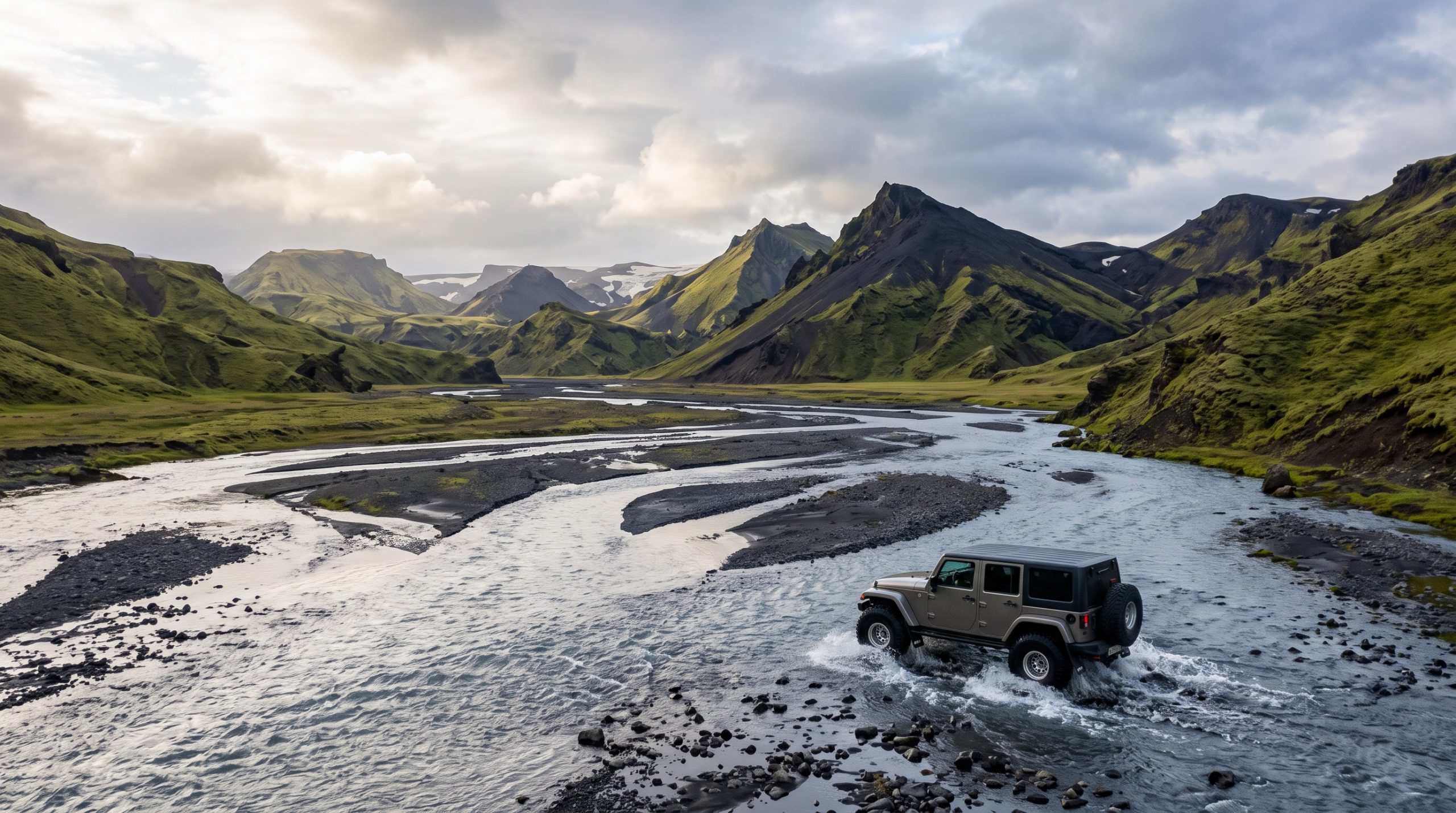
Icelandic car rental agreements do not cover Krossá. That single line of small print shapes every elopement in Þórsmörk, because Krossá is the last unbridged crossing before Básar and it moves. The channel that was ankle deep at nine in the morning is somewhere else by afternoon, fed by three glaciers that never stop melting. So the way in is a modified super jeep with a driver who has already crossed that day, or the scheduled highland bus, which is a high-clearance machine built for the same water.
What you get for that inconvenience is the greenest valley in the Icelandic highlands. Birch woods that the Icelandic Forest Service has protected for more than a century, growing thick on ground that most of the interior gave up on. Ridges high enough on all sides that the wind you fought on the south coast simply stops. Eyjafjallajökull, Mýrdalsjökull and Tindfjallajökull close the horizon in every direction except west.
This is what we have learned building ceremony days in there: where you can actually stand, what each walk costs in wedding clothes, the hour the sun leaves the valley floor, and who is legally allowed to marry you at the end of a gravel road.
The valley, the river and the vehicle
Þórsmörk sits at the end of F249, about four hours from Reykjavík on the highland bus and open only in summer, once the Road Administration has inspected the crossings. Couples marry on the birch floor at Húsadalur, in Stakkholtsgjá canyon, or on Valahnúkur at 465 metres. An Icelandic licensed officiant is required.
Gravel, water, and the crossing that decides the day
You leave the Ring Road near Hvolsvöllur, and road 249 runs east along the Markarfljót plain before it becomes F249 and the surface turns to coarse gravel. Nothing about it is steep. What makes it slow is water. The crossings start small and get bigger the deeper you go, and the last of them, Krossá, is the one people stand and watch for a while before they commit to it. That is why the honest options are two: a chartered super jeep, which is one of the few things billed outside our fee, or the highland bus that leaves the BSÍ terminal in Reykjavík early in the morning and takes roughly four hours to reach the valley.
The bus sets everyone down at Húsadalur. From there, Langidalur is about half an hour on foot and Básar, on the south side of the river in Goðaland, is about forty five minutes, including the footbridge over Krossá. That bridge is worth understanding before you plan a spot around it. It is a movable structure, placed for the summer and repositioned by rangers as the river shifts its channel, so it is not in the same place every season. We confirm where it stands on the morning, and if the crossing is not in play that day, the whole timeline gets built on one bank.
In wedding clothes, the Húsadalur to Langidalur walk is genuinely fine. It is a wide vehicle track of packed gravel with no exposure and no scramble, and we have walked it with a dress carried in a bag and boots on. The footbridge is planks and a handrail, crossed one at a time, unglamorous and quick. What does not work is doing that walk in heels, or dragging a long hem the last stretch through the riverbed, where the gravel is loose and studded with wet stones.
Where you can actually stand
Þórsmörk is not one viewpoint. It is a dead-end valley split by Krossá, with three separate hubs and a set of spots that ask very different things of you. The table is our working shortlist, ordered by how much walking each one costs.
| Spot | Walk from nearest hut | Ground underfoot | What it gives the film |
|---|---|---|---|
| Húsadalur birch clearing | Five minutes | Soft moss and leaf litter | Shelter, close sound, green in every frame |
| Langidalur riverbed | Ten minutes | Loose grey gravel, braided channels | Scale, wide sky, Valahnúkur as backdrop |
| Stakkholtsgjá canyon | Roadside start, 45 minutes in | Black sand, boulders, shallow stream crossings | Hundred-metre walls, waterfall in the side cleft |
| Valahnúkur summit, 465 m | About an hour up from Langidalur | Steep dirt steps, loose gravel near the top | The full three-glacier panorama from the ground |
| Básar and Goðaland | Forty five minutes across the footbridge | Firm woodland tracks, then scree slopes | Views back into Þórsmörk from the south |
Two of those deserve detail. Stakkholtsgjá starts straight off F249 at the mouth of the reserve and runs about two kilometres between walls that stand roughly a hundred metres high, with the waterfall hidden in a narrow side cleft around a kilometre in. It is flat the whole way and takes about forty five minutes each direction, but the floor is black sand and rounded stone crossed by shallow streams, so a long hem picks up wet grit inside the first ten minutes and stays heavy for the rest of the day. We plan the canyon for boots and carry the dress, or keep the long hem for the birch and let the canyon be the walking part of the film.
Valahnúkur is the opposite trade. From Langidalur it is a there and back of about 2.4 kilometres with a bit over 200 metres of climb, an hour to ninety minutes at a comfortable pace, on steps and loose ground that reward proper footwear and a swap at the top. The summit itself is small. Four or five people fill it, which matters when you are choosing between it and the riverbed for the vows.
Deep valley, late light
Þórsmörk sits close to 63.7 degrees north, and around midsummer the sun there rises in the north-northeast and sets in the north-northwest, with no real darkness in between. That geometry matters more here than in most places, because the valley runs east to west and opens westward onto the Markarfljót plain. The last hours of sun come straight up the valley from the lowlands, side-lighting the east-facing faces and holding on the ridge tops long after the floor has gone flat and blue.
Which means the useful instruction is not a clock time, it is an elevation. In the final two or three hours of light, the riverbed at Langidalur and the clearings at Húsadalur are already in shade while Valahnúkur and the plateau above Húsadalur are still lit. If the vows matter more than the panorama, we take the shade and use the sky as a giant softbox. If the panorama matters more, we walk up and accept that the climb sits inside the timeline.
Midday is worth being blunt about. With the sun high and the walls steep, the contrast in the canyon and under the birch is brutal, and Stakkholtsgjá at noon on a cloudless day is a grey slot with a bright stripe down it. The canyon and the glacier tongues photograph far better under an even overcast, which is why a forecast of cloud is often good news rather than bad. You can see how the valley reads on film and in stills across our published elopement stories and films, including days where the weather did the opposite of what anyone hoped.
The bus arrives late morning and leaves mid-afternoon
For a stretch in the middle of the day, Þórsmörk is busy in a way that surprises people who came for wilderness. The scheduled bus lands late morning, day tours arrive on the same road, and for a few hours the Stakkholtsgjá stream crossings have a small queue at each stepping stone and the Valahnúkur summit works as a rotation. Add the walkers coming off the 55 kilometre Laugavegur trail and down from Fimmvörðuháls, most of them arriving in the afternoon, and the campsites fill from three onwards.
Advice to arrive early does not solve this, because nobody arrives earlier than the road allows. The lever is sleeping in the valley. Húsadalur has huts, guesthouse rooms, glamping and a campsite, with a sauna and a shallow hot tub sitting around 32 degrees, plus a summer restaurant. Langidalur has the Iceland Touring Association hut, staffed from around the start of May to the start of October depending on when the road opens, with camping held back until 20 May to let the vegetation recover. Básar, on the Goðaland side, is Útivist’s ground, and the Forest Service also runs a campsite at Slyppugil. Stay one night and you own five in the morning and eleven at night, which in high summer are both fully lit hours with nobody in them.
Who can legally marry you at the end of a gravel road
In Iceland the list of people who can perform your marriage is closed and short. Civil ceremonies are conducted by district commissioners and their legally trained representatives. Religious and life-stance ceremonies are conducted by leaders of registered organisations who hold certification from the district commissioner. An ordination bought online at home carries no weight here, and a friend cannot stand in.
You can ask for a civil ceremony to be held away from the office and outside office hours. Whether that request is granted depends on the individual office and its circumstances, and there is an additional charge for it under the published tariff on top of the standard ceremony fee, currently 11,000 ISK. One detail catches almost everyone: the date you write on the marriage application is not a booking. The office treats it as an estimate, and you arrange the actual time and place with the officiant separately. Couples living outside Iceland also submit a certificate of marital status from the country where they are legally resident, alongside passports and birth certificates. Our elopement planning guide walks through the sequence of documents and decisions in order.
The ground itself is simpler than the paperwork. North of Krossá you are in the birch woods the Forest Service has cared for since the 1920s. South of the river, Básar and Goðaland belong to Útivist. There is no venue, no gate and no ticket for two people standing on marked ground with vows and a celebrant. Where a landowner or an authority does want something arranged in advance, that research and correspondence is ours; the fee itself, if there is one, is yours.
Two cameras in a riverbed, two cameras in a slot canyon
The physical space decides how a photographer and a filmmaker work together, and Þórsmörk gives us both extremes in one valley. At Langidalur the riverbed is wide open grey gravel, so our two can stand fifty metres apart on different lines and neither appears in the other’s frame; the constraint there is sound, because Krossá is loud and vows have to be recorded with the water behind the microphones rather than beside them. Inside Stakkholtsgjá the floor narrows to a few metres, the walls throw every footstep back, and two people cannot flank you without one of them being in shot, so we work in sequence instead, and the birch a few hundred metres back becomes the quiet place for anything that has to be heard clearly.
That is the whole reason we send photography and film as one team rather than two hired separately. The Adventure covers a full day with one dedicated photographer or one dedicated filmmaker, from $4,900, and The Expedition puts a dedicated photographer and filmmaker on the ground together from $7,900, with professional audio for the vows where conditions allow. Team travel is included worldwide, flights and accommodation with it, so the Iceland premium does not land on your invoice. Highlights reach you in five days and the full gallery or film in three weeks.
Common questions
Does the footbridge over Krossá stay in place all summer?
It is a movable bridge, set for the summer season and repositioned by rangers as the river changes channel, so it is not always in the same spot from one year to the next. We check its position the morning of your day and, if crossing is not sensible, we build the entire timeline on the bank you are already standing on.
Can we drive ourselves into Þórsmörk in a rental 4×4?
Standard Icelandic rental agreements exclude river crossings, and Krossá is the last one before Básar. Almost everyone arrives either with a chartered super jeep and a local driver or on the highland bus from Reykjavík. Both work for a ceremony day and they produce quite different timelines, so tell us which one appeals and we will shape the hours around it.
Is there anywhere to change out of hiking boots and into a dress?
Yes, at all three hubs. Húsadalur has guesthouse rooms and huts and a summer restaurant, Langidalur has the touring association hut, and Básar has Útivist’s hut. We put a changing window into the timeline at whichever hut sits closest to your ceremony spot, and your clothes travel in dry rather than on you.
How early in the year can we plan a ceremony in Þórsmörk?
The valley opens when the Road Administration has inspected F249 and declared it passable, which usually happens in June, and the huts follow the road. For a late May date we plan on the lowland side around the Markarfljót and Seljalandsfoss, keep Þórsmörk as the upgrade if the road is early, and tell you honestly which it is likely to be.
Can our vows be heard on film with the river that close?
Krossá is loud where it braids, and no microphone strips that out afterwards. We site the vows so the water sits behind the recording position, or move a few hundred metres into the birch, where the sound drops away quickly. Audio placement is part of the timeline rather than something improvised on the day.
One road, one summer window
Þórsmörk gives you a valley where the wind stops, birch to your knees, and glacier ice above the treetops in three directions, and it asks for a driver, a river reading and a plan built around a bus timetable in exchange. We currently have Iceland elopement dates available through 2027–2029, and the destination guides in our Iceland and worldwide elopement guides will tell you whether this valley or the black beaches down on the south coast suit the day you have in your head. Everything with us happens in writing, at whatever hour suits you: send the inquiry form and you will have a reply and our first brochure within 24 hours, then a tailored proposal, then a 30% retainer and the planning starts. Start Your Story.