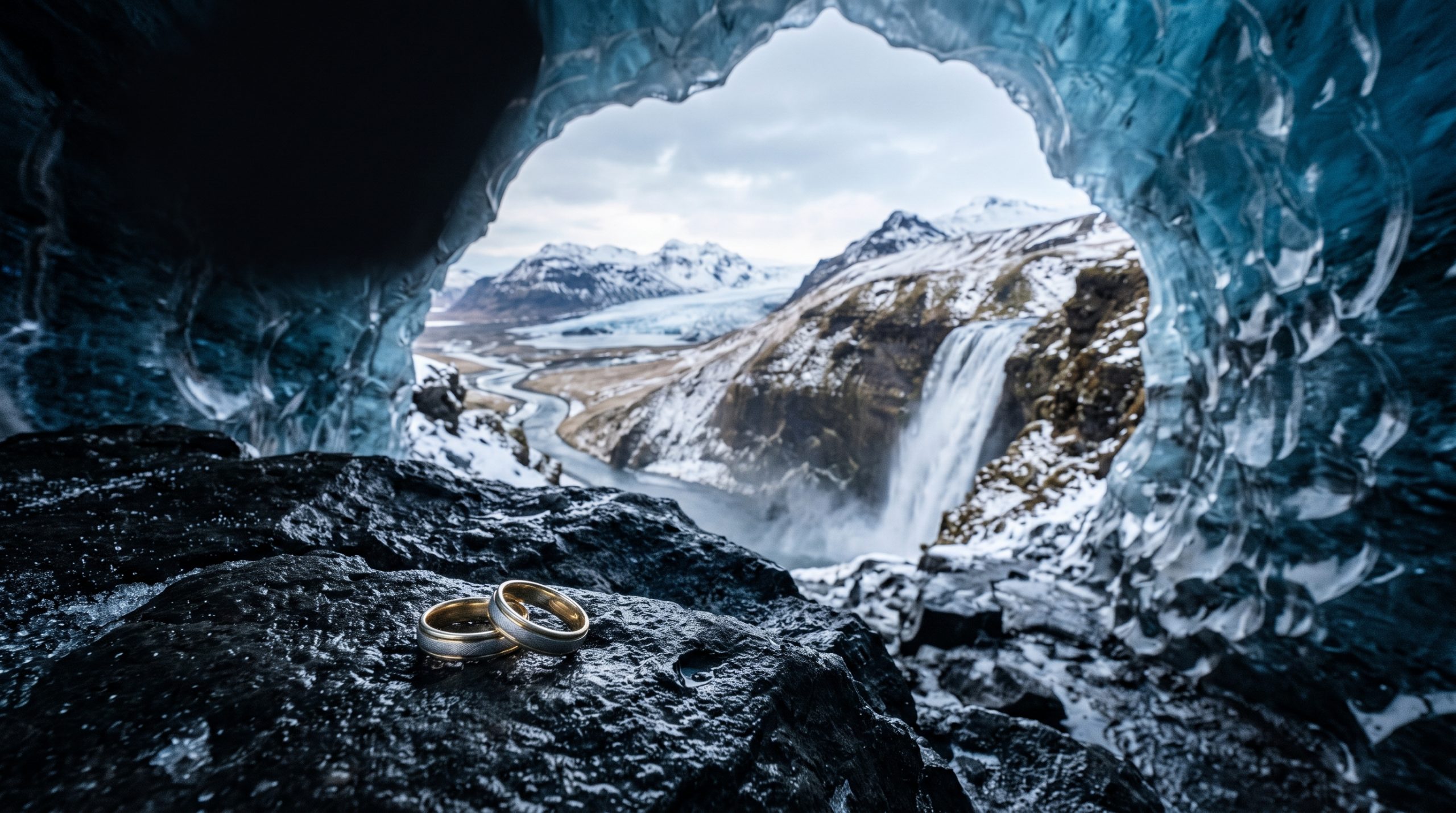
A band that fits perfectly in an American August fits differently at 0°C. That is the year-round temperature inside the ice tunnel cut into Langjökull, and it is roughly what your hands meet in a natural cave under Vatnajökull in February. Blood leaves the fingers to protect your core, the finger gets narrower, and the ring that would not budge at home turns into a loose band on a wet hand.
Then the two things that always happen next. Gloves come off for the vows, gloves go back on afterward, and a band can travel out with the glove without anyone feeling it go. Meanwhile the exchange itself is happening on a cave floor running with meltwater, or on a waterfall boardwalk where the gaps in the grating are wider than a ring.
None of this is a reason to leave the rings at the guesthouse. It is a reason to treat the exchange as logistics, planned with the same care as the drive and the guide’s meeting time. This is how we build it into a day on Icelandic ice and in Icelandic spray.
Why the cold does most of the work
Rings go missing in cold, wet places for one boring reason: cold hands. Blood vessels in the fingers constrict to protect your core, the finger narrows, and the metal contracts slightly too. Wet skin, slowed fingers and a glove being pulled off do the rest. Plan the exchange properly and it stops being a problem.
Four ways a band goes missing between the car and the vows
Every one of these is ordinary. None of them involves anybody being careless, which is exactly why they keep happening to careful people.
| Where it happens | What actually goes wrong | How we plan around it |
|---|---|---|
| Peeling off a glove or mitten | The lining grips the band and lifts it off the finger, into snow or ash that hides it at once | Gloves come off before the rings go on, and back on only after a deliberate check of both hands |
| The cave floor | Wet ice slopes, and the floor carries meltwater channels that anything dropped follows downhill | The box never opens over open ice, so we move to a flat step or the daylight at the entrance |
| Grating and boardwalk at waterfalls | Gaps in the metal are wider than a ring, and spray makes wet metal slip through wet fingers | The exchange stands on gravel or grass, with the boardwalk kept for walking frames |
| The transfer vehicle | Layers get swapped in a warm cab, and the box moves from a zipped pocket into a loose one | One named person carries the box all day, in the same zipped inside pocket, from breakfast onward |
Inside the cave: crampons, headlamps and a floor that drains
Natural ice caves in Iceland are entered with certified glacier guides, and the guide decides on the morning itself which cave the group goes into, based on conditions that day. That single fact shapes the whole timeline. We plan to a meeting point and a window, never to a named cave, because the cave is confirmed only hours before you stand in it.
Season matters more here than almost anywhere else in the country. The natural caves under Vatnajökull are a winter thing, forming and holding while the cold keeps the ice stable, and they are not part of a summer itinerary inside the national park. If your date sits outside that window, ice is still available to you, in a different form.
| The ice | When it works | Getting to it | What it gives the film |
|---|---|---|---|
| Natural caves under Vatnajökull | Winter, roughly late autumn to the end of March, occasionally into April depending on the season | Certified glacier guide from a fixed meeting point, cave chosen the same morning | The blue everybody comes for, and a bright entrance that reads as real daylight |
| Katla ice cave, Kötlujökull | Year round | Super Jeep from Vík across black sand to the glacier snout, guided | Blue ice banded with volcanic ash, darker and more graphic than the eastern caves |
| Langjökull ice tunnel | Year round, a constant 0°C inside | Modified vehicles only, from Húsafell, about two hours from Reykjavík | Carved corridors and lit chambers at around 1,260 metres, opened in 2015 |
Footwear is the practical trap. Crampons need a stiff boot with a rim to hold them, so they will not go over a dress shoe or a flat, and delicate heels do not get onto the ice at all. Bring one pair of real boots you can walk a wet, uneven floor in. The other shoes travel in the bag and come out later for the indoor frames.
Caves drip constantly, so everything is wet: gloves, cuffs, the box lid, your hands. When the moment comes we want level footing, a light source that is not only a headlamp, and the open box held below both hands rather than balanced on ice. How ash bands, headlamp light and the blue at a cave mouth actually render is easier to see than to describe, and it is all in our published films and galleries.
Spray, grating and the path behind the water
The walk-behind path at Seljalandsfoss is why most couples put it on the list, and it deserves a straight description. It is a soaking. Spray direction shifts with the wind, so on some days the far side of the curtain is a wall of water rather than a view through it, and in flat overcast light at two in the afternoon the whole thing photographs like a wet rock wall with a queue on it. Early, late, and with the wind behind you, it is a different place entirely.
Parking at Seljalandsfoss is currently a flat ISK 1,000 for a standard car, paid by card at the kiosk on site, receipt on the dashboard. Skógafoss has charged for parking since 2027 at much the same level, and its car park was moved further back and roughly doubled in size, so the walk in from the car is longer than older guides suggest. That walk is when the box lives in a zipped inside pocket rather than in a hand.
Gljúfrabúi sits a short walk from Seljalandsfoss, and reaching its chamber means walking up the stream inside the gorge. Feet get wet. It is worth the wet feet for the light coming down the shaft, and it is not worth attempting in the shoes you want for the vows. For the exchange we step out of the spray zone completely, onto gravel or grass, with rock rather than metal grating under everyone’s feet.
Where the map lies: the leg no route planner shows
Route planners end where the road ends, and on an ice day the road is not where the ice is. Húsafell is about two hours from Reykjavík in a normal car, and that number is honest. The tunnel itself sits at around 1,260 metres and cannot be reached in a normal vehicle at all, so the final leg is a modified-vehicle transfer the planner does not know exists. In summer, with a 4×4, you can drive as far as the base camp at the glacier’s edge. Not to the tunnel.
The same gap opens up south and east. Your own driving toward a Katla cave finishes in Vík, and the glacier leg is a Super Jeep charter over the sand. Your driving toward a Vatnajökull cave finishes at a meeting point, and the ice leg belongs to the guide. Both add real time on both sides of the cave, plus the gear fitting before anyone moves.
Then the daylight arithmetic, which is the part that actually decides the plan. In mid-December, sunrise in Reykjavík lands around 11am and sunset falls between 3 and 4pm, giving four to five hours of usable light. A route planner that says four hours has therefore quietly spent your entire day, with darkness at both ends. Which is why pairing a Vatnajökull cave with a south coast waterfall inside one December day is technically possible and mostly a drive with the headlights on.
By early March, sunset is back near 7pm and those same two locations fit together without hurrying anybody. That is the honest trade. Tell us which of the two you care about more and we will tell you which month makes both work, or shape the whole day around the one that matters. Our destination guides go further into how the Icelandic seasons behave.
Two ring plans, and the dull one that works
Travel in stand-ins. A plain silicone or steel band for the flights, the hikes and the transfer legs means the real rings stay in their box until the minute they are needed, and your hands are still not bare in the frames along the way. The box should latch rather than press shut, and it should stay in the same zipped pocket on the same person all day.
Get the fit checked before you fly, and tell the jeweler the band will be worn at freezing point on wet hands. A sizing bead, a slightly snugger size or a fitted insert takes five minutes at a counter at home and cannot be solved on a glacier. American couples should also look at the jewelry line in their home insurance before the trip. A scheduled personal property endorsement on a homeowners, condo or renters policy covers a named piece for its appraised value instead of the low sublimit a standard policy applies to jewelry, and insurers commonly price it at roughly one to two percent of that value. Expect to supply a current appraisal, a photograph and the receipt.
How the exchange sits in a mid-December day
This is the shape of a real winter day built on that four to five hour light window, with a glacier meeting point and a waterfall in the same plan.
- 08:15 Breakfast in the dark. Layers on, boots on, box checked and pocketed by whoever is carrying it.
- 09:30 At the guide’s meeting point. Crampons, helmets, and the morning’s cave confirmed.
- 10:15 Transfer onto the ice, with the first frames as the sky begins to lift.
- 11:00 Sunrise. Entrance light at its best, and the wide frames that put you inside the scale of the place.
- 11:45 Vows and rings on level footing near the daylight, gloves already off, hands warmed for a couple of minutes first.
- 13:00 Off the ice. Hot food, dry gloves, clean socks.
- 14:00 Waterfall hour in low sun, with wind direction deciding which side of the water we stand on.
- 15:30 Sunset, then a long blue hour that flatters ice and black sand far more than midday does.
- 17:00 Indoors. The good shoes finally, candles, the quiet frames.
Two of us on the ground changes what that timetable can hold. With a photographer and a filmmaker working together, one walks ahead with the guide to read the entrance light and the footing while the other stays with you, and there are two sets of bodies and lenses in two bags rather than one kit an hour from the nearest town. If aerials belong in the film, commercial filmmaking inside Vatnajökull National Park requires an application through the park’s permit system at least 30 days in advance, and the permit conditions are specific to the project and location. Recreational drone windows are separate: in front of Skaftafellsjökull they vary by season, including before 11am or after 3pm from November through February. We confirm the commercial permit and current site conditions before any aerial is written into the film.
Both shapes of coverage, one artist or a photographer and filmmaker together, are set out on our pricing page, with our team’s flights and accommodation already inside the figure. Highlights reach you five days after the date, and the full gallery or film three weeks after. If you want the planning sequence first, our guide to eloping lays it out. When you have a month in mind, Check Your Date and we will tell you what the light does that week.
Common questions
Should we take our real rings into an ice cave, or use stand-ins?
Take the real ones, and travel in stand-ins. The plain bands cover the flights, the hikes and the transfer, and the real rings stay boxed until the exchange. The only minutes they spend on cold, wet hands are then the minutes that matter.
Where on a glacier day is the best place to actually exchange rings?
Near the cave entrance, on level footing, in daylight, with the open box held under both hands. Deep inside a cave you are working by headlamp over a floor that slopes and drains, which is a fine place to stand and a poor place to hand over something small.
Do our rings need resizing before an Iceland winter elopement?
Have the fit checked at home rather than resized on instinct. Fingers narrow in the cold, so a band that is comfortably loose in summer can be genuinely loose at freezing point. A sizing bead or an insert is a quick fix at a counter and impossible on the ice.
How far ahead do we book the glacier charter?
As soon as the date is signed and the 30% retainer is in, at the same time as accommodation. Left late, you join a scheduled departure and share the cave and its fixed window with other guests instead of having the ice and the timing to yourselves.
Do we need extra insurance for the rings while we travel?
Look at it before you fly. Standard home policies cap jewelry at a low sublimit, while a scheduled endorsement covers a named ring for its appraised value. Insurers typically ask for a current appraisal, a photo and the receipt, and price it at around one to two percent of value.
Can you fly a drone over the ice for the ring and glacier frames?
Where it is legal, safe and appropriate, yes. Commercial filmmaking inside Vatnajökull National Park requires a permit through the park’s application system, submitted at least 30 days in advance, and individual sites can carry their own restrictions. We confirm the permit and the current conditions for your date and location before an aerial is written into the film.
What to send us when you write
The month, whether ice or water is the thing you cannot leave out, and how early you are genuinely willing to be awake in the dark. That is enough for us to come back with a timeline, a base town and an honest note on what December light will and will not give you. Everything runs in writing, at whatever hour suits you, with a reply and our first brochure inside 24 hours. We are booking 2027, 2028 and 2029, so there is room to move a date to the week the light works. Tell Us Your Story and we will start with the rings and build outward from there.