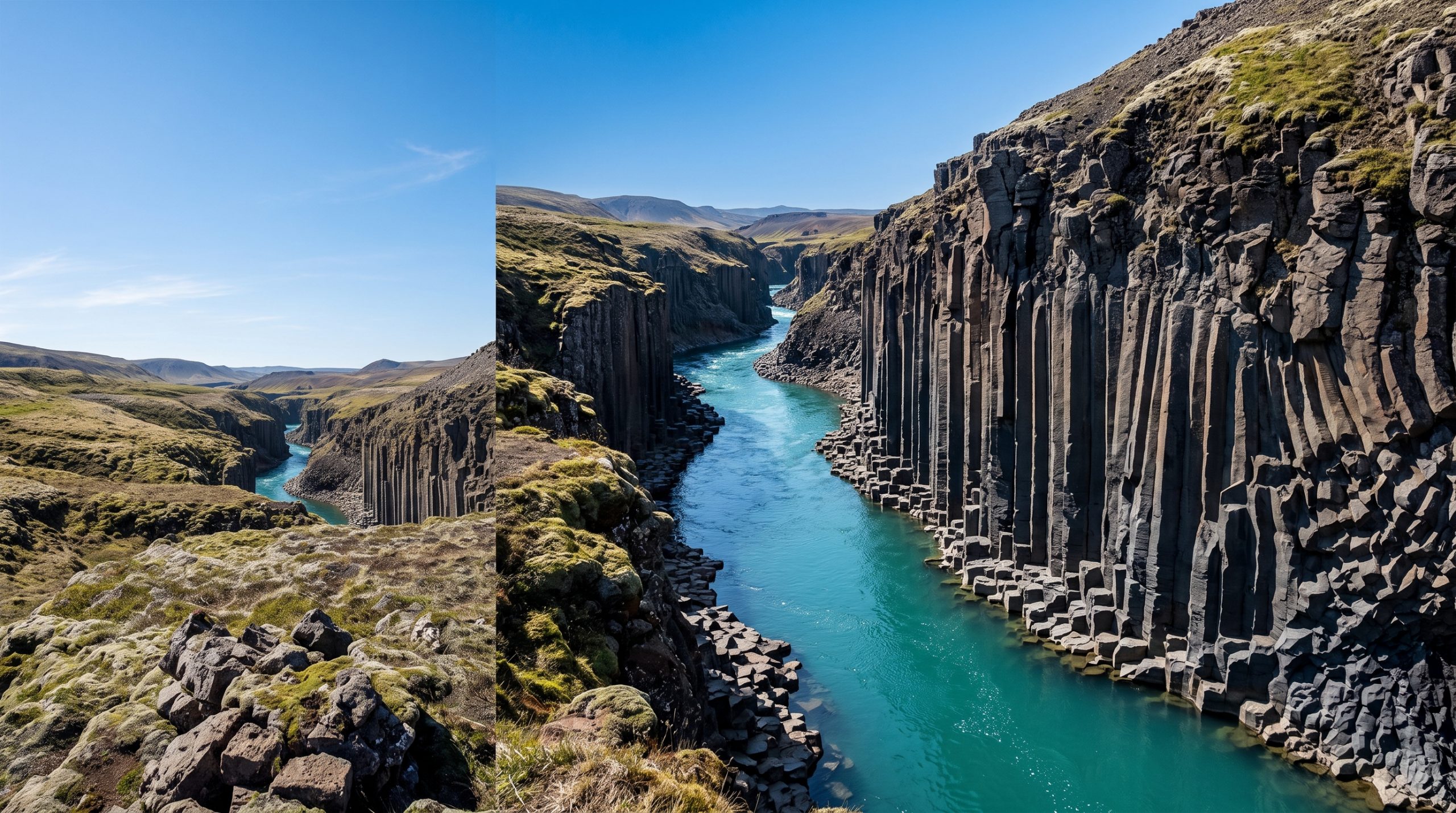
The color of the water at Stuðlagil is not a weather question. It is decided upstream in the highlands, by how full a reservoir is.
Hálslón, the reservoir behind the Kárahnjúkar dam, holds back most of the glacial flow that used to fill this gorge. That is the only reason the basalt columns are visible at all, and the reason the Jökla runs blue-green between them instead of grey. When Hálslón reaches the top it spills into the old riverbed, a hundred-metre waterfall called Hverfandi, the Vanisher, appears below the dam, and the river through Jökuldalur carries silt again.
Visit Austurland, the regional tourism board, puts that overflow most often between the beginning of August and October, and says plainly that it can happen outside those months too. So the useful question is never which month is turquoise. It is how close your date sits to this year’s spill, and what the day becomes if the river gets there first.
Which weeks are actually blue-green
Stuðlagil runs blue-green through summer and much of the winter. It goes grey-brown during heavy spring thaw, and again once Hálslón fills and overflows into the Jökla, most often from early August into October. Late June and July are the most dependable turquoise weeks, and the reservoir level can be checked before you travel.
The reservoir that decides your river
The change is not a slow fade. Hálslón fills all summer as Vatnajökull melts, tops out on a particular night, and from that night the Jökla in Jökuldalur is a different color. In some years that happens in the first days of August. In others the reservoir does not reach the lip until September. The company that operates it monitors the level and publishes it as it moves, which is the most useful thing about planning around this place: the deciding factor is a number heading one way all summer, not a rumor.
We start watching it as soon as a Jökuldalur date is on the calendar, and in the fortnight before a late-summer day we read the reservoir curve as closely as the forecast. That is what lets us tell you, early enough to matter, whether the turquoise plan or the grey plan is the one to build.
Grey is not a write-off. The columns do not change. Wet basalt after rain is darker and more graphic than dry basalt, and a silt-heavy Jökla under a black wall is a moodier frame rather than a lost one. We pull the ceremony tighter to the columns so the wall carries the picture, and we give Stuðlafoss, the waterfall beside the east car park, a bigger role in the middle of the day. The water also returns to blue-green through much of the winter, which is a genuine option if you would rather have the columns in snow than in green grass. The shape of that day is different and we will tell you exactly how before you commit to it.
Grund’s stairway, or the walk on the east bank
Two working farms sit either side of the gorge, and they offer two completely different days.
On the west bank, the marked car park at Grund has toilets and a five-minute walk to a stairway and platforms built above the gorge. It is a fine first look, and Visit Austurland is direct about the limitation: you cannot get down into the canyon from that side. You are looking across and down at the tops of the columns, which is the angle that makes them look smaller than they are. For a ceremony it puts you on a metal platform with your backs to the thing you came for.
The east bank is where the day happens. Turn off the Ring Road onto Route 923 and drive roughly 14 kilometres of gravel to Klaustursel, cross the bridge over the Jökla, and park on the east side near Stuðlafoss. From there it is 2.5 kilometres on foot to the point where the trail drops into the gorge, about 5 kilometres round trip, and the regional estimate of two to three hours with stops matches what we allow. This is the only side that puts you level with the river, inside the curve of the columns, with the wall rising over your shoulder.
| What matters | Grund, west bank | Klaustursel, east bank |
|---|---|---|
| Walk from the car | About 5 minutes, then a long metal stairway | 2.5 km each way on a farm track and grass |
| Where you end up | Platforms above the gorge | River level, among the columns |
| Facilities | Car park and toilets | Gravel car park beside Stuðlafoss |
| Time to allow | Half an hour | Two to three hours |
| Ceremony here | No, the angle flattens everything | Yes, this is the spot |
Photographed from river level the place does something no viewpoint does: the columns read as a curved wall of vertical lines with two people standing very small inside it, and the water gives you the one saturated color in a frame that is otherwise black rock and grey sky. On film it is even better, because the columns pass behind a slow walk and the geometry moves. You can see how we handle canyon and river light in our published stories and films. Highlights reach you five days after the day itself, the full gallery or film in three weeks.
What 2.5 kilometres feels like in a dress
The walk in is flat enough to be easy and rough enough to matter. Farm track, sheep-cropped grass, gravel, and boggy ground that holds water for a day or two after rain. There is no shade and nothing to shelter behind, so wind decides how the walk feels more than gradient does. A long dress will pick up wet grass along the hem in the first ten minutes, which is why we carry it in a bag and you walk in boots, then change at the top of the descent. The last few metres down to the water are uneven rock and worth taking slowly with a hand from someone. We do that stretch with you, not ahead of you with a camera up.
When the sun actually reaches the water
This is a slot in the ground with hard walls, so direct sun on the river is a middle-of-the-day event and a short one. That sounds like a problem and is the opposite. Around midday the top of one wall burns out while the base stays black, and the water loses its color to a hard highlight. Earlier and later, the gorge fills with light bounced off the columns, the blue-green sits at its deepest, and nobody is squinting through their vows.
Our default here is the late evening. This far north the June and July sun barely commits to setting, it slides along the northern horizon instead, and the hours after six give you warm light on the rim, even shade on the water and a trail with almost nobody on it. Before nine in the morning works the same way with colder color and a real chance of stillness. Between those two windows, mid-morning to mid-afternoon in July, there is a steady flow of people on the 2.5 kilometres and at the top of the descent.
River level is a ledge and a slope, not a field, and that shapes how two of us work. A photographer and a filmmaker have to agree the choreography before you start walking, because there are maybe four places to stand and any one of them is in somebody’s frame. In practice one of us takes the wall side and stays low while the other works long from further along the bank, and we swap on a signal rather than by walking through the ceremony. The Jökla is loud between stone walls, so audio goes on the collar and we set the vows a few steps back from the fastest water, which keeps the words on the film. One dedicated photographer or filmmaker for the day starts at $4,900, a photographer and filmmaker working together at $7,900, and what sits inside each of those is set out on our pricing page, including the team’s flights and accommodation to East Iceland.
Whose land it is, and what Iceland asks of you
Both banks are farmed. The car parks, the stairway, the platforms and the trail exist because Grund and Klaustursel built them, and that is worth remembering when you plan to stand in the middle of it in a dress for twenty minutes. There is no state permit for a small private ceremony in the gorge, nothing to apply for and no gate to pass through. What there is, is a courtesy: we write to the farm ahead of your date so that nobody is surprised by a tripod and a party of four on a Tuesday morning. Where a landowner or an authority anywhere does charge a fee, that part is yours to pay. The asking, the arranging and the research are ours.
The legal side of an Icelandic marriage is paperwork and an officiant, not ground permission. Ísland.is, the government’s own service, sets out that a couple without legal residence in Iceland submits a certificate of marital status from the country where they are registered, and that the District Commissioner then issues the examination certificate which you hand to your officiant before the ceremony. The same page is explicit that the estimated wedding date on your application is not an appointment, and that the place and time are arranged directly with your officiant. Which is exactly why a canyon works: the state does not book your location, you and your celebrant do. If the sequence of documents is new to you, start with how eloping abroad actually works and we will fit Stuðlagil into it.
Common questions
Is Stuðlagil still turquoise in late August?
Sometimes. Overflow from Hálslón is most common from the beginning of August into October, and the exact night the reservoir tops out moves by weeks from year to year. Some years it is the first week of August, others not until September. For any date after the end of July we build the turquoise plan and the grey plan together.
Can we get down to the river from the Grund viewing platform?
No. Grund gives you a five-minute walk and a stairway to platforms above the gorge, and the regional tourism board states outright that there is no route into the canyon from the west side. River level is reached only from the east bank, on the 2.5 kilometre trail from the car park at Klaustursel.
Do we need permission from the farm to have our ceremony in the canyon?
No permit is required for a small private ceremony on the marked access, and Iceland’s marriage rules leave the place and time to you and your officiant. Both banks are working farmland, though, so we contact the farm before your date as a matter of manners rather than paperwork.
Can our officiant meet us at the canyon instead of in Egilsstaðir?
Yes, and most do. Place and time are agreed directly with the officiant rather than assigned by the District Commissioner. Build the drive into the timeline: Stuðlagil is about an hour from Egilsstaðir, roughly an hour and a half from Mývatn, and the last 14 kilometres are gravel, so nobody should be arriving in a hurry.
Where do we change out of hiking boots?
There is no changing room at either car park. Grund has toilets, and the east side is a gravel lot beside Stuðlafoss. In practice you change at the car, walk the 2.5 kilometres in boots, and swap into shoes and dress at the top of the descent while we hold the bag and block the wind.
How early do we need to arrive to have the columns to ourselves?
Before nine in the morning, or after six in the evening. At Stuðlagil early arrival genuinely works, which is not true of every famous spot in Iceland, because the 2.5 kilometre walk filters the traffic on its own. Coach passengers who stop here tend to take the short stairway at Grund on the other bank.
From Egilsstaðir at seven, married by half nine
Our favorite shape for this valley is an evening. Leave Egilsstaðir around seven, gravel down Route 923, park past the bridge at Klaustursel and walk in through low light with the whole gorge quiet. Vows at river level around half past nine, an hour among the columns after that, then Stuðlafoss on the way back to the car while the north is still glowing. Mornings work too, and if the reservoir has spilled we will have already told you what we would do instead.
We are currently taking Iceland dates for 2027, 2028 and 2029, and the planning stays in one written thread, on your schedule rather than in a diary slot. Tell us the week you are thinking about and what you want the day to feel like, and we will come back with the light, the walk and the reservoir all accounted for. For other East Iceland ideas to pair with it, our destination guides are a good place to wander. When you are ready, Tell Us Your Story.