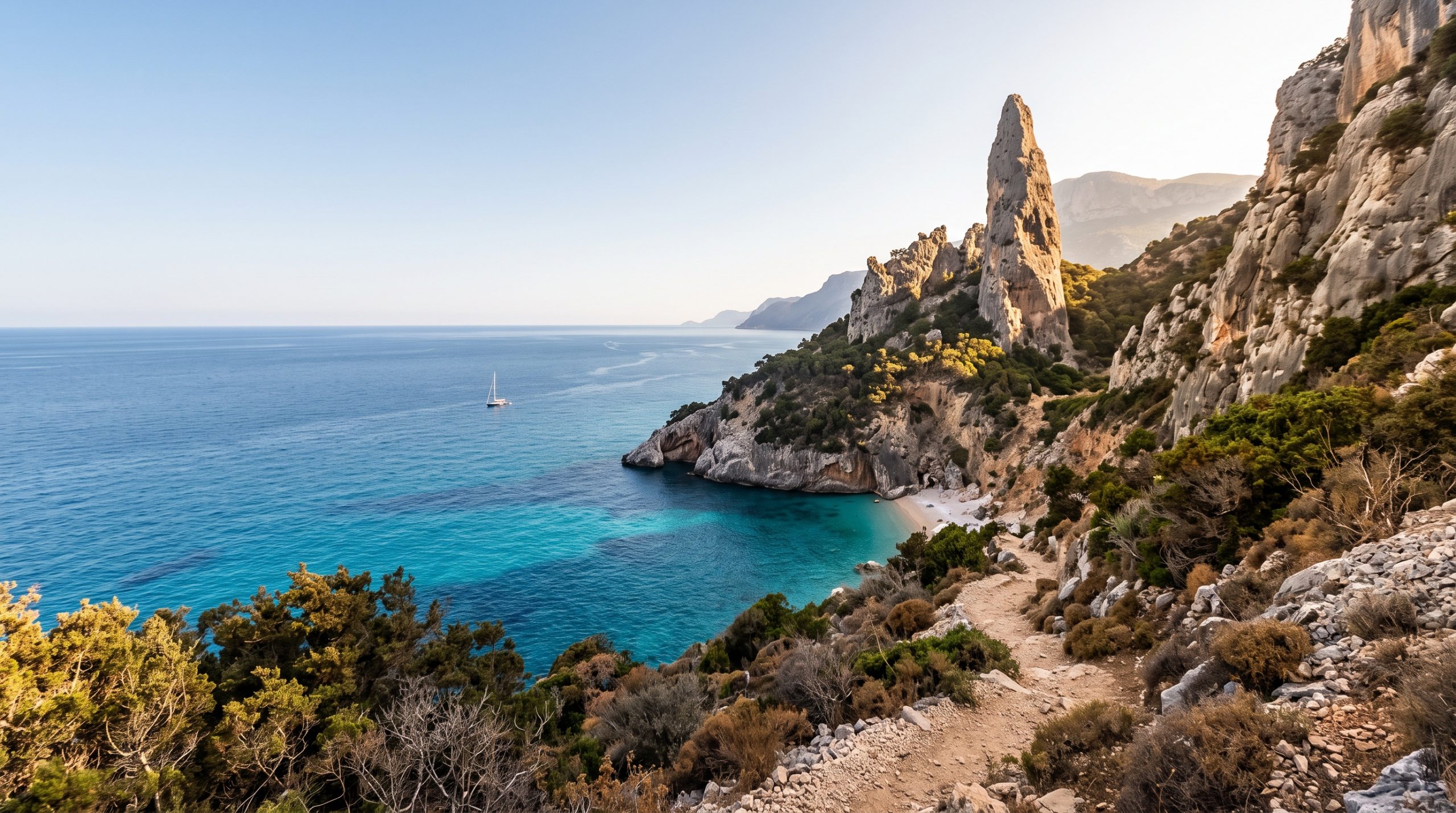
You cannot reserve Cala Goloritzé a year out. The booking window for Baunei’s most protected cove opens 72 hours before you walk, and it stays open until minutes before the trail gate lifts at 7:30. Every other part of an elopement here gets decided in months. This part gets decided in three days.
There is one exception worth knowing early. If you sleep inside the Municipality of Baunei, an enabled accommodation provider can issue you a hospitality code that opens a fourth booking day, inside a separate allowance of 150 places. Where you choose to stay changes what you are able to book, which is not something most planning pages mention.
What you are booking is 3.5 km of limestone path, roughly 470 metres of descent, and a floor of pale pebbles that a rockfall dropped there in 1962, under a free-standing spire of about 143 metres. Vows happen down there in the morning, because that is when the cove has sun, and because the trail shuts at 14:00 whether you are finished or not.
Marrying inside a 250-person cap
Yes, and the paperwork is smaller than you would expect. Access runs on a ticket rather than a venue booking: 250 people in the cove at one time, booking open from 72 hours before your date, currently 7 euros a person, mandatory April through October. The trail shuts at 14:00, so vows here are a morning affair.
Three days of notice, and a fourth if you sleep in Baunei
Booking runs through the Heart of Sardinia app or website, and it is mandatory from April through October. The ticket is currently 7 euros a person, free up to and including age five, and it covers three things at once: the trail, the car park at Su Porteddu on the Golgo plateau, and access to the beach. Restrooms are up at the trailhead, not down at the water. Tickets are not refundable.
You will see the limit described as a daily cap. The number that actually governs your morning is 250 people in the cove at the same time, and everyone in your group needs a ticket of their own, including a celebrant and anyone carrying flowers. Ten people is ten tickets and ten bodies on a narrow pebble strand with nowhere to spread out. Two people is two tickets and a completely different morning. Guest numbers change access, permits and transport here. They do not change our fee.
There are two entry slots, and only one of them is any use for a ceremony.
| Slot | When you must be at the trail entrance | What it gives a ceremony |
|---|---|---|
| Full day, 7:30 to 17:00 | Guidance is to arrive by 10:00 | Low sun coming in over the water, and the coolest walk back out |
| Afternoon, 12:00 to 17:00, when it is active | Between 12:00 and 13:30 | A cove already sliding into shade, with no ceremony light left |
Because the window is short and the tickets are firm, we build everything so that the three-day booking is the last easy step rather than the first risky one. The date is chosen for season and light, the accommodation is chosen partly for that hospitality code where it helps, and a second location is held in reserve on the plateau above. Our destination elopement guides show how the same sequencing works on other coastlines with access systems of their own.
Three and a half kilometres down, and every metre of it back up
The path is CAI 702. It starts at the Su Porteddu car park on the Golgo plateau above Baunei, reached on the road out of the village signposted for Golgo. The grade is E on the Italian hiking scale, which means a walk rather than a climb, with no equipment involved. Steady walkers are at the water in about an hour to an hour and a half. The return takes an hour and a half to two, because all 470 metres you dropped are now in front of you.
The line drops through a limestone gorge under old holm oaks, shaded for most of the way in, over rock that is polished smooth in places and loose in others. Baunei’s own guidance is blunt about two things: closed shoes with real grip, and your own water. There is nothing to buy at either end of the walk.
In wedding clothes, the honest answer is to carry them. A long skirt on 470 metres of worn limestone becomes something you manage rather than something you wear, and the gorge has enough loose stone that you want your hands free and your eyes down. Boots and shorts on the descent, dress and jacket in a pack, and you change at the bottom where the white rock gives way to pebbles. There is no cabin and no restroom at the water, so the boulders at the back of the beach are the only screen there is. We time the arrival for the quietest stretch of the morning and work facing the sea while you get ready.
Footwear at the bottom matters more than people expect. The pebbles are hard and rounded, they roll under any kind of heel, and barefoot across them is a slow, deliberate walk. Flat sandals for the ceremony hour, boots either side of it.
Then there is the exit, which is the part almost nobody plans for. You walk out of your own ceremony and immediately gain 470 metres, in full sun on the upper half, in whatever heat the day has found by then. So we put the celebrating at the top rather than the bottom: something cold waiting at Su Porteddu, the last frames on the plateau with the Supramonte behind you, and no obligation to look composed on the climb.
Southeast walls, and the hour the sun leaves
Cala Goloritzé faces southeast. The sun arrives over open water, low and level, straight into the cove, then climbs behind the wall standing above the beach. Direct light holds through the morning, and the cliffs take the beach back progressively in the afternoon: mid-afternoon around midsummer, closer to half past one by autumn. There is no evening light here at all. The cove goes cool and blue while the ridges above it are still lit.
Which means the ceremony hour writes itself. Gate at 7:30, on the pebbles around 8:45, vows while the sun is still low enough to come across the water rather than down onto it. That is also the coolest window for the climb out. Every constraint here points at the same two hours, and there is something restful about a place that decides for you.
On crowds, we would rather be straight with you: arriving early helps and it is not a solution. The gate opens for everyone at 7:30, so the first wave of the day walks down when you do, and in July and August the cove holds its 250. What we do instead is push toward the edges of the booking season, April and October rather than the middle of summer, work the first thirty minutes hard while the beach is still thin, and then move along the waterline toward the arch, where the geology does the framing and the towels behind you fall away.
It photographs unlike anywhere else on this coast, and the pebbles are the reason. Pale limestone throws light back up under a chin, so faces stay open even with the sun almost horizontal. The stone arch at the water’s edge and the spire above it give a sense of scale you cannot fake with a lens. You can see how we handle hard, high-contrast coastal light in our published galleries and films.
The beach itself is a short strand between water and boulders, and there is not much depth to it, which is exactly why a photographer and a filmmaker who already work together matter here. One takes the waterline while the other takes height on the rock toward the arch, then they trade, and neither ends up standing in the other’s frame on a strip of pebbles that narrow. Sound is the other reason. The gulf funnels wind along that wall, and vows spoken out toward the sea disappear into it, so the audio goes on you rather than on a stand hopefully placed nearby.
The boat is a view, not an entrance
Motorboats cannot land at Goloritzé and anchoring is not permitted. Tour boats and dinghies hold at the buoys, roughly 300 metres out, and strong swimmers cross from there. Only rowed craft and kayaks come in to the pebbles. A boat therefore gives you the Aguglia and the arch from the water, which is a genuinely different picture and a real option for the film, and it gives you nothing whatsoever as a way of arriving in your clothes. It is also the least dependable variable on this coast, since Grecale and Tramontana are the winds that keep the gulf’s boats at their berths. The trail runs regardless of what the sea is doing. Private charters, if you want that sea angle, sit on your side of the budget rather than ours.
Who governs the cove, and what a ceremony needs from you
The Municipality of Baunei manages access. The cove has been protected since a regional decree in 1993 and was named an Italian national monument in 1995. It is not a UNESCO site, whatever a dozen listings tell you, and that distinction matters the moment you start working out who to ask for what.
What the protection means in practice is that nothing is built here. No bar, no rented umbrella, nowhere to leave rubbish, no shade until the wall shadow arrives. You carry out everything you carried in, and Baunei runs a standing campaign asking visitors to leave the pebbles where they are: “Non portarmi via, la spiaggia è casa mia”, don’t take me away, the beach is my home. So the ceremony that works down there is portable and leaves no trace of itself: two people, a celebrant, vows on paper, flowers that go back up the hill in a pack. An arch and rows of chairs are not the shape of this beach, and anything beyond a small private gathering is a conversation with the comune rather than an assumption. Running those conversations, and the permit research behind them, is our work. The fees sit with you.
On the legal side, an Italian civil marriage is celebrated by a registrar, in the casa comunale or in a setting the municipality has formally designated for the purpose. That is a separate errand from your morning at the cove. Most couples who come down this trail with us hold the legal file at home and treat the pebbles as the ceremony that counts. If you would rather marry legally in Italy too, that happens somewhere designated for it and we build the day around both. Our notes on how to plan an elopement set out the order those pieces go in.
The couples this trail suits
This cove rewards people who like walking. Two and a half to three and a half hours of moving on the day itself, no services, hard pebbles underfoot, the best light gone by ten, and a 470-metre climb between you and lunch. Couples who read that and feel keen tend to love Goloritzé more than any other stop on the Ogliastra coast. If you read it and feel tired, tell us, and we will change the shape of the morning rather than talk you into the descent.
There is good ground either way. The Golgo plateau at the top of the trail has character of its own: open pasture, ancient holm oaks, the small church of San Pietro al Golgo, the Supramonte standing behind it, minutes from the car. Further along the same gulf, Cala Sisine keeps its sun later into the afternoon, which is the answer if you want an evening ceremony rather than an early one.
One full day with a dedicated photographer or a dedicated filmmaker starts at $4,900, and the version with both of them working the same day starts at $7,900. Longer journeys of two to seven days, across one or several destinations, are written as their own proposal. Team travel is included worldwide, delivery runs to fixed timings, and the fee does not move with your guest count. It is all laid out on our pricing page.
Common questions
Do our guests each need their own Cala Goloritzé ticket?
Yes. Every person walking down needs a booking of their own, currently 7 euros, and the cove holds 250 people at one time. Children up to and including age five are free. We book the group as one block the moment the window opens.
Is there anywhere to change into a dress at the bottom of the trail?
No. The restrooms are at Su Porteddu, at the top, and the beach has no structures of any kind. The boulders at the back of the pebbles are the only privacy available, so we plan the arrival for the thinnest part of the morning and keep the team turned toward the sea while you change.
Can we arrive by boat instead of hiking down?
Not onto the beach. Motorboats and dinghies hold at the buoys around 300 metres offshore and anchoring is not permitted, so anyone arriving that way swims the last stretch. Rowed craft and kayaks are the exception. For a ceremony, the trail from Su Porteddu is the way in.
What happens to our tickets if the weather turns that morning?
Tickets are not refundable, which is why we watch the forecast and the wind direction before the window opens rather than after. If the sea side of the day looks wrong, we move the ceremony up to the Golgo plateau, minutes from the car park, and the timeline keeps its shape.
Is 7:30 really early enough to have the cove to ourselves?
Early gets you the best light and the coolest walk, not solitude, because the gate opens for everybody at once. Real quiet comes from the season instead: April and October mornings on those pebbles feel like a different beach from the same hour in August.
Can you fly a drone over Cala Goloritzé?
Aerials happen where they are legal, safe and appropriate, and this is a protected monument with an access system around it, so we confirm permission and a time window in writing before any part of the film depends on them. Where that clearance is not in hand, the film is built from the ground, the water’s edge and the trail.
Your morning on the pebbles, from here
Our current Sardinia availability runs across 2027–2029. Send us the form and you will have a reply and our first brochure within 24 hours, then a proposal written for your date, and planning starts once the contract is signed and the 30% retainer is in. From there we work backwards from 7:30 on a specific morning: the slot, the shoes, the pack, the plan for the plateau if the gulf has other ideas. Highlights reach you five days after the day itself, and the full gallery or film three weeks after. From the first reply onward, the whole process stays in writing, at whatever hour suits your time zone. Check Your Date and tell us which morning you are imagining.