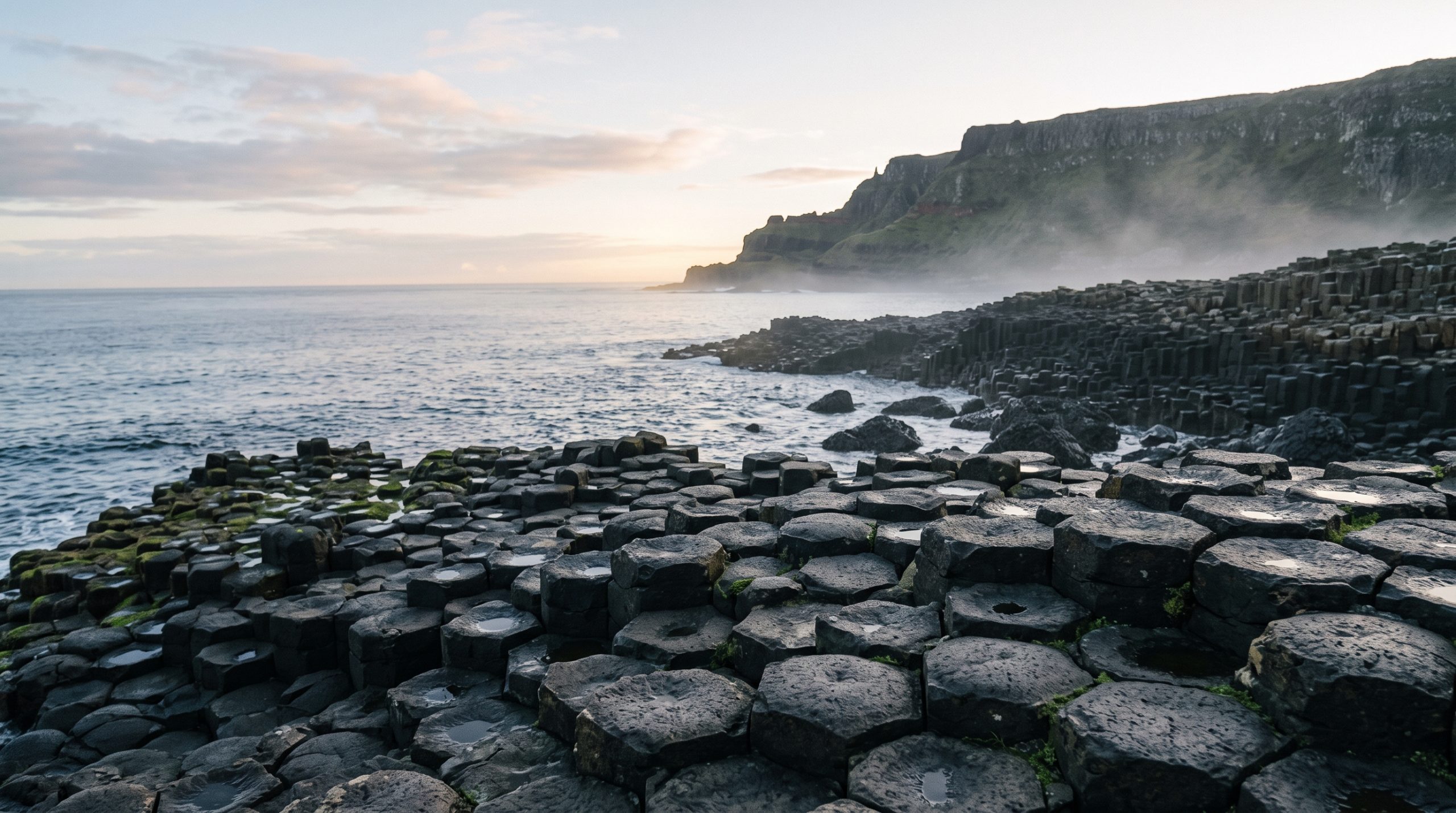
The road from the Visitor Centre down to the stones is sealed tarmac, wide enough for a bus, because a bus drives it. That one detail decides more about a Giant’s Causeway ceremony than any photograph of the place you have saved. A dress travels that half mile without drama. What changes through the day is not the walk at all. It is who else is standing on the columns when you get there.
In late June the sun clears the horizon here just before 5am, out to the northeast over open water, and it rakes along the basalt while the car park is still empty. In late December it does not appear until close to 8:50am, reaches about twelve degrees above the horizon at its highest, and never climbs far enough to get over the headland behind the bay. Same rocks, two completely different films.
The useful information about eloping here is not scenic. The fees are small and clear, the access is gentler than the pictures suggest, and the only scarce thing on this site is an hour with the pavement to yourselves.
Who has to say yes before you stand on the stones
Three parties. The National Trust owns the site and consents to commercial photography and filming on its land. Your officiant governs where vows can legally happen: a registrar needs an approved venue, while a humanist celebrant can marry you at a suitable outdoor spot. And the district registrar needs your marriage notice at least 28 days ahead.
Sunrise just before 5am, and the winter days that stay in shade
The Grand Causeway pushes north into the sea, and the cliffs of the Amphitheatre stand behind it to the south. Hold those two facts together and the lighting here explains itself. The sun never fronts those cliffs at midday. It reaches the columns from the sides, early and late, and from straight overhead in between.
In midsummer that gives you two low-light windows seventeen hours apart. First light arrives from the northeast, down the coast over the water, and it hits the seaward faces of the columns while everything behind is still blue. Last light comes back the other way, from the northwest, across Port Ganny and Weir’s Snout, and in the third week of June that is still happening at ten in the evening.
Between those windows, honestly, this is a difficult site. At one in the afternoon in July the sun sits nearly sixty degrees up and due south. The tops of the hexagons go bright and flat, the cliff wall behind falls into its own shade, and everybody squints. The single most photographed hour at the Giant’s Causeway is the hour we would least like to hand you.
Winter inverts all of it. Around the solstice the sun rises close to 8:50am in the southeast, is gone just after 4pm, and at its highest barely clears twelve degrees. The headland is taller than that angle, so Port Noffer and the causeway itself sit in soft, even shade all day. Faces look wonderful in it, and a film cut from a January morning has a consistency July midday never gives you. The light that day is up on the clifftop instead, along the Yellow Trail toward Hamilton’s Seat, which is where we spend the second half of a winter date.
In practice: in June we build the ceremony for around 5:30am or around 8:30pm, and in December we can put it almost anywhere in the short day and split the hours between shore and clifftop. If you want to see what raking coastal light does to basalt and to a linen suit before you commit to an alarm time, the films and galleries in our published stories are the honest version.
Twenty minutes downhill on a road the shuttle bus uses
From the back of the Visitor Centre, the Blue Trail runs about twenty minutes to the main part of the Causeway, and 0.8 miles to the far end where the Giant’s Boot sits. It is one continuous surfaced road, downhill on the way out, and that gradient is the thing to plan around. Coming back up in a long dress after two hours on the rocks takes closer to thirty minutes, and it is warmer work than it looks.
During Visitor Centre opening times there is a Translink accessible shuttle from the back of the building down to the stones and back, every ten to fifteen minutes, at one pound or one euro twenty per person each way, cash or card. It exists for visitors who cannot make the walk independently, and the Trust asks everyone to leave it to them first. For a sunrise ceremony the point is academic: no shuttle runs at 5am, so the walk is the plan.
Footwear is the real wardrobe question, and it is easily solved. The road is fine in anything. The columns are not: they tilt, they step, and near the seaward end they are damp where the sea reaches. Walk down in boots, carry the shoes you want in the photographs, and change on a flat column while we set up.
If someone in your group wants the clifftop view, the Shepherd’s Steps connect the upper path to the lower one in 162 steep steps, described in the Trust’s own trail notes as “not for the faint-hearted”. We do not route a wedding dress up them. We send a camera up instead, then bring it down while you walk the road. Planning around terrain like that is most of what our destination guides do.
The consent conversation: the Trust, your celebrant, 28 days
The National Trust’s position on cameras is clear. Photography and filming outdoors for private, non-commercial use is welcome at most of the places in its care, and anything commercial needs the Trust’s consent. We are paid to be there, so our cameras fall on the commercial side of that line every time. So we write to the Trust in advance with a date, an hour, the specific part of the site and a headcount, because those four things are what consent turns on.
The research and correspondence are ours. Any fee the Trust or a landowner charges is yours, the same as everywhere we work.
Then the legal side, where Northern Ireland is unusually generous. A civil ceremony conducted by a registrar has to happen in an approved venue, and the closest is the Trust’s own Causeway Hotel, where the Drawing Room is licensed for civil ceremonies over Runkerry beach and the ballroom seats up to 120. But humanist marriages have been legally recognized in Northern Ireland since 2018, and a humanist celebrant can conduct a legally binding ceremony at any location they consider suitable. That is the route that puts vows with legal weight on the basalt itself, and it is no fringe choice: in 2024, more than a thousand humanist weddings took place in Northern Ireland, around fifteen percent of all marriages that year.
Either way, the marriage notice form has to reach the registrar for the district you are marrying in at least 28 days before the date, and for the Causeway that district is Causeway Coast and Glens. Notice can be given up to a year ahead, and earlier is better. The sequence of paperwork, celebrant and permissions is laid out in our guide to planning an elopement.
Aerials are the one thing we never promise before it is signed. Flying over Trust land runs on the Trust’s written consent and is not granted as a matter of course, so we design the film to be complete without a drone and treat any aerial as an addition. Hamilton’s Seat, at the top of the Yellow Trail, looks straight down onto the Amphitheatre, and the clifftop path gives us height that no permission can withdraw.
What you pay, and what you only pay if you park
Pedestrian access to the Giant’s Causeway is free. The charge is attached to the facilities, parking included, which surprises couples who assume there is a gate somewhere between them and the stones. Here is the cost picture.
| How you arrive | What it costs | What that covers |
|---|---|---|
| On foot from the coastal path | Nothing | The stones themselves, at any hour you choose to walk down |
| Parked at the Visitor Centre | Visitor Experience ticket, peak and off-peak rates, free for National Trust members | Parking, exhibition, guided tours, audio guide, cafe, lockers |
| Causeway Coast Way car park, Innisfree Farm, 60 Causeway Road | Currently 15 pounds per vehicle, paid through the JustPark app | Parking for walkers using the coastal path network |
| Translink accessible shuttle, centre to stones | One pound or one euro twenty per person each way | A lift down and back every ten to fifteen minutes during centre hours |
| Guided Clifftop Experience | 55 pounds per person | Rambler bus to Dunseverick, 3.5 hours out and back, full Visitor Experience |
Our own coverage starts at $4,900 for one full day with a dedicated photographer or a dedicated filmmaker, and $7,900 for a day with both working together, team travel to Antrim included; the rest sits on the pricing page. Guest numbers do not move that figure. They move access, transport and the timeline, which is a different conversation and one we would rather have early.
The gap the coaches leave at either end of the day
Arrive early is advice that fails at a lot of famous places. It works here, and it works for a structural reason: you do not need the Visitor Centre to be open to reach the stones. Walk down the road at 4:30am in June and the Grand Causeway belongs to whoever wanted it enough to set an alarm.
The middle of the day is a different site entirely. Coaches and mini coaches are all pre-booked through the Trust’s north coast bookings office, so arrivals come in blocks rather than a trickle, and by the time the Trust’s guided clifftop walk sets off at 11am with its group of sixteen, the lower path is in full motion. Summer evenings reopen the door. Once the centre closes and the last shuttle stops, the road quiets while June still has hours of light left.
A 3:45am start is not everyone’s idea of a good beginning, and it does not have to be yours. An 8:30pm ceremony in late June has almost the same emptiness with warmer light coming from the opposite direction. Tell us which end of the day you actually want to be awake for and we will build the timeline around that, or tell you plainly which month makes it easier.
Where two cameras stand, and where we go when the wind turns
The good ground near the seaward end of the Grand Causeway is not large. It is a tilted stage of flat-topped columns with steps and drops built into it, which turns out to be ideal for two of us working at once. The filmmaker holds a low wide from the landward side while the photographer moves along the sea edge, and neither appears in the other’s frame, because dropping one column lower puts you under the sightline. On the exposed nose the breeze comes straight off the Atlantic and any microphone knows about it, so we move vows a few minutes east into Port Noffer, where the Amphitheatre cliffs cut a northwesterly and the audio on an Expedition day has something to work with.
Port Noffer is also the first of three answers to a hard forecast, and all three are close. It sits under the cliffs on the lower path, with the Giant’s Boot and the Organ nearby, sheltered from anything out of the northwest. Runkerry beach, at the western end, gives open sand and a long horizon, and the Causeway Hotel looks directly over it. Dunseverick Castle sits east along the clifftop with a wholly different profile: no ticket, few people, ruins on a headland.
Tide matters less than couples fear, but it is not nothing. The lowest tiers at the seaward end are where the sea actually reaches, so we set the ceremony hour against the Portrush tide table and confirm that the ground in the plan is dry ground on the day.
Common questions
Can a registrar marry us out on the Causeway itself?
No. A registrar-led civil ceremony in Northern Ireland has to take place in an approved venue, and open basalt is not one. A humanist celebrant can, since humanist marriages became legally recognized in Northern Ireland in 2018 and the celebrant chooses a suitable location. Notice still goes to the district registrar at least 28 days ahead.
Do we need Visitor Experience tickets just to stand on the stones?
Not to reach the stones. Pedestrian access is free. The ticket covers the facilities, and parking at the Visitor Centre is one of them, so most couples arriving by car buy it anyway. Walkers can instead use the Causeway Coast Way car park at Innisfree Farm for a flat charge per vehicle.
How early do the coaches actually start arriving?
Every coach and mini coach is pre-booked through the Trust’s north coast bookings office, so arrivals land in groups through the middle of the day rather than building steadily. The Trust’s guided clifftop walk leaves the centre at 11am, which is a fair marker for when the lower path is busy. Before opening and late on a summer evening are the two quiet windows.
Is there anywhere to change out of hiking boots?
There are lockers inside the Visitor Centre big enough for a small cabin bag, which handles boots, a jacket and a bag of shoes. For anything more involved, the Causeway Hotel is the closest room to the site, so couples staying there walk out already dressed and come back for a warm shower.
Will high tide cover the spot we want to stand on?
Only at the seaward end, where the lowest columns sit in reach of the sea. The wide flat area everyone pictures stays dry. We check the Portrush tide table against your ceremony hour when we build the timeline, and pick the exact columns to match.
Can you fly a drone over the Giant’s Causeway for our film?
Only with the National Trust’s written consent, which is never assumed in advance. We build the film so it stands without aerials, then add them if consent is in place. Hamilton’s Seat on the Yellow Trail already gives a raised view down onto the Amphitheatre, and the clifftop path supplies height either way.
The morning we would build, and how to start it
A June version runs like this. Notice with the registrar months ahead, Trust consent confirmed in writing, a bed in Bushmills five minutes down the road. Awake at 3:45am, walking down the sealed road by 4:20, on flat ground in Port Noffer for vows at 5:15 with the sun coming up the coast behind you. Back at the top by 7:15, before the first arrival of the day. Then breakfast, and the clifftop later for the wide frames. Highlights reach you in five days, the full gallery or film within three weeks.
Our Ireland calendar is currently open across 2027, 2028 and 2029 for the Antrim coast. We keep the planning in one written thread rather than on a schedule of calls: send us your date and what you picture, and a reply with an initial brochure comes back within 24 hours, then a tailored proposal, then a 30 percent retainer and the planning starts. Check Your Date and tell us which end of the day you want.