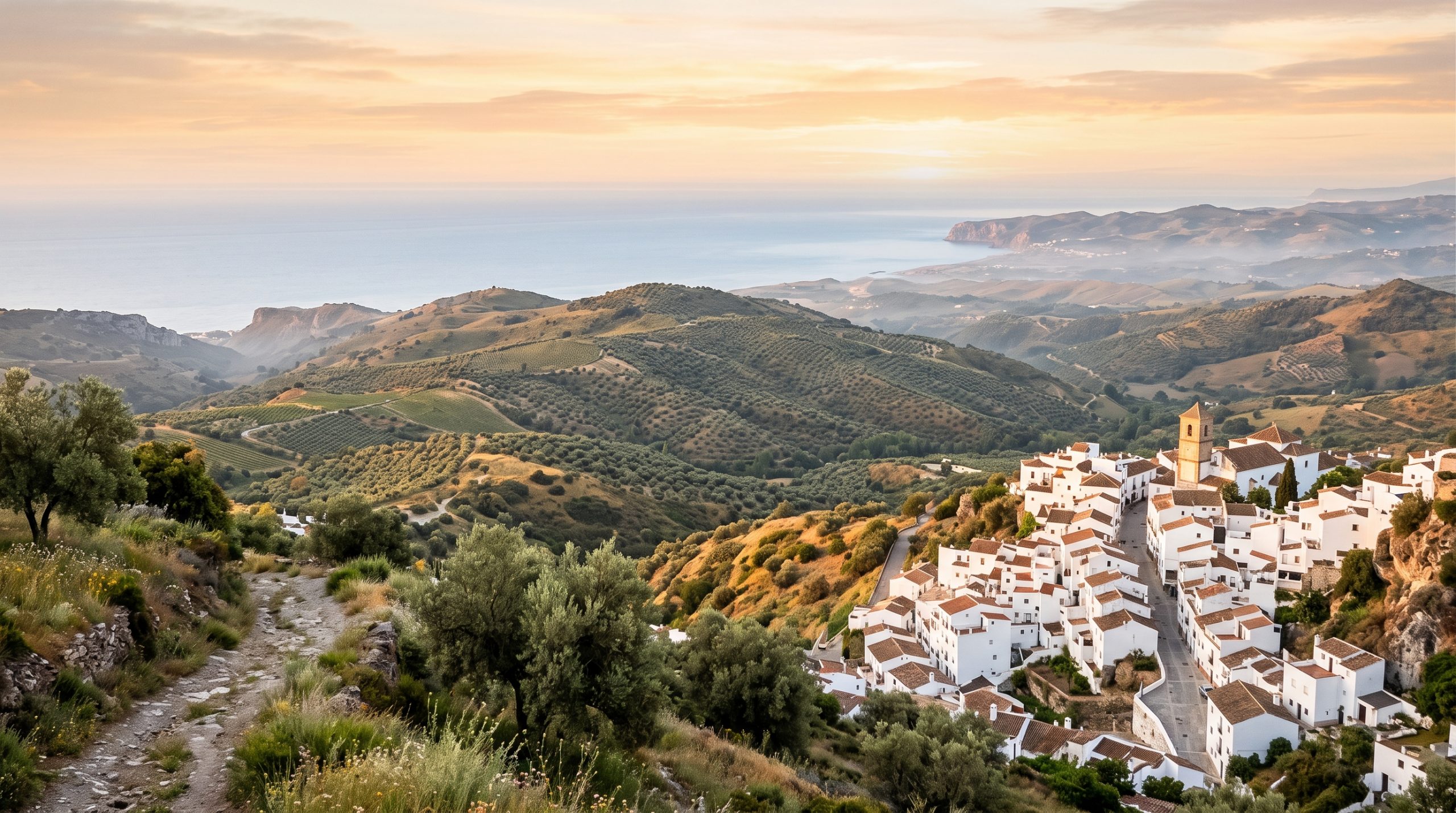
The Patronato de la Alhambra y Generalife defines an audiovisual production or a photographic commission as the capture of images, in any format, of any interior or exterior part of the monument, for editorial, advertising, commercial or cinematographic use. Your ticket gets you through the gate at Granada. It does not get your photographer through with you.
That single distinction explains most of what follows. Andalusia is eight provinces of very different ground: municipal streets in Seville, coastal public domain along the Costa de la Luz, the protected space of Sierra Nevada, walled monuments with their own boards, and a great deal of private cortijo. Each of those is governed by a different office, and each office asks a different question of you. There is no single Andalusian wedding permit.
The good news arrives early. The legal marriage is the part most couples lose sleep over, and for Americans flying in it is the part that is already settled before you pack, because it happens at home. What is left is the ground, the hour, and the office that governs both.
Residence is the one word that decides this
You cannot open a Spanish marriage file as a visitor. The registry office or notary that processes it is the one where one of you is domiciled, so couples flying in for a week marry at home first and hold the ceremony in Andalusia. What you then need is location permission, not marriage paperwork.
The marriage can be simple; the ground permission is not one-size-fits-all
Spain’s own citizens’ portal is unambiguous about who handles the file. The marriage documentation is processed by the civil registry officer or by a notary at the place of residence of one of the spouses, and the certificate confirming there is no impediment to the marriage comes from that same authority. The U.S. Embassy in Spain puts it in plainer English for its own citizens: applications are made directly to the Registro Civil or the Juzgado where at least one of the applicants resides.
Since the Jurisdicción Voluntaria reform of 2015, a notary can also draw up the preliminary marriage record and celebrate the civil marriage itself. That opened a second door, but it did not move the lock. The notary still has to be one at the place of residence of one of you.
What counts as residing there is proved with an empadronamiento certificate, the town hall’s record of who lives in its district, which the U.S. Embassy notes American residents can obtain from their local Ayuntamiento at no charge. It is a free piece of paper and it is precisely the one a visiting couple cannot produce.
So rate the two halves separately. The marriage: straightforward, and done at your county courthouse before you fly. The ground: fiddly, and how fiddly depends entirely on which of five surfaces you have chosen to stand on. Same-sex marriage has been legal in Spain since 2005, and it changes nothing anywhere in this article.
This guide helps you plan the Andalusia process; it is not legal advice. Rules can depend on nationality and circumstance, so confirm your own case with the responsible office.
Five kinds of ground, five different answers
Before anyone can tell you yes, you have to know who owns the square metre you intend to stand on. In Andalusia that is rarely the obvious answer, and the same beach can involve two authorities within fifty metres of each other.
| Where you are standing | Who authorizes it | What the permission actually covers |
|---|---|---|
| City streets and squares | The Ayuntamiento, under its own filming ordinance | A filming license, plus separate permission to occupy space and to draw on municipal services |
| Beaches and shoreline | The coastal administration for that stretch, alongside the town hall | Occupation of the maritime-terrestrial public domain with audiovisual activity |
| Sierra Nevada and Andalusia’s protected spaces | Junta de Andalucía | Professional film and photography treated as a public-use activity inside the protected space |
| The Alhambra and Generalife | Patronato de la Alhambra y Generalife | Filming and photography, assessed zone by zone and by the content itself |
| Cortijos, private estates, hotels | The owner | Access, hours, and what you may do once you are inside the gate |
City ground
Seville publishes an ordinance written specifically for audiovisual work on municipal land, and it is a useful model for how Andalusian cities think. Applications for the filming license, together with any complementary request to occupy space or to draw on municipal services, go in on a standard form through the single-window office. Fees arising from municipal services have to be paid before the license is granted, while fees for occupying space are settled once the work has finished. The city may require specific insurance policies, and its technical services may require a deposit against any damage to municipal spaces. If traffic has to be held at any point, Local Police attendance is requested and alternative routes have to be planned in advance.
None of that machinery was written with two people and a bouquet in mind, which is exactly why the wording of the application matters. The office needs an honest footprint. When the honest footprint is four adults, two cameras and eleven minutes on a corner of Plaza de España before the tour groups arrive, saying so clearly is what gets a quick answer.
Sand, and the line nobody can see
The beach is not the town’s to hand out. The strip that runs up to the reach of the waves in the biggest storms is dominio público marítimo-terrestre, coastal public domain, and Spain’s environment ministry publishes a standard application for occupying it with audiovisual activity. It asks for the municipality, the exact area, the dates and a description of what you intend to do there. Meanwhile the town hall still governs the promenade behind you, the access steps, the parking and the beach services.
Two offices, one sunrise. On the Costa de la Luz, where the Atlantic wind decides the whole texture of a morning, we also build the coastal hour around the tide and the wind direction and hold a sheltered alternative within a short drive, so the permission you hold is never the only thing standing between you and a good hour.
Protected spaces
Sierra Nevada is administered by the Junta de Andalucía through a single authorization covering public use, active tourism and ecotourism activities in the Espacio Protegido de Sierra Nevada. Its own guidance states plainly that cinematographic and photographic activities carried out by companies or in the course of professional work, such as filming, photographic reportage or advertising, must be applied for through that authorization. Doñana, over on the Huelva side, sits under the same regional administration, and access there is managed rather than open, which shapes what is realistic long before any form is filled in.
There is a seasonal layer on top of the paperwork in the mountains. Sierra Nevada holds snow high up well into spring, so an April date and a July date in the same range are two entirely different films. We build early-season days on lower ground and save the high traverses for later in the year.
Monuments that run their own gate
The Alhambra is the clearest example of a site whose board answers for itself. The Patronato treats the capture of images of any interior or exterior part of the monument for editorial, advertising, commercial or cinematographic use as something requiring its authorization, handled through its public visit and commercialization service. It distinguishes between areas that fall on the public visit route and areas that do not. It also reviews the content: only work whose character is compatible with the historic and artistic nature of the site is authorized. Admission and permission are two different things, bought from the same building.
Match the Andalusia location to the right permission route
In the order it has to happen
- The legal marriage at home, with the license issued and the certificate in hand. Nothing in Andalusia depends on it, but your marriage does.
- A date and a ceremony hour fixed to the minute, because every application asks for both and none of them accept “morning”.
- The governing authority identified for the exact spot, not the general area. A viewpoint and the road below it can belong to different offices.
- The written application, with the descriptive memo the form asks for: municipality, precise area, number of people, equipment, times in and out.
- Civil liability insurance in force, since the ordinance or the authorization can require it as a condition.
- Fees, paid where and when the rules say. In Seville, service fees are settled before the license is issued and occupation fees afterwards.
- A deposit, where technical services ask for one against damage.
- A separate authorization for anything airborne. Aerials run on their own permission and their own time window, which we confirm before the film is designed around them.
- Written landowner consent for any private ground, including hotel terraces and cortijo courtyards.
Counting backwards from the ceremony hour
Work backwards, not forwards. The hour is decided by the light, the light is decided by the month and the aspect of the valley, and only then does the paperwork have a fixed thing to describe. Reverse that order and you end up with a permission for the wrong hour, which is worse than no permission at all because it feels like progress.
The real minimum is whatever notice the governing office requires, and in a small coastal town that can be short. The comfortable minimum is a full season ahead, with the location chosen, the fallback chosen at the same time, and the application submitted while the office still has room to ask you a question and wait for an answer. We work to the comfortable minimum. We are currently booking 2027, 2028 and 2029, which means most Andalusian dates on our calendar have their permission conversations opened well before the year in question begins. If you are still deciding between provinces, our destination elopement guides are the faster way to narrow it down than any permit form will be.
The details that catch people out here
This is the section we would want if we were the ones planning. None of it is dramatic. All of it is the difference between a calm morning and a rushed one.
- A ticket is not a permission. At the Alhambra, entry and authorization to work are separate approvals from the same institution, and one does not imply the other.
- The zone matters as much as the monument. The Patronato draws a line between areas included in the public visit route and areas that are not, so “the Alhambra” is not one answer, it is several.
- Content is reviewed, not just logistics. Authorization at the Alhambra depends on the work being compatible with the historic and artistic character of the site, which is a judgement made by people, on a description you wrote.
- The beach answers to two desks. Coastal public domain and municipal beach services are different files, and being told yes by one is not being told yes by the other.
- The final municipal number can arrive after the day. Under Seville’s ordinance, fees for occupying space are settled once the work is finished, so the figure on application day is not always the closing figure.
- Insurance and a deposit are conditions, not afterthoughts. Both can be required before a license is issued, which means both have to be organized in the weeks before, not the week of.
- Originals, not copies, if you ever do go the resident route. Spanish civil registries expect the original birth certificate, and a photocopy will not open the file.
The Andalusia costs and processing windows below are a point-in-time reference, not a promise of future tariffs. Send us the location you have in mind and the month you are considering, and we will tell you which of these actually applies to it: Send Us a Message.
Legal at home, ceremony on the Andalusian ground you actually want
Arriving already married is the normal shape of an Andalusian elopement, and it is worth saying clearly that this is not a downgrade or a workaround. It is the version that gives you the most freedom, and the version many couples would choose even if the other one were open to them.
Here is what changes. There is no Spanish marriage file, no certificate of no impediment, no sworn translation into Spanish and no apostille to chase, because you are not asking any Spanish office to recognize anything. Witnesses carry no legal weight, so you can bring two friends, twelve people, or nobody at all. The date is yours to move if the forecast turns, which is a freedom no legally scheduled ceremony ever has.
Here is what does not change. The vows are the ones you wrote. The rings go on at the hour the light is best rather than the hour a registrar was free. You can read to each other on a headland above Zahara de los Atunes at seven in the morning and nobody is checking a clock. If you want to see how that reads on screen rather than on paper, our published elopement stories and films are the honest version, weather and all. And if you are earlier in the process than permits, the how to elope fundamentals cover the order to make decisions in.
Our role in the Andalusia day, and the permissions that stay yours
Photography, film and planning come from one team of eight rather than from a photographer and a separately hired videographer who introduce themselves on the morning. In permit terms that matters more than it sounds, because one application describes one group, one footprint and one set of hours.
| Ours | Yours |
|---|---|
| Destination and location design, including which side of a boundary line to stand on | The permit fees themselves, paid to the authority that issues them |
| Permit research and logistics guidance: which office, which form, what it asks for | Accommodation, celebrant and any vendors you want on the day |
| A custom timeline built around light and real travel time, with the ceremony hour held against it | Unusual transport: 4×4 charters up a mountain track, private boats along the coast, guides |
| Weather alternatives and backup locations chosen at the same time as the first choice | The legal marriage, completed at home before you travel |
| Team travel worldwide, flights and accommodation included, with no long-haul surcharge | Anything you want to add that is genuinely yours to choose |
Because the photographer and the filmmaker work from the same team, the ceremony hour gets pinned to the light rather than negotiated between two vendors with different priorities. There is always a second camera on the ground and a colleague in reserve, which is why a fifteen-minute window inside a monument or on a permitted stretch of sand can hold both the wide frame and the close one without anybody being asked to repeat a vow.
What we do not do: we are not lawyers and we do not file your paperwork. We research it, we tell you who to ask, we shape the day around what the answer allows, and we hold your date against the availability of the office or celebrant involved. Coverage runs from one full day with a dedicated photographer or filmmaker up to a multi-day route across more than one province, and the shape of each is set out on our pricing page.
Highlights reach you five days after the day itself, and the full gallery or film three weeks after that. Guest count does not change the fee. It changes access, permits, transport and the shape of the timeline, which is a different conversation and a useful one.
Common questions
Can two Americans get legally married in Spain?
Not as visitors. The marriage file is processed by the civil registry or a notary at the place of residence of one of the spouses, and the U.S. Embassy in Spain directs applicants to the Registro Civil or Juzgado where at least one of them resides. Couples flying in complete the legal marriage at home and hold the ceremony in Andalusia.
Do we need a permit to have our ceremony on a beach in Andalusia?
Assume two answers rather than one. The sand itself is coastal public domain, and audiovisual activity on it is authorized through an occupation application to the coastal administration for that stretch. The town hall governs access, the promenade and beach services. We put the same question to both offices in writing and plan around whichever answer is narrower.
Can we take wedding photos at the Alhambra?
Only with the Patronato’s authorization. It treats image capture of any part of the monument for editorial, advertising, commercial or cinematographic use as something it must approve, through its public visit and commercialization service, and it distinguishes between areas on the public visit route and areas off it. Content compatible with the site’s historic and artistic character is the standard it applies.
Do we need a permit for a small ceremony in a Seville square?
Ask. Seville has an ordinance specifically for audiovisual work on municipal land, with a standard form through the single-window office, service fees payable before the license is issued and occupation fees settled afterwards. Two people and two cameras are a small footprint, and describing that footprint accurately is what makes the request straightforward.
Is a symbolic ceremony in Spain legally binding?
No, and that is the point of it. Your legal marriage is the one completed at home, and nothing said on a headland in Cádiz province alters it. It also means no Spanish paperwork, no sworn translations, no witnesses with a legal role and no registrar’s diary deciding your hour.
Does our American marriage certificate need an apostille for Spain?
Not for a ceremony you are holding yourselves. The apostille route runs the other way: a Spanish marriage certificate is accepted in the United States once it has been legalized through the Hague apostille. If your own plans involve any Spanish office recognizing your marriage, that is the moment to ask your consulate rather than a photographer.
Can we get married in Sierra Nevada National Park?
You can hold your ceremony in the Espacio Protegido de Sierra Nevada, and professional filming and photography there require the Junta de Andalucía’s authorization for public use, active tourism and ecotourism activities. Season matters as much as paperwork: the high ground holds snow into spring, so early-year dates work better on lower terrain.
How far in advance should we start on permits?
The real minimum is whatever notice the office requires, which is sometimes short. The comfortable minimum is a season ahead, with a fallback location chosen at the same time. That is the standard we work to, and it is why our permission conversations for a given year usually start in the year before it.
Your hour, your stretch of Andalusia
Tell us the province, the month and the kind of morning you want, and we will come back with the offices that govern it, the hour the light works, and a second location for the day the wind turns. Everything runs in writing, so you can read it, sit with it and answer when your timezone suits. You will have a reply and our initial brochure within 24 hours, a tailored proposal after that, and planning begins once the contract is signed and the 30% retainer is paid.
Andalusia rewards couples who decide the hour first and the paperwork second, and we would rather help you do that in the right order: Start Your Story.