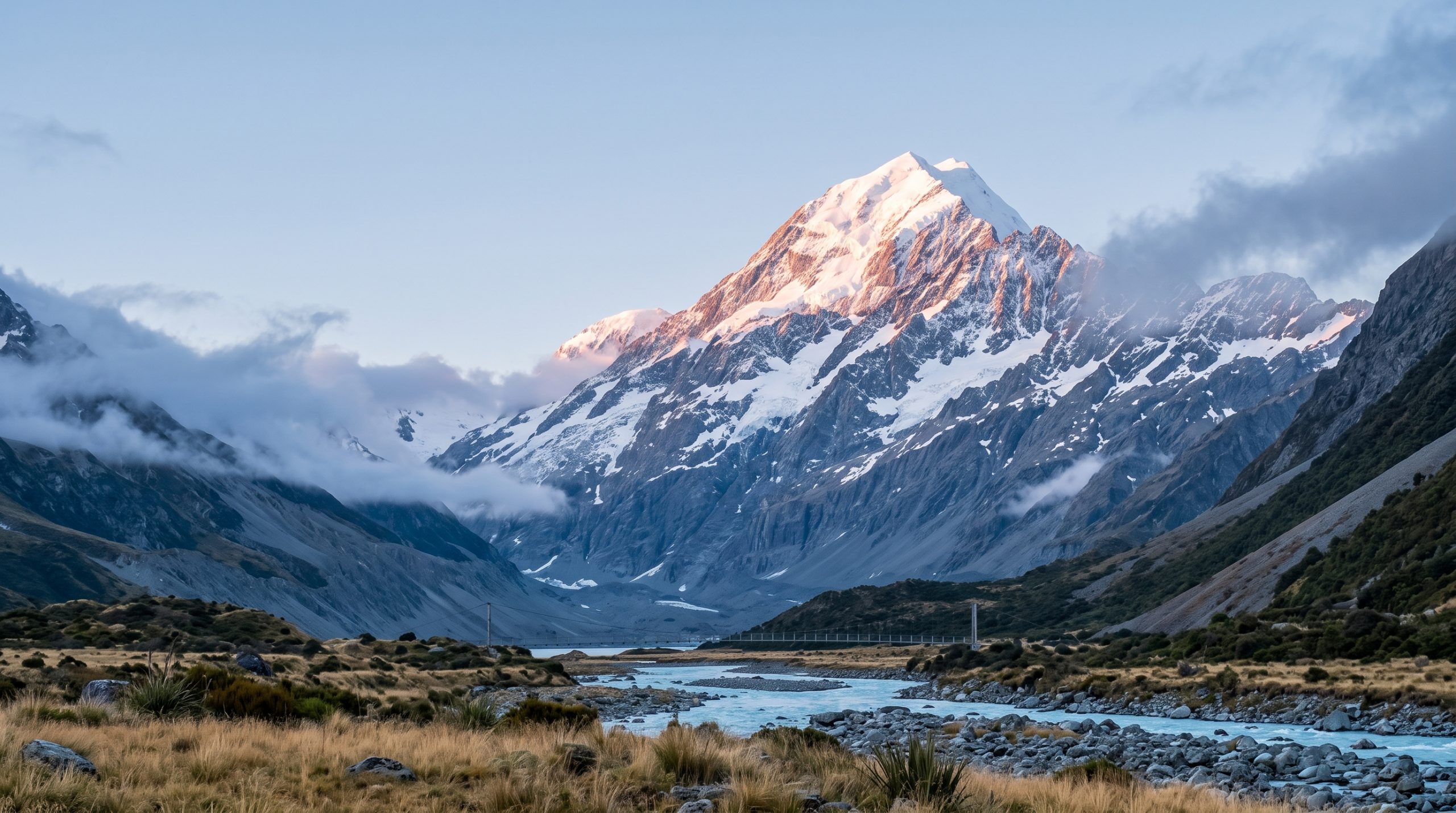
The parking machine at White Horse Hill gives you twenty free minutes. That covers unloading the car, looking straight up at Mount Sefton, and working out that the ground you actually pictured for your vows is another 5 km up the valley on foot. After that, the Department of Conservation charges NZ$2.50 per half hour or NZ$25 for the day, and you pay on arrival rather than on the way out.
That machine is Aoraki/Mount Cook in miniature. Everything here is honest about what it asks of you in time. The Hooker Valley Track is fine gravel with a few sets of steps, three swing bridges and roughly 120 m of climb spread over 5 km, finishing on the stony shore of Hooker Lake at 877 m, where icebergs sit in gray meltwater and Aoraki, 3,724 m, closes the head of the valley.
What follows is the part that decides whether a day here works. How long that walk really takes in wedding clothes, when the sun reaches this valley floor and when it leaves, which hours the track is quiet, and what we do on the mornings the mountain is buried in cloud.
Aoraki in one paragraph
Aoraki/Mount Cook National Park is public conservation land administered by the Department of Conservation. Marrying here needs a New Zealand license applied for at least three working days ahead, a registered celebrant and two witnesses. The ceremony ground most couples have in mind sits 5 km up the Hooker Valley Track from a paid car park.
The 5 km from White Horse Hill to Hooker Lake
Hooker Valley Road is the first turn on your left as you drive out of Aoraki/Mount Cook Village on SH80. It ends 2.5 km later at White Horse Hill car park, with the campground alongside it. Sites there are booked in advance rather than claimed on arrival, and campers park in the campground area rather than the car park to avoid the charge. The village has a petrol station and a small handful of places to eat. The nearest supermarket is Twizel, 70 km and about an hour away, so anything you need on the day travels in with you.
The track itself is graded easy and it earns that. Fine gravel, boardwalk over the wet ground, some steps, three swing bridges over the Hooker River. Mueller Lookout comes just before the first bridge, which matters more than it sounds: it is a genuine ceremony spot roughly twenty minutes from the car, with the Mueller glacier lake below you, for couples who would rather not spend two hours walking. Past the first bridge the track threads humps of moraine to the Kakīroa/Mount Sefton View Lookout, then works north to the upper bridge and the last open stretch to the lake. A signposted side track early on goes to Freda’s Rock, named for the mountaineer Freda Du Faur.
Official guidance puts the 10 km return walk at three to four hours. That is the figure for walking it. A wedding day is not walking it, so we build the valley at closer to five hours door to door: slower on the outward leg, the ceremony itself, time on the shore, then the walk back with the light behind you.
In wedding clothes, three things matter and nobody writes them down. The swing bridges are single file and they move under you, so a long skirt gets gathered in one hand before you step on, and the bridge decks are the windiest points on the whole walk. The gravel is pale and dusty, and a hem picks that up inside the first kilometer, which is why most couples we take up here walk in boots with the dress in a pack and change on the moraine above the lake. And the lake shore is loose stone rather than sand, so heels do nothing here except make you cautious in the exact ten minutes you want to be present. Flat shoes, or bare feet on the warm rock in February.
First light on the summit while the floor waits
This is where most planning goes wrong, because the almanac and the valley disagree. At the village in late December the sun rises at about 5:54am and sets at about 9:22pm, a fifteen and a half hour day. In late June it rises around 8:14am and sets around 5:09pm, which is under nine hours from end to end. Those are the numbers on paper.
What happens on the ground is different. The ridge on the eastern side of the Hooker stands between the trailhead and the horizon, so Aoraki’s summit snow is lit and burning orange while the gravel under your feet is still cold and blue. That gap is the best hour of the day here, and it happens before the almanac sunrise means anything at valley level.
Direction matters more than time. In midsummer the sun comes up in the southeast, at around 124 degrees, and goes down in the southwest, at around 236 degrees. Walking north up the Hooker toward Aoraki, that puts the sun behind your shoulder at both ends of the day, and the mountain is front lit morning and evening. In midwinter it rises northeast, near 58 degrees, and sets northwest, near 302 degrees, which is in front of you: the same view reads as a silhouette with light coming over the peak rather than onto it. Neither is better. They are different pictures, and knowing which one you are getting six months out changes the hour we set for the vows.
In practice, a February ceremony at the lake works between 7:30pm and the 8:48pm sunset, with the walk out finished in the long dusk. A June ceremony has to sit inside one short arc, which is oddly kind: you can shoot both ends of the day without anyone getting up at four. If you want the summit alpenglow, we leave the car park around 4:30am in late December and walk the first hour by headlamp with usable light arriving from about 5:20am.
There is not much room on the moraine track, and that shapes how two of us work. On the narrow sections one of us drops back and shoots long while the other stays ahead, because a wide frame in a gully like this has nowhere to hide a second person. At the lake it opens out: the filmmaker can take the low line along the shore while the photographer climbs the moraine for the frame that puts you against the ice, and neither appears in the other’s work. The wind off the glacier is the real problem, not the space, which is why on an Expedition the vows are recorded on body-worn audio rather than trusted to open air. You can see how the valley actually resolves on film and in stills in our published elopement stories and films.
When the car park fills, and the hour it empties
The Hooker Valley Track is the most walked track in the park, by tens of thousands of people a year, and the Tasman Valley car park on the other side of the village is regularly full between November and April. Arriving early is not the whole answer. By 7am on a February morning there is a steady line of day walkers on the moraine, and there is no camera angle that hides a queue on a meter-wide track.
The two windows that genuinely belong to you are before dawn and after about 7pm. Coaches and rental cars work to the middle of the day, and the valley empties from late afternoon. That is not a compromise hour, it is the better hour anyway.
Shorter ground: Kea Point and the Tasman Valley
Not every couple wants the full valley, and the two alternatives here are not consolation prizes. Kea Point climbs 180 m over 3 km from the village and ends on a viewing deck looking at Mount Sefton, The Footstool, the Hooker valley, the Mueller glacier lake and Aoraki itself. It is named for the alpine parrots that will absolutely come and inspect your things. The flat ground the track crosses was rearranged in 1913, when a stream from the glacier cut a channel down to the site of the first Hermitage.
The Tasman Valley is the second turn out of the village, 8 km of unsealed road and a one-way bridge to the car park. From there the Tasman Glacier View Track climbs steps for about 10 minutes to the first of the Blue Lakes, and another 5 minutes to the viewpoint over Tasman Lake and the glacier. If steps are not workable for someone in your group, the Tasman Lake and River Track leaves from the same place on the level. The valley is broader and browner than the Hooker, the peaks stand further back, and the light lasts longer in the evening because there is no near wall to the west. It is also inside the Aoraki Mackenzie International Dark Sky Reserve, and a late ceremony here can end under stars rather than under a sunset. More ideas on shaping a day like this sit in our destination elopement guides.
What DOC governs, and what you file
The Hooker Valley is sacred to Ngāi Tahu and carries Tōpuni status, a symbolic cloak of protection that recognizes that significance. That is the first thing worth knowing about standing here, ahead of any paperwork, and it shapes how we work: nothing built, nothing left, nothing staged in a way that would jar here.
The practical rules are short and clear. There is a permanent fire ban across the national park, fireworks included, so candles and sparklers are out. Dogs are not allowed. Recreational drone flying is not permitted anywhere in the park, and commercial drone work needs a DOC permit, which means aerials here are a planned item with a paper trail rather than something we decide on the morning. Parking is charged and paid on arrival.
On the legal side, you apply online through the Department of Internal Affairs at least three working days before the date, the license stays valid for three months, and you need a registered celebrant plus two witnesses aged 18 or over. The application asks where the marriage will take place, so we settle that wording with your celebrant while the timeline is being built rather than the week before. Permit research and logistics guidance are part of every experience we run; the government, venue and landowner fees themselves are paid by you, directly, at cost. If you are earlier in the process, our guide to how to plan an elopement covers the fundamentals.
Weather windows and the day that moves
Snow can close SH80, the only road in, which is the single reason we ask couples to sleep in the village or in Twizel the night before rather than drive up on the morning. It turns a road problem into a non-event.
Cloud on Aoraki is normal rather than bad luck, and a valley day works without the summit. The river runs milky green, the bridges are strong frames in flat light, and the moraine looks larger when the tops are hidden. When low cloud sits right on the floor instead, we move to the Tasman side, roughly fifteen minutes of driving from the village, where the valley is wider and the ceiling is often higher. That decision gets made the evening before, in writing, with a timeline we have already drafted twice.
Weather is also the honest argument for more than one day at the mountain. A single full day with one dedicated photographer or one dedicated filmmaker is The Adventure, from $4,900. A photographer and filmmaker working together across the same day is The Expedition, from $7,900. The Odyssey runs from two to seven days, which at Aoraki means two or three sunrises to choose from rather than one, and it is quoted as a custom proposal. Team travel is included worldwide, so flights and accommodation for the crew are not a line item you argue about. Highlights reach you in 5 days and the full gallery or film in 3 weeks. What each experience covers is set out on the pricing page.
If the 4:30am start sounds like your idea of a good morning, this valley will repay it more than almost anywhere we work. If it does not, say so plainly when you write to us. There is a version of this day that starts at nine, uses Kea Point and the Tasman Valley, and ends under the dark sky reserve, and it is a real day rather than a lesser one. Our New Zealand planning calendar currently covers 2027, 2028 and 2029.
Common questions
How early do we have to leave the car park to reach Hooker Lake for sunrise?
In late December, allow about 4:30am from White Horse Hill for a 5:54am sunrise. The first hour is walked by headlamp, with usable light from around 5:20am. In autumn the same walk starts closer to 5:30am, and in June you can arrive at the car park after breakfast and still be early.
Do we have to pay to park at the Hooker Valley trailhead?
Yes. DOC charges NZ$2.50 per half hour or NZ$25 for the day at White Horse Hill, paid on arrival, and stays under 20 minutes are free. At recent exchange rates that day rate is about fifteen US dollars. A ceremony at the lake plus the walk in and out runs past five hours, so the day rate is the one to buy.
Can we fly a drone over the Hooker Valley for our film?
Not recreationally. Recreational drone use is not allowed anywhere in the national park, and commercial flying requires a DOC permit. Where that permission is in place and conditions are safe, we fly. Where it is not, the film is built from the ground, and in a valley this vertical that is rarely a loss.
Is there anywhere to change out of hiking boots near the trailhead?
There are basic toilets and a cooking shelter at White Horse Hill campground, next to the car park, and that is the extent of it. Most couples dress in the village, 2.5 km away, drive down in boots, and change footwear at the car or on the flat moraine above the lake.
What happens if the road into the park closes on our date?
SH80 can close in snow, so we plan the night before in the village or Twizel and treat the drive as done. If the tracks themselves are unworkable, we shift the ceremony hour rather than the ceremony, and the alternatives on the Tasman side are fifteen minutes from the village.
Choosing your hour under Aoraki
The valley does not need decorating and it does not need a crowd. It needs you standing on the right patch of gravel at the right forty minutes of the day, with the walk in and out already worked out. Tell us the season you are thinking about, whether a pre-dawn start appeals, and how far you are willing to walk in what you plan to wear, and we will come back with a timeline built around Aoraki’s light rather than a template. Everything runs in writing, at your pace: you send us your dates, we reply with a brochure within 24 hours, and a signed contract with a 30% retainer starts the planning. Check Your Date.