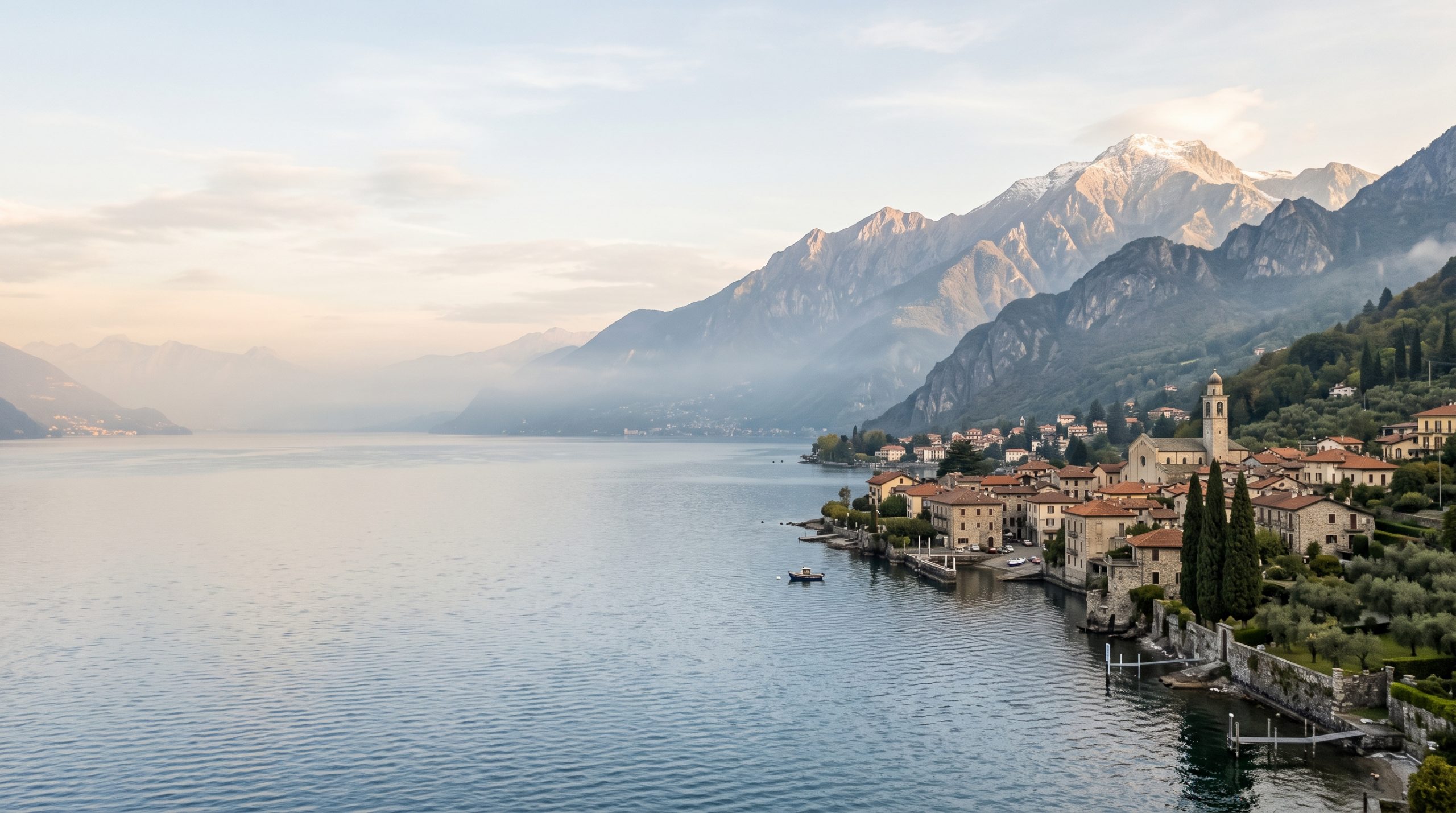
Stand on the Domaso waterfront at nine in the morning and the lake is flat enough to read a book off. By eleven it is not. The Breva comes up from the south when the night wind gives out, somewhere between 10:30 and 11:00, and once it settles it holds through the afternoon at around seven or eight meters a second. Kites go up. Sails come out of the boathouses. Almost everything about how a wedding day works at the top of Lake Como sits downstream of that single fact.
Gravedona ed Uniti and Domaso are on the western shore, looking east across open water. Colico is directly opposite, on the eastern side, in a different province. Between the three of them you get a cardinal’s palace begun in 1586, a town hall that used to be a count’s villa, a Cistercian cloister from 1257, and a shoreline that belongs to windsurfers rather than to tour groups.
This is not the Lake Como of the terraced villa gardens. It is wider, flatter and more workmanlike, the mountains stand further back, and the light does completely different things at each end of the day depending on which shore you happen to be standing on. That last part is the whole planning problem, and most people get it backwards.
Three towns, two provinces, one wind
You can elope in all three. Gravedona ed Uniti and Domaso sit in the province of Como, Colico in the province of Lecco, and each comune has its own registrar who celebrates civil marriages. Palazzo Gallio and Villa Camilla are the two rooms worth knowing about. The Breva, up from the south by eleven, sets the hour.
The Breva arrives between half past ten and eleven
The upper lake runs on two breezes. The Tivano blows down from the north overnight and into the early morning, then stops. The Breva takes over from the south, generally between 10:30 and 11:00, and it is a regular, well-mannered thermal wind rather than a squall: rarely violent, usually sitting around seven to eight meters a second. It is felt most strongly on the Lecco branch, but it climbs the whole length of the lake and Domaso is one of the stretches it works best.
What that means for a ceremony is simple and it is worth being blunt about. Vows spoken before half past ten happen over glassy water with clean sound. Vows spoken at two in the afternoon happen with a warm wind in your face, a lake full of sails behind you, and a veil that becomes a full-time occupation for somebody. Neither is worse. They are two entirely different films, and the choice has to be made months out, not on the morning.
We plan around it in three ways. Aerials and anything on flat water go in the still hour before the Breva sets in. Spoken vows either go early, or go into the lee of a building where a mic can hear you, which on this coast usually means the courtyard side of a palazzo rather than the open promenade. And anything that involves a boat, a paddle or a long train of fabric goes onto the timeline with a clear eye on the clock.
There is a second breeze worth knowing. In the evening, roughly between 18:00 and 21:00, the Montive come down out of the side valleys, weaker and less predictable than the Breva but enough to move hair and fabric again just as the light gets good. And there is a season to all of this: the Breva fades out through October and does not properly return until spring. An autumn elopement at the head of the lake is a still-water day with short light, which some couples want very much once they understand it is on offer.
Morning belongs to the west shore, evening belongs to Colico
Gravedona and Domaso face east. The first direct sun of the day crosses the water from the Legnone side and lands flat on their façades, which is why the Gravedona lakefront at seven in the morning looks like a different town from the one you walked through the previous afternoon. The corollary is the part couples rarely plan for: the sun goes down behind the ridge that stands directly behind Gravedona, so the west shore loses direct light early while the opposite bank is still fully lit.
Colico gets the reverse deal. Sitting on the eastern shore, it holds the last of the sun on its water and its stone long after the Domaso promenade has gone blue and cool. So if the picture in your head is warm low light on a couple with the lake behind them, that picture is taken from the Colico and Olgiasca side, not from Gravedona.
The lake-facing loggia at Palazzo Gallio is a morning room for the same reason. It looks out across the water at Monte Legnone and Monte Legnoncino, which means it is catching light, not backlit, in the first part of the day. Come back at six and it is a lovely shaded space with the drama happening over on the other bank.
Water does the other half of the work. Before the Breva, the surface is a mirror throwing light back up under a chin; afterwards it is textured and the bounce disappears. If you want to see how the upper lake actually renders once you work with that instead of against it, our published galleries and films are the honest version, morning flat water and windy afternoons both.
The registrar, the hall fee and the American paperwork
A civil marriage in Italy is performed by the comune, not by a venue, and that is genuinely good news here. Three towns means three registrars. You marry inside one of them and the rest of the day belongs to you, which is how a single elopement ends up touching all three places without any of them needing to grant permission for anything beyond the ceremony itself.
Palazzo Gallio in Gravedona was begun in 1586 for Tolomeo Gallio, cardinal and secretary of state to the papal throne, and designed by Pellegrino Tibaldi, the architect Carlo Borromeo used. Building work outlasted the cardinal himself. The plan is a square with four heavy corner towers linked by narrow loggias, two of which open on the façade, one toward the mountain and one toward the lake. Inside, the central hall runs two storeys high and takes concerts, exhibitions and weddings. Down the shore in Domaso, Villa Camilla was built in the early 1600s, enlarged by Count Filippo Antonio Calderara, passed through the hands of an English couple and then Count Giuseppe Sebregondi, who added the paintings and stuccowork and widened the park, and was sold to the Comune di Domaso in 1955, which turned it into the town hall. Its park runs to about 8,000 square meters and finishes at the water.
On cost, the US Consulate General in Milan, whose district covers this corner of Lombardy, gives the range for renting a marriage hall in an Italian comune as anywhere from 25 to 1,500 euros depending on the season and the day of the week. That is paid to the town, not to us. For American couples the sequence around it is an Atto Notorio, which usually takes four to 10 days unless you request the urgent version, a Nulla Osta sworn in front of a US consular officer, a declaration of intention to marry made at the town hall where you will be married, and an apostille on the certificate afterwards. Plenty of couples handle the legal file at home and keep the vows here symbolic instead; both routes are covered in our guide to planning an elopement.
Permit research and the logistics around it are part of every experience we run, along with our own travel to reach you, wherever in the world that is; the fees themselves, to a comune or a landowner, are yours. Coverage starts at $4,900 for The Adventure, with one dedicated photographer or one dedicated filmmaker, and $7,900 for The Expedition, with both working the day together, and you can read what each experience includes in full.
Piona keeps monastery hours
The Cistercian priory of San Nicolò sits out on the Olgiasca peninsula inside the comune of Colico, about 37 kilometers up from Lecco. Its cloister dates from 1257 and mixes Romanesque arcading with early Gothic, and along the walls there is a figured calendar fresco that reads right to left, beginning at December, following the old Comasco way of counting the liturgical year. The community has belonged to the Cistercians of Casamari since a donation in 1937. The monks still sell their own liqueurs, honey and herbal preparations from a shop in one of the outbuildings.
Hours matter more here than anywhere else in this article, because Piona is a working monastery and not a venue. The grounds are currently open from 7:00 to 19:00, while the church, cloister and chapter house open 8:00 to 12:00 and again from 14:00 to 18:30. The shop keeps shorter weekday hours, roughly 10:00 to 11:55 in the morning and 15:00 to 17:00 in the afternoon.
We treat Piona as a quiet visit arranged in advance with the community, never as a room to be booked, and the slot we like is the first hour after the cloister reopens at two. Outside, that is the moment the Breva is at full strength. Inside the arcade it is the calmest square of ground in the province.
Arriving by train, and the last stretch in a dress
Colico is the only one of the three with a railway station, and it is a real one: the Lecco to Colico to Sondrio and Tirano line runs through it, a branch peels off to Chiavenna, and the RegioExpress from Milan calls at Varenna-Esino and Bellano before it gets there. Milano Centrale to Colico takes around an hour and a half. Gravedona and Domaso have no station at all, which is a large part of why they stayed quiet. From Colico, the C10 and C11 buses run the western shore between Como, Menaggio and Colico, threading through both towns, and a local service from the station works its way out through Corte to Olgiasca for the abbey.
In wedding clothes, this is one of the kinder corners of the lake. There is no ridge walk and no scramble. Villa Camilla’s park and the Domaso promenade are flat and paved, and you can go from a car to a ceremony position in under a minute without changing shoes. What actually catches people out is the shoreline itself, which is stone rather than sand and tips down toward the water at an angle that a long hem will find. And there is the wind again. A cathedral-length veil on the open Domaso lakefront after eleven needs a second pair of hands, which is one of the less romantic but more useful arguments for having two of us on the ground.
Two of us on a lakefront one lane wide
The Domaso promenade is a line, not a space: water on one side, a narrow strip of paving and grass on the other. Two people working a line like that cannot orbit you, so we split along it, one long and one close, and swap ends between setups. The cloister at Piona is the opposite shape, a closed square of arcade, where a filmmaker can hold the far colonnade on a long lens while a photographer stands two meters from you and neither one lands in the other’s frame. Sound is the real constraint after eleven, when the Breva puts a steady hiss into any open mic on the waterfront, and it is why vows here go early or go behind a wall. There are eight of us at Unmapped Stories, which is why there is always a second camera on the ground and a colleague in reserve.
Common questions
How windy does Domaso actually get during a ceremony?
The Breva is a thermal breeze, not a gale. It comes up from the south between 10:30 and 11:00 and usually sits around seven to eight meters a second. Vows before that window happen over flat water with clean audio. After it, the wind is in the film whether you want it there or not, so we decide which one you are having at the planning stage.
Can we hold our ceremony inside the cloister at Piona?
Piona is a living Cistercian community rather than a wedding venue. The church, cloister and chapter house are open 8:00 to 12:00 and 14:00 to 18:30, and we arrange a respectful visit with the monks rather than book the space. The arcade photographs best in the first hour after it reopens at two.
Do Gravedona and Colico share the same town hall for the paperwork?
No. Gravedona ed Uniti and Domaso are in the province of Como and Colico is in the province of Lecco, and each comune has its own registrar. The legal ceremony happens in one of them. Everything after that, including crossing the water to the other side for the evening light, needs no further permission.
What does the comune charge for the wedding hall?
The US Consulate General in Milan puts the rental of a marriage hall in an Italian comune at anywhere between 25 and 1,500 euros, depending on the season and the day of the week. It is paid directly to the town. We do the research and the correspondence to pin down the exact figure for your date and room.
Can we do this at the top of the lake without renting a car?
Yes, with planning. Colico station is about an hour and a half from Milano Centrale on the Tirano line, and the C10 and C11 buses run the western shore from Como through Menaggio to Colico, passing Domaso and Gravedona. Transfers between locations on the day are part of the timeline we build for you.
A day that starts before the wind
The version we like most runs like this. First light on the Gravedona waterfront while the lake is still a mirror and the town is asleep. Vows in the loggia or the hall at Palazzo Gallio, or on the Domaso lakefront, finished before half past ten. A long lunch while the Breva fills in and the kites go up. The cloister at Piona once it reopens at two. Then across to the Colico side to catch the last light on the water while the shore you started on has already gone into shade. If a six in the morning start is not your idea of a good beginning, tell us, and we will build the same day backwards out of Colico with the wind in the film deliberately. Our other destination elopement guides cover the neighboring stretches of the lake if you are still weighing them up.
Everything we do runs in writing, so you can read it, think about it and reply in your own time, wherever you are. Send us your dates and a sentence about the day you actually want, and we will come back with an honest read on whether the top of the lake gives it to you. Check Your Date.