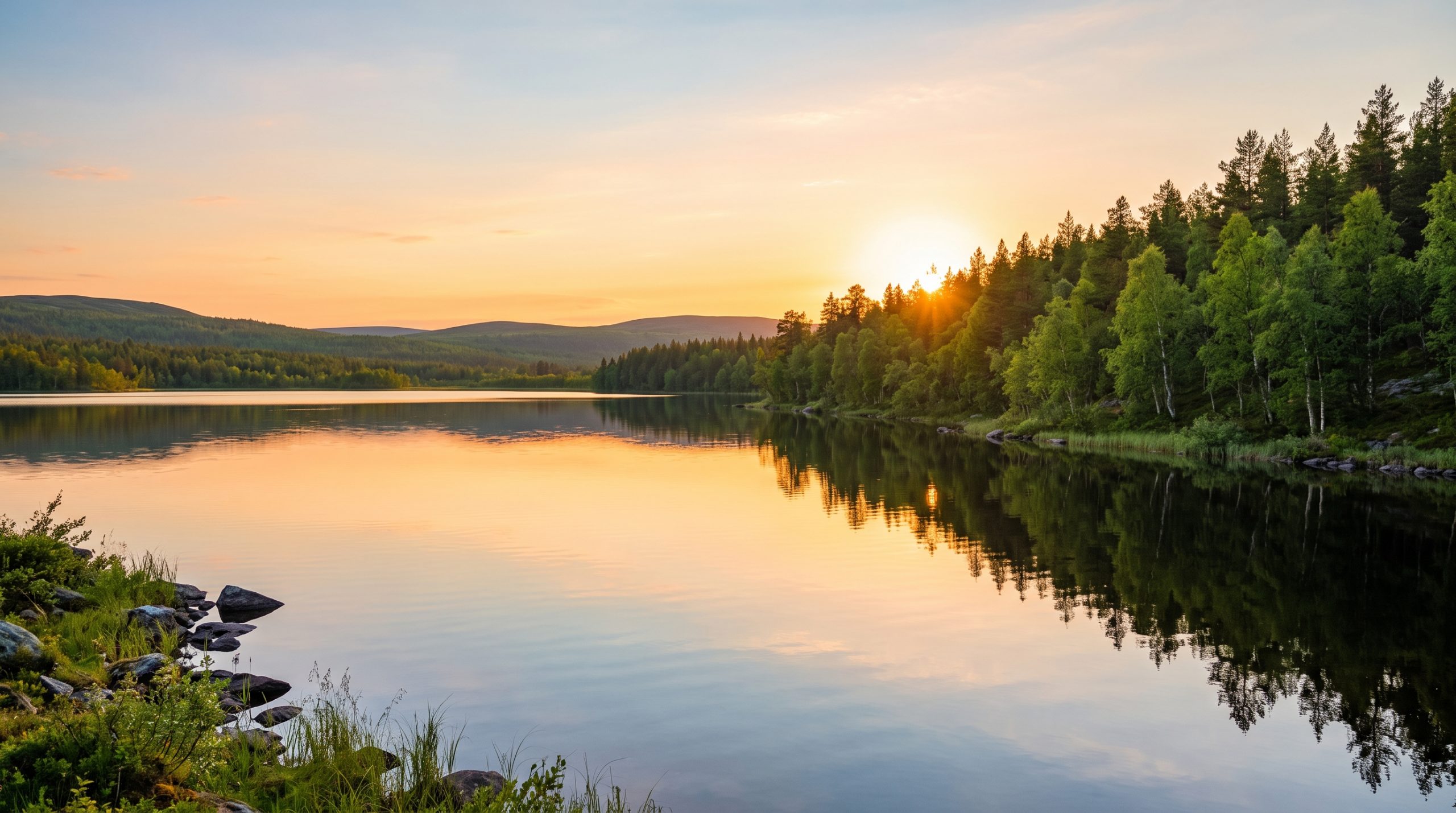
At half past midnight on 21 June, on a fell top north of Rovaniemi, the sun is still up. It is not setting and it has not risen. It sits on the horizon at roughly zero degrees of altitude, sliding sideways instead of down, throwing shadows the length of a football pitch across the heather.
Then the air stops moving, and the mosquitoes find you.
Both sentences are true about a Lapland summer, and any article that gives you the first without the second is selling you a postcard. What follows is the version with numbers in it: when the sun genuinely does not set, how long the green forest lasts, which nights the insects own, and the fortnight we would put on a contract if the choice were ours.
Why the first half of August gets our vote
The first two weeks of August. Rovaniemi still gets close to nineteen hours of daylight on 1 August, with sunset near 22:50 rather than never. The birch forest is at full green, the insect peak has broken with the cooler nights, and the summer traffic on the fell trails has largely gone home.
Snowmelt to ruska, month by month
Six windows, not four seasons. The light figures below are calculated for Rovaniemi, on the Arctic Circle; drive three hundred kilometres north to Inari and every one of them stretches.
| Window | Ground and weather | Light | Company on the trail | Our verdict |
|---|---|---|---|---|
| 15 to 31 May | Snow off the lowlands, ice going out of the lakes, birches still bare | Sunset 23:21 on 20 May, about twenty hours of daylight, no darkness at all | Almost nobody | Too raw for a green forest |
| June | Forest turns green through the month, warm afternoons, insects arrive with the snowmelt | Midnight sun at Rovaniemi from 6 June, 24 hours of daylight | Quiet, except Midsummer weekend | Book it for the sun that never sets |
| July | Warmest and wettest, around 86 mm of rain over some sixteen days | Midnight sun to 7 July at Rovaniemi, to 27 July at Utsjoki | Busiest weeks of the Lapland summer | Go north, and plan the day around räkkä |
| 1 to 14 August | Full green, cooler nights, insect numbers falling | Sunset 22:49 on 1 August, 21:55 by 14 August | Emptying fast | Our first choice |
| 15 to 31 August | First colour on the high fells, crisp mornings | Sunset 20:47 on 31 August, true darkness back for close to four hours | Very quiet | Strong second choice, with an aurora chance |
| September | Ruska colour, first frosts, insects finished | 13.5 hours of daylight on 12 September, sunset 19:59 | Finnish hikers, few others | No longer summer, often the better film |
Read the table across rather than down. The green forest of the title exists from roughly mid-June to mid-August, and the sun that never sets runs from early June to early July at Rovaniemi’s latitude. Those two windows overlap for about three weeks, and those three weeks are also the insect peak. That is the whole planning problem in Lapland, stated plainly.
Räkkä: the weeks Lapland names after its insects
Räkkä is the local word for the stretch when the insects run the place. It begins as the last snow leaves the bogs, usually in the first half of June, and holds through Midsummer week to the end of July. By mid-August the nights are cold enough that numbers drop away, and once September brings the first frosts you can stand in a willow thicket at ten at night and be left alone.
Now the part that does not appear in brochures. The best light of a Lapland summer day arrives when the air stops moving, and still, warm, damp air at eleven at night in a spruce forest is precisely what a mosquito has been waiting for. The light and the insects want the same conditions. We do not fight that hour. We move it.
- Open ground above the tree line. On the bare tops around Ylläs and Pallastunturi there is nearly always some air in motion, and the low sun has nothing to hide behind.
- Water and sand. A lake shore, a river sandbank, the deck of a boat out on Inari. Insects lose interest over open water.
- Wind direction rather than wind speed. Which side of the fell the breeze is on decides where the vows happen, and it is a five-minute call on the morning that changes the entire evening.
- Head nets and repellent in our packs, not only in yours. Long loose layers for the walk in, and the net comes off half a minute before we start working.
Audio is the honest trade. On a still July night a microphone close to the vows keeps the hum in the background of the wide shots instead of over the words, and up on an exposed top the problem inverts and we are working against wind. Our filmmakers hold both versions in their heads before anyone picks the spot, because the sound of your vows is the one thing that cannot be recovered from a different angle later.
What the light does between 9pm and 2am
Numbers first, because this is the part that changes the photographs. At Rovaniemi on 21 June the sun falls below ten degrees of altitude at 21:25 and does not climb back above it until 05:13 the following morning. Below six degrees, which is where most photographers would call it golden, it runs from about 22:20 to 04:15. That is not a golden hour. It is a golden night, close to six hours of it, and it is the strongest single argument for coming this far north in June.
Rovaniemi’s midnight sun lasts from 6 June to 7 July, and the light nights either side of it carry from late May into August. Go further north and the phenomenon becomes almost comic: in Utsjoki the run has stretched to 71 unbroken days, 16 May to 27 July. At Utsjoki on the solstice the sun’s lowest point is still more than three degrees above the horizon, so it circles the sky rather than touching the ground.
Then it tapers, fast. Sunset at Rovaniemi is 23:41 on 20 July, 22:49 on 1 August, 21:55 on 14 August, 20:47 on 31 August. By 14 August the sub-six-degree evening light is down to about eighty minutes, and by 12 September to roughly seventy, followed by two and a half hours of true astronomical darkness. That is why aurora becomes a real possibility from late August onward. Nobody can promise you the lights; a clear, dark, active night is a roll of the dice, so you plan the day around the landscape and treat an aurora as the bonus it is.
This is where having two people on the ground turns from luxury into arithmetic. In late June the low light lasts most of the night, so a photographer and a filmmaker can work in sequence, share a ridge, walk you up the same slope twice and lose nothing. On 31 August, with sunset at 20:47 and a little over an hour of usable low light, there is no second pass: the photograph and the shot happen in the same minute. That is what a dedicated photographer and a dedicated filmmaker on one day are for, and our published films and galleries show what the two of them bring back from a single Lapland evening.
Trails, fell tops and the Midsummer weekend
Summer access here is unusually generous. Finland’s everyman’s rights let you walk, stand and stay overnight across most land without asking anyone, which is why so much of a Lapland day can happen where there is no gate, no venue and no hire fee. Pallas-Yllästunturi National Park alone holds around 500 kilometres of marked summer trails, an entirely separate network from its winter routes, painted on the ground and signposted at the junctions.
Some things do need arranging. An organised event inside a Metsähallitus protected area goes through their notification process, and driving off the road network needs a permit, so we plan on foot from a legal parking place and pick locations that pay you back for a forty-minute walk. Aerials run under EU rules with a 120-metre ceiling and operator registration through Traficom, and certain protected and bird-nesting areas are closed to flight, so we confirm the site before any part of the film depends on a drone. Up high, snow lingers in the north-facing gullies long after the valleys have gone green, which pushes the first comfortable date on the high fells a fortnight later than most planning guides suggest.
Midsummer weekend, in the second half of June, is the one date in the Lapland summer that behaves like a national holiday: shops shut, offices shut, and rooms in the fell villages are taken long in advance. It is a fine weekend to marry, provided everything is held months ahead. The paperwork sits separately. Finland’s Digital and Population Data Services Agency runs the examination of impediments to marriage, and a couple arriving from abroad brings a certificate from the authority of their own country; if your officiator is not from the agency, that certificate goes to them before the ceremony. Our guide to how eloping actually works walks the sequence, and permit research is part of every experience we run.
Tell us the week you are thinking about and we will come back with what the sun is doing on those exact dates. Check Your Date.
Two windows we would move you off
The back half of May, and the first days of June. On 20 May Rovaniemi already has twenty hours of daylight and a sunset at 23:21, which sounds ideal on paper. You arrive to find the birches bare, the ground the colour of wet cardboard where the snow has only just left it, and lake ice going out in grey sheets. The green forest in the title does not exist yet. Shift three or four weeks later and the same location is unrecognisable.
The second is mid-July, if a still forest full of insects would genuinely take the shine off the day for you. Plenty of couples find räkkä funny by the second hour. Some do not, and knowing which one you are is useful information. Say so in your first message and we will build the day in early August instead, or move the whole thing to the ruska window, where our destination guides point at the same fells in the second week of September, colour at its peak for roughly ten days, and not an insect in sight.
How we build a midnight-sun day around rain and mosquitoes
July is the wettest month at Rovaniemi, in the region of 86 millimetres spread over some sixteen rainy days, and the sky is overcast or mostly cloudy about half of it. Rain is not an interruption to a Lapland summer. It is part of the design brief, and we write for it before anyone gets on a plane.
In practice that means two locations for every block of the day, chosen by wind direction rather than by which one looks best in perfect conditions: an exposed top for a west wind, a sheltered river bend for a north one, drive time between them already measured. It means a ceremony hour that can move three hours either way in July, because the low light window is eight hours wide and nothing is lost by waiting out a squall with coffee. And it means knowing that a boreal forest interior gains saturation in flat grey light, so wet birch and dark spruce are a plan B we are pleased to use rather than a consolation prize. Photography, film, planning and team travel come from one team and one fee, and the coverage options are set out here.
Common questions
Can we elope in June and actually see the sun at midnight?
Yes, at the right latitude. At Rovaniemi the sun stays above the horizon from 6 June to 7 July, so any date inside that window gives you a midnight ceremony in direct sunlight. Further north the window is wider, which is where we go if the never-setting sun is the reason for the trip.
How bad are the mosquitoes in Finnish Lapland in July?
Real, and managed by planning rather than luck. Peak räkkä runs from around Midsummer to the end of July, worst in still air near bogs and thick forest. We put the evening hours on open fell tops, lake shores and sandbanks where the air moves, carry nets and repellent, and keep sheltered forest work for the breezier afternoon.
Is there any darkness in a Lapland summer, and can we see the northern lights?
Not in June or early July at any useful latitude. Darkness returns through August: by 31 August Rovaniemi has around four hours dark enough to matter, and aurora becomes possible from late August. A late-August elopement gives you green forest by day and a genuine chance of lights, without any promise attached.
What time would our ceremony be if we come in July?
Usually between 21:00 and midnight. On 20 July the sun sets at 23:41 at Rovaniemi and the low warm light runs from roughly 21:45 to 05:00, so a 22:00 ceremony sits inside seven hours of usable golden light. That is the most relaxed timeline you will find anywhere on earth.
Does it rain a lot during a Lapland summer?
July is the wettest month of the year at Rovaniemi, about 86 millimetres across some sixteen days. Showers pass rather than settle, and with an eight-hour light window in high summer we can simply wait one out and start forty minutes later.
When does the green forest turn to ruska colour?
Northern Finland’s colour peak typically lands in the second week of September and holds about ten days, moving south from there. The dates shift by a week or more with the weather, so a September day is planned around a location that works whether the birches are gold already or still turning.
Do we need permits to elope in a Finnish national park?
Everyman’s rights cover walking and standing on most land, so a small ceremony on a trail or a fell top rarely needs anything. An organised event inside a Metsähallitus protected area goes through notification, off-road driving needs a permit, and drone flight is restricted in some zones. We research all of it; the fees themselves are yours.
What we would do with your August
If your dates are already locked into a month we would not have chosen, the answer is not to move the wedding. It is to move the hours, the altitude and the wind direction, which is what the planning work is for. A fixed mid-July date becomes a midnight ceremony on an exposed top, with the breeze handling the insects. A September date becomes a ruska film with two and a half hours of darkness at the end of it.
Our current availability runs across 2027, 2028 and 2029, and everything on our side happens in writing. Send the form with your rough dates and what you want the day to feel like, and a reply with our initial brochure comes back within 24 hours. Tell Us Your Story.