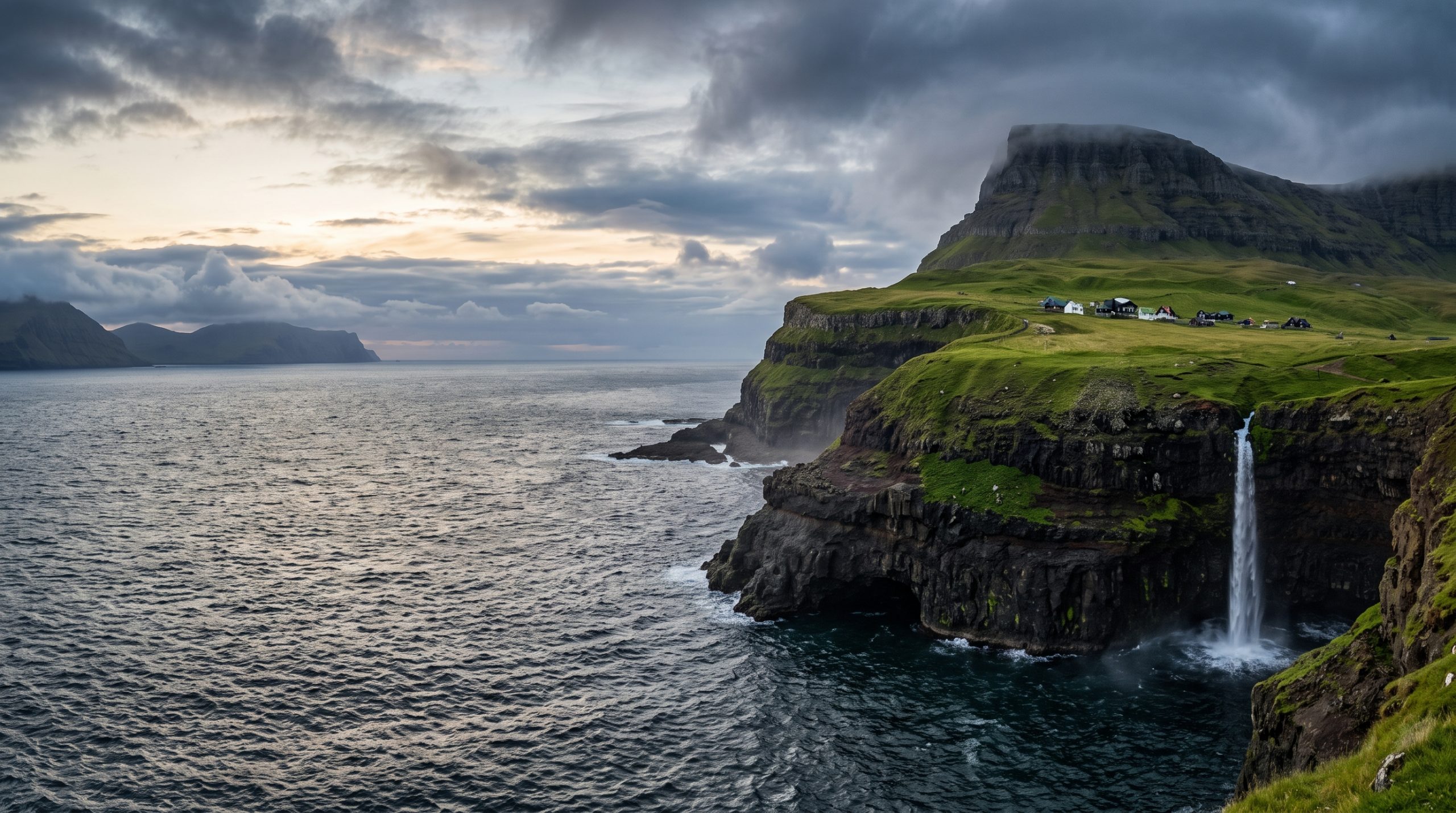
The last stretch of road into Gásadalur runs through 1.4 kilometers of single-lane tunnel with no lighting in it. Headlights on, pull into a lay-by when a car comes the other way, and then the rock opens out and you are in a valley of thirteen people with a waterfall pouring off the end of it into the Atlantic.
That is Múlafossur, and it is the image the Faroe Islands are known for. The honest part is that it is not earned. The lookout is about a five-minute walk from a parking area, which is why the fence line is busy in the middle of a July day and why nobody arrives out of breath. What makes this place worth building a ceremony around is not the walk. It is the hour.
At 62 degrees north the sun takes a long time to leave. In mid-September it drops below ten degrees above the horizon around 18:20 and does not actually set until 19:54, and all of that low light comes in off open water. So we plan Gásadalur backwards from the evening, and everything else in the day is arranged to get you standing on that grass at the right time.
Vows at the lookout, paperwork in Tórshavn
Múlafossur sits five minutes from a small parking area in Gásadalur, on the west coast of Vágar. A ceremony here works best in the last two hours of light, when the sun arrives off the sea rather than over the mountain. The legal marriage happens separately, either at home or with the municipality in Tórshavn.
Through the tunnel, and the five minutes after it
Vágar Airport is on the same island, roughly 11 kilometers east, which makes this one of the few landscapes of this kind you can stand in within half an hour of collecting a rental car. The road west runs through Sørvágur and then Bøur, where the road narrows and the sea comes up on your right. Then the tunnel.
Gásadalstunnilin is one lane wide, unlit, and dead straight, so you see oncoming headlights a long way off and there are lay-bys to wait in. Two or three minutes and you are through, dropping down a curve into the village. Everything after that is small: a handful of houses, a road that ends, a parking area, and a marked track running out toward the coast.
The walk is the part couples ask about most, and it genuinely is short. Five minutes on a made path, close to level, over grass and packed earth with fencing where the ground falls away. In wedding clothes the walk itself is a non-event. What it does not survive is rain from the night before, because the last section holds water and a long hem will find it. We keep boots on until the last twenty meters, carry the shoes, and dress the couple where the ground is dry. Thirteen people live here and their driveways are not parking spaces, so we come in one or two cars and leave the turning circle clear.
Why the light arrives late here and then stays for hours
Gásadalur is a west-facing valley with Árnafjall, at 722 meters the highest mountain on Vágar, standing over the settlement. That geometry decides your ceremony hour more than anything else on this page. In June the sun comes up at 03:38 in the north-northeast, behind the high ground. In October it comes up at 08:01 in the east-southeast, behind the ridge the tunnel runs through. Either way, sunrise happens somewhere the valley floor cannot see it, and the grass by the waterfall stays flat and cool for the first hours of the day.
The compensation is the evening, and it is generous. There is nothing between this coast and the horizon, so once the sun clears the shoulder of the land it lights the waterfall, the cliff face and the houses together, all from the seaward side.
| Date | Low light from | Sunset | Sun sets toward |
|---|---|---|---|
| 21 June | 21:10 | 23:26 | North-northwest |
| 20 August | 19:41 | 21:18 | West-northwest |
| 15 September | 18:21 | 19:54 | Almost due west |
| 10 October | 16:50 | 18:32 | West-southwest |
Read the first column as the moment the sun passes ten degrees above the horizon, which is when this place starts to look like the version of itself people travel for. In midsummer that window runs more than two hours. In mid-September it is closer to ninety minutes, which is still longer than most couples expect and long enough to hold vows, then walk, then work the falls from three positions without hurrying anyone.
There is a second thing that window gives you, and it is the reason we like this lookout more than its reputation suggests. From one standing spot you can turn twice. Face inland and the light is full on your faces with the water dropping away below you. Turn toward the sea and you are rim-lit against a bright horizon with the cliff going dark. That is two completely different sets of frames from the same patch of grass, which is worth knowing on a coast where the weather may only give you one clear hour. Our published galleries and films show what that evening angle does to skin tones and to water that is falling straight into the ocean.
On crowds we will be straight with you, because the usual advice is wrong here. Arriving early does not solve Múlafossur. Early is exactly when the valley is in shade, and it is also when the first tour vans come through the tunnel. The middle of the day belongs to the road. What thins out is the evening, once the day visitors have driven back east for dinner, and that happens to be the same stretch of clock the light is best. We put the earlier part of the day somewhere else on Vágar and bring you here late.
Which way the spray is blowing
This is an exposed piece of coast and the fall is short, so wind does visible things to it. A strong westerly lifts the plume and bends it sideways up the cliff, which is beautiful in a photograph and wet on a wool jacket. Standing position is the whole answer, and it changes day to day rather than season to season. We check wind direction the morning of and pick the side that keeps you dry, and if the ocean is throwing weather straight into the valley we hold ground back near Bøur, four minutes east through the tunnel, where the coast turns and gives you a lee.
Two of us working on a narrow shelf of grass
The lookout is not a big place. It is a shelf of grass and a fence, and a photographer and a filmmaker who have not worked together will spend the good light stepping into each other’s frames. Ours plan it before you walk out: the filmmaker takes the low line along the fence, the photographer works from higher up the slope, and neither is ever standing where the other is pointing. Sound is the other problem this spot sets, because the falling water and the wind coming off the sea are both constant here and neither of them cares about your vows. On The Expedition we put audio directly on the couple so the words survive, then let the water sit underneath them in the mix. One dedicated photographer or one filmmaker for a full day is The Adventure, from $4,900, and the two working together as a pair is The Expedition, from $7,900, with everything else set out on our pricing page.
Four weeks, two witnesses, and the drone window
There is no ticket office at Múlafossur and no booking system for the lookout. Two people saying vows on public ground at the end of a marked path, with nothing built and nothing set up, is treated the way any other visit is treated: stay on the paths, respect the signage, keep off the fenced ground. Once a ceremony involves more people, more vehicles or anything placed on the grass, it becomes a conversation with the village and the landowner instead, and that research and those approaches are part of the planning we do for you rather than something you chase from another time zone.
The legal side sits elsewhere. Civil marriages in the Faroe Islands are conducted by the municipality, and Tórshavnar kommuna marries visiting couples Monday to Thursday between 10 and 15 and on Friday between 10 and 14, when slots are free. Notice has to reach them no later than four weeks before the date, or six weeks if you want to marry in weeks 34, 35 or 36, and the Notice of Marriage form cannot be sent more than four months ahead. Ceremonies are not held in weeks 31, 32, 33 or 52. You bring two witnesses to sign the register, and if you are travelling as a pair with nobody else, the municipality can provide two members of staff instead. Afterwards you are given an international marriage certificate in Faroese and English.
Two details matter for how we plan around it. The enquiry has to come from the couple themselves rather than through a third party, so this is the one piece of the day we cannot send on your behalf, though we will tell you exactly what to write and when. And Tórshavn is on a different island from Gásadalur, which means a legal ceremony in the city and vows at the waterfall are two separate events, usually on two separate days. Plenty of couples simplify it by marrying at home first and letting the valley carry the ceremony that actually means something. Our notes on how eloping works, step by step go through both routes.
Aerials are worth planning early. Faroese drone rules require new drones placed on the market from 1 January 2027 to carry a C-mark, apply distance requirements to non-C-marked drones over 250 grams, and rule out flying over any gathering of people without specific permission. So drone footage here runs on rules and a time window, and we confirm both before we design a single shot of the film around it.
If five minutes from the car feels too easy
Some couples read all of the above and want the opposite. They want the arrival to cost them something. Before the tunnel existed, Gásadalur was reached over the mountain from Bøur on the old postman’s path, or by boat when the sea allowed it, and that path over the ridge is still walkable. If that is the day you want, tell us and we will build the morning around the climb and keep the vows for the lookout in the evening, with dry clothes waiting in the car.
Vágar carries the rest of it too. The sea stacks off Bøur and the cliff walk above Sørvágsvatn are both a short drive from the same tunnel, which is why this island reads so well as a two or three day plan rather than one stop. The Odyssey covers exactly that kind of shape, from two days to a week, and our destination guides cover how the pieces of Vágar fit around each other.
Where we would be candid: if your picture of the moment involves nobody else in sight, no July afternoon in this valley delivers that, and no amount of early rising changes it. What does change it is the hour, the month, and sometimes the island. Tell us what the moment looks like in your head and we will tell you honestly whether Gásadalur in September at seven in the evening gives it to you, or whether a different corner of the Faroes does.
Common questions
Can we legally get married at Múlafossur itself?
The ceremony that carries legal weight is conducted by the municipality, and for visiting couples that means Tórshavnar kommuna during weekday office hours, on another island. Vows at the waterfall are held as their own ceremony, with the paperwork handled either in Tórshavn on a separate day or at home before you fly.
How long is the walk to the viewpoint, and can it be done in a dress?
About five minutes from the parking area on a made, close to level path. It is comfortable in a long dress in dry weather. After rain the final stretch holds water, so we carry the shoes and change at the end of the track rather than at the car.
Does the wind ever ruin the waterfall for filming?
A westerly bends the plume sideways, which films beautifully but soaks whoever is standing in the wrong place. We choose the standing side by wind direction on the day, and if the weather comes straight into the valley we move to sheltered coast near Bøur, four minutes back through the tunnel.
Is the one-lane tunnel to Gásadalur hard to drive?
It is 1.4 kilometers, unlit and straight, with lay-bys along it. Keep your headlights on, pull in when you see oncoming lights, and you are through in a few minutes. It is the single piece of the drive couples worry about and almost never the piece they remember.
What time should we plan vows for in September?
Mid-September light drops low around 18:20 and the sun sets at 19:54, so vows somewhere between 18:30 and 19:00 leave time to say them, walk, and still work the falls in the last of the color before it goes.
Where do we change out of hiking boots, given there is nothing at the lookout?
The car is the changing room, and that is normal here. We usually have couples dress in Sørvágur or Bøur, drive through the tunnel ready, and keep boots, towels and a second layer in the car for the walk back.
Putting a whole evening together around one waterfall
A day here often looks like this: dressing in Sørvágur late in the afternoon, an hour on the coast near Bøur while the sun is still high, then the tunnel around eight, vows at the lookout as the light goes long, and the drive back east when the color finally leaves the water. Highlights reach you within 5 days and the full gallery or film within 3 weeks. Team travel to the Faroes is included, as it is everywhere we work.
Our Faroe Islands calendar is currently open across 2027, 2028 and 2029, and everything between your first message and the day itself happens in writing, at whatever hour suits you. Send us the month you are thinking about and we will tell you what the evening light is doing then, then start with a 30 percent retainer once the shape of the day is agreed. Check Your Date.