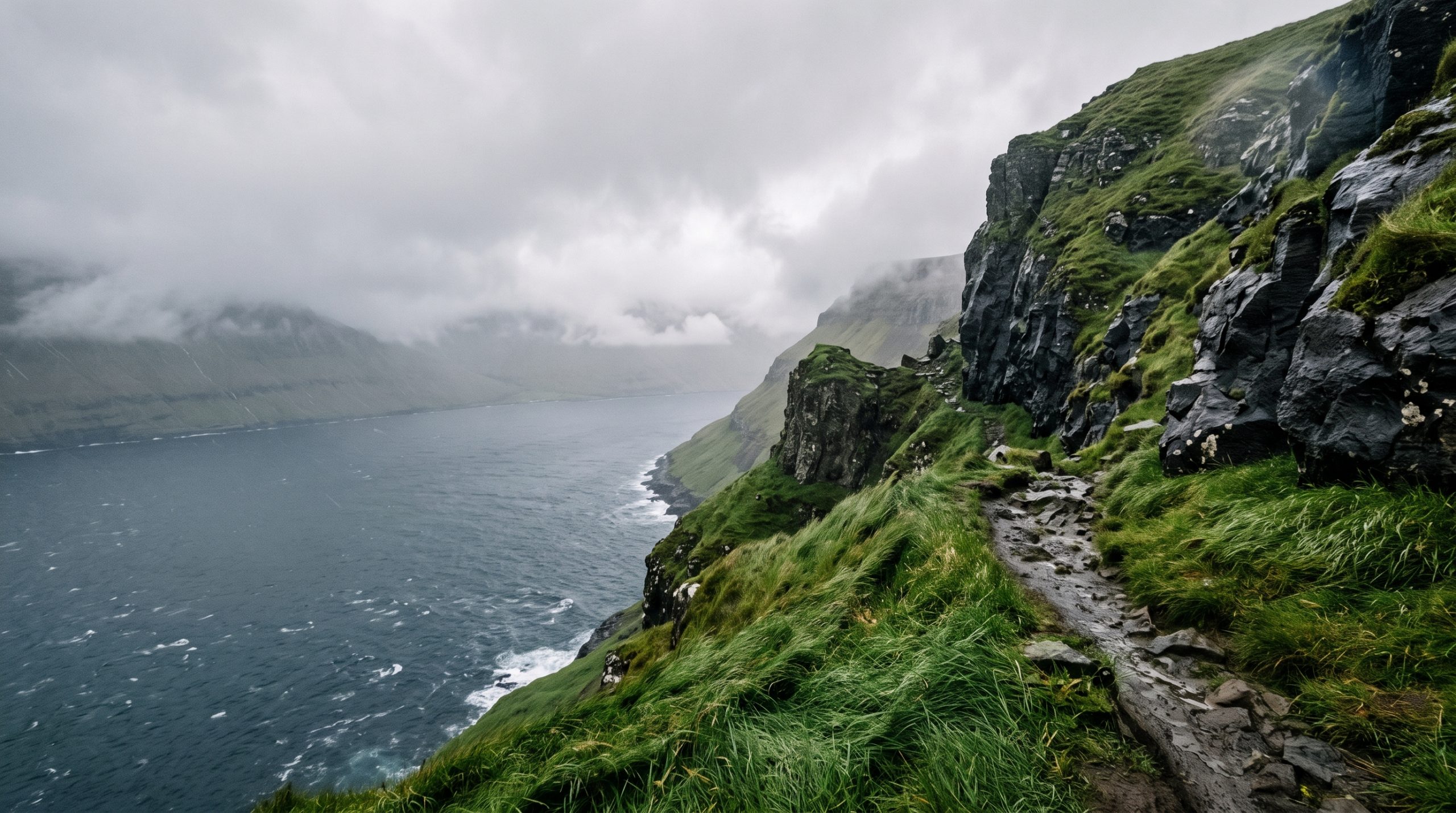
Wind is not an event in the Faroe Islands. It is the background condition. The Danish Meteorological Institute’s standard normals for 1991 to 2020 put the average wind speed in Tórshavn at 6.6 metres per second, about 15 miles an hour, as a year-round figure. Summer settles to an average near 5 metres per second. Winter runs at 7.8.
That one number decides more about your clothes than anything else on this page. A dress that behaves on a sheltered lawn in Miðvágur does something entirely different on the headland above Gásadalur, where the air comes in off open ocean and runs straight up a cliff. We have watched a cathedral veil go horizontal and stay there. It made a beautiful sequence. It was not what the couple had pictured when they ordered it.
So this is the wardrobe conversation we have with couples before they buy anything: fabric weight, hem length, what your feet are actually standing on, and the layer that matters more than the dress during the vows.
Dressing for 6.6 metres per second
Choose weight over volume. Heavy crepe, mikado and duchess satin hold their shape in the 5 to 8 metres per second that Tórshavn averages through the year, while chiffon and tulle move constantly. Pack waterproof boots for the walking, a low block heel for the vows, and a wool layer you can pull on between locations.
Fabric weight decides everything else
Forget silhouette for a moment and think in grams. A heavy fabric in a simple cut looks composed on a Faroese cliff. A light fabric in an elaborate cut spends the whole hour reorganising itself, and you spend the whole hour holding it down.
Crepe is the most reliable thing you can wear here. Mikado and duchess satin do the same job with more shine. A wool or wool-blend gown is badly underused in a place where the warmest month, August, tops out around 13 °C. Lace over a fitted lining behaves well, because the lining does the structural work. Where couples get caught out is chiffon, organza and loose tulle. None of them are wrong. All of them need a plan, and the plan usually means using the movement rather than fighting it.
Then there is water. Peat holds rain for days after the sky clears, and the ground between the road and almost any viewpoint is peat, moss and tussock grass. A floor-length hem that touches it wicks moisture several inches up the fabric and stays dark there for the rest of the day. That is not a problem, it is a sequencing question. We build the frames that need a dry hem into the early part of the day and let the hem go after that.
Silk charmeuse and anything with a high sheen shows individual raindrops as dark spots, which reads well close in and less well in a wide frame. Ivory and warm whites sit better against black basalt than optical white, which goes faintly blue under heavy overcast. The most useful garment decision we see is a detachable overskirt: a narrow base for the walking, volume added in ninety seconds once you arrive.
| Fabric | Behaviour in steady Faroese wind | Best used for |
|---|---|---|
| Heavy crepe, mikado, duchess satin | Holds its line, moves as one piece | Cliff edges, ridges, anywhere exposed |
| Lace over a fitted lining | Stable, and the texture reads in flat light | Full-day wear, village and coast |
| Wool or wool blend | Warm, structured, sheds light rain briefly | October to April, evening vows |
| Chiffon and organza | Lifts constantly, needs two hands or a wind shadow | Deliberate movement frames, sheltered coves |
| Loose tulle skirt | Acts as a sail, hard to manage alone | Short bursts with the team holding it |
| Silk charmeuse | Clings when damp, shows every drop | Interiors and close frames |
Veils, and the layer that goes over the top
Veils are the thing couples ask about most, and the easiest to get right once you accept the physics. A blusher or a shoulder-length veil stays where you put it. A fingertip veil is manageable. A cathedral veil at 6 metres per second is not a delicate accessory, it is a sail with two people attached, and it produces some of the strongest footage we shoot here when everybody knows in advance that is what is coming.
Three practical notes. A wide comb pushed into backcombed hair holds far better than pins alone. A weighted or horsehair edge settles a veil noticeably. And fit the veil at the location, not at the car, because the walk in is where they get damaged.
The over-layer matters more than most couples expect. The ceremony is the stillest part of the day, and standing still in damp air at around 9 °C gets cold faster than moving in it. A mid-weight wool overcoat in cream, camel or deep green photographs beautifully against basalt. An oiled cotton coat handles rain better. A Faroese wool sweater bought in Tórshavn is warmer than either, and it earns its place on the walk in.
Our rule at the vows: the coat comes off as you start and goes straight back on when you finish. Two minutes of cold is fine. Twenty is a distraction.
What your shoes are actually standing on
Very little of what you walk on here is a path in the sense that word implies at home. Between the car and the viewpoint you cross tussock grass sitting on saturated peat, sheep tracks worn to bare soil, wet basalt with a film of algae on it, loose gravel at the pull-ins, and in the villages short runs of wooden walkway and turf. On Kalsoy, reached by the ferry from Klaksvík, the ground rising toward Kallur lighthouse is grass on a gradient, a different problem from rock.
Bring two pairs each and treat them as different tools. Waterproof boots with deep lugs for everything between the vehicle and the spot. Ceremony shoes carried in a dry bag and put on at the last moment. A block heel sinks into peat and a stiletto disappears into it, which is not a reason to leave them at home, only a reason to keep them bagged until you are on rock, boardwalk or cropped grass.
Merino socks, and a spare pair, because dry feet change your mood more than anything else in the car. Barefoot on wet basalt looks better in the imagination than it feels underfoot, so if bare feet matter to you, we will find the one patch of flat dry rock in a location and put you there for ninety seconds.
Access is worth knowing before you pack. Several of the best-known walks cross private land, and the landowners charge visitors an access fee, with some routes run as guided walks. Kallur lighthouse and Mykines are both on that list. Footwear that lets you keep the pace of a group is worth more here than footwear that looks right in the parking area, and our destination elopement guides go through the access picture location by location.
The suit, and why linen loses
Mid-weight wool, every time. Linen creases within an hour of sitting in a car, darkens unevenly in rain and goes translucent once it is properly wet. Grey, brown and deep green sit well against basalt and moss, while black flattens under heavy overcast. A waistcoat gives you movement on a slope that a buttoned jacket does not. Leather boots with a rubber lug sole beat dress shoes on every surface here. Bring a second tie, because a silk one dried on a car heater never hangs the same way again.
Where the forecast lies
A single forecast for “the Faroe Islands” is close to meaningless. Eighteen islands, cliffs on nearly every coast and fjords that funnel air mean the conditions where you are standing can be nothing like the conditions a twenty minute drive away. Tórshavn is often dry and bright while Gásadalur, on the far side of Vágar, is in cloud down to sea level. We read three or four separate points before committing to an order of locations, and we change the order far more often than we change the plan.
The average also hides the peaks. That 6.6 metres per second figure is a mean that includes flat calm midsummer mornings, and the gust at a headland can be a multiple of whatever the app shows for the nearest town. The seasonal pattern is well documented: May to August are normally free of storm-force wind, while autumn and winter carry numerous gales, usually out of the west and south west. That direction is useful, because it tells us which side of a headland is sheltered.
Rainfall totals mislead in the other direction. Tórshavn takes over 1,100 millimetres a year, but it arrives spread thinly across the whole calendar rather than in one wet season, and a good share of it travels sideways. A coat that sheds water from above will not keep your legs dry. What works is a full-length shell you can pull over the dress between locations and step out of on arrival.
Light is the part couples usually get backwards. June gives Tórshavn close to twenty hours between sunrise and sunset, but only around 125 hours of bright sunshine across the entire month, roughly four hours a day. Dress for overcast, not for sun. That flat, even light is also why Faroese frames hold detail all the way from the white of a dress to the black of a cliff, and it is worth going through our published elopement stories and films to see what a full grey day here actually delivers before you assume you need blue sky.
| Season | Daytime temperature | Average wind | What it changes about clothing |
|---|---|---|---|
| May to August | Around 11 °C in June, near 13 °C in August | About 5 metres per second | Lightest wind and longest light of the year, but the wool layer still earns its place at a late evening ceremony |
| September to October | Falling back toward the annual average near 9 °C | Climbing from the summer figure | Heavier over-layer, gloves in a pocket, plan around wind from the west and south west |
| November to February | Around 6 to 7 °C | About 7.8 metres per second | Roughly five hours of daylight near the December solstice, thermal base layer under the dress |
| March to April | Still close to the winter figure | Easing month by month | The wettest ground of the year underfoot, waterproof boots and spare socks are the whole game |
How we build changing points into the day
Almost none of the places you want to stand in have anywhere to change. There is no room behind the turf-roofed church at Saksun, and the stop above Múlafossur is a gravel shoulder. So the changing plan goes into the timeline rather than being solved on the morning. We look for a base within roughly twenty minutes of the first location, usually a guesthouse or rented house on Vágar or around Tórshavn, so you are never more than one short drive from somewhere warm and dry.
In the vehicle, every time: ceremony shoes in a dry bag, a towel, spare merino socks, the wool layer and the shell. On the ground, the order of the day is written around the hem, the wind direction and the light rather than around a list of viewpoints, and we hold a sheltered alternative for every exposed location, so a shift in the wind costs you a change of order and nothing else. Planning, permit research and the weather alternatives are part of every experience we run, and what each one covers is set out on our coverage and pricing page.
This is where having the photographer and the filmmaker on one team stops being a nice idea and becomes practical. One of us can walk the last few hundred metres ahead to read the wind on the ridge while the other stays with you at the car, so the veil goes on once, at the right moment, instead of three times. On a ferry-dependent island like Kalsoy, that difference is the whole afternoon. Two sets of gear also means two dry cameras when the weather turns, and two people who can carry something on the way up.
If you already have the dress, or you have three tabs open and cannot choose between them, Send Us a Message with the links and your month, and we will tell you what each one does in a Faroese crosswind.
Common questions
Can I wear a dress with a long train in the Faroe Islands?
Yes, with a sequence. A train on wet peat is soaked and grass-marked within about ten minutes, so we take the frames that need it clean first, on rock, gravel or cropped grass near the vehicle, and let it go after that. A detachable train or overskirt solves the problem in ninety seconds.
Will a long veil work in Faroese wind?
It works if you want movement rather than stillness. Above roughly 6 metres per second a cathedral veil flies and does not settle again. We fit it at the location with a wide comb into backcombed hair, and we place the vows in the wind shadow of a headland so the ceremony itself stays calm.
What shoes do we actually need?
Two pairs each. Waterproof boots with deep lugs for every walk between the vehicle and the spot, and lighter ceremony shoes carried in a dry bag. Merino socks plus a spare pair. Heels are fine on rock, boardwalk and short grass, and they sink into peat, so they stay in the bag until you arrive.
Where do we get changed?
Usually a guesthouse, cabin or rented house within about twenty minutes of the first location, then the vehicle for adjustments through the day. Most viewpoints are a gravel pull-in with nothing behind them, so we choose the base around the changing plan rather than for its own view.
What changes if we elope in November or February?
Daylight drops to roughly five hours around the December solstice and the average wind climbs to about 7.8 metres per second, so the whole day compresses into one long usable stretch of light. You want a thermal base layer under the dress, a wool over-layer, closed waterproof footwear and gloves that come off for two minutes at the vows.
How do we keep hair and makeup intact between locations?
Assume wind instead of resisting it. Styles with structure hold, loose ones do not, and a hood pulled up for the drive and the walk in does more than any product. We build the timeline so the walking happens before the frames that depend on the hair, not after.
The dress you already own
None of this is an argument for buying a technical garment. Couples wear the dress they wanted long before they ever looked at a Faroese forecast, and it works, because the day gets built around the clothes rather than the other way around. Tell us what you have and we will say honestly which locations suit it, which hour to put it on and what belongs in the car.
We are booking 2027, 2028 and 2029. Every part of our planning happens in writing, so you can answer at your own hour and keep the whole thread to come back to, and we reply to every inquiry within 24 hours. If you are earlier than the wardrobe stage and still choosing a month, our guide to planning an elopement is the place to start. When you are ready, Tell Us Your Story.