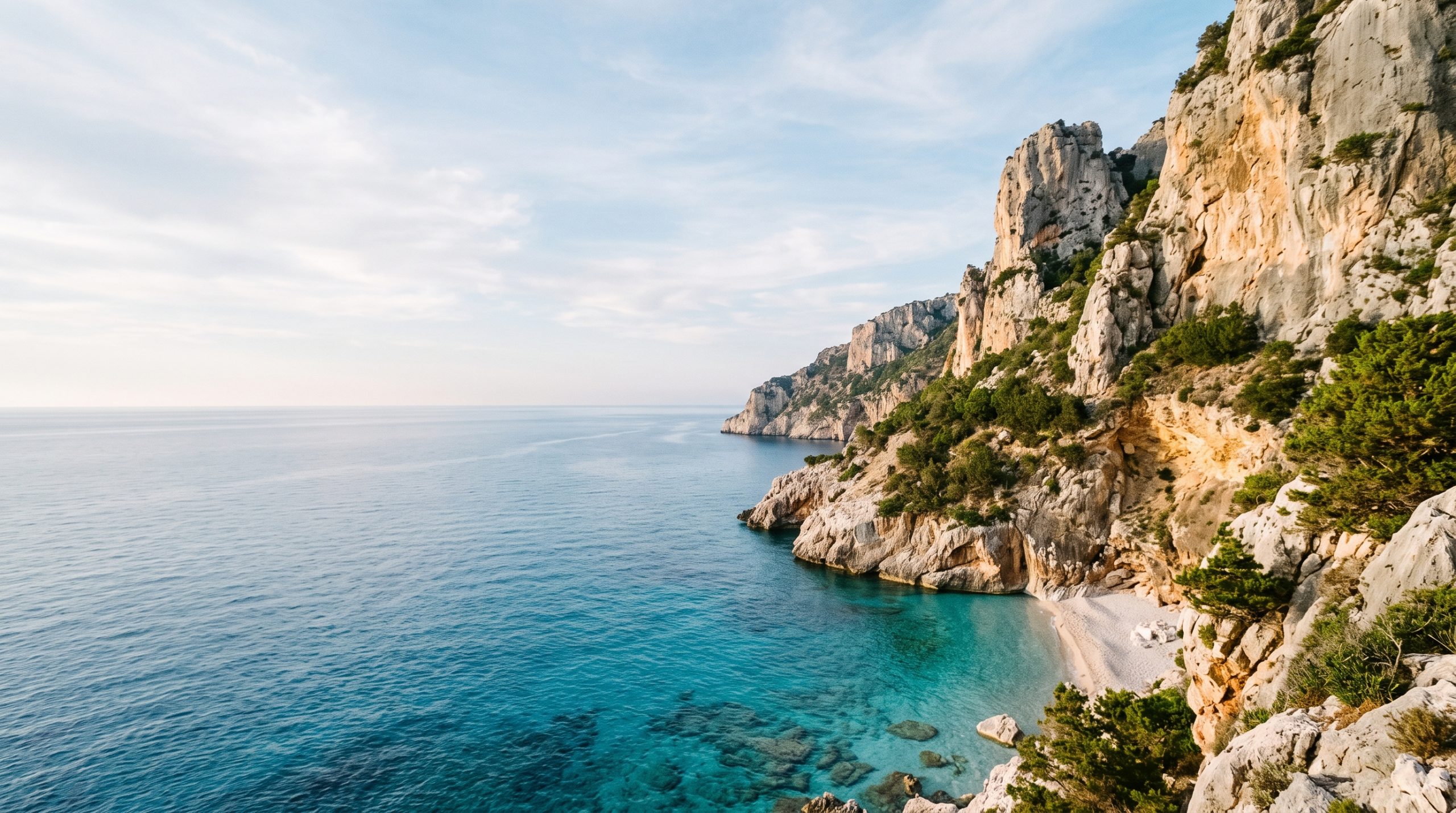
Ask the internet where to elope in Sardinia and it hands you the same corner of the northeast every time. Porto Cervo, a tender out to a beach with no road to it, dinner on the Piazzetta afterward. It is a real place, it photographs consistently, and in August it is full.
The rest of the island is a different proposition. Baunei, halfway down the east coast, looks after roughly 40 kilometers of the Gulf of Orosei, and its most famous cove now sells 250 tickets a day at 7 euros a head, bookable 72 hours ahead. Two hours west of there you can walk a dune field at seven in the morning in October and meet nobody at all.
Eight of us work photography and film as one team, and we plan a day long before we shoot it, which means we spend an unreasonable amount of time on cliff aspects, ferry timetables and the hour the day boats arrive. Here is where we would actually put an elopement on this island, and an honest account of what the famous coast still does better than the rest of it.
The coast we would pick if you gave us the whole island
The Gulf of Orosei, on the east coast, in late September or October. Limestone walls straight out of deep water, coves reached by boat rather than road, and an access system that quietly thins the crowd for you. The Costa Smeralda still wins for a short trip with no rental car and dinner at nine.
Five Sardinias, in a practical comparison
Five stretches of coast cover almost everything couples ask us for here. They are genuinely different from one another rather than variations on a theme: different airports, different access rules, different months when they go quiet. The drive times below are the real ones on Sardinian roads, where a hundred kilometers rarely means an hour.
| Coast | Nearest airport | Access and fees in season | When it thins out | Best at |
|---|---|---|---|---|
| Costa Smeralda (Porto Cervo) | Olbia, 30 to 40 minutes | Hotel grounds and boat tenders; the flagship hotel on the Piazzetta publishes a season of 1 April to 31 October | Late May and the first half of October | Short transfers, water reached by boat, pink granite and maquis |
| Gulf of Orosei (Baunei, Cala Gonone) | Olbia about 2 hours, Cagliari about 2 hours 30 | Cala Goloritze booked online, 250 people, 7 euros; Cala Mariolu 700 people from 15 June to 15 September | Before the day boats land, and from late September | Vertical limestone, water color, coves with no road in |
| Sinis peninsula (Cabras, Is Arutas) | Cagliari or Alghero, about 1 hour 30 | Open access, no booking; the car parks fill through August | Almost any morning outside high summer | Quartz beaches, flat lagoon light, the ruins at Tharros |
| Coral coast (Alghero, Bosa, Stintino) | Alghero, 15 minutes to 1 hour | La Pelosa booked online, 1,500 people, 3.50 euros, 8am to 6pm from mid-May to mid-October | Evenings, once the ticketed window closes | West-facing sunsets, a walkable old town, the cliffs at Capo Caccia |
| Costa Verde (Piscinas, Arbus) | Cagliari, under 2 hours | Open access; the last stretch in is an unsealed mining road | Most of the year | Dune fields, empty sand, weather you can see coming |
Our side of it does not change with the map. Team travel is included worldwide, so a day on the Costa Verde and a day at Porto Cervo carry the same fee, and guest count moves access and permits rather than the price. The Adventure covers one full day with a dedicated photographer or a dedicated filmmaker, from $4,900. The Expedition puts both on the same day, from $7,900. Two to seven days across one or several parts of the island becomes an Odyssey, and the coverage breakdown lives on the pricing page.
What the Costa Smeralda is genuinely better at
Landing and being on the coast inside forty minutes. That matters more than it sounds when you have four nights and no interest in driving a rental car on a road with sheep on it. Olbia is close, the transfers are short, and the coast was built from the 1960s onward under a controlled architectural style, which is why the villages photograph as one consistent thing rather than a jumble.
It is also the only part of Sardinia with a proper shoulder-season infrastructure. The flagship hotel above the Piazzetta publishes a season running 1 April to 31 October, and the restaurants around it open and close with it, so a mid-October evening still has somewhere to eat at ten.
The part nobody writes down: at midday in July the marina is flat, hard light and moving people, and every good cove within tender range already has a boat parked in it. We would rather have you there in the first half of October, when the same granite goes gold at six and the Piazzetta is half empty.
Baunei sells 250 tickets a day, and that sets your morning
Cala Goloritze is the reason most people eventually look past the northeast. Reservations are mandatory from April to October, access is capped at 250 people, and the entrance fee currently sits at 7 euros a head. Booking opens 72 hours before your visit, which is uncomfortably late if you are planning a wedding day around it, so we build the morning to hold either way and treat the cove as one hour inside a longer plan.
There is no road. You either walk in, about 3.5 kilometers from the Su Porteddu trailhead with roughly 500 meters of descent, or you arrive by boat from Cala Gonone or Santa Maria Navarrese. Both of those change what a dress can be, and both are decisions we make months out rather than the night before. The beach itself was shaped by a landslide in the 1960s, which is why the pebbles are so pale and so round, and why the needle of rock above it looks like it was set there on purpose.
The gulf faces east, and that single fact rearranges the whole day. Sun is on the walls at breakfast and off them by mid-afternoon, so the hour couples instinctively ask for, golden hour at the beach, is the hour the cove goes into shade. We shoot the east coast early and use the afternoon inland, on the Supramonte plateau above Baunei, where the light lasts.
The other cove worth planning around is Cala Mariolu, which runs its own cap of 700 people at a time between 15 June and 15 September. Around those two, the fleet from Cala Gonone lands mid to late morning and thins again by five. Before and after are yours. That gap also matters for sound: at seven the gulf is birds and water, and by eleven it is outboard engines, which is why an Expedition day here starts early when vows are being recorded. Photography and film on this coast pull in different directions, one reaching for scale and one for movement, and the clearest way to see how that resolves is to look through the films and galleries in our stories before you decide which one you want.
The west coast belongs to the wind
The maestrale comes off the northwest and it is not an occasional inconvenience, it is the reason this side of Sardinia looks the way it does. It builds the dunes, it polishes the quartz, it puts surf on beaches that face open sea for a thousand kilometers. We plan west coast days with the wind as an input: hair up or hair loose as a decision made in advance, a veil only where it will behave, and a sheltered alternative inside fifteen minutes of the main location.
Sinis, and a beach made of quartz
Is Arutas is not sand. It is grains of quartz, white and pink and green, and it reads in a photograph like nothing else on the island. The grains are protected and they stay on the beach, so we plan around that rather than through it. The peninsula behind it is flat and full of lagoons, which gives a soft, wide, almost Baltic light in the hour after sunrise, and the Punic and Roman ruins at Tharros sit on the point at the end of it for couples who want something older than the coast.
Bosa, Alghero and the cliffs at Capo Caccia
Bosa is a river town with a castle above it and a row of houses along the Temo painted in colors that would look absurd anywhere else. Alghero, forty minutes north, still speaks a Catalan dialect and has an old town you can shoot on foot at first light with nobody in it. Capo Caccia gives you the drama: a headland with a stair cut down the cliff to the sea caves, and a sunset that goes into the water rather than behind a hill.
North of Alghero, La Pelosa at Stintino runs the island’s other big booking system, with 1,500 places a day at 3.50 euros a person. Here is the useful detail nobody puts in a guide: the cap applies between 8am and 6pm, and the ticketed period runs roughly mid-May to mid-October. The hour after six, when the light finally softens and the shallows go the color the postcards promised, sits outside all of it.
Piscinas, and the road down from the mines
The Costa Verde is the emptiest thing on this list. Piscinas, in the comune of Arbus, is a dune field that runs into the sea, reached by a long unsealed road through abandoned mining country, and it is under two hours from Cagliari. There is no town, no marina and very little shade. In October you can be the only two people on it at seven in the morning, which is the entire point.
Paperwork, and why the comune comes before the cove
American couples marrying legally in Italy assemble two documents before anything else happens. The first is an atto notorio, a notarial act sworn before four attestants at the Italian consulate covering your state, in which nobody present has a family tie to you; it is valid for 180 days. The second is a nulla osta, issued by the US diplomatic authorities in Italy. That file then belongs to a specific comune, which is why we ask which town you want to marry in before we talk about which beach you want to stand on.
Plenty of the couples we work with take the other route and sign at home first, then treat Sardinia as the ceremony that actually means something to them. Neither route is better, but they produce different timelines, and the one thing that does not work is deciding late. Our planning covers the research and the logistics on both, including permit research for the location itself, while the government, venue and landowner fees are paid directly by you. If the legal side is new to you, our guide to planning an elopement covers the fundamentals in order.
Aerials work the same way. Italy runs the EU open category with operator registration held through ENAC, and restricted airspace is published, so we confirm the zone and the window before we design a shot that depends on it. Where a drone is out, this coastline still gives you everything from the water. Send Us a Message with the coast and the month you are circling, and we will tell you what the route looks like from there.
Three shapes of trip, and the coast each one wants
Four nights, no rental car, and you want to swim and eat well. Costa Smeralda, first half of October. You are on the coast thirty-five minutes after landing, the day runs on a boat rather than a road, and the restaurants are still open. This is the one case where we would not send you south.
Six nights, and you are willing to be at a trailhead before six. The Gulf of Orosei, with two days built around it: one on the water and in a capped cove, one up on the Supramonte where the limestone goes on for miles and the afternoon light survives. This is the version of Sardinia that looks like nowhere else in the Mediterranean, and it asks for early alarms rather than fitness.
Two full days and a strong preference for being alone. The west, in a loop from Cagliari: Piscinas at sunrise, the Sinis quartz the next morning, and Bosa or Capo Caccia for the evening if you push north. Nothing here is capped, ticketed or booked. Nothing here is comfortable in a strong maestrale either, which is why we hold a lee-side alternative for every west coast hour.
The conventional advice gets one thing badly wrong, and it is the month. Most couples write to us about July and August because that is when the island is on television. October water sits around 22 degrees Celsius, close to where it was in June. La Pelosa’s ticketed window is still running into mid-October, Cala Goloritze reservations run to the end of the month, and both are far easier to get. The trade is shorter days and a real chance of a wet one, which is what backup planning is for. Our destination guides go into the month-by-month detail for the places we return to most.
Common questions
Do we have to book Cala Goloritze in advance to elope there?
Yes. Reservations are mandatory from April to October, access is capped at 250 people, and the fee currently sits at 7 euros a head. The booking window opens 72 hours before the visit, so we plan a morning that works with or without the cove and secure the ticket as soon as it releases.
Can we sign the legal papers in Sardinia, or is it easier at home?
Both work. Marrying legally in Italy as US citizens means an atto notorio sworn before four attestants at the Italian consulate for your state, valid 180 days, plus a nulla osta issued by the US authorities in Italy, with the file going to the comune where you marry. Couples who would rather not spend a trip day in an office sign at home first.
Is October too late for a Sardinian elopement?
It is our first suggestion. Sea temperatures sit around 22 degrees Celsius, close to June, and the access systems are still running while the crowds are not. Days are shorter, so the timeline tightens, and we build a weather alternative for every location as a matter of course.
How long is the drive from Olbia to the Gulf of Orosei?
Around two hours to Baunei, and about two and a half from Cagliari. It is a good road but a slow one in places, and it is the single biggest reason couples underestimate the east coast. We build the transfer into the timeline as a real block of time rather than a gap between locations.
Can you fly a drone over the coves?
Where it is legal, safe and appropriate, which on this coast is often. Italy runs the EU open category with operator registration held through ENAC, and restricted zones are published in advance, so we confirm both the airspace and the time window before we build a sequence around aerials.
Do we need a boat to reach the best coves on the east coast?
For several of them, yes. Cala Mariolu is a boat arrival for almost everyone, while Cala Goloritze can be walked in from Su Porteddu, about 3.5 kilometers with roughly 500 meters of descent. Private boats and other unusual transport are booked and paid directly by you, and we handle the timing around them.
Tell us the two weeks you cannot move
Give us the dates that are fixed and the one thing you refuse to compromise on, and we will tell you which of these five coasts fits, or which month fits it better. The planning stays in one written thread, so nothing has to be scheduled around a time zone: the inquiry form comes back within 24 hours with an initial brochure, a tailored proposal follows, and planning starts once the contract is signed and a 30% retainer is paid. Highlights reach you 5 days after the day itself, the full gallery or film within 3 weeks. We currently have dates available through 2027, 2028 and 2029 across the island. Start Your Story.