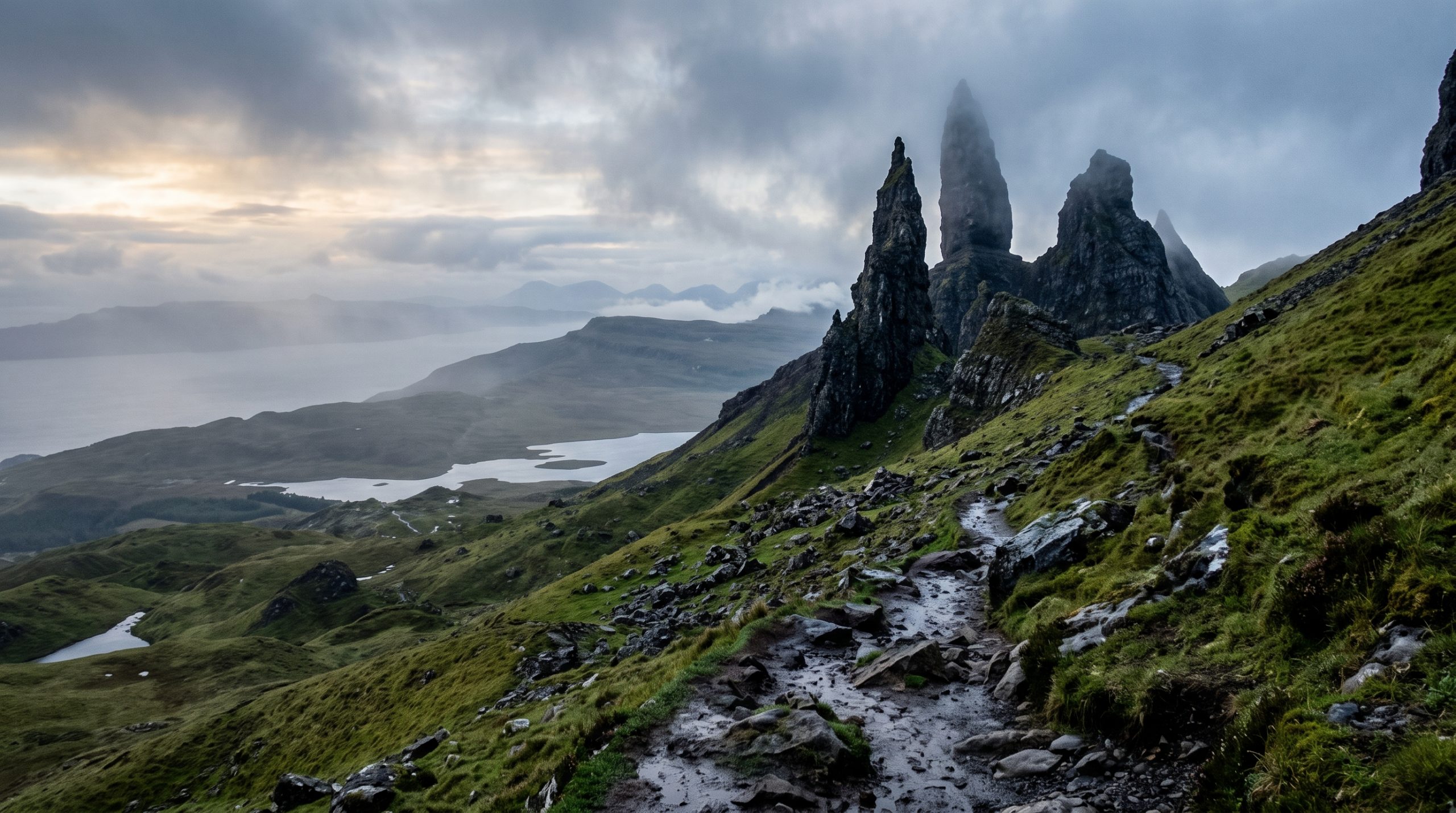
The gravel under your feet on the way up the Storr was flown onto the hillside in bags by helicopter. Path builders bagged the stone at the bottom, lifted it to the worn sections, and rebuilt the line by hand. That is the reason a ceremony beneath the Old Man is a sensible plan rather than an ordeal: forty minutes of steady climbing on a graded surface, instead of an hour of churned peat in shoes you will never wear again.
The pinnacles face east, out over the Sound of Raasay toward the mainland hills. The main car park holds 140 cars and it fills. Put those two facts together and the shape of an elopement here is settled before you book anything. You are on that ground in the first hour of light, or you are on it in flat midday sun with several hundred other people.
We will say the unflattering part first. At eleven in the morning in July, the Storr is a queue on a gravel path and the rock is lit from directly overhead. At half past four on a June morning it is some of the finest ground in Scotland and there is nobody else on it.
Married under the pinnacles: what it takes
Yes, you can marry at the Old Man of Storr, and a small ceremony needs no site permit. Scotland allows marriage outdoors anywhere once your registrar paperwork is complete. The walk is 3.8 kilometers round trip, about 2.4 miles, on a graded gravel path, roughly forty minutes of climbing, and the car park sits fifteen minutes north of Portree.
Forty minutes up, in clothes nobody bought for hillwalking
The path leaves the A855 beside the car park and climbs in three moods. The first stretch is a gentle gradient on wide gravel across open slope where a conifer plantation used to stand. The middle section steepens into steps and long switchbacks. The last few minutes are rocky and uneven, hands out of pockets, and that is where the whole ridge opens above you at once.
The island’s own walking notes put the round trip at 3.8 kilometers and an hour and a quarter with no stops. Walkhighlands times the longer loop over the upper viewpoints at 5 kilometers with 340 meters of ascent, up to two hours, on clear hill paths that get steep and rocky higher up. In wedding clothes, plan on forty to fifty minutes to reach the ground below the pinnacles, at a pace slow enough that you arrive dry.
Here is what that is actually like. Gravel is kind to a hem in dry weather and less kind after rain, because the grass either side holds water and the drainage cuts run straight across the path. Most mornings we carry the dress up in a bag and you change on the terrace. Some couples walk up already in it, hem gathered, with one of us behind carrying the train clear of the stone. Both work. Boots go on at the car and come off at the top, and someone carries the shoes you actually want in the photographs. A long veil is the one item that argues with this hill, since the gaps between the pinnacles funnel wind even on a still day, so we keep it packed until the moment you want it and take it back afterwards.
The ground immediately beneath the rock is loose and worn, so we do not set the ceremony there. The firm grassy terraces just below and to the side hold a small group comfortably, give the pinnacle its full height above your shoulders, and leave the walking route clear behind you. On the hill we hold two and a half to three hours in total: the climb, the ceremony, portraits while the light moves, and about half an hour back down.
The east face, and the hour the light actually arrives
The Storr’s cliffs face east over the Sound of Raasay, while the slopes behind them fall away west in grass. So the pinnacles are lit early, and lit from the front. But only at certain times of the year, because at 57 degrees north the sunrise point swings a very long way around the compass.
In late June the sun clears the horizon at about 4:25 in the morning, and it does so in the northeast, well to the left of the classic view. The light rakes along the faces rather than landing on them, which is generous on the terraces and less obliging on the rock itself. By mid-September sunrise is just before seven and arrives from almost due east, straight up the Sound and flat onto the pinnacles. Around the winter solstice the sun is not up until after nine, and then it comes from the southeast and stays low all day.
Two further things about first light here. Printed sunrise is not the moment light lands, because the sun still has to climb over the mainland hills across the water, which usually costs another ten to twenty minutes; we build that gap into the timeline rather than discover it. And the site loses the sun early in the evening, because the Storr’s own summit ridge stands between you and the west. In late June the pinnacles are out of direct light in the early evening while the printed sunset is not until nearly half past ten.
An evening up here is blue, quiet and backlit along the skyline. That makes a fine film and a harder portrait. Our own shorthand is that late September and early October is the best trade this location offers: front-lit sunrise at a civilized hour, cold clear air, and paths that belong to you. Our published galleries and films show what the rock does with that raking morning light, and what the same ground looks like when the cloud is only half lifting.
140 spaces, and the hour the coaches come
The Storr is the busiest walk on Skye. It is on every coach itinerary and every ten-day driving loop of the island, and the ridge has stood in for other planets on film, Prometheus among them. The main car park takes 140 cars, with another 55 spaces on the road in front of the toilets, and the site asks that cars use the off-street car park so that motorhomes can use the on-street ones. The verges are peat and cannot be parked on. When the car park is full, the official request is to come back later, which tells you most of what you need to know about August afternoons.
Parking is chargeable for every motor vehicle at the site, paid on arrival, and that money maintains the car park, the path network, the toilets and the motorhome waste point. The toilets themselves are free to use, and the accessible one opens with a radar key. The site is run by The Highland Council alongside partners including the Skye Iconic Sites Project, NatureScot, the Outdoor Access Trust for Scotland and Staffin Community Trust, with staff on the ground through the season.
Arrive early is the advice everybody gives, and on this hill it is not enough on its own. By nine on a July morning there are people on every terrace and a steady line coming up behind them. That is exactly why a summer timeline has you leaving Portree in the dark. You get the first hour of light to yourselves, and you pass the first real wave on the way down: dressed, married, and finished before most of the island has had breakfast. In November or February the arithmetic changes completely, with sunrise at a reasonable hour and perhaps two other photographers and a dog for company.
Permission, paperwork and the drone question
Nobody sells tickets to the top of the Storr. Scotland’s statutory access rights let you walk up and stand there, and they cover people working professionally on the hill provided the work is done responsibly and nobody else’s day is obstructed. For two of you, a celebrant and two of us with cameras, that is the whole answer: no site permit and no venue fee to negotiate.
The paperwork that does matter is the marriage paperwork, and in Scotland it is pleasingly location-blind. A marriage may be solemnized outdoors, anywhere in the country, and there is no residency requirement for visitors. Notice goes to the registrar well ahead of the date, the Marriage Schedule is issued to you before the ceremony, and your celebrant carries it up the hill in a jacket pocket. We hold that calendar and tell you what has to be signed and when. Our guide to how eloping abroad actually works sets out the sequence in general terms, and your proposal sets it out for your date.
Aerials are a permission question rather than a weather one. Flying a drone at the Storr requires a flyer ID and an operator ID from the Civil Aviation Authority, and the practical constraint stacked on top of that is people. So we fly in the empty hour, on a plan agreed in advance, or we leave the drone in the bag. Government, venue and landowner permit fees are yours where they arise; the research and the correspondence are ours. Anything out of the ordinary, such as a larger group or gear that needs staging on site, goes through the people who manage the Storr, and that is a message we send rather than one you chase.
Two of us on a narrow terrace
The terraces below the pinnacles are narrow, tilted and interrupted by boulders. There is room for two people to work up there, and no room at all to be careless about it. In practice the photographer drops low and to one side so the pinnacle keeps its full height above your shoulders, and the filmmaker takes the terrace above and behind on a long lens, moving slowly. Neither appears in the other’s frame, because they settled the geometry in the car park before anyone started walking. Sound is the harder problem here, not space: wind accelerates through the gaps between the pinnacles even on a calm morning, so vows are recorded close, with the microphone shielded and both of you turned out of the airflow. On the Expedition, that professional audio is included wherever conditions allow. A full day with a dedicated photographer or filmmaker starts at $4,900, and a day with both working as one team starts at $7,900, and the coverage page sets out exactly what sits inside each. There are eight of us, so there is always a second camera on the ground and a colleague in reserve, and we are booking 2027, 2028 and 2029.
When the cloud sits on the ridge
The top of the Storr keeps its own weather. The coast can be perfectly clear while the pinnacles are inside a cloud, and a southwesterly pushes hard through the notches in the ridge. That is a decision we make in the car park, not a morning anybody loses. The whole ridge reflects in the lochs a few minutes back down the A855 toward Portree, and from there the Old Man reads as scale rather than texture, which in soft gray light is often the better frame. Lower on the hill, the felled slope gives shelter and foreground. Every Storr morning we plan carries a named second location with the drive time already checked, the same way our destination guides treat every headline viewpoint as one option among several.
Common questions
Do we need a permit to get married at the Old Man of Storr?
Not for a private ceremony. Scotland’s access rights cover walking up and standing on the hill, and no venue fee or site permit applies to a couple, a celebrant and a small group. Your legal requirements are the registrar’s, not the landowner’s. Larger groups or anything needing vehicles or staging on site is a conversation we have with the site’s managers on your behalf.
Can we really climb 40 minutes in a wedding dress?
Yes, and it is more comfortable than it sounds because the path is graded gravel rather than open hillside. The usual arrangement is boots and layers on the way up with the dress carried in a bag, then changing on the terrace. If you would rather walk up dressed, we walk behind you and keep the hem off the stone. Trousers and jackets go up as they are.
Is there anywhere at the Storr car park to change out of hiking boots?
There are free public toilets at the car park, and the accessible one opens with a radar key. In practice couples dress at their accommodation in Portree, fifteen minutes away, and swap footwear on the hill where the ground is firm and the view is the reason you came. We carry the shoes, and a towel for the boots.
Will other walkers end up in our ceremony?
Not if we start before first light in summer. The terraces are broad enough that a ceremony in the first hour of daylight is genuinely private, and the first walkers usually appear as we are coming down. From late autumn to early spring, sunrise arrives at a civilized hour and the path is quiet anyway.
Can you fly a drone at the Old Man of Storr for our film?
Where it is legal, safe and appropriate, yes. Drone flying here needs a flyer ID and an operator ID from the Civil Aviation Authority, and it needs an hour when the terraces are not full of people, which in practice means early. We confirm both before the film is planned around aerials, so nothing in your timeline depends on a shot we cannot take.
One Storr morning, start to finish
In late June that morning begins at about a quarter past three, leaving Portree in the dark with head torches and one bag each. You are settled on the terrace before 4:25, when the sun clears the sea to the northeast. Ceremony in the first half hour of light, portraits while the sun climbs and the ridge changes color, then down at your own speed past the first walkers coming up, and back at the car by mid-morning with the entire day still in front of you. In late September the same morning starts at a quarter to six, which most couples prefer.
Highlights reach you in five days, and the full gallery or film follows within three weeks. Everything between the first message and the morning itself happens in writing, at whatever hour suits you: you send the inquiry, we reply with the brochure inside 24 hours, then the tailored proposal and a 30 percent retainer open the planning.
Tell us the week you have in mind, and say plainly if you want the Storr at first light or something gentler later in the morning, and we will build the morning around that answer, or tell you honestly which month gives you the light you are describing. Check Your Date