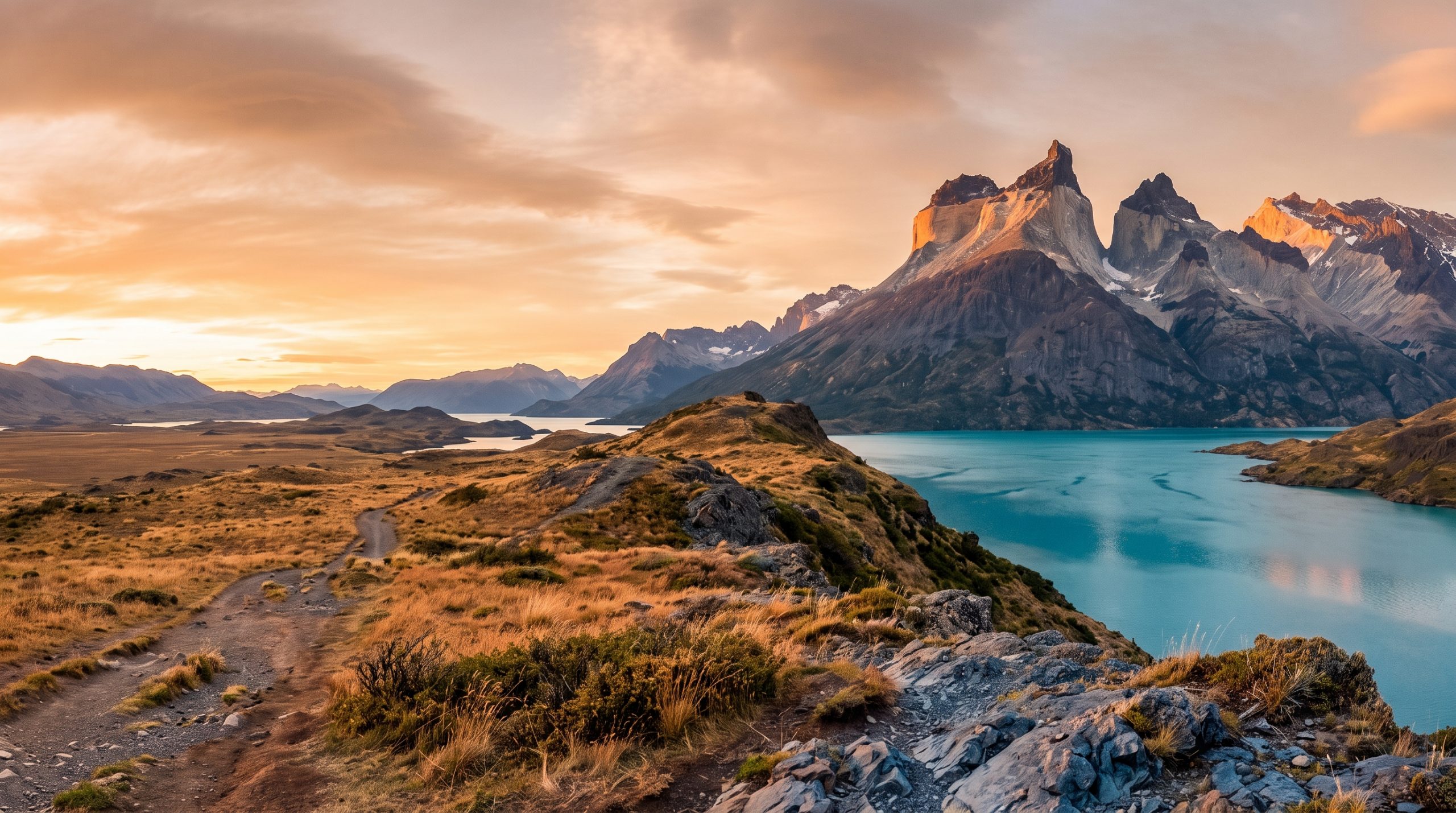
The Registro Civil office in Puerto Natales will marry two visiting Americans. What it will not do is climb the moraine to Mirador Las Torres with you. A Chilean civil officer can travel to an address you name, at a published fee, and the process is genuinely open to people who do not live in Chile. It is still an officer, a desk, an address and a working day.
Across the border in Santa Cruz province the shape is much the same. The provincial registry treats ceremonies held away from its own premises as ordinary business, and says the demand for them is strongest in tourist towns like El Calafate. Everything upstream of that, though, runs in Spanish, through apostilles and sworn translators, on certificates that age out while you are still choosing a date.
So most couples do the straightforward thing. They sign at home, in a twenty-minute morning at a county clerk’s counter, and then they come to Patagonia for the ceremony that actually means something to them. That is not a downgrade. It is the version that lets you stand at Laguna Capri before six in the morning with nobody’s opening hours involved. Below is the whole picture, both countries, with the real numbers in front of you.
Who is legally allowed to marry you down here
In both countries only a civil registry officer creates a marriage, and only inside the office or at a street address the officer travels to. Chile is open to non-resident couples but wants two witnesses holding Chilean identity cards. Argentina wants apostilled, Spanish-translated documents. Almost every couple we work with signs at home first and keeps Patagonia for the ceremony.
Magallanes is workable. Santa Cruz is slower.
Chile is the easier of the two, and it is not close. The government’s own ChileAtiende listing sets out the conditions plainly: both people over 18, legally capable, not currently married, no active civil union agreement with anyone else, and able to produce competent witnesses. Foreign nationals present the identity document of their home country, or a passport with a tourist visa where one applies. Nowhere in that list is a residency requirement.
The Chilean process has three named steps. The manifestación is the declaration of intent, made in person before an officer. The información is the moment two witnesses state that neither of you has any impediment to marrying. Then the celebration itself, which must happen within 90 days of that witness statement. Miss the 90 days and the manifestación and información are both done again from the start. One detail works strongly in a travelling couple’s favour: any civil officer is competent to celebrate the marriage regardless of where you are domiciled, as long as you made the manifestación before that same officer.
Chilean fees are modest and published in three bands, which tells you a great deal about how the system thinks about location and time.
| Where and when the ceremony happens | Fee |
|---|---|
| In the registry office, during working hours | No charge, beyond the marriage booklet at 1,830 pesos |
| At an address you name, during working hours | 21,680 pesos |
| At an address you name, outside working hours | 32,520 pesos |
Those are Chilean pesos. At an exchange rate in the region of 950 pesos to the US dollar, the largest of the three bands comes to under forty dollars, so cost is not the thing that shapes your decision here. The thing that shapes it is the phrase “an address you name”.
Argentina is possible too, and Santa Cruz province is used to it. The provincial registry runs matrimonio a domicilio, a ceremony conducted outside the official premises, and describes the demand as particularly strong in destinations like El Calafate. Weekend, holiday and out-of-hours ceremonies currently carry 300,000 pesos in provincial stamp duty collected by the Agencia Santacruceña de Ingresos Públicos, a figure the province revises as its published rates change. Argentina’s Civil and Commercial Code also asks for two witnesses when the marriage happens inside the registry office and four when it happens anywhere else, which is a small thing that surprises people planning a two-person day.
The slower part of Argentina is not the ceremony. It is the paper that has to arrive before it, and that is worth its own section.
How the paperwork fits together
Collect these in sequence. Doing step four before step three is how people end up paying twice.
- Valid passports. Both of you, with plenty of validity left past the date. Chile’s listing accepts a home-country identity document or a passport with a tourist visa where one is required.
- Birth certificates, recently issued. Argentine registry practice is to accept original certificates issued within the last six months. Validity window applies. Order these late rather than early, because the clock starts when the certificate is printed, not when you hand it over.
- Apostilles on every foreign document. Both Chile and Argentina are apostille countries. For a US-issued birth certificate the apostille comes from the Secretary of State of the state that issued it, not from a federal office. Apostille required.
- Proof that any previous marriage has ended. A divorce decree, or the earlier marriage record with the divorce recorded on it, apostilled by the same route. Apostille required, and the six-month rule can apply here too.
- Sworn Spanish translation. In Argentina this must be done by a registered public translator, a traductor público. A translation produced by a bilingual friend, or by a service without local registration, gets handed back. Translation by a locally registered translator required.
- The manifestación in Chile, made in person at the registry office you have booked, before the officer who will marry you.
- The witness statement. Two witnesses, both over 18, both holding a valid Chilean identity card, present in person to declare that neither of you is barred from marrying.
- The ceremony, inside 90 days of that witness statement in Chile.
- The certificate afterwards. It is issued in Spanish. It needs an apostille before authorities at home will act on it, and a translation once it gets there.
Turning the ceremony date into deadlines
Write your ceremony date at the bottom of a page and work up. The order matters more than the exact spacing, because two of these items expire.
Twelve months out is where the date itself gets chosen, and where you decide which side of the border you are standing on. Registry hours are reservable a long way ahead, and locking one in Magallanes early removes a variable from everything downstream of it. This is also the point at which the shape of the trip gets built, and our guide to planning an elopement covers the parts that are the same everywhere.
Six months out, and not a day earlier, order fresh birth certificates. This is the single most common sequencing error we see. A certificate ordered enthusiastically fourteen months ahead is already outside the window by the time it reaches a counter in El Calafate.
Five months out, apostilles. Four months out, sworn translations. Three months out, the Chilean 90-day ceiling comes into range, which means witnesses get confirmed by name and the registry hour gets locked rather than pencilled. Two weeks out, confirm that the office is actually open on your date and that nothing has moved.
The real minimum, if your documents already exist in apostilled and translated form and you have two Chilean-ID witnesses lined up, is short. The comfortable minimum is nine months, and nine months is what we plan to. It leaves room for a certificate to be reissued, a translation to be corrected and a date to shift by a day without any of it touching the ceremony.
Five things that catch couples out
Witnesses need Chilean identity cards. This is the one that changes plans. Chile asks for two witnesses over 18 holding a valid Chilean identity card, present on the day, declaring there is no impediment. Two friends flown in from Denver with US passports do not satisfy it. The fix is simple once you know it exists: name your witnesses early, arrange them through your celebrant or your lodge in Puerto Natales or Punta Arenas, and treat it as a booking rather than a favour. Tell us at the planning stage and we build the introduction into the timeline instead of discovering it the week before.
The 90 days run forward, not backward. Chile’s window opens at the witness statement and closes 90 days later. If you make the manifestación on a scouting trip in October and marry in February, you repeat both formalities. Couples who visit Patagonia twice get caught by this more often than couples who arrive once.
Certificates age out. Six months is the working assumption for Argentine offices. Anything issued before that is a reprint waiting to happen, and reprints from a US vital records office are not instant.
Translations have to be local and registered. Argentina wants a traductor público whose registration the office can check. This is not a quality judgement on your translator at home. It is a registration requirement, and it is not negotiable at the counter.
The best hour of the day is often outside the working day. In Magallanes in December, the light that makes the Cuernos worth photographing arrives long before an office opens and again long after it closes. That is precisely why Chile publishes a separate fee band for ceremonies held outside working hours, and why Santa Cruz applies its stamp duty to weekends and out-of-hours ceremonies. If you want the legal act itself at golden hour, budget for the higher band and book it early. If you would rather not fight the clock at all, this is the argument for signing at home.
Fees and deadlines quoted here were correct at the time of writing and are worth re-checking with the office that issues them.
Sign at home, then stand where you actually want to stand
Here is what the ceremony-only route really means. You marry at home on a Tuesday, in a room with strip lighting, and it takes less time than parking. Then you fly south and hold the ceremony that you will remember, with no officer’s diary attached to it, no jurisdiction over where you may stand and no requirement that anyone present holds a particular country’s identity card.
What changes practically: your celebrant can be a friend, a guide, a stranger who turns out to be perfect, or nobody at all. Your vows are entirely yours, with no statutory wording read out first. Your hour is chosen for the light rather than for the office. You can be at Laguna de los Tres for sunrise, on the water in Última Esperanza sound, or standing on the Perito Moreno boardwalks at opening rather than at eleven, when the coaches arrive and the light goes flat and hard across the ice. Los Glaciares logged close to 690,000 visitors in 2023, and almost all of them are on the same walkways in the same three hours.
What does not change: anything that matters. The rings, the reading, the crying, the walk back down in silence. On our end nothing changes either, and the way these days look on film is the honest answer to whether a symbolic ceremony feels lesser. Spend ten minutes in the films and galleries we have published and see whether you can tell which couples signed the paperwork at home.
Access is still a real planning question, and it is ours to handle. Entry to Torres del Paine runs on a CONAF admission permit with a capped number of visitors, bought in advance through the national parks pass system. Los Glaciares charges admission at rates set by the park administration, whose intendancy sits on Avenida del Libertador in El Calafate. Our destination guides go further into how the two parks differ once you are inside them.
What we can coordinate, and what remains yours
We are photographers and filmmakers, not lawyers. Rules change and circumstances differ, so confirm the detail with the relevant registry office or your own consulate before you book flights. We do not file paperwork on your behalf and we do not sign anything at the counter.
What we do hold is everything around it. We research the permits that apply to where you want to be, we hold your date against registrar and office availability rather than against a blank calendar, and we build the ceremony hour around the light for that specific week rather than a generic sunset time. Permit research and logistics guidance sit inside every experience we run. The permit fees themselves, the celebrant, accommodation, and any unusual transport such as a boat charter or a 4×4 into the backcountry are paid by you directly.
Photography and film come from the same eight-person team, which matters more on a legal day than it sounds. When a registry officer has a fixed slot at four in the afternoon and the good light lands at nine in the evening, the photographer and the filmmaker are solving the same timeline in the same conversation, not negotiating it on the morning. There is always a second camera on the ground and a colleague in reserve.
Highlights reach you in 5 days and the full gallery or film in 3 weeks, wherever in Patagonia we shot it. Team travel is included worldwide, and what coverage costs is set out on our pricing page.
If you already know your month and your side of the border, send it to us and we will tell you honestly what the paperwork chain looks like for that date. Check Your Date.
Common questions
Can we legally get married inside Torres del Paine National Park?
The legal act needs a Chilean civil officer and a street address the officer can reach, so in practice couples complete it in Puerto Natales or Punta Arenas and hold the ceremony in the park. Park entry itself runs on a CONAF admission permit with capped numbers, bought ahead through the national parks pass system.
Do we have to live in Chile or Argentina to get married there?
No. Chile’s official listing sets out age, capacity, absence of an existing marriage and competent witnesses as the conditions, and residency is not among them. Foreign nationals present a home-country identity document or a passport. Argentina has no residency test either, but its document chain in Spanish is longer and slower.
Who can be our witnesses if we do not know anyone in Chile?
They need to be over 18 and hold a valid Chilean identity card, so visiting friends and family will not qualify. Couples usually arrange them through their celebrant, their lodge or a local coordinator in Puerto Natales or Punta Arenas. Name them early, because they have to be listed before the day.
Is a symbolic ceremony in Patagonia legally binding?
No, and that is the point of it. The legal marriage happens at home, usually months earlier and in under half an hour. The Patagonian ceremony carries all the meaning and none of the statutory wording, which is why couples write their own vows and choose their own hour instead of the registry’s.
How far in advance do our documents need to be issued?
Argentine registry practice is to accept original certificates issued within the previous six months, so order birth certificates about six months before the date rather than as soon as you get engaged. Apostilles and sworn Spanish translations then follow in that order, since a translation of an unapostilled document has to be redone.
Does our translation have to be done in Argentina?
It has to be done by a public translator whose registration the office can verify locally. A certified translation arranged in the United States, however good, is routinely refused at the counter. Budget time for this step and treat it as a local appointment rather than something you tick off before you fly.
What happens if we miss Chile’s 90-day window?
You repeat the manifestación and the witness statement, then the 90 days start again. The window opens at the witness statement, not at your first enquiry, so it only becomes an issue for couples who complete formalities on one trip and return to marry on another. Handled in a single trip, it rarely bites.
Is same-sex marriage legal in Chile and Argentina?
Yes, in both. Argentina has recognised equal marriage since 2010 and Chile since 2022, and the same rules on witnesses, documents and ceremony location apply. Santa Cruz province lists equal marriages as an established part of its registry work rather than an exception to it.
The first thing to send us
Send us a month, a rough idea of which side of the border pulls at you, and whether you are signing at home or working through a registry office down here. From the first message onward, the planning stays in writing, which suits a subject with this many moving parts, and you will have a reply and our first brochure back within 24 hours. We currently have dates open across the 2027, 2028 and 2029 seasons across both sides of the border. Tell Us Your Story.