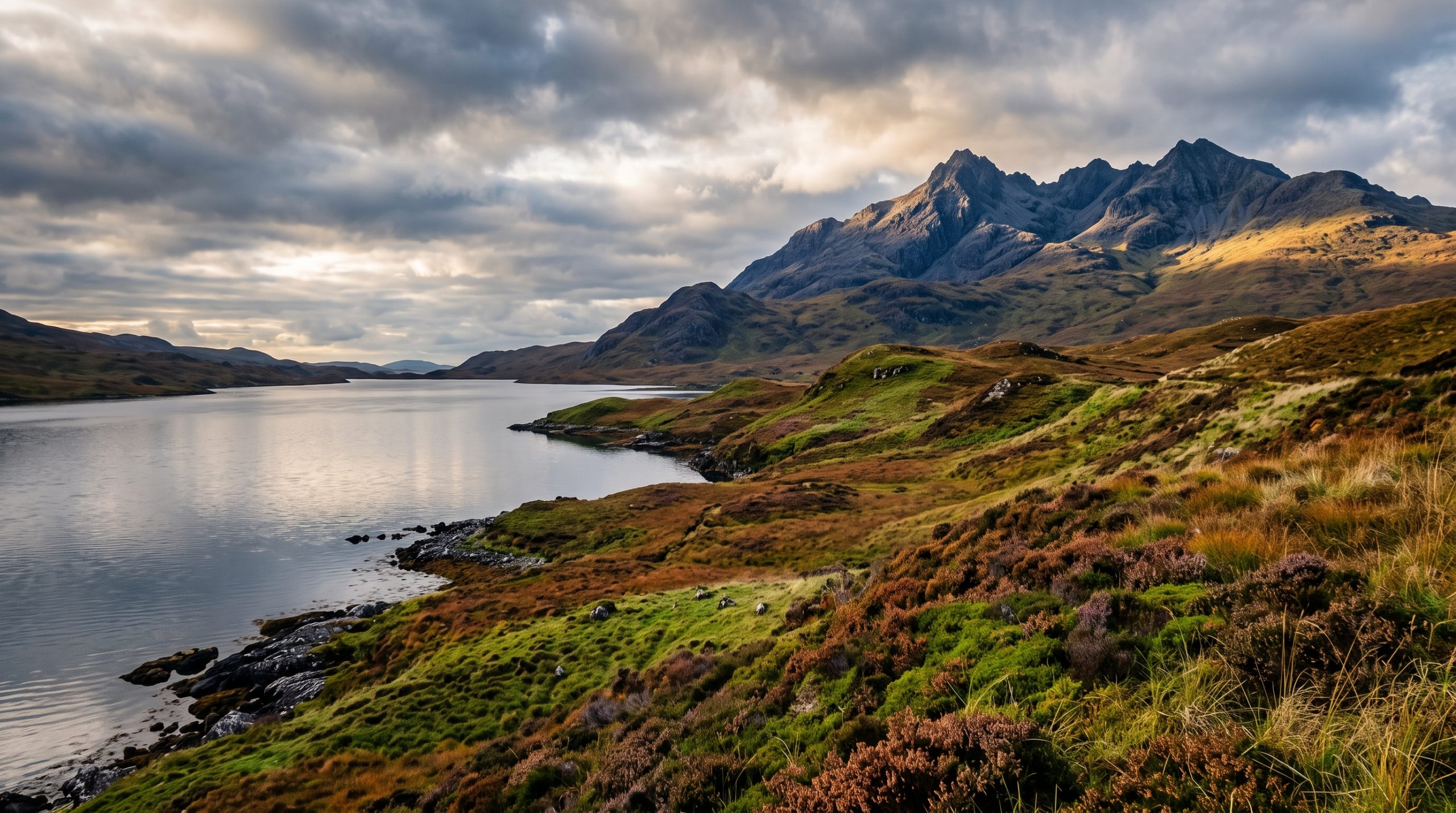
The pay-and-display machine at the Quiraing car park does not start charging until 8am. That single detail explains most of what we know about eloping on the Isle of Skye, because the hour when a Highland Council tariff is irrelevant is also the hour when the col above Staffin is quiet, the light is coming in sideways along the Trotternish terraces, and nobody is waiting for you to step out of the frame.
Skye has two windows where that early hour is comfortable, the ground is dry underfoot, and the evening still has warm light in it. Mid-May to the first days of June is one. The first three weeks of September is the other. They are not the warmest weeks of the Skye year and they are not the longest days either, and that is exactly the point.
Below is the month-by-month version, with the numbers we actually plan against: Met Office averages for the island, sunset times to the minute, and the length of the low-sun window that decides when your ceremony starts.
The two windows we build Skye days around
Mid-May and the first three weeks of September are the strongest windows on Skye. May is the driest month of the island’s year, near 115 mm of rain, with sunset around 9:40pm. September is a degree warmer by day, hands you a low, warm sun from about 6:20pm, and empties the headline car parks once the schools go back.
Skye month by month, and the verdict we give
Temperatures here are Met Office long-term averages for the island, quoted as the average daily maximum. Clock times are local Skye time, which means British Summer Time from late March to late October. If you want the geography behind the months, that sits in our destination guides.
| Month | Numbers that matter | Light | Crowds | Our verdict |
|---|---|---|---|---|
| January | 6.6°C, wettest month of the year | 7h 20m of daylight, noon sun only 11° up | The island is yours | Low, soft, everything within 20 minutes of a road |
| February | 7.1°C | Sunset near 5:25pm, 9h 30m of daylight | Quiet | The best of the true winter months |
| March | 8.5°C | Sunset near 6:30pm, 11h 45m | Quiet until Easter | Good light, cold wind off the water |
| April | 11.2°C | 14h 20m; full darkness gone by the 30th | Building through the month | Strong, and ahead of the midges |
| May | 14.1°C, around 115 mm of rain | Sunset 9:40pm mid-month, 16h 35m | Busy by 10am, empty at 5am | Our first choice |
| June | 15.7°C | 18h of daylight, sunset 10:30pm | Peak | Long, but the warm hour lands near midnight |
| July | 16.9°C | Sunset 10:10pm mid-month | Peak | Coast and ridge, where the breeze is |
| August | 17.1°C, warmest month | Sunset 9:05pm mid-month | Peak until schools return | Heather at its best, roads at their fullest |
| September | 15.1°C | Sunset 7:45pm mid-month, 12h 50m | Falls away after the first week | Our other first choice |
| October | 11.9°C | Sunset 6:20pm mid-month, 10h 20m | Quiet | Colour, weather, and dark skies again |
| November | 8.9°C | 8h of daylight, noon sun 14° up | Very quiet | One continuous soft window, no golden hour needed |
| December | Solstice daylight 6h 42m | Earliest sunset 3:42pm, noon sun 9° | Very quiet | Short, low and atmospheric, planned tightly |
What the sun actually does at 57 degrees north
Skye sits at 57.4°N, and that latitude does something to a wedding day that no amount of planning can argue with. On the June solstice the sun clears 56° at midday and does not set until 10:30pm. In mid-September it tops out at 35°, and by the winter solstice it never gets more than 9° above the horizon at all, which is why a December film on Skye looks like one long sunset.
The number we build the timeline on is not sunset. It is the length of time the sun spends below 10°, because that is the light that makes the Trotternish ridge look carved and turns wet basalt gold. In mid-May that window runs about 93 minutes, from roughly 8:07pm to sunset. In mid-September it is about 80 minutes, from roughly 6:24pm. Almost the same amount of usable light. One of them ends at a reasonable hour and one of them does not.
That difference is the whole argument for September. Vows at 6pm on the ridge, warm light on your faces for the walk down, a table somewhere by 9pm. In May the equivalent ceremony hour sits after 8pm, which is a beautiful thing if you want it and a long day if your family has travelled. September also loses light fast: sunset moves back roughly 80 minutes across the month, about three minutes a day, so a timeline written for the 5th does not work on the 28th. We rebuild it for your actual date.
There is one more thing the latitude does. From about 30 April to 13 August, Skye never reaches full astronomical darkness. On solstice night the sun stays within about 9° of the horizon, and the northern sky holds a blue-grey glow until sunrise. Beautiful for a late walk on Staffin beach. Useless for stars.
Heather, first colour and the return of dark skies
Three natural windows are worth shaping a date around on Skye, and all three move.
Heather starts flowering in July and peaks in August, holding on in patches into September. On a good year the moor above Loch Slapin and the slopes below the Storr go properly purple for two to three weeks, and the exact fortnight shifts with how warm and wet the early summer was. If purple hillsides matter to you, the last week of August is the intelligent compromise: heather still up, crowds already thinning as the school holidays end.
Autumn colour on Skye is a bracken and grass show rather than a forest one, which means it arrives as a change in the whole hillside from green to rust and copper. It builds through October. It is the most underrated fortnight of the Skye year on film, because the ground colour and the low sun are working in the same direction. You can see what that looks like in our published films and galleries, where the autumn days read warmer than the May ones even though May is the drier month.
Dark skies return from late September and run to March, which is also the aurora season for this latitude. We will not sell you the northern lights. A visible display needs solar activity, a clear northern horizon and no moon, all on the same night, and most trips get two of those three at best. What we do is pick accommodation with a dark northern outlook, keep the second camera charged, and treat it as a bonus we are ready for rather than a promise on a timeline.
If your date lands in high summer or midwinter
Some dates are fixed before anyone starts researching. Anniversaries, visas, the only fortnight two families can travel. Here is how we make the harder stretches work rather than talk you out of them.
Late June to mid-July. The problem is not weather, it is arithmetic. Sunset at 10:30pm pushes the warm hour to nearly 11pm, and midges are at their strongest from late May through August in still, sheltered, damp ground. So we invert the day. Vows in the early morning, when the ridge is empty and the air is moving; the middle of the day spent on the water or driving between coasts; the long evening used for a slow, low-pressure hour on exposed ground at Neist Point or Talisker Bay, where the wind off the Minch keeps everything comfortable. High summer on Skye is genuinely good if you accept a 4am start.
December and January. Six hours and forty-two minutes of daylight at the solstice sounds like a constraint. In practice it is a gift, because there is no golden hour to chase when the midday sun sits between 9° and 12° all month. The entire day is low light. We plan tight: one area, drive times under 20 minutes, a ceremony around 12:30pm, and a shortlist of shelter that works in any wind. Midwinter Skye films look like nothing else we shoot.
The one we will be straight about. If you want a mountain summit, an open boat to Loch Coruisk and a beach in the same day, that is a May or September ask, not a January one. Tell us what the day has to contain and we will either build it, or name the month that actually fits it.
Passes, car parks and the hours they charge
Access on Skye is seasonal in ways that catch planners out, and almost all of it is manageable once it is written down.
- Most headline sites now charge for daytime parking. At the Quiraing the Highland Council machine runs 8am to 6pm and takes card or the RingGo app, currently a few pounds for a three-hour stay. Arrive at first light in May and it is neither busy nor chargeable.
- The single-track road over the Quiraing pass is high, unlit and the first on the island to go over to ice. From December to February we build days on low ground and treat the ridge as a bonus if the morning is kind.
- Car parks at the Storr and the Fairy Pools are the ones that fill first. Between 10am and 4pm from June to August, plan on walking further or being somewhere else entirely.
- Boat time out of Elgol towards Loch Coruisk, and anything involving a guide on the Cuillin, belongs in the May to September half of the year. We confirm operator availability for your exact week before either goes into a timeline.
Permit research and the paperwork for landowners and sites is part of what we do for every date. Fees themselves, along with a boat charter or a mountain guide if the day needs one, sit with you. What is and is not included is set out plainly on our pricing page, and it does not change with your destination.
How the rainy version of the day is designed in advance
Rain falls on Skye in every month of the year. So the plan is not optimism, it is wind direction. Before your date we write a short document with your primary locations and a paired alternative for each, chosen by where the weather is coming from. A westerly that makes Neist Point unworkable is often perfect at the Fairy Glen above Uig, fifteen minutes inland and low enough to be sheltered. The Trotternish ridge runs north to south, so an easterly and a westerly give you completely different halves of it. Loch Slapin’s eastern shore holds up when Glen Brittle is closed in by cloud.
Your ceremony hour moves too. We hold two candidate slots rather than one, and pick 36 to 48 hours out when the forecast has settled. Nothing about that is improvised on the morning.
This is also where having eight people on one team stops being an abstraction. On a September date, when the good light lasts about 80 minutes, a photographer and a filmmaker working the same ground at once is the difference between covering your vows and choosing between them. One holds the wide frame with the ridge in it. One is close, on your hands and your faces, with audio running. In May, with a two-hour evening and light until half past ten, we work slowly and cover more ground. The season decides the shape, not the crew.
Check Your Date and tell us the month you are circling. We will reply with what that week on Skye realistically does.
Common questions
Is May or September better for eloping on Skye?
May if you want the driest ground and the longest evening. September if you want a ceremony hour that ends before dark, warmer average days at 15.1°C, and far fewer people at the Quiraing and the Storr. We book both windows heavily and would happily argue either side.
How bad are midges on Skye in June and July?
Noticeable in still, damp, sheltered spots from late May to August, and close to absent on exposed coast and high ground where the air is moving. That is why summer timelines here favour Neist Point, Talisker Bay and the ridges, and why we start early, when it is cooler and breezier.
Can we elope on Skye in December?
Yes, and midwinter is one of the more distinctive films we make. Daylight at the solstice runs 6 hours 42 minutes with the sun never above 9°, so the whole day is low light. We keep the ceremony near 12:30pm, drive times under 20 minutes, and shelter options within reach.
What time should our September ceremony be on Skye?
Around 6pm in the first half of the month. The sun drops below 10° at roughly 6:24pm mid-September and sets near 7:45pm, giving about 80 minutes of low, warm light for vows and the walk afterwards. By the end of September that whole sequence has moved 40 minutes earlier.
Will it rain on our Skye elopement?
Some rain is likely in any month, and May is the driest at around 115 mm against more than double that in January. Every plan we write pairs your locations with wind-direction alternatives, and the ceremony hour has two candidate slots until the forecast settles 36 to 48 hours out.
Could we see the northern lights on Skye in late September?
Possibly. Dark skies return around late September after four months without full astronomical darkness, and the season runs to March. It needs solar activity, clear northern sky and little moon on the same night, so treat it as a bonus rather than a plan. We stay ready for it.
How far ahead should we book a Skye date in May or September?
Those two windows go first, and we are currently booking 2027, 2028 and 2029. Legally you need much less time: marriage notice in Scotland must reach the registrar at least 29 days before the ceremony, and the marriage schedule is collected in person between 7 and 29 days beforehand.
Choose the quieter fortnight, then hold it
Start with what the day has to contain and let the calendar follow. A boat to Loch Coruisk and a ridge walk points at mid-May. Vows in warm light with dinner afterwards points at the first fortnight of September. Purple hillsides point at the last week of August. The fundamentals of paperwork and pacing are laid out in our guide to planning an elopement.
We keep the planning in one written thread, at whatever pace suits you. Send the inquiry form, we reply with a brochure inside 24 hours, then a tailored proposal, then a contract and a 30% retainer hold the date while planning starts. Tell Us Your Story and name the month you are looking at.