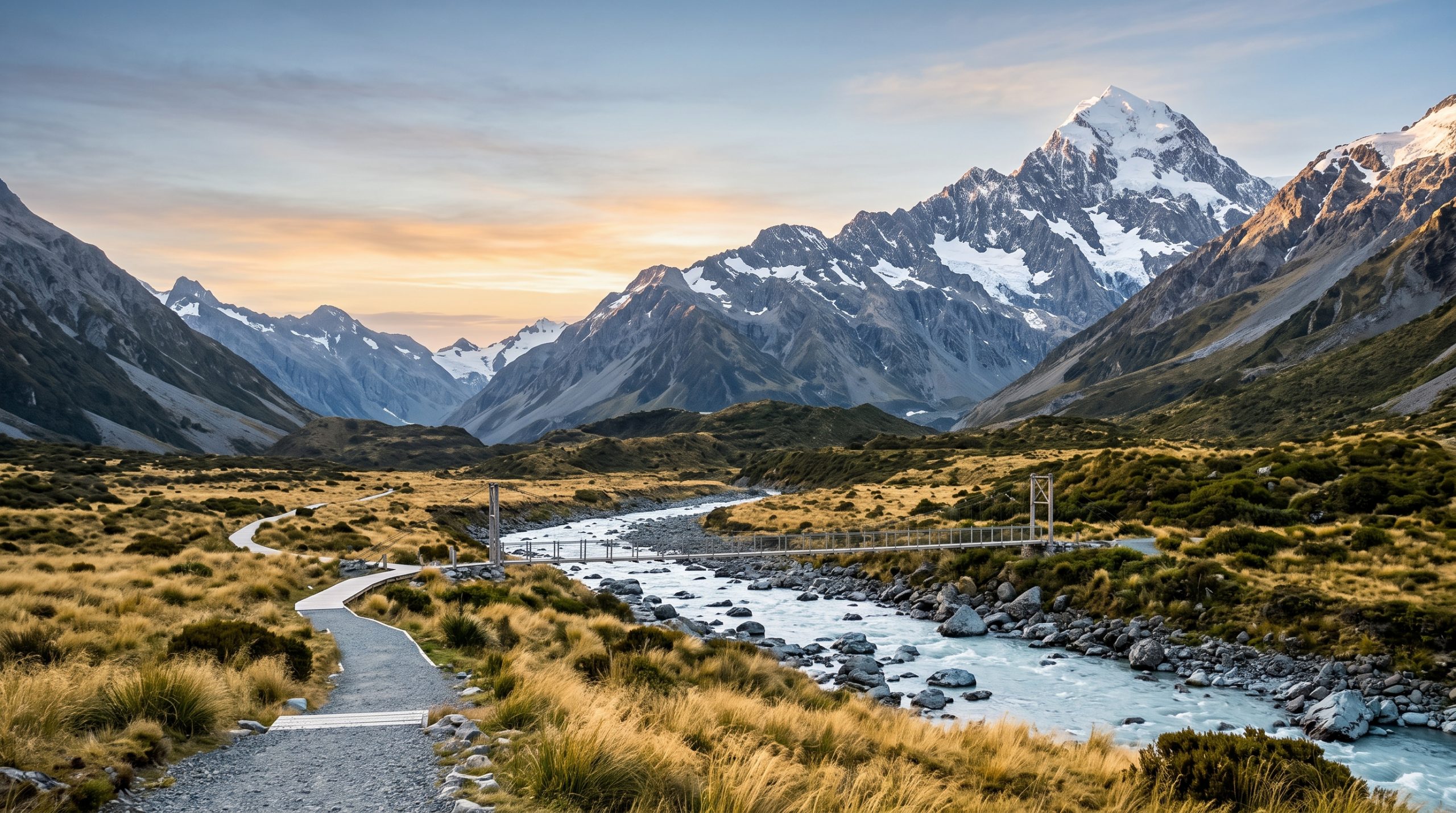
The Department of Conservation charges NZD 2.50 per half hour to park at White Horse Hill, or NZD 25 for the whole day, and the first twenty minutes are free. From that gravel car park a 10 km track runs up the Hooker Valley, over swing bridges and along the river, to a glacial lake with Aoraki/Mount Cook standing at the far end of it. Three to four hours, return, on a graded surface with a few steps.
That is the entry price to one of the great pieces of ground in the country. Most New Zealand elopement inspiration you have scrolled past, though, was made in the sixty minutes after a helicopter shut down on a glacier, and the quiet implication is that the good version of this requires a charter.
We shoot both. We have worked on the ice after a landing and we have walked the Hooker at 6am with a couple who drove themselves there, and we have a clear view on which one leaves people with more to keep. Here is the comparison, with the numbers behind it.
Flight or road: the answer we give first
Road, for most couples. A South Island elopement built on tracks, roads and one boat gives you the full arc of light across several landscapes, and bad weather has to spoil all of them to spoil the day. A landing buys about an hour in one extraordinary place, on the one morning it can fly.
Air access and road access, compared on the decisions that matter
Access is the only real variable. Our team, our fee and the delivery timings are identical whichever way you travel. What changes is how many hours you get, how many kinds of ground you can reach inside them, and how many ways the day still works when the cloud sits at 900 metres.
| Criterion | Helicopter landing | Road, track and boat |
|---|---|---|
| Cost of the access itself | Published wedding flight rates from Wanaka start at NZD 1,800 for a one hour alpine landing in a four seat machine, paid direct to the operator | NZD 25 buys a full day in the White Horse Hill car park, and most roadside ground costs nothing |
| Time in one location | Roughly an hour, fixed by the flight window | As long as the light stays interesting |
| Weather exposure | One go or no-go decision on the morning | Alternatives sitting 15 to 90 minutes apart by road |
| Season | Flies year round when conditions allow | Roys Peak closes 1 October to 10 November for lambing, and SH94 can require chains in winter |
| Permissions | DOC concession for commercial filming on conservation land, plus the operator’s landing permissions | DOC concession for commercial filming on conservation land |
| Genuinely best at | Glacier ice, untracked ridge tops, complete privacy | Hours, variety of ground, and vows you can hear on the film |
Our own cost does not move with the transport. The Adventure is one full day with a dedicated photographer or a dedicated filmmaker, from $4,900. The Expedition is the same day with both of them working together, from $7,900, and it adds professional audio for the vows where conditions allow. Team travel to New Zealand is included in either, and the full breakdown lives on the pricing page.
What only a landing can reach
There is terrain here with no walking route, and pretending otherwise would be dishonest. The upper snowfields, ice that survives a Canterbury February, the flat crown of a ridge that no track climbs: those are flights, and there is no clever substitute. A landing also removes the climb. Roys Peak gains over 1.2 km of vertical from the road, and not every couple wants to arrive at their own ceremony having done that in head torches.
Privacy is the other honest advantage. The machine lifts off, the sound goes with it, and for an hour there is nobody within several valleys of you. On a public track at sunrise there are other people, and we work around them rather than pretending they are invisible.
Four South Island days that never leave the ground
These are not scenic stops strung on a string. Each one is a whole day with a first light position, a mid morning move, a ceremony somewhere the wind cannot get at the vows, and an evening location, all inside a driving distance we would happily cover twice.
Aoraki/Mount Cook and the Hooker Valley
The Hooker is the rare famous walk that deserves it. Ten kilometres return, three to four hours, and the mountain grows in the frame the entire way in. The valley carries Tōpuni status and is sacred to Ngāi Tahu, which shapes how we work there rather than whether we work there: smaller footprint, quieter setups, ceremony off the track rather than on it. Drones are prohibited in the national park without a permit, so we plan the film here from the ground and place the aerial work on a day and a piece of land where it is properly authorised.
Wanaka, and the ridge without the queue
Roys Peak starts from a car park 7 km northwest of Wanaka and climbs over 1.2 km of vertical with no water on the way. The famous ledge is genuinely worth the effort, and it also has a line of people on it on a February morning, which is not what most couples picture when they plan a sunrise ceremony there. Our answer is usually to keep climbing past it, or to shoot it on a weekday in late autumn, or to use Diamond Lake and Rocky Mountain instead and save the legs. The track also closes for lambing from 1 October to 10 November each year and reopens on 11 November, which quietly rules out a chunk of spring.
The head of Lake Wakatipu
Past Glenorchy the seal ends and the road runs out toward Paradise through red beech and shallow fords, with the Dart and Rees valleys opening behind. This is the closest thing in New Zealand to landing somewhere remote without leaving the ground, and it holds an afternoon better than almost anywhere else in Otago because the light keeps changing as the valley walls move. A boat on the lake extends it again, and the water is often calmest early.
The Milford Road, built from Te Anau
SH94 is one of the most actively managed alpine roads in the country, with its own avalanche programme and winter periods when chains have to be carried. We treat that as planning information. The Fiordland leg gets built from Te Anau rather than driven out and back from Queenstown, with the Eglinton Valley flats, Mirror Lakes and Lake Gunn held in reserve at lower altitude, and the Homer Tunnel crossed early enough that the day is not hostage to it. Our other South Island routes sit in the destination guides.
The licence names one place, and DOC governs the rest
New Zealand is one of the more straightforward countries in the world to marry in as a visitor. There is no residency or citizenship requirement. You apply for a marriage licence at least three working days before the ceremony, it stays valid for three months, and the fee is NZD 150, rising to NZD 158 from 18 June 2028. You need two witnesses, which for a couple travelling alone usually means the people already standing there with cameras.
The detail that catches people out is the address field. A New Zealand marriage licence names the place where you are authorised to marry, so the ceremony is legally tied to that spot. This is why we put a realistic alternative on the application at the outset, and it is the single strongest argument for holding the legal ceremony on ground you can drive to. If the licence names a peak you can only reach by air and the machine cannot fly that morning, the view is not the only thing you lose. Sign somewhere reachable, then treat any flight as photography.
On the conservation side, commercial filming and photography on public conservation land requires a concession from the Department of Conservation, and drone use on that land needs its own. Under CAA Part 101 the aircraft stays below 120 metres, inside visual line of sight, with consent from the people and property underneath. Permit research and logistics are part of what we do in planning; the government and landowner fees themselves are paid by you. The wider sequence is set out in our guide to planning an elopement.
The three differences that settle it, and who lands on each side
Hours come first. A landing is an hour, and it is an hour chosen by the operator’s availability and the day’s flying conditions, which in practice often means mid morning. Mid morning is the flattest light of the day. A road day starts before dawn because we decide when it starts, and it ends when the last colour leaves the tops.
Weather is second, and it is not really about rain. It is about how many decisions the day contains. A flight is one decision made once. A route through Fiordland or the Mackenzie is a decision you get to make again at nine, at noon and at four, which is why couples on the ground almost never lose a day outright.
Sound is third and it is the one people forget. Exposed alpine ground is windy by definition, and wind is the enemy of a vow you want to hear again in twenty years. Lower, sheltered positions in beech forest or on a lake edge give us clean audio, and the Expedition builds around that. You can see how differently the two read in finished work: the aerial films are wide and cinematic, the ground films hold faces and voices, and both are in our published stories and films.
So the shapes divide fairly cleanly. Couples with one day and a fixed date who want the widest possible spread of landscape should drive. Couples for whom standing on snow is the entire point should fly, with the legal ceremony held somewhere reachable first. Couples who care most about hearing the vows again should stay lower and let us build the day around shelter. Couples with three to seven days should look at the Odyssey, which is where several regions in one trip stops being a rush and starts being a proper expedition. Tell us which of those sounds like you and we will send back a route rather than a menu.
Send Us a Message with your dates and the two or three places you keep coming back to, and we will tell you honestly what fits into one day.
Where “you need a helicopter for the good stuff” breaks down
The conventional Queenstown advice is heli first, because the flight is the marquee product and it compresses an entire elopement into a single, sellable hour. Three things go wrong with that.
The hour lands in the middle of the day. The rest of the day goes unplanned, so couples spend twelve good hours of light with nothing designed into them and then wonder why the gallery feels thin. And the ambition tends to spread sideways rather than deeper, which is how Milford Sound ends up as a day trip from Queenstown, arriving in the middle of the afternoon with everyone else.
Turn it around and the flight becomes excellent. Build the day on the ground, decide where the ceremony happens and where the last light will be, and then, if the morning is clear and you want the ice, add a landing inside a structure that already works without it. That is the version we recommend, and it is the one that survives a low cloud base.
Common questions
Can we reach glacier scenery at Aoraki/Mount Cook without flying?
Yes. The Hooker Valley Track runs 10 km return from the White Horse Hill car park, three to four hours on graded gravel, and finishes at a glacial lake directly below Aoraki/Mount Cook. The Tasman Valley on the other side of the village puts you among moraine and ice after a much shorter walk.
Do we need a DOC permit to elope on conservation land?
Commercial filming and photography on public conservation land requires a concession from the Department of Conservation, and drone work on that land needs a separate one. Permit research and logistics guidance are included in planning with us. The government fees themselves are paid by you.
When do we apply for the New Zealand marriage licence?
At least three working days before the ceremony, and within three months of it, since the licence is valid for three months. The fee is NZD 150, rising to NZD 158 from 18 June 2028. There is no residency or citizenship requirement for visitors.
What if the weather moves us somewhere other than the place on the licence?
The licence authorises you to marry at the place named on it, so we put a realistic alternative on the application when you apply. A low cloud morning then changes the view rather than the legality, and the ceremony simply happens at the second location on the form.
Can you fly a drone at Aoraki/Mount Cook or on the Milford Road?
Not without permission. Public conservation land requires a DOC concession, and the national park prohibits drone flying without a permit. CAA Part 101 keeps the aircraft below 120 metres, in sight, with consent from people and property below. We confirm the window before the film is planned around it.
Is Roys Peak open in October?
Not for most of it. The track closes for lambing from 1 October to 10 November and reopens on 11 November. If your date falls inside that window we move to another Wanaka hill, and there are several with the same lake and mountain view.
Is one day enough without a flight?
One day covers a single region properly: first light, a ceremony, an evening position, with real travel time built in. Two or more days is what you need to put Fiordland and the Mackenzie in the same trip, and that is exactly what the Odyssey exists for.
What to send us when you are deciding
Send your dates, the region you keep returning to, and the one thing you are least willing to give up, whether that is standing on snow, hearing the vows clearly, or simply not setting an alarm for 3am. We will come back within a day with a shape for it, and if the month you have chosen fits a different part of the South Island better, we will say so. We keep the planning thread in writing, so you can read it, think, and reply when it suits you.
Our calendar is currently open across 2027, 2028 and 2029. Start Your Story and tell us what you actually want the day to feel like.