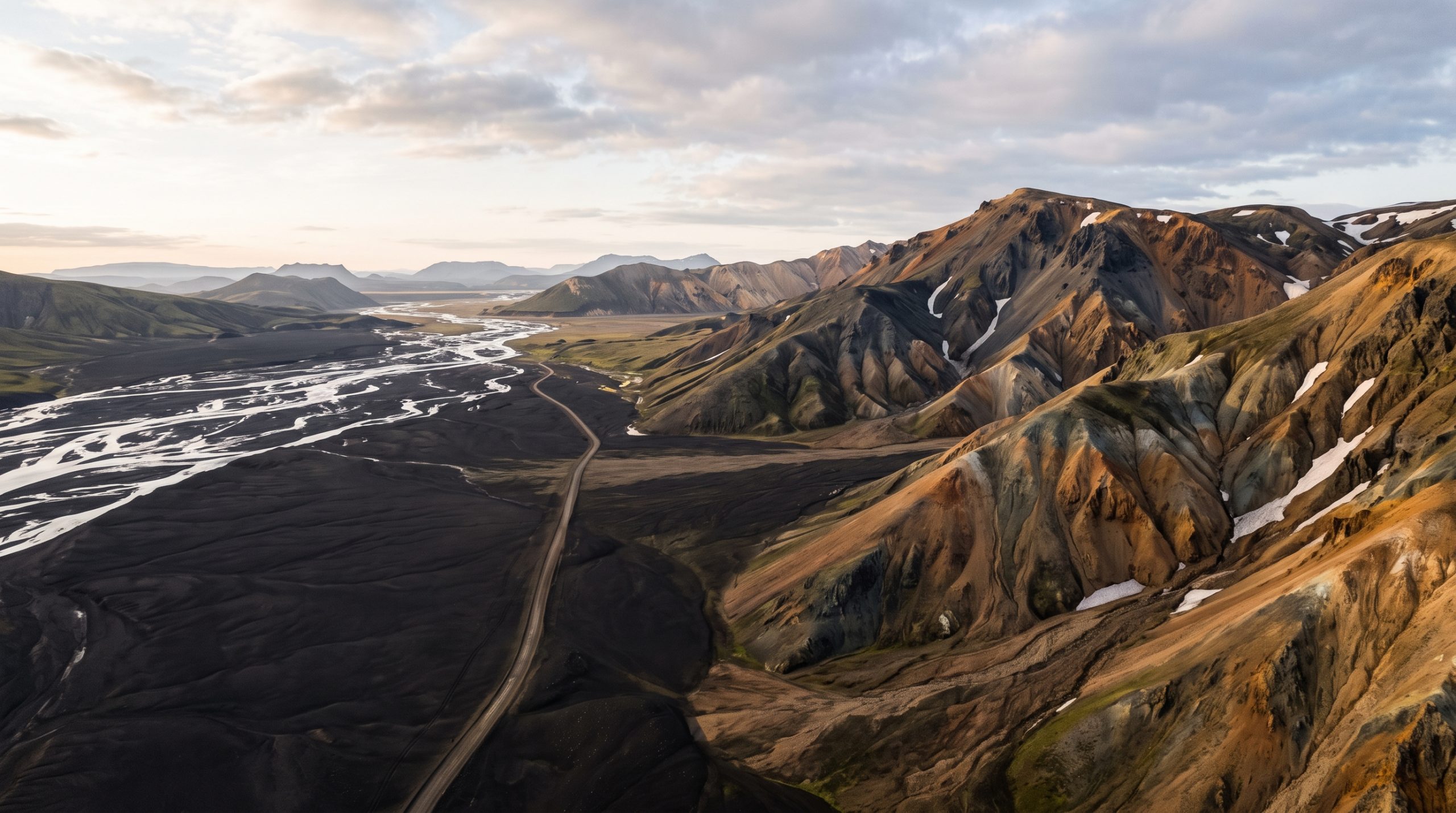
Nobody publishes the date Landmannalaugar opens. Vegagerðin, the Icelandic road administration, sends someone up the F208 in spring to look at the snowfields and the river levels, and the road only goes green once the track will carry a vehicle without tearing up the ground under it. Most years that lands somewhere in June. The gap between an early year and a late one is a matter of weeks, not days.
Everything else follows from that. From the morning the road opens to the autumn when the wardens leave the hut and the track goes back under snow, you have roughly ten dependable weeks, and the basin in week one is not the same place as the basin in week ten. Snow still sits in the high gullies in late June. By early September the moss on the rhyolite slopes has turned copper and there is real darkness again after ten at night.
One more thing catches almost every couple out. Iceland keeps UTC all year while Landmannalaugar sits about nineteen degrees west of Greenwich, so the sun here is at its highest at roughly twenty past one in the afternoon. Every instinct you have about when the good light arrives is running about eighty minutes early.
Vegagerðin opens the road, not the calendar
Landmannalaugar has about ten dependable weeks a year. Vegagerðin opens the F208 once it has inspected the snow and the rivers, usually somewhere in June, and the hut is staffed through the summer into early autumn. Everything else about the day, from the ceremony hour to the walk, follows from where inside that window you land.
Three different Landmannalaugars inside one summer
The first fortnight after the road opens is the quiet one. The main F208 comes open before the smaller tracks around it, so the side trips out to Ljótipollur and up into Jökulgil can still be shut while the campsite is already filling. There is compensation. Around the solstice the sun sets at about ten to midnight and is back up before three, and at its lowest it sits due north less than three degrees under the skyline, so it does not get dark at all.
July is the month when everything works and everyone knows it. The Laugavegur runs at full flow from the hut door, the hut is full, and the campsite fills by evening. Late August and early September are the quiet secret of the ten weeks. Sunset drops back to a quarter past nine on 20 August and to twenty past eight by 5 September, which gives you an honest golden hour at a civilised time of day, and the moss changes colour. If your dates are flexible, that fortnight is the one we push hardest for. Our destination elopement guides set out how the Icelandic seasons compare across the rest of the country.
| Window | Ground conditions | Sun sets | The trade |
|---|---|---|---|
| Late June | Main road usually open, snow in the high gullies, some side tracks still shut | Around 23:45, no darkness at all | The opening date is not confirmed until it happens |
| Mid-July | Everything open, ground dry underfoot | Around 23:10, low sun from 21:35 | The busiest fortnight of the year here |
| Late August | All tracks open, moss turning, rivers lower | Around 21:15, dusk by 22:15 | Weather swings faster from day to day |
| Early September | Road open, hut still staffed, colour at its strongest | Around 20:20, dark enough for aurora | First snow can arrive on the passes |
The sun is highest at twenty past one
Solar noon at Landmannalaugar falls at about 13:20 for most of the summer. That single fact reorganises the entire timeline. A four o’clock ceremony is an early-afternoon ceremony in light terms. Six in the evening is barely mid-afternoon. Couples arrive with a mental clock set for a temperate latitude and a time zone that matches its longitude, and Iceland has neither.
Around the solstice the sun clears the horizon at about 02:50 in the north-northeast and drops back into it just before midnight in the north-northwest. It stays below six degrees of altitude, which is where light stops being hard and starts wrapping around people, for close to seven hours in a row, and below the horizon for only three of them. There is no forty-minute scramble for golden hour here. There is a long, slow, cold night that behaves like one extended sunset.
What complicates it is the shape of the basin. The campsite sits at around 600 metres, ringed by ridges and cones that stand 250 to 350 metres higher, and Bláhnúkur alone reaches 943 metres directly above the hut. Direct sun leaves the floor of the basin long before it leaves the sky, and it returns to the floor long after sunrise. In practice the last light of a July night lands on the ridge tops and the upper slopes, not on the flat ground by the hot spring. If you want to be standing in that light, you are standing higher than the campsite, and we plan the walk to put you there in time.
The other thing worth saying plainly is that bright overhead sun is the worst light this place gets. Rhyolite is at its most saturated wet or under cloud, when the ochre and the rust separate out instead of bleaching into one pale wash. A drizzly evening at Landmannalaugar is not a fallback, it is frequently the better version of the day. You can see how wet lava and coloured rock actually hold up in our published films and galleries.
The last river, and what the lava does to a hem
There are two ways in. F208 north leaves Route 26 near Sigalda, and F208 south climbs up from the ring road side, a longer run with more crossings. Almost everyone uses the north approach, and from Reykjavík that is the better part of four hours of driving, the last stretch of it gravel where forty kilometres an hour is a decent pace. These are F-roads, which in Iceland means four-wheel drive, legally and practically. The nearest bed that involves no river at all is the highland hotel at Hrauneyjar, out on the paved road at the top of Route 26.
The last kilometre is the one that shapes the morning. F224 branches off to the campsite and holds the two largest fords of the whole route, immediately before you arrive. There is a car park on the near side with a footbridge across it, and that car park is where we stage the day whenever meltwater has the river running high. It adds about ten minutes on foot and it removes a whole category of decision from a wedding morning.
Once you are in, the walking is short and very specific. The hot spring is five flat minutes from the hut on gravel and boardwalk. The edge of the Laugahraun lava field is ten to fifteen minutes on a made path through blocky, abrasive rock that you place your feet on rather than stride across. Bláhnúkur is about an hour up from the hut on loose ash and scree.
In wedding clothes that grades out clearly. The spring and the lava edge are both fine in a dress, and both are unkind to a long train. The lava grit is black and sharp and does not brush off silk, and the ash on Bláhnúkur travels up a hem in a grey band that stays there. Boots to the lava edge with a change of shoes at the top is the normal move, and we build fifteen minutes into the timeline for it rather than pretending it takes none. A shorter dress, or one you are happy to see marked, will get you considerably further up the mountain than a cathedral train will.
The middle of the day belongs to the buses
Landmannalaugar at one in the afternoon in July, seen from the boardwalk by the spring, is not the place in the photographs. The buses come in over the middle of the day, the parking by the hut fills, the sun sits almost overhead at exactly the wrong angle for coloured rock, and the basin looks flatter and busier than it has any right to. That is the hour most visitors get, because the driving at either end of the day forces it.
Arriving early is not the fix, because arriving early from Reykjavík means leaving at two in the morning and being tired for the part that counts. Staying the night is the fix. Hikers coming off the Laugavegur head for the hot spring through the late afternoon, the day traffic pulls out mid-afternoon, and from about nine in the evening the lava field belongs to whoever is still standing in it. Every hour we care about here is an hour you can only reach by sleeping within a river crossing of it.
If your date falls on an Icelandic holiday weekend, or the hut is booked out and the campsite is at capacity, the basin has good neighbours. Frostastaðavatn is over the pass a few minutes north, Ljótipollur is a short track beyond it, and Sigöldugljúfur sits back towards the paved road. None of them is a consolation prize, and on a busy weekend one of them often becomes the ceremony while Landmannalaugar becomes the walk afterwards.
Nobody owns the ground, but somebody runs the hut
Landmannalaugar sits inside Friðland að Fjallabaki, the Fjallabak nature reserve. There is no venue here, no gate and no ticket for the ground itself, and a small private ceremony standing on open ground in the reserve needs nothing booked. That is worth stating without hedging, because most pages about this place manage to imply otherwise.
The hut and the campsite are a different matter, and they belong to Ferðafélag Íslands, the Iceland Touring Association. The hut is reserved ahead through FÍ and goes early for the summer. The campsite is registered at the warden’s desk on arrival rather than booked in advance. FÍ’s own terms also set a facility fee for visitors who use the toilets, the shelter or the grill without staying overnight, included in the fee if you do stay, which is the kind of detail that is easier to know in advance than to discover with a bouquet in your hands.
The paperwork that does exist attaches to hardware rather than to vows: drone flying inside a protected area, and anything the reserve counts as commercial filming. We confirm both in writing for your date before we build any part of the film around aerials, and staying on the marked paths is the reserve’s rule rather than a suggestion. Permit research and logistics guidance are part of every experience we run, while the permit fees themselves, along with accommodation and your celebrant, sit with you. The order all of it happens in is laid out in our guide to planning an elopement.
Where two of us can stand without meeting
The boardwalk to the spring is one person wide with marsh either side, so it is not a place for two cameras at once, and anyone standing on it is in the frame. The lava field is the opposite. Laugahraun is broken into blocks that stand higher than a person in places, so a filmmaker can move thirty metres and simply be gone, then come back with a completely different angle on the same minute. Wind funnels down out of Jökulgil and across the flat ground, which is why vows here go on a body microphone rather than on the camera, and why we would rather set them behind a lava wall than out in the open. Photography, film and planning come from one team of eight, so the person filming already knows where the person shooting stills intends to stand.
Our full-day coverage starts at $4,900 for one dedicated photographer or one dedicated filmmaker, and at $7,900 for a photographer and filmmaker working the day together with team travel to Iceland included, and the detail of what each experience covers sets out the rest. Highlights reach you in five days, the full gallery or film in three weeks.
Common questions
What happens if the F208 has not opened by our date?
We plan for it from the start. Vegagerðin confirms the road when it confirms it, so a late-June date carries a second version of the day built on ground you can reach from the paved road, with Sigöldugljúfur, Frostastaðavatn and the Hekla approaches doing the work instead. If the road opens on schedule, we drive in as planned. Nothing about the timeline moves at the last minute except which valley you are standing in.
Is there anywhere at Landmannalaugar to change out of hiking boots?
There is a service block beside the hut with toilets, and beyond that the honest answer is the back of the car. Most couples change at the vehicle before the walk in, or carry shoes and swap at the lava edge. It works perfectly well, and it is one reason we build the timeline with the car park as a base rather than treating it as somewhere you merely park.
Do we need a permit for a ceremony inside Fjallabak nature reserve?
For a small private ceremony on open ground, no. There is nothing to book and no charge for the ground. The permissions that do apply cover drone flying in a protected area and filming the reserve treats as commercial, and we confirm those in writing before your date. Government and landowner permit fees are paid by you, while the research and the guidance are ours.
Can we reach the campsite in a rented two-wheel drive?
No. Everything from the turn onto F208 is a designated mountain road, which means four-wheel drive, and the two fords on F224 just before the campsite are why. If you would rather not cross them even in a 4×4, use the car park on the near side and the footbridge, then walk the last ten minutes. A 4×4 charter with a driver is straightforward to arrange as part of the logistics, and it sits outside our fee.
Can we get an aurora over the rhyolite mountains?
Only at the end of the window. Nothing is dark in June or July, when the sun never drops more than about three degrees below the horizon at its lowest. By 5 September it sets at twenty past eight and is properly dark by ten, which is the first point in the season where aurora over the coloured slopes becomes a real possibility rather than a hope. It is one of several reasons the early-September fortnight is the one we recommend most often.
Picking your ten weeks
Tell us the fortnight you are weighing up and we will tell you honestly what it gives you: light that never runs out and a road confirmed late, or two real golden hours, copper moss and a forecast that moves faster. Our Iceland calendar is currently open across 2027, 2028 and 2029, and the whole planning process stays in writing, so you can read our reply properly and answer when it suits you. Send us your dates and where you are flying from, and our first response and brochure reach you within 24 hours. Check Your Date