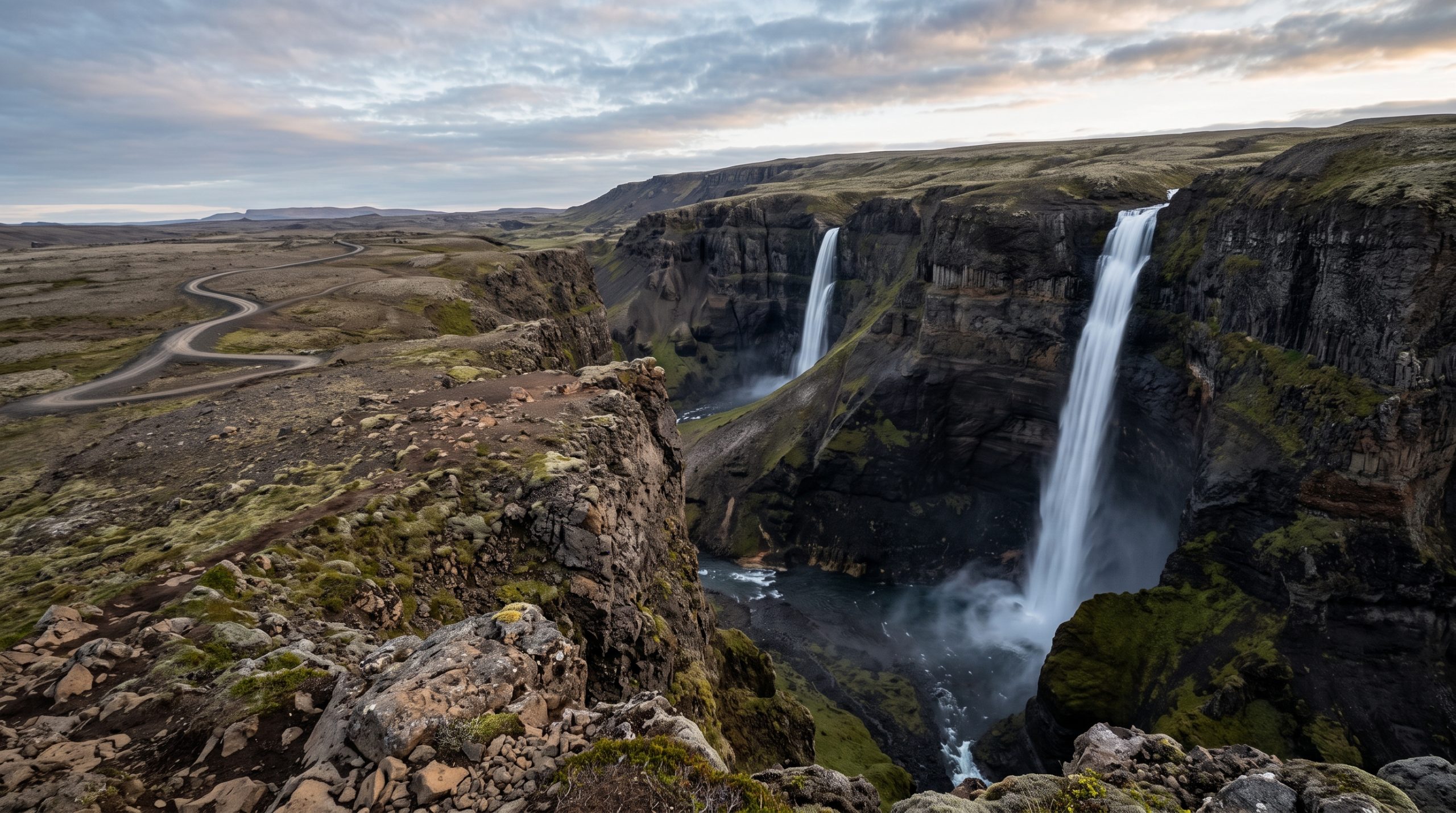
Eight kilometers of gravel take about twenty minutes. The walk from the car to the canyon edge takes two. That ratio is the whole planning problem at Háifoss, and most couples arrive expecting the opposite.
Road 332 leaves Route 32 just before the Sultartangi power station and climbs to a graded parking area on the rim of Fossárdalur, around 400 meters above sea level. From there the falls sit roughly 370 meters away to the northwest: Háifoss at 122 meters, Iceland’s fourth tallest after Morsárfoss, Glymur and Hengifoss, with Granni beside it at a little over 100 meters, both fed by the river Fossá on its way down to Þjórsá. Nothing is built here: there is no visitor center and no ticket window.
So the real question is not whether you can get married at Háifoss. It is what the road, the light and the wind will let you do once you are standing on that rim in a dress.
Eight kilometers of gravel, then a two-minute walk
Yes, you can marry here. Háifoss sits inside a protected area of Þjórsárdalur, so there is no venue to hire, only a rim of gravel above a 122 meter waterfall. You reach it on 7 to 8 kilometers of rough road off Route 32, then walk two minutes. Iceland requires an officiant authorized under its own law and two witnesses.
Road 332 from the Sultartangi turn
From Reykjavík it is about 140 kilometers one way, two to two and a half hours: Route 1 east past Selfoss, Route 30, then Route 32 into Þjórsárdalur, past Hjálparfoss, and left onto 332 shortly before the power station. If you are staying in Flúðir, Selfoss or Hella, the tarmac part of that drive is short and pleasant. Then the surface changes.
Road 332 is not an F-road, which matters legally: no rule bars a two-wheel-drive rental from it. That is not the same as it being comfortable. It runs potholed, loose and washboarded for the whole 7 to 8 kilometers, and higher clearance makes the difference between a drive and an endurance test. Gravel damage also sits outside most Icelandic rental cover, so it is worth reading the policy before you choose the car rather than after. We plan that stretch at around 25 km/h in both directions and tell couples to budget twenty minutes for it, not eight.
The road gets no winter service. It becomes dependable somewhere between late May and mid-June depending on the thaw, and stays that way into September, which sets the outer edges of the season for a rim ceremony.
There is a second way in, on foot along Fossá from the old farm site at Stöng, roughly eight kilometers and two and a half hours each way. It is a fine walk and the wrong tool for a wedding day, so unless you specifically want the crossing built into the trip, we drive.
Now the part nobody writes down. In wedding clothes, the difficulty at Háifoss is not the walk, because there is barely a walk. It is the dust and the door. Everything on 332 arrives at the top with a film of grit on it, so the dress travels bagged and stays bagged until the last moment, and the car becomes the changing room because there is no building up there to use instead. Opening a car door on the rim with a veil in your hand is a two-person job on a windy afternoon, and it is worth knowing that before it happens. Walk to the edge in boots, change shoes at the top, and accept that heels have nowhere useful to go on loose gravel and low scrub. We build ten minutes into the timeline purely for changing, because the hour you have chosen for the light does not wait while somebody hunts for a hairpin.
Guests change the convoy, not the fee. Each additional car is another vehicle picking its way up 332 and another set of arrival times to hold together, which is why we ask early how many people are coming and how they intend to drive.
Which way the canyon faces, and when the sun reaches the bottom
This is the part almost every guide to Háifoss skips, and it decides more about your photographs than the dress does.
From the parking area the falls lie to the northwest, which means the wall they drop down faces roughly southeast. Iceland holds the same clock all year, so the times below are the times on your phone. In late June the sun clears the horizon here just before three in the morning and sets a couple of minutes before midnight, tracking from north-northeast round to north-northwest.
The canyon is 122 meters deep and about 370 meters wide at the viewpoint, which gives a useful working rule: the sun has to be roughly 18 degrees above the horizon before it reaches the foot of the falls. In late June that window runs from about seven in the morning until nearly eight in the evening. By the third week of August it has shortened to about half past eight until quarter past six. Outside it, the plunge pool stays in its own shade while the rim above is still bright, and a camera has to choose between them.
Inside the window, the light changes character twice. Between nine and ten in the morning the sun sits east-southeast, thirty to forty degrees up, raking across the wall at an angle and showing every ledge and every change of texture in the basalt. Around eleven it swings almost square to the falls and climbs past forty-five degrees, which lights all 122 meters evenly and flattens the whole thing. That is the hour when Háifoss photographs like a postcard rather than a place, and it is also the hour most visitors are standing there.
Late evening is the one we plan ceremonies around. By ten at night in late June the sun is at roughly 315 degrees and about six degrees above the horizon, which puts it almost exactly on the line from the viewpoint to the falls. The wall goes into shade, the spray lights up from behind, the eastern side of the canyon turns warm, and two people standing on the rim are edged in light against a drop that reads as pure shape. It is a completely different location from the same patch of gravel eleven hours earlier. If you want to see how canyon light behaves once it is on a screen, our published galleries and films are the honest version, weather and all.
The rim empties before it fills
Háifoss does not hold people. Most visitors give it ten or fifteen minutes, look, photograph it and drive back down, because there is nothing else up there to do and nowhere to sit out of the wind. The rim turns over rather than fills up, and that is the useful thing to know.
The road does some filtering too. No coach is coming up 332, so what arrives is self-drivers and small jeep tours, in ones and twos, spread through the middle of the day.
Arrive early is only half the advice here. A seven in the morning ceremony in late June is genuinely quiet, but in the shoulder months the base of the falls is still in shadow at that hour, so you buy solitude and lose the drop. What we do instead is choose the hour for the light, keep the vows compact at ten or twelve minutes, and work the gaps. On a rim this open you can see who is arriving three minutes before they reach you, which is enough time to move a ceremony forty meters along the edge and out of frame.
A protected valley, a district commissioner, and the drone question
An area of Þjórsárdalur was formally protected in January 2020. Háifoss and Granni are natural monuments inside that protected area, along with Gjáin and Hjálparfoss down the valley, which is why the place still looks the way it does and why there is no development on the rim. It also means the terms that govern a ceremony come from the national protected-areas regime rather than from a venue manager with a price list. Permit research and logistics guidance sit inside every plan we build, and we confirm the current terms for your date, your party size and any filming before a timeline is fixed. Where a government or landowner fee applies, you pay it directly.
The legal side of the marriage runs separately and runs through the District Commissioner, the sýslumaður, whose office examines whether there is any impediment to the marriage. The ceremony itself has to be conducted by someone authorized under Icelandic law, a district commissioner or their legally trained representative, or a registered religious or life-stance organization, and two witnesses are required. A celebrant brought from home generally cannot sign for you in Iceland without special permission, which is why many couples handle the legal signature separately and keep the rim for the words that matter to them. Our planning fundamentals for eloping walk through how those two pieces fit together.
Drones follow the European framework here: operator registration, flight within visual line of sight, and a 120 meter ceiling in the open category, on top of whatever the protected area’s own terms allow. We confirm both before a single aerial shot goes into a film plan, which is the only way to promise something and still deliver it.
A full day with one dedicated photographer or one dedicated filmmaker starts at $4,900, and the version with both working together starts at $7,900, with team flights and accommodation already inside the figure wherever in the world the day happens; the detail sits on our coverage and pricing page.
Tell Us Your Story and we will tell you which hour of which month puts the light where you want it.
When the wind takes the rim, the valley floor still works
At 400 meters on the edge of the highlands, Fossárdalur runs colder and windier than the farmland twenty minutes below it. Summer afternoons in this part of the valley typically sit somewhere between 8 and 15 degrees Celsius, which is 46 to 59 Fahrenheit, and the rim subtracts a few more.
So every Háifoss day we plan carries a second location that is already in the timeline rather than improvised at the top. Hjálparfoss, where Fossá meets Þjórsá, is about twenty kilometers back down the route and a little over half an hour once you allow for the gravel. It is low, broad, split into two channels, and sheltered in a way the rim never is. The track toward Gjáin and Stöng is a different proposition, with a ford and a genuine need for a proper 4×4, so we treat it as a planned choice rather than a last-minute diversion. Our destination elopement guides cover how we pair exposed and sheltered locations across a single day.
Two cameras on a rim with no cover
There is nothing to hide behind up here. No trees and no walls, which changes how a photographer and a filmmaker share the same ground. We split by distance rather than by cover: one works close on the edge, the other drops sixty or eighty meters back with a long lens so the two of you read small against the 122 meter drop, and neither appears in the other’s frame. The falls and the wind also take the audio, so vows on this rim need a microphone rather than hope, which is what the two-person version of the day includes where conditions allow. There are eight of us, so there is always a second camera on the ground and a colleague in reserve.
Common questions
Can we drive Road 332 in a standard rental car?
Nothing legally stops you, because 332 is not an F-road. It is loose, potholed and washboarded for 7 to 8 kilometers, higher clearance is far more comfortable, and gravel damage falls outside most rental cover in Iceland. Read the policy before you pick the car, and allow twenty minutes each way.
Is there anywhere at Háifoss to change out of hiking boots?
There is no building on the rim, so the car is the changing room. We park as close to the edge as the parking area allows, keep the garment bag off the dusty seats, and put ten minutes in the timeline for changing shoes and fixing hair in the wind.
Can we elope at Háifoss in May?
Road 332 gets no winter maintenance and becomes dependable somewhere between late May and mid-June, depending on the thaw. For early-season dates we build the day on the valley floor and treat the rim as the upgrade if the road is in, so the plan holds either way.
Do we need a permit for a ceremony at the falls?
The valley was protected in January 2020, and Háifoss and Granni are natural monuments inside that area, so the rules come from the national protected-areas regime rather than a landowner. We research the current terms for your date and party size as part of planning, and any official fee is paid by you directly.
Can we fly a drone over the falls?
Iceland follows the European framework: operator registration, visual line of sight, and a 120 meter ceiling in the open category, plus the protected area’s own terms. We confirm both before aerials go into a film plan, so what we promise in the proposal is what arrives in the edit.
Will other people be at the viewpoint while we say our vows?
Probably, in short bursts. Most visitors stay ten or fifteen minutes, so the rim cycles rather than crowds, and you can see arrivals coming from a long way off. We keep the ceremony to around ten minutes and choose the hour with that rhythm in mind.
Fossá at nine in the evening
The shape we like best here starts in the afternoon on the lower valley, moves up 332 in time to walk the rim while the sun is still high enough to fill the canyon, and puts the vows in that last hour when the light comes from behind the water. Down the gravel again near midnight, in daylight, in June. Highlights reach you five days later and the full gallery or film three weeks after that.
Everything with us happens in writing, which suits planning across time zones: send the form, get a reply and an initial brochure inside 24 hours, then a tailored proposal, a contract and a 30 percent retainer to begin. We are currently taking Iceland dates for 2027, 2028 and 2029. Check Your Date and tell us what you actually want the day to feel like.