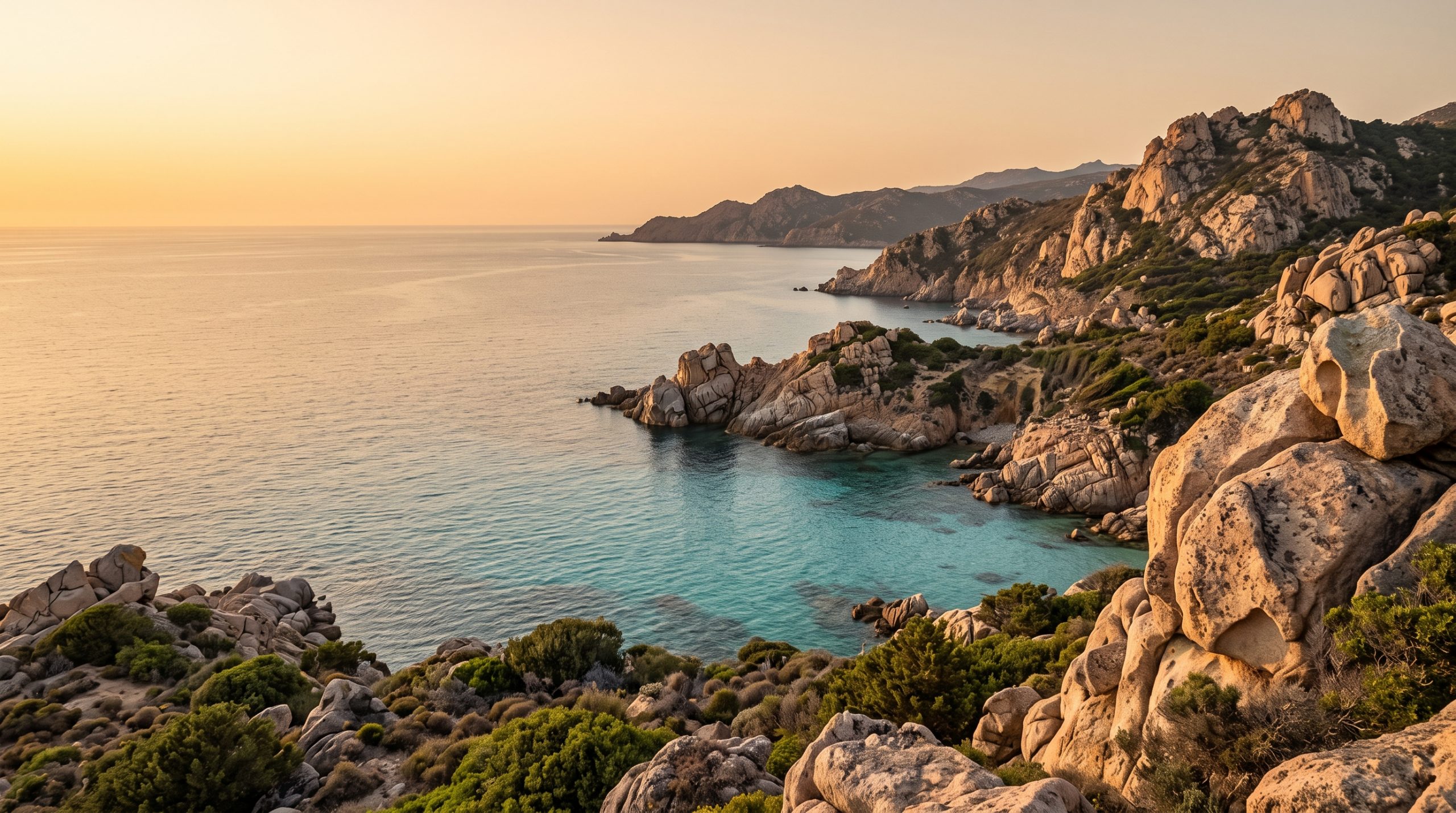
Access control at La Pelosa runs from 8:00 to 18:00. That one line in the Comune di Stintino’s booking rules has shaped more of our Sardinian mornings than any legal question ever has, because it tells you exactly when the beach belongs to the two of you and when it belongs to fifteen hundred other people.
A symbolic ceremony is what most American couples we work with actually hold here. They are legally married at home, in their own county, with their own clerk. Then they fly to Sardinia and stand on granite or in shallow turquoise water and say the words that matter to them, in English, at an hour they chose. The paperwork question disappears entirely. The permission question does not, and that is the part almost nobody writes about honestly.
So this covers both halves: what a symbolic ceremony in Sardinia costs and how the day is actually assembled, and the full Italian civil marriage chain if you want the legal act to happen here as well.
No registrar, no file, no notice period
A symbolic ceremony in Sardinia has no legal effect, so there is no registrar, no document file and no notice period. You marry at home, then choose the cove, the hour and the words. The costs are access and people: La Pelosa charges 3.50 euros per person, Cala Goloritzé currently 7 euros, plus whoever you hire.
The honest difficulty rating for an American couple
Symbolic in Sardinia is straightforward. Nothing has to be sworn, apostilled, translated or filed, and no office anywhere holds a veto over your date. The work moves to the ground itself: which stretch of coast you can legally stand on, at which hour, with how many people, and who has to say yes first.
Legally marrying in Italy as a US citizen is a different animal. It is not hard so much as fiddly, and the reason is structural. Article 116 of the Italian Civil Code expects every foreign national to produce a certificate from their own country confirming there is no impediment to the marriage, and the United States has no authority that issues one. Italy handled this with an exchange of notes, so American couples substitute two sworn declarations instead: one made in front of Italian consular staff, one made in front of a US consular officer on Italian soil. Two countries, two offices, two sets of witnesses, one ceremony.
For that reason the great majority of American couples we photograph in Sardinia register the marriage at home and hold the ceremony here. We want to be clear that this is not a workaround or a lesser version of the thing. It is the better plan for most people, and it buys you something the legal route cannot: the hour. A civil marriage happens inside the hours a comune’s regulation allows, in a room or an approved venue. A symbolic ceremony can happen at 6:10am on an empty beach in September, which is when this island is at its best.
| Question | Symbolic ceremony | Italian civil marriage |
|---|---|---|
| Legal effect | None. The marriage is the one you registered at home | A marriage under Italian law |
| Documents in Italy | None | Apostilled birth certificate, atto notorio, dichiarazione giurata, declaration of intention |
| Witnesses | Anyone you like, or none at all | Two, over 18, any nationality, with photo ID |
| Interpreter | Not required | Required if you do not speak Italian, and sworn in before the registrar |
| Who leads it | A celebrant, a friend, or the two of you | The mayor or one of their deputies |
| Where | Anywhere the landowner or the comune permits | The town hall or a venue the comune has approved |
| Hour of day | Yours, first light included | Inside the comune’s ceremony hours |
The legal file and the location permission are two different tracks
If you do want the legal marriage to happen in Sardinia rather than at home, this is the order the documents arrive in. Skipping ahead does not work, because each office wants to see the output of the one before it.
The order the documents happen
- A long-form birth certificate for each of you, the version naming both parents, apostilled by the Secretary of State of the state where you were born, and translated into Italian with the translation certified by the Italian consular authority. Two separate offices touch this document, so start it first.
- The atto notorio, an affidavit that nothing in US law stands in the way of your marriage. It is sworn before the Italian consulate covering your state, with witnesses who are over 18, hold valid photo ID, know you and are not family. It carries a 90-day life, so its date has to sit inside the run-up to the ceremony rather than comfortably ahead of it.
- The dichiarazione giurata, sworn in Italy in front of a US consular officer, stating that the law of your state of residence puts no impediment in the way. This one cannot be done before you fly, so it becomes a fixed point in your Italian itinerary.
- The declaration of intention to marry, made in front of the civil registrar of the comune where you will marry, with the documents above in hand and, if you do not speak Italian, a sworn interpreter beside you.
- Banns. In the ordinary case these are posted at the town hall for two consecutive weeks including two Sundays, and only after the declaration of intention is filed. Where neither of you is an Italian citizen or resident in Italy, the US Embassy in Italy states that they are waived automatically or shortened to somewhere between one day and a week, depending on the town hall’s own rules.
- The ceremony, led by the mayor or a deputy, with two witnesses over 18 carrying photo ID, and an interpreter if one is needed. A witness cannot also serve as the interpreter.
Use this as practical wedding-planning guidance for Sardinia. For a binding answer on your documents, ask the authority or consulate handling your file.
Counting backwards from the ceremony hour
For a symbolic ceremony, the true minimum is startlingly short at the access end. A thousand of La Pelosa’s fifteen hundred daily places open no earlier than 48 hours before the day of use, the other five hundred can be booked with no time limit, and Cala Goloritzé opens its bookings 72 hours ahead. The ground can genuinely be locked down inside a week.
Everything human takes longer. A comune’s designated ceremony area, a celebrant who will hold a specific hour, a boat that can be at a specific cove at 6am: those move on institutional and seasonal time, and in July and August they move slowly. The comfortable minimum we work to is nine to twelve months for June through September, and a little less either side of that. We are currently booking 2027, 2028 and 2029.
For the legal route, count backwards like this. Twelve months out, choose the comune, because that choice decides which court, which venue list and which hours apply. Four months out, order the birth certificates and send them for apostille and certified translation. Inside the final three months, swear the atto notorio so its 90-day validity still covers your date. In the days before the ceremony, make the dichiarazione giurata in Italy and then the declaration of intention at the comune. Our elopement planning fundamentals cover how the rest of the trip gets built around those fixed points.
Permission for the place, not for the marriage
Here is the thing that surprises couples most about Sardinia. The permission you need has nothing to do with your marriage and everything to do with the sand under your feet. Sardinian beaches are state maritime property, administered regionally, and the region’s operating rules for coastal concessions are explicit about ceremonies: they take place in areas that each comune has defined and designated for the purpose, once a concession has been issued and the state fee paid. The comune is also the body that sets the area up. A concession can be granted even where no coastal use plan exists, which means a stretch of free beach can become a legitimate ceremony area, and a comune can also celebrate inside ground that is already under someone else’s concession.
The practical consequence is a better question to ask. Not “can we have our ceremony on that beach”, which invites a shrug, but “which areas has this comune designated, and what does it cost to use one”. Alghero, for example, runs its civil ceremonies under a published municipal regulation, puts out a public notice listing approved ceremony venues, and takes hall bookings on its own form. That is the shape of the process almost everywhere on the island: a written regulation, a venue list, a tariff.
Then there is access, which is now a real planning constraint on the famous coves. At La Pelosa in Stintino a booking and a QR code are required through the summer season, currently mid-May to mid-October, at 3.50 euros per person. Fifteen hundred people a day get in, no more. Each reservation covers a maximum of four people, one reservation per user per day, children under 12 are not counted, and the Comune di Stintino’s own site is the only place authorized to sell them. Access control operates from 8:00 to 18:00, which is precisely why our Stintino mornings start before it does.
Cala Goloritzé deserves plain speaking. It is one of the most photographed coves in the Mediterranean and it is not a ceremony venue. Booking is mandatory from April to October, capped at 250 people at a time, at 7 euros a head with under-sixes free. The trail opens at 7:30 and closes at 14:00, you can stay on the beach until 17:00, and the walk in is 3.5 kilometers with 500 meters of descent, roughly an hour and a half down and two hours back up, with closed shoes with good grip and your own water both mandatory. Dogs are not allowed on the beach. Read those numbers together and the answer is obvious: you cannot be at Goloritzé for first light, and you cannot arrive there in a long dress and heels. What you can do is walk it as a couple on a second day, in shorts and boots, and come back with the strongest sequence of the trip. That is a very different and much better use of the place, and it is the kind of decision our published galleries and films are full of.
Six details that catch couples out in Sardinia
None of these are difficult. They are simply the things that decide whether a plan holds together, and they are worth getting right early.
- The witness count depends on which office issues the affidavit. Published guidance genuinely differs here, and the office that issues the document is the one whose rule governs. Italian consulates in the United States require four witnesses for the atto notorio. The US Embassy in Italy describes the version sworn before an Italian court official, in the city where the marriage will take place, as needing two. Ask the specific office, then bring the number it asks for.
- The atto notorio has a shelf life of 90 days. Swear it too early and it lapses before your date. Leave it too late and you are waiting: the embassy’s guidance puts the Italian court version at four to ten days, with a same-day option, and its own advice is to obtain the document in the United States before you fly rather than rely on an Italian court’s timing.
- A witness cannot double as your interpreter. If you are relying on one bilingual friend to cover both roles at a civil ceremony, you are one person short. The interpreter is also sworn in before the registrar, and is required if the witnesses do not speak Italian either.
- La Pelosa bookings have arithmetic. Four people per reservation and one reservation per user per day means a group of ten needs several separate reservations made by several separate people. Sort that out days ahead, from the official Stintino site, not on the morning.
- You do not hold the beach concession, and you do not want to. Under the regional rules a concession carries an annual state fee, a bank or insurance guarantee set at three times that fee, and registration with the tax office at the holder’s expense. That paperwork belongs to a comune or a venue. Your job is to pick from the areas that already have it.
- Sardinia’s ceremony traditions are worth borrowing deliberately. Sa razia, the plate of rice, wheat, salt, coins and rose petals broken and scattered over the couple, and sa cadena, the chain of 66 silver rings that joins their hands, both come from real island practice. The historic wedding re-enactments at Selargius in mid-September and Santadi in early August are where they are still staged in full.
Where the money goes, and where it does not
A symbolic ceremony has no state fee at all. Nothing is owed to any Italian office for the act itself, which is the single largest practical difference between the two routes. What you do pay for falls into three groups.
Access to the ground comes first, and it is small money with hard limits: 3.50 euros per person at La Pelosa, 7 euros at Cala Goloritzé, parking and boat transfers on top where the cove has no road. Second, if you use a comune’s designated area or municipal venue, there is a tariff, and it varies by location, by season and by day of the week. Third, the people: a celebrant if you want one, flowers, a driver, a boat, dinner. On the legal route you can add the state’s own small charges, which are stamps rather than fees in any meaningful sense. The revenue stamps for an atto notorio applied for at an Italian court run to two of 16 euros and one of 10.62 euros, or 31.86 euros for the version issued on the spot.
Our own coverage sits alongside all of that rather than inside it, and the figures for a full day of photography, film, or both together live on our coverage and pricing page. Before non-refundable travel depends on the Sardinia process, reconfirm the latest fee and timing with the office responsible for it.
One number that does not move: guest count. Ten people instead of two changes your access bookings, your transport and your timeline. It does not change what we charge. If you are weighing a Sardinian cove against Norway or the Dolomites, our destination guides compare the shape of the day rather than the postcard. When you have a month in mind, check your date with us and we will tell you honestly what that week on the island looks like.
What we can handle for the Sardinia day, and what stays in your name
We design the location and the route, build the timeline around the light and real travel time, research which permissions attach to the ground you have chosen, hold your date against the comune’s or celebrant’s availability, and carry a weather alternative for every outdoor hour. Drone footage comes in where it is legal, safe and appropriate, on the permit and the time window that particular coast requires. Highlights reach you in 5 days, the full gallery or film in 3 weeks.
The filing stays with you, because the offices deal with the two of you directly and no photographer can stand in for that. What we can do is make the ceremony hour work twice. On an Expedition day a dedicated photographer and a dedicated filmmaker work the same hour side by side, which matters more here than people expect: at 6am on a Sardinian beach, with a celebrant and two witnesses and nobody else, the person recording the vows cannot also be the person circling for the wide frame. Eight of us in the team means there is always a second camera on the ground and a colleague in reserve.
Common questions
Is a symbolic ceremony in Sardinia legally binding?
No. A symbolic ceremony carries no legal effect in Italy or at home, which is exactly why it needs no documents, no notice period and no registrar. The legal marriage is the one you register in your own state, usually a few weeks before you fly. The ceremony in Sardinia is the part your family will remember.
Do we need a permit for a symbolic ceremony on a Sardinian beach?
You need permission for the place, not for the ceremony. Under the region’s coastal rules, beach ceremonies happen in areas each comune has designated and set up under a concession, so the question to put to the comune is which areas are designated and what the tariff is. Access fees at ticketed beaches are separate.
How much does it cost to get onto La Pelosa for a ceremony morning?
The reservation fee is 3.50 euros per person through the ticketed season, currently mid-May to mid-October, bought only from the Comune di Stintino’s official site. Fifteen hundred places are released each day, each reservation covers up to four people, and one user can hold one reservation per day. Access control runs from 8:00 to 18:00.
Can we have our ceremony at Cala Goloritzé?
Not realistically, and we would rather say so early. The trail opens at 7:30 and closes at 14:00, entry is capped at 250 people and costs 7 euros each, and the walk is 3.5 kilometers with 500 meters of descent in mandatory closed shoes. It makes a superb second-day hike in boots, not a ceremony venue.
Do we need witnesses for a symbolic ceremony in Sardinia?
Not legally, because there is nothing to witness in the legal sense. Many couples bring two people anyway, or nobody at all. For an Italian civil marriage the rule is firm: two witnesses over 18, any nationality, carrying valid photo ID, and a witness cannot also act as the interpreter.
Can same-sex couples have a symbolic ceremony in Sardinia?
Yes, on identical terms to anyone else, because no Italian office is involved. Italy’s legal instrument for same-sex couples is the civil union rather than marriage, and the US Embassy in Italy publishes a separate document list for it. Most American couples in this position register at home and hold the ceremony here.
How far ahead should we plan a symbolic ceremony in July?
Nine to twelve months is comfortable for June through September, mostly because celebrants, boats and comune venues commit earlier than the beaches do. Beach access itself books far later: 48 hours ahead for most La Pelosa places, 72 hours for Cala Goloritzé. Our planning calendar is open for 2027, 2028 and 2029 now.
Do we need an interpreter if we do not speak Italian?
Not for a symbolic ceremony, which can be entirely in English, or in two languages if that suits you better. For a civil marriage an interpreter is required, both for the declaration of intention and at the ceremony, and they are sworn in before the registrar before either can proceed.
The cove, the hour and the month
Sardinia rewards couples who are willing to be awake before the ticket gates open and to let the tide and the light pick the hour. If that is not your idea of a good morning, there is a gentler shape to the day here, built around late afternoon on the granite and dinner in a village, and it is worth telling us which one you actually want.
Everything with us happens in writing, at whatever pace suits your time zone. Send the inquiry form and you will have a reply and the first brochure within 24 hours, then a tailored proposal, then a contract and a 30% retainer, and planning starts from there. Tell us the month you are thinking about and which coast you are drawn to, and we will tell you what that week looks like at 6am. Tell Us Your Story.