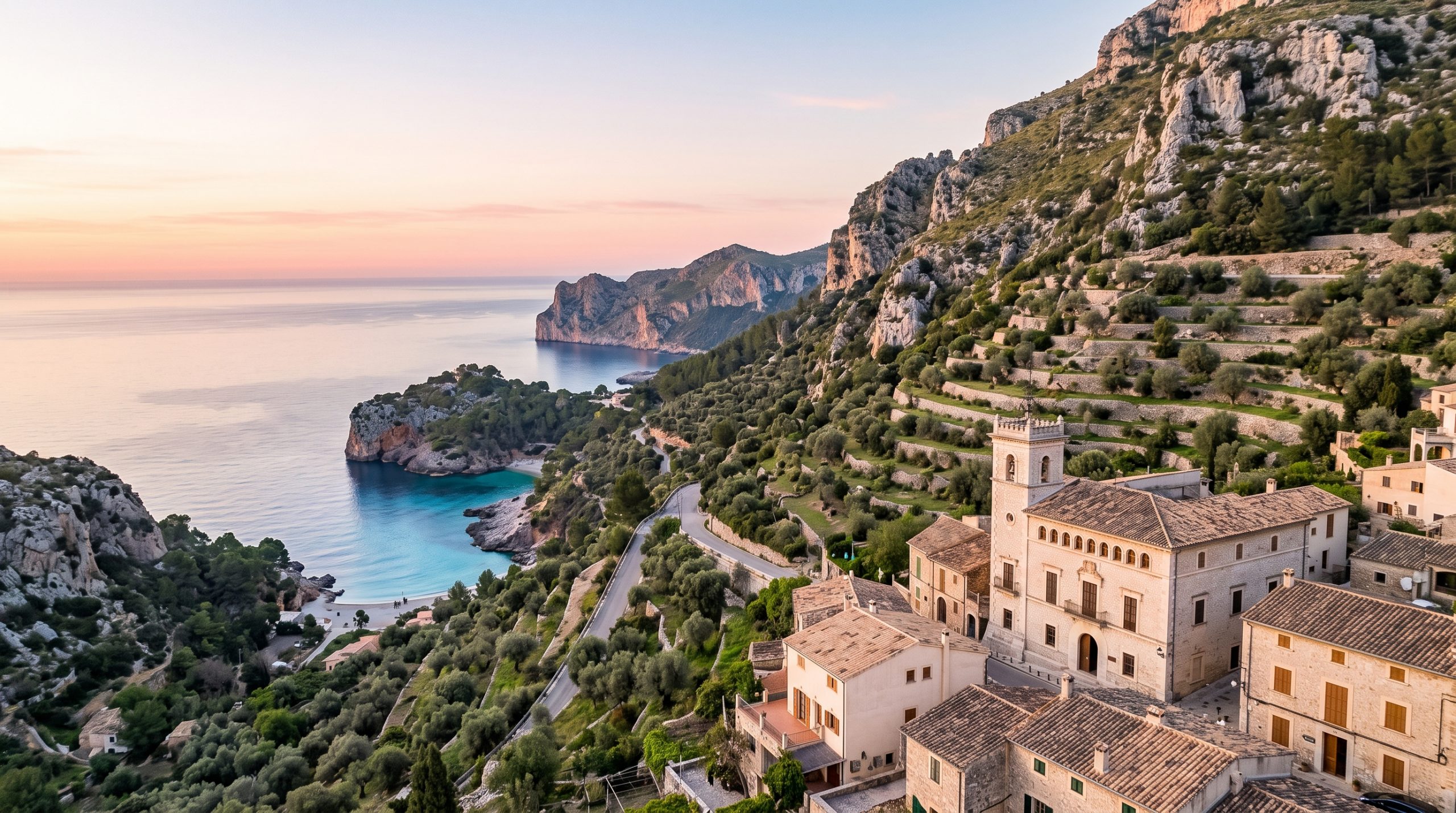
The most useful thing we can tell you about Mallorca is that the piece of paper couples worry about most is rarely the one that shapes the day. Everyone asks about the marriage licence first. What actually decides the shape of your morning is which authority is allowed to stand in front of you, where that authority is allowed to stand, and on which day of the week.
Palma marries couples inside Cort, the city hall built into a seventeenth-century Baroque palace, and inside Bellver Castle, the circular fourteenth-century fortress on the hill above the Bay of Palma. Both are real rooms with real doors and a booking diary that runs on office hours. Neither of them is a cove at seven in the morning.
So this page keeps apart the two halves that most guides tangle together. There is the legal marriage, which is documents and an office. And there is the ceremony on Mallorca, which is light, terrain, and somebody’s written permission to be standing on their land. Treat them as two separate projects and the whole thing becomes manageable.
The permission that decides everything else
Mallorca has no single wedding permit. A legally binding civil marriage in Spain needs a marriage file approved by a Registro Civil or a notary, and a ceremony held on the authority’s own premises. Everything outdoors, whether on a beach or high in the mountains, runs instead on landowner consent and municipal permission for the setup.
Signing at home separates the Mallorca ceremony from registry rules
Here is the honest grade. If one of you is registered on a Mallorcan municipal roll, the legal route is fiddly but entirely routine, and it works. If you are two Americans arriving with return flights in your pocket, the picture changes. The Spanish marriage file, the expediente matrimonial, is opened at the office covering the address where one of you actually lives, and it asks for municipal registration and for your place of residence over the previous two years. That one requirement is what sends most visiting couples down the second route.
The second route is to complete the legal marriage at home, in a short appointment at your county clerk’s office, and then come to Mallorca for the ceremony that means something to you. We say that without a flicker of condescension, because in practice it produces the better day. The US Embassy in Spain is blunt about the alternative: marrying in Spain can be more complicated than marrying in the United States, approval of a marriage application there can take up to 45 days, and consular officers cannot perform marriages themselves.
What changes practically is the paperwork, and only the paperwork. What does not change is the day. A ceremony that is not the legal act can happen wherever you have permission to stand, at whatever hour you like, led by whoever you want to lead it. No weekday-morning office slot. No queue behind other couples. You write your own vows, your celebrant is your choice, and the hour is chosen for the light rather than for a diary. If you are still deciding between the two shapes, our notes on how an elopement is actually planned walk through both.
We plan and document wedding days; we do not give legal advice. For your own Mallorca case, let the relevant authority or consulate confirm the final requirements.
Cort, Bellver and the municipal tariff
A Spanish civil marriage is celebrated by an authority acting on its own premises. In Palma that means a room inside Cort, or Bellver Castle, or the office of the notary who has your file. It does not mean a headland, and it does not mean a hotel lawn, however beautiful the lawn is. Once you accept that, the town hall stops being a disappointment and becomes a twenty-minute legal appointment that you can put wherever you like in the day.
Municipal fees for that appointment vary enormously from one Mallorcan town hall to the next, from around ten euros in some small municipalities for couples on the local roll to several hundred elsewhere. Palma prices its settings separately: the plenary chamber sits at roughly 74 euros, Bellver Castle at around 159 euros, and a couple with neither name on the Palma roll currently faces something closer to 424 euros. Published figures for these tariffs differ between sources, and the number that governs is the one printed in that municipality’s own fee ordinance. Administrative prices and deadlines in Mallorca can move, so confirm the live version with the authority handling your application before you commit travel.
The room slot is short and the light inside it is whatever the windows give you, which is exactly where having photography and film on one team earns its place. One of us works inside beside the registrar while the other is already positioned at the doors for the moment you come back out into the courtyard. Nobody is negotiating for position, because we planned who stands where the week before.
| Setting | Who grants permission | What it can be |
|---|---|---|
| Cort or Bellver Castle | The municipality, once the Registro Civil or notary approves your file | The legally binding marriage, in office hours |
| Private finca or estate | The owner, plus the local council for the event side | A ceremony at any hour, any celebrant, any wording |
| Public beach or cove | The municipality managing that stretch of coast | Vows with nothing built on the sand |
| Tramuntana ridge or terraces | The landowner whose track you drive up | Portraits, film, and spoken vows between the two of you |
Who the sand actually belongs to
Spanish beaches are public. That is the whole answer, and it explains everything that follows. Nobody privatizes a cove for an hour, so a built ceremony on the sand, with an aisle, chairs and an arch, needs authorization from the municipality that manages that stretch of coast, and plenty of Mallorcan municipalities simply do not issue them any more.
We are not going to pretend this is a hardship. In July and August the good coves have people in them from nine in the morning, and no permit on earth clears a public beach of swimmers. What works instead is a ceremony with nothing built: the two of you, a celebrant, two witnesses, bare feet, and thirty minutes on a cove at first light before the first car arrives at the top of the path. The east coast faces the sunrise, so that is where the early hour lives. The west coast, from Banyalbufar down towards Sa Foradada, takes the evening.
In the Tramuntana, permission has a name
The Serra de Tramuntana has been a UNESCO World Heritage cultural landscape since 2011, and almost all of it is somebody’s property. The great stone possessió estates of the Orient valley, the olive terraces above Sóller, the sheep ground behind Alaró: these are working estates with gated tracks and owners who answer email. Permission in the mountains is rarely a form. It is a person saying yes in writing, and then telling you which gate will be open at six in the morning.
Access is the real constraint, not paperwork. Roads through the range are single track with passing bays, and the drive from Palma to a ridge above Sóller takes far longer than a map suggests once you factor in the descent behind a hire car doing twenty. We build that into the timeline rather than hoping. And we will say plainly that the famous Tramuntana viewpoints with car parks attached are flat and busy by mid-morning, coaches included, so we work them at first light or we work somewhere else entirely.
The range photographs differently at seven in the morning than it does at any other hour, with the terraces still holding shadow and the sea flat and pale below. You can see what that actually looks like in our published stories and films, and the same instinct runs through our destination guides for other mountain coastlines.
From civil documents to land permission: the Mallorca sequence
This is the chain for the legally binding Spanish route, in the sequence you actually need it. Every step depends on the one above it, which is why doing them out of order costs weeks.
- The full birth certificate for each of you. Registries want the complete certified copy, not a short-form abstract, and they want it recently issued rather than the one in your filing cabinet from a decade ago. Order it close to your appointment.
- An apostille on each birth certificate, issued under the Hague Convention by the authority in the jurisdiction that produced the document. Apostilles are per document and per issuing state, so three certificates from three US states means three separate requests.
- The divorce decree, apostilled, if either of you has been married before. The US Embassy in Spain is explicit that a foreign divorce decree has to be authenticated with the Hague Apostille to carry any weight in Spain.
- A certificate of matrimonial capacity or freedom to marry, establishing that there is no impediment to the marriage. US citizens generally obtain this through their embassy or consulate, and it then needs its own apostille.
- Sworn translation into Spanish of everything not already in Spanish. This has to be done by a traductor jurado accredited by the Spanish Ministry of Foreign Affairs. A translation certified or notarized in the United States is not the same thing and will not be accepted in its place.
- Passports, plus proof of address for whichever of you is registered in the Spanish municipality, including where you have lived for the past two years.
- The file itself, opened either at the Registro Civil covering that address or through a notary. In the Balearics the notarial route runs through the Colegio Notarial de les Illes Balears, which assigns you a notary and emails you their name and address. You do not choose which notary handles your file, and that notary sets the timescale according to what your case needs.
- Two witnesses, over eighteen, of any nationality, present at the ceremony with valid photo identification. Without witnesses there is no valid marriage.
- Afterwards, the registration and the certificate. Since the 2015 reform a notary can both celebrate the marriage and register it, which lifts that job off you. The literal marriage certificate comes from the Registro Civil. To use it in the United States it needs an apostille and an official English translation, and the embassy supplies neither.
Counting backwards from the ceremony hour
The real minimum is set by the apostilles and the sworn translations stacked in front of a marriage application that can take up to 45 days to be approved. Realistically that is several months of elapsed time, and it assumes nothing comes back for correction. The comfortable minimum, and the one we would work to, is a year: the office side settled first, the ceremony hour chosen last. For the ceremony-only route the constraint is different and gentler, and six to twelve months is plenty, most of it spent on accommodation, access and where you want to be standing when the sun comes up. We are currently booking 2027, 2028 and 2029.
Small things that quietly move a date
None of these are dramatic. All of them have cost real couples a fortnight.
- You cannot shop for a faster notary. The Colegio Notarial assigns one, tells you who it is, and that notary sets the deadlines based on the documents your file needs. Plan around the office you are given.
- Sworn is a legal category, not a compliment. The translator has to be on the Spanish Ministry of Foreign Affairs list. Order from that list the first time and the translation cost is a footnote; order from anywhere else and you pay for it twice.
- Certificates age. The full birth certificate is the single most common cause of a file being handed back, usually because it was ordered far too early. Time it to arrive a few weeks before your appointment, not a year.
- Offices marry people on working days, in working hours. That is why the legal hour and the ceremony hour are almost always two different hours, and why we design the day with the legal appointment as a fixed point and the light as the thing everything else bends around.
- Mallorcan afternoons start late. Ceremonies here commonly begin at three or four in the afternoon to stay out of the midday heat, which pushes dinner back and means venues have their own end-of-night limits, some extendable for a fee. Ask what yours is before you plan the last hour of film.
- Witness details are sometimes wanted early. We confirm in writing with the specific office whether identification for your two witnesses is needed when the file is prepared or on the morning itself, because the answer differs from one town hall to another.
If you already know roughly where and roughly when, tell us the shape you have in mind and we will tell you honestly which parts of it the calendar and the terrain will support. Send Us a Message with the destination and the month, and we will come back with the real constraints rather than a brochure answer.
Common questions
Can two Americans get legally married on Mallorca without living in Spain?
In practice, no. The Spanish marriage file is opened at the office covering the address where one of you lives, and it requires municipal registration plus your residence history for the previous two years. Visiting couples almost always complete the legal marriage at home and hold the ceremony here. Confirm your own circumstances with the Registro Civil or your consulate.
Can we legally get married on a beach in Mallorca?
The legally binding civil ceremony happens on the authority’s premises, so no. A ceremony on the sand is a non-legal one, which is why it can be at sunrise, barefoot, with your own words. Building anything on a public beach needs authorization from the municipality managing that coast, and many no longer grant it.
Do our documents need an apostille, a translation, or both?
Both, and in that order. Each foreign document is apostilled under the Hague Convention by the authority where it was issued, then translated into Spanish by a traductor jurado accredited by the Spanish Ministry of Foreign Affairs. A US-notarized translation does not substitute for a sworn one.
How long does approval of a marriage application in Spain take?
The US Embassy in Spain puts approval at up to 45 days, and that clock only starts once your apostilled and translated documents are in. Where a notary handles the file, that notary sets the timescale according to its complexity. Budget several months in total, and a year if you want to be relaxed about it.
Is same-sex marriage legal on Mallorca?
Yes. Same-sex marriage has been legal throughout Spain since 2005, and the marriage file, the document chain and the ceremony itself are identical. Mallorca is an easy island to be married on.
Will our Spanish marriage certificate be accepted back in the United States?
A marriage that is valid where it took place is valid in the United States, and the Spanish certificate is the proof. You will need the Hague Apostille on it, plus an official English translation, and the embassy cannot provide either of those for you.
Do we have to bring our own witnesses?
You need two, over eighteen, and they can be any nationality with valid photo identification. If you are travelling as two and the ceremony is the legal one, ask the office early how it handles couples without guests, because arrangements vary between municipalities.
Can we marry at Bellver Castle if we do not live in Palma?
Bellver is one of Palma’s two civil settings alongside Cort, and the municipal fee is higher when neither of you is on the Palma roll. The residency question sits with the marriage file rather than the room, so that is the part to resolve first.
What we can coordinate in Mallorca, and what stays with you
We design the destination and the locations, build a timeline around real travel time and the actual hour the light works, research the permits and tell you which office holds which piece of it, hold the ceremony hour against the availability you are given, and keep a weather alternative ready that does not feel like a compromise. Highlights reach you five days after the day itself, the full gallery or film three weeks later. What stays with you is the paperwork: we are not lawyers, we do not file your documents, and the government, venue and landowner fees are yours to pay.
Coverage runs from one full day with a single photographer or filmmaker up to multi-day work across more than one location, and the coverage and pricing page lays out what each shape includes. Everything from here happens in writing, which suits paperwork like this: you send the inquiry form, we reply within 24 hours with an initial brochure, and a tailored proposal follows. Start Your Story by telling us the month, the coast or the mountains, and whether the legal act is happening here or at home.