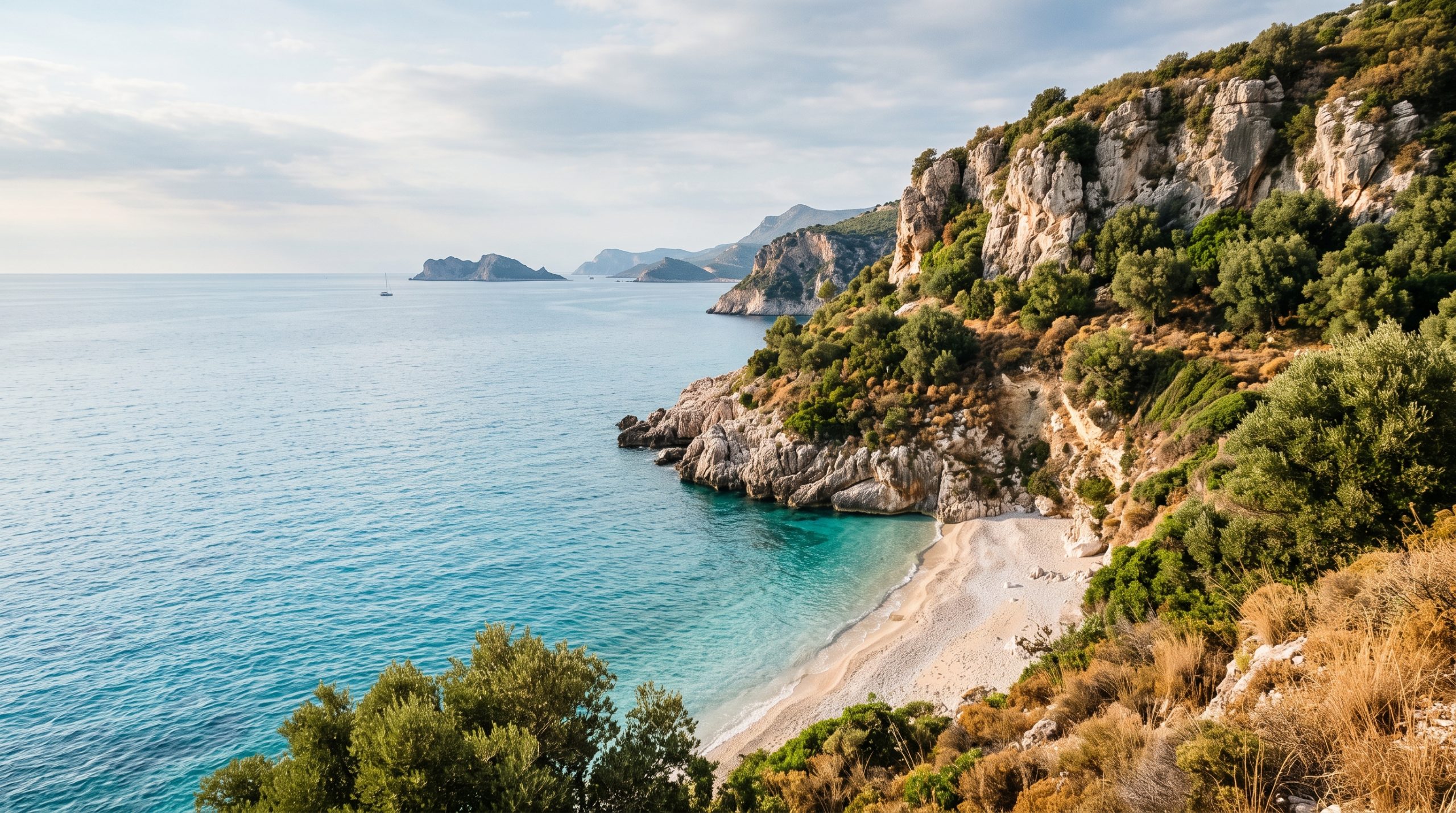
On May 15 the sun leaves Corfu at 8:48pm, out to the north-west, over open water. On October 15 it goes at 7:02pm, well round to the south-west, behind the hills. Same island, same coastline, thirty-seven degrees of difference in where the last light lands. That number decides more about a shoulder-season day here than the forecast does.
The Ionian coast covers a lot of ground. Corfu and Paxos at the top, the mainland shore around Parga and Sivota, then Lefkada, Kefalonia, Ithaca and Zakynthos running south. What they share is a season most visitors read as June to early September, and a shoulder at either end that is greener, quieter or warmer than the peak depending on which end you choose.
We work this coast in all three shoulder months, and they are not interchangeable. Below is what each one actually gives you, with the light times, the rainfall averages and the things that quietly stop running once the summer timetable ends.
Why we would book the third week of September
Late September is the strongest week on this coast. The sea is at its warmest after a full summer of storing heat, daytime averages sit around 25°C, the August traffic has gone home, and sunset still lands near 7:40pm. Rain is possible rather than likely. May is the alternative if you want green hillsides and long evenings.
The table we send couples who are choosing a week
Sunset times are for Corfu Town, mid-month. Lefkada and Kefalonia run within a few minutes of these, and Zakynthos loses another two or three. Rainfall figures are long-term monthly averages for the island, not a forecast for your week.
| Month | Weather | Sunset | Crowds | Our verdict |
|---|---|---|---|---|
| April | Mild and very green, showers still regular | 8:19pm | Empty, half the coast still opening up | Lovely and unreliable |
| May | Around 21°C, hills still green, rain thinning fast | 8:48pm | Building, never full | Our pick for long evenings |
| June | Hot and effectively dry | 9:10pm | Filling from the first week | Excellent light, shared coves |
| July and August | Hottest of the year, August averaging 28.5°C, almost no rain | 9:08pm falling to 8:37pm | Peak everywhere | Workable at dawn, hard by noon |
| September | Around 25°C, roughly 110 mm of rain across the month, plenty of clear days | 7:41pm | Thinning every week | The best all-round month |
| October | Air near 21°C, water still summer-warm, close to 150 mm of rain | 7:02pm, then 5:44pm once the clocks go back | Genuinely quiet | Best for empty coastline |
| November | Wettest month of the year, around 225 mm over roughly 14 rainy days | 5:25pm | Local life only | Ten hours of daylight, plan tightly |
What the light does between May and the clock change
The first thing to understand about latitude 39 north is that the warm hour is genuinely an hour. The sun drops from ten degrees of altitude to the horizon in about sixty minutes in mid-May and about fifty-six in late September. There is no long, slow northern falloff to hide in. You get one good hour at each end of the day and you spend it deliberately, which is why our timelines here are written in fifteen-minute blocks rather than vague halves of the afternoon.
The second thing is direction, and it moves more than people expect. In mid-May the sun sets at an azimuth of 296 degrees, which is north-west, so a bay facing up the coast catches the whole thing on the water. By September 20 it has swung to 272 degrees, near enough due west. By mid-October it is down at 259 degrees, south of west, tucking behind headlands that framed the light beautifully five months earlier. A cove that was the obvious sunset spot in May can be in shade by 6pm in October. We choose the location for the month, not from a list of pretty places.
Mornings work the same way in reverse. On May 15 the sun comes up at 6:27am from 65 degrees, well north of east, which puts it out over the sea from most of Corfu’s east coast. By October 15 it rises at 7:51am from 101 degrees, and on the channel side of the island it has to clear the mainland mountains a couple of kilometers away first, so useful light arrives noticeably later than the printed time. The west-coast cliffs stay in blue shadow until mid-morning all year. That is not a problem, it is a decision about where you stand at 7am, and it is the sort of thing we settle months before you fly. Our notes on building an elopement day around light rather than around a venue go into how that timeline gets drawn.
Then the clocks. Greece moves from UTC+3 to UTC+2 on the last Sunday in October, and sunset falls off a cliff overnight, from just after 7pm to 5:44pm. Nothing about the day gets worse. It just moves. Ceremony at 4pm instead of 5:30pm, dinner in the dark, and a genuinely peaceful coastline for all of it.
The windows that are narrower than they look
The green does not last. Ionian hillsides hold their spring color through May and are burnt gold by the last week of June, and the exact turn moves a week or two either way with the winter rainfall. The crowd collapse is faster still: the last days of August into the first ten days of September, when the coast empties almost overnight and the water is at its warmest all year. At the other end, the olive nets start going down under Corfu’s groves at the end of October, which is a quiet, working, entirely unposed thing to have in the background of a film.
When the Ionian shoulder season stops working
Mid-July through the third week of August is the part of the calendar we push back on. August averages 28.5°C and it barely rains, which sounds ideal until you are standing in a linen suit on white limestone at two in the afternoon with four tour boats in the bay. The light is fine. Everything around the light is compromised. Move the same date to the first ten days of September and you keep the warm sea and the settled weather, lose most of the traffic, and gain a sunset at a civilized 8pm.
The second half of November is the other one. It is the wettest month on Corfu, around 225 mm spread over roughly 14 rainy days, with daylight down to ten hours and sunset at 5:25pm. Pull the same week back to early October and the difference is enormous: an extra ninety minutes of usable evening, a third less rain, and a sea that is still swimmable.
If your date is already fixed, none of this is a problem to solve at your end. Tell us the week you have and we will build the day around what that week actually does here, or tell you honestly which stretch of coast handles it better. An August date works beautifully on a 5:45am start and a boat, and we have run it that way more than once.
What runs on a summer timetable and what does not
Access changes faster than weather does on this coast, and it changes on a calendar you can plan against. The small boats that reach the Paxos sea caves, the blue caves on Zakynthos and the far beaches of Kefalonia run a summer timetable and a sea-state rule, so an early October crossing is usually straightforward and a late October one is a decision made that morning. The Igoumenitsa car ferry to Corfu runs year round, which is why we often route mainland couples through it rather than through a seasonal flight.
Lefkada is the useful exception. You reach it by road across the causeway rather than by boat, so it holds up better than anywhere else in the group once the ferry timetables thin out, and Porto Katsiki and the west-coast beaches sit within an easy drive of Lefkada Town. On Zakynthos, the Laganas Bay marine park carries overnight access restrictions on its nesting beaches through the season, so we simply build first and last light on the west coast and the cliffs, where the drama is anyway.
Two practical notes. Direct European flights into Corfu and Preveza run a summer timetable that winds down through late October, after which you connect via Athens and want an extra travel day in the plan. And municipal offices, which matter if you are marrying legally in Greece rather than holding a ceremony, keep weekday morning hours, so paperwork days and Saturdays do not mix. Our destination guides carry the location-level detail for each island.
How we build the off-season coast day around rain
Corfu is the greenest of these islands because it is one of the wettest, and the rain mostly arrives outside the months you would be here. September averages around 110 mm and October close to 150 mm, but on this coast autumn rain tends to cross in hours rather than sit over you all day. A wet forecast usually means a wet part of a day, and the part is moveable.
So we plan by wind direction, not by optimism. The afternoon breeze on the Ionian is a north-westerly that builds through the day, which is why mornings are glassy and three o’clock is choppy. When it is up, we move you to the sheltered side of whichever island you are on, and the alternates are named in your timeline before you land, with drive times attached. The ceremony hour moves too. We hold the hour loosely and the light tightly, rather than the other way around.
This is where two of us on the ground stops being a nice idea and starts being the whole plan. In late October the usable window after the clocks change is under an hour, and one person cannot shoot vows and film them at the same time. On The Expedition a dedicated photographer and a dedicated filmmaker work those same minutes in parallel, with professional audio on the vows where conditions allow, which is the difference between a good gallery and a good gallery plus a film that has the actual words in it. You can see how that plays out in the films and galleries we publish. In May, with an evening that runs to nearly 9pm, the same team simply works slower and covers more coastline.
Every experience we offer includes the planning, the location design, the permit research and worldwide team travel, with highlights back to you in 5 days and the full gallery or film in 3 weeks, and the whole of it is laid out on our coverage and pricing page.
Tell us the month you are circling and we will tell you what it does here. Send Us a Message and we will come back with a first read on your dates.
Common questions
Is October too late to elope on the Ionian coast?
No, and it is the emptiest good month of the year here. Air temperatures sit near 21°C, the sea is still holding its summer heat, and you will have most coves to yourselves. Plan around two things: rainfall climbs to roughly 150 mm across the month, and the clocks go back on the last Sunday in October, taking sunset from 7:02pm to 5:44pm. We move the ceremony earlier and start the morning later.
How likely is rain on a September elopement in Corfu?
September averages around 110 mm, which sounds heavy until you see how it arrives. It comes in a small number of events rather than as steady drizzle, and most September days on this coast are clear. Your timeline carries named alternates chosen by wind direction, and the ceremony hour is written so it can move by two or three hours without anything else unraveling.
Is the sea warm enough to swim in May?
It is swimmable rather than warm. May and October sit at almost the same air temperature, around 21°C, and the water is not remotely the same, because the sea spends spring catching up and autumn giving heat back. If getting in the water matters to you, September and October are the months. If long green evenings matter more, May wins easily.
Do the boats and restaurants still run in late October?
In the towns, yes. Corfu Town, Lefkada Town and Argostoli work year round, while seasonal beach places wind down from the end of October. Small-boat trips run to a shortening timetable and the state of the sea, so we confirm operators for your specific week before the timeline is locked rather than assuming last year’s timetable.
How much does sunset actually move between May and October?
Three hours and four minutes, from 8:48pm in mid-May to 5:44pm at the end of October. Direction shifts too, from 296 degrees in May to 259 degrees in mid-October. A May day can hold dinner before dark. An end-of-October day cannot, so we put the ceremony in the middle of the afternoon and the meal after nightfall.
Our date is fixed in early August. Can you still make it good?
Yes, and we would build it very differently. Sunrise on August 15 is 6:53am, so we start at 5:45am while the coast is empty and the sea is glass, take the middle of the day out entirely, and come back for an 8:37pm sunset reached by boat rather than by road. Heat and crowds are a timeline problem, and timelines are the part we control.
Choosing your week on the Ionian
If you want one sentence to act on: aim at the third week of September, take early October if you would rather have the coast to yourselves, and take May if long green evenings are the thing you actually picture. Our calendar is currently open across 2027, 2028 and 2029 on this coast, and everything from the first reply onward happens in writing, in your own time, across whatever time zone you are in.
Send us the dates you are weighing and what you want the day to feel like, and we will come back within 24 hours with an honest read on that week and a first brochure. Check Your Date.