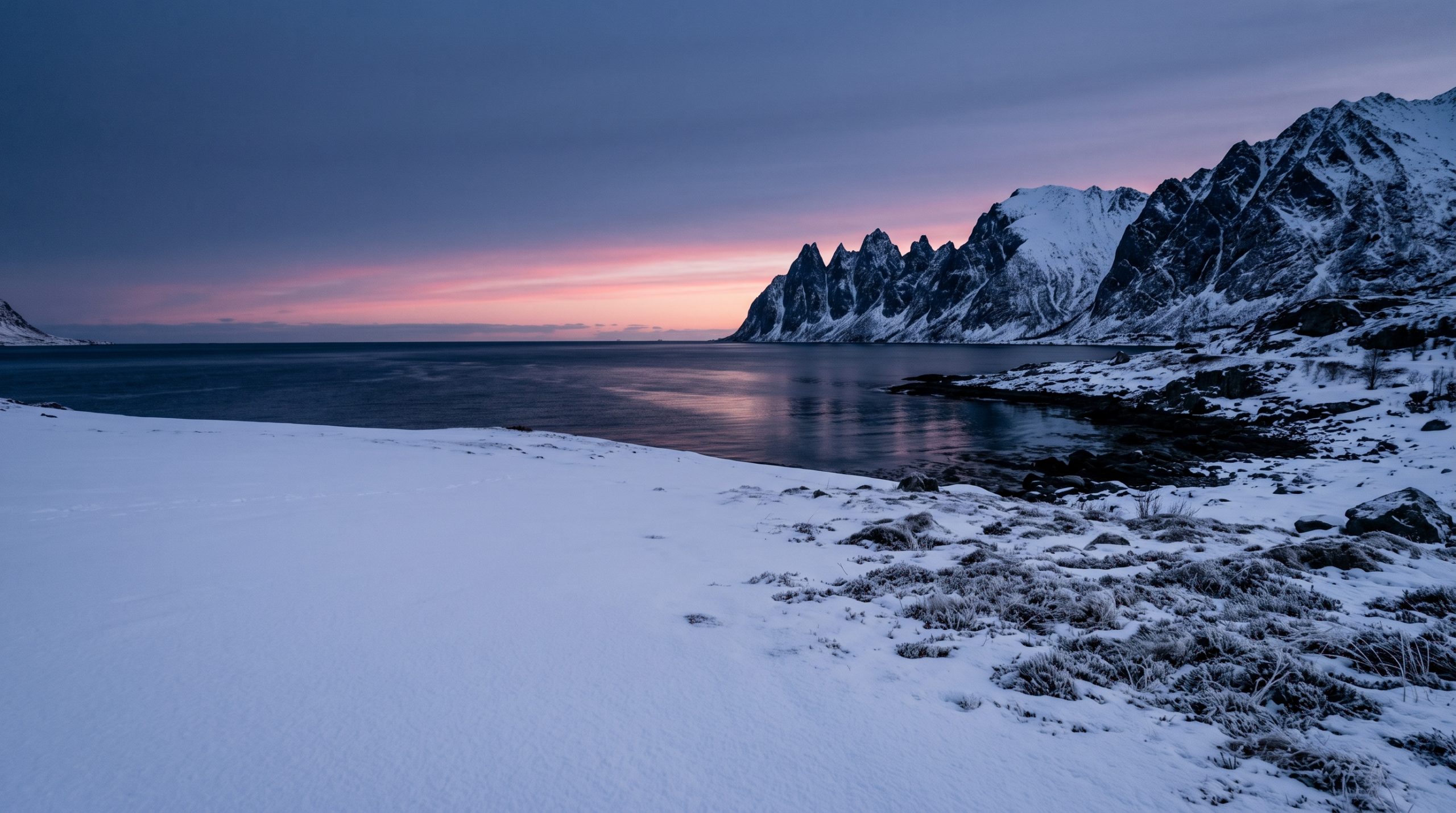
A symbolic ceremony is the version of an Arctic elopement where no office anywhere is holding a file on you. You stand on a ridge above Longyearbyen, or on lake ice near Inari, read what you wrote to each other, and nobody is waiting on a stamped certificate, because the legal marriage was registered at home weeks earlier.
That single decision changes the shape of the day more than couples expect. The ceremony fee is rarely what costs money up here. A civil marriage performed by the Governor of Svalbard is free of charge. What costs money in the Arctic is access: the snowmobile, the boat, the guide, the two hours of usable February light that everyone wants at once. Choosing a symbolic ceremony hands back the one thing paperwork takes away from you, which is control over the hour and the place.
Below is the practical version. What you file and where, what the fees come to, how far ahead to start, and the small print inside the Nordic offices that decides whether your date holds. One detail before any of it: print your vows on paper. Cold drains phone batteries quickly, and paper unfolded with gloved hands photographs better than a screen anyway.
Where a symbolic ceremony stands legally
A symbolic ceremony has no legal effect, so no Arctic authority is involved: no licence, no notice period, no certificate of no impediment, no residency test, no registration afterwards. You marry legally at home, usually at your own county office, then hold the ceremony that matters to you anywhere the landowner and the weather allow.
How hard this is, and what the fees come to
Straightforward. Genuinely. Of all the legal questions we get asked, this is the easiest one on the site, because the only office involved is the one nearest your home, working in your language and on your calendar. Nothing needs translating. Nothing needs an apostille. No four-month validity clock ticks against your date, and no certified original has to cross the Atlantic in time for a deadline.
The fees follow from that. On the Arctic side of a symbolic ceremony there is no marriage fee at all, because there is no marriage to register. What you pay at home is whatever your county charges for the licence and for certified copies. If the ceremony sits somewhere that needs written permission from a landowner, a municipality or a park authority, the permit fee is real, and it is usually small next to the flights. The lines that actually move an Arctic budget are transport and access: a snowmobile convoy out of Longyearbyen, a boat into a Senja fjord in the hour before the light goes, a spare night held in reserve for weather.
There is a craft argument for the symbolic route as well, and it is the reason planners in Norway keep recommending it for remote locations. Getting an authorised officiant onto a mountaintop or a fjord shoreline at a fixed hour is the hardest scheduling problem in a legal outdoor wedding. Handle the legal part in a town hall or at home, and the ceremony is free to move with the weather rather than the diary. If you are still working out the overall shape of the trip, our guide to planning an elopement sets out the sequence.
Our own coverage is a single worldwide price with the assigned team’s flights and accommodation included, and a full day with a dedicated photographer and filmmaker working together starts at $7,900, with everything else laid out on the pricing page.
The chain, in the order you need it
For a symbolic ceremony the chain is short, and every link in it is at home.
- Your marriage licence, from your own county or local registrar. Check two things when you apply: whether your state sets a waiting period between issue and ceremony, and how long the licence stays valid once issued. Both are set locally, and both are quick to confirm with the office that issues them.
- The legal ceremony at home. A courthouse morning, a registrar’s office, a celebrant in a friend’s back yard. Witness rules are your state’s.
- Certified copies of the marriage certificate. Order more than one. Leave a copy at home, and carry one if you intend to travel or check in under a married name.
- Passports, and flights that genuinely connect. Longyearbyen is reached through mainland Norway, most often via Oslo or Tromsø, and that connection is what fixes your arrival day rather than the other way round.
- Written permission for the location, where the land calls for it. Open ground in Norway and Finland is broadly walkable under the Nordic right of access, while protected areas, private property, church land and certain municipal viewpoints carry rules of their own. This is the part we research and hand back to you as a plan.
- Drone clearance, where aerials are part of the film. In Longyearbyen that means permission from the tower at Svalbard Airport, because the whole town sits inside the five kilometre zone around the runway. Inside Svalbard’s protected areas it means no drone at all.
Not one item on that list needs an apostille, and not one needs a sworn translator. An apostille only enters the story when a foreign authority has to accept a document issued at home, and a symbolic ceremony asks nothing of any foreign authority.
Build the Arctic ceremony around light, travel and weather
Real minimum for the symbolic route: however long your county needs to issue the licence, plus a courthouse slot, plus flights. Couples have done the whole thing inside a month. We would rather you did not, and the reason has nothing to do with paperwork.
Beds, guides and vehicles are the true constraint in the Arctic, and they run out long before the light does. The comfortable minimum we work to is the better part of a year for Longyearbyen and for aurora season in northern Norway, and roughly half a year for a summer day in Lofoten or Lapland. That is not about our diary. It is about which snowmobile operator still has a morning free in the third week of February.
If you decide the Arctic ceremony should also be the legal one, the arithmetic tightens and the deadlines stop being negotiable. The Norwegian certificate of no impediment, the prøvingsattest, is valid four months, so the useful window opens four months before your date. A case that goes to manual processing at the Norwegian Tax Administration runs four to five weeks. Originals travel by post, since electronic certificates are not accepted. And for a ceremony with the Governor of Svalbard, the original certificate has to be in the Governor’s hands at least 14 days beforehand. Real minimum, around eight weeks if everything behaves. The comfortable minimum, and the one we build timelines to, is to start the moment the four-month window opens and to aim for originals landing in Longyearbyen a clear month early.
The details that catch couples out up here
None of these are hard. They are simply the things that are easy to miss from six time zones away, and each one has caught somebody’s date before.
- The four-month clock runs to the ceremony, not to the application. A Norwegian certificate of no impediment is valid four months, and for Svalbard it cannot be older than four months on the day you marry. Couples who apply early to be safe sometimes find the certificate has aged out of range.
- Originals go by post, and only by post. The Norwegian Tax Administration does not accept electronic certificates, and original supporting documents have to be mailed. Add courier time from the United States, and add it twice if a document has to come back to you.
- Send a colour copy of the passport, not the passport. The Tax Administration asks for a high quality colour copy of a passport, national ID card or visa used as proof of lawful stay. The original stays with you, where you need it.
- The translation needs the apostille too. Where a translation is made outside Norway, it has to be apostilled or legalised in the same way as the certificate. This is the single most common gap we see: an apostilled certificate paired with a plain translation.
- Svalbard’s 14 days is about arrival, not posting. The original certificate must be received by the Governor of Svalbard no later than two weeks before the ceremony, and Longyearbyen is a long way down the mail route.
- The filing afterwards is not your job. In Norway the officiant sends the marriage notification to the Tax Administration within three days of the ceremony, so flying out the next morning changes nothing.
- Arrive five to ten minutes early, and treat that as a hard number. That is what the Governor of Svalbard asks of the couple, the wedding party and guests. A Longyearbyen morning can eat twenty minutes in scraping ice off a windscreen.
- Aerials are a separate permission with its own map. Drones are prohibited within five kilometres of the airport unless the tower grants permission, which puts all of Longyearbyen inside the zone. They are prohibited in every protected area in Svalbard, prohibited within 500 metres of a bird cliff, and limited to 120 metres above the ground everywhere. We plan aerials only where they are legal, and we never build a film around a shot that depends on a permission nobody has yet.
- Svalbard’s field safety rules brought in approved guides. The field operations safety regulations took effect on 1 January 2028 with an approval scheme for Svalbard guides, and from 1 July 2029 tourist and field activity outside the settlements must use an approved guide. In practice this means booking your local operator early and letting them shape the route.
- Finland will not look at your file too early. The examination of impediments to marriage can be requested no earlier than four months before the wedding, and the Digital and Population Data Services Agency asks you to allow several weeks when one of you is a foreign citizen. Early is not always possible; on time always is.
- Iceland charges for the examination certificate, and charges by transfer. The fee is 6,700 ISK, paid to the District Commissioner rather than handed over on the day. Iceland’s mainland stops just short of the Arctic Circle, but plenty of couples plan it alongside the Arctic destinations, so it is worth knowing.
If you want the Arctic ceremony to be the legal one
This is a genuinely good option, not a complication, and in Svalbard it is unusually simple. The Governor of Svalbard performs civil marriages and does not charge for them. Norwegian marriage law is gender neutral, and it applies in Longyearbyen exactly as it applies in Tromsø. On the mainland, a ceremony can be conducted by a municipality, by an authorised religious or belief community such as the Norwegian Humanist Association, by certain Norwegian foreign service missions, or by the Governor in Svalbard.
| Route | Office that governs it | The clock or condition to plan around |
|---|---|---|
| Symbolic ceremony, marriage already registered at home | Your own county or local registrar, before you fly | Whatever validity window your home licence carries |
| Civil marriage with the Governor of Svalbard | Governor of Svalbard, on a certificate issued by the Norwegian Tax Administration | Original certificate received at least 14 days ahead, and no older than four months on the day. Ceremony free, two witnesses present |
| Civil marriage on the Norwegian mainland | Norwegian Tax Administration issues the certificate, the municipality performs the ceremony | Certificate valid four months, manual processing four to five weeks, originals by post |
| Civil marriage in Finnish Lapland | Digital and Population Data Services Agency | Examination requested no earlier than four months ahead, several weeks longer with a foreign citizen |
| Civil marriage in Iceland | District Commissioner | Examination certificate issued on payment of 6,700 ISK before the ceremony |
Two witnesses have to be present at a civil marriage with the Governor, which matters if you are travelling without guests. On an Expedition day there are two of us on the ground all day, a photographer and a filmmaker who work together the rest of the year as well, so the question of who stands beside you is worth raising while we are building the timeline rather than in the corridor on the morning.
What does not change between the two routes is the day itself. The light is the same light, the walk in is the same walk, and the hour you read your vows is chosen the same way. Tell us which route you are leaning towards and we will hold the ceremony hour against both the office’s availability and the sun. Send Us a Message with the month you have in mind.
What we coordinate for the symbolic day
This guide is practical planning help, not legal advice. Confirm the final requirements with the registry office or your consulate before booking travel.
Our side of it: destination and location design, a timeline built around the light and real travel time rather than optimistic driving estimates, permit research and logistics guidance, weather alternatives held in reserve, and drone footage where it is legal, safe and appropriate. On an Expedition we also record proper audio for the vows where conditions allow, which in the Arctic mostly means choosing a spot where the wind is behind us and not across the microphone. Highlights reach you five days after the day, the full gallery or film within three weeks. Ceremonies in cold light look nothing like a room with a registrar in it, and you can see how they come out in our published stories and films.
Your side of it: the permit fees themselves, accommodation, a celebrant if you want one, other vendors, and any unusual transport such as helicopters, private boats, 4×4 charters or mountain guides. We do not file paperwork and we do not sign anything on your behalf. Fees and processing windows can move. Treat the figures here as a planning snapshot and reconfirm them with the issuing office before you file.
Guest count does not change our fee. It changes access, permits, transport and the timeline, which is a planning conversation rather than a pricing one, and it is the same in Longyearbyen as it is in Lofoten.
Common questions
Is a symbolic ceremony in the Arctic legally binding?
No, and that is the whole point of it. A symbolic ceremony has no legal effect in Norway, Svalbard, Finland or anywhere else. Couples on this route register the marriage at home first, then travel, and the ceremony they hold on the ice or the ridge is the one they will actually remember.
Do we need a permit for a symbolic ceremony in the Arctic?
Not for the ceremony itself. Permission comes from the land rather than from marriage law: protected areas, private property, church ground and some municipal sites have their own rules, and aerials are regulated separately again. We research the location rules and tell you which fees to expect, and those fees are paid by you.
Can a friend lead our symbolic ceremony?
Yes. Because nothing is being registered, nobody needs authorisation to stand in front of you. A friend, a parent, a professional celebrant, or the two of you alone all work equally well. On a legal ceremony in Norway the officiant must be authorised, which means a municipality, an authorised religious or belief community such as the Norwegian Humanist Association, certain Norwegian foreign service missions, or the Governor of Svalbard.
What does the Governor of Svalbard charge for a civil marriage?
Nothing. A civil marriage performed by the Governor of Svalbard is free. Ceremonies should be booked well in advance, two witnesses have to be present, and the couple, wedding party and guests are asked to arrive five to ten minutes before the scheduled time. The cost of a Svalbard day sits in flights, guides and vehicles.
Do we need an apostille or a translation for a symbolic ceremony?
Neither. No foreign office is being asked to accept your documents, so there is nothing to authenticate. Apostilles belong to the legal route: Norway requires a foreign certificate of no impediment as an original, apostilled or legalised, and where the translation is made abroad, the translation must be apostilled or legalised as well.
Can we marry legally in Longyearbyen and hold the symbolic ceremony out of town?
Yes, and it makes a good two-day plan. The legal ceremony goes in the diary with the Governor, with the original certificate of no impediment arriving at least 14 days ahead and dated within four months of the ceremony. The outdoor ceremony can then move with the weather, which is exactly what you want at 78 degrees north.
Is same-sex marriage available if we want the legal ceremony in Norway or Svalbard?
Yes. Norwegian marriage law is gender neutral and applies in Svalbard in the same way it applies in Tromsø. The document chain, the four-month validity and the 14-day deadline with the Governor are identical.
Choosing the month before you choose the hour
Light is the first decision, not the last. Midwinter in Longyearbyen has no sunrise at all and midsummer has no sunset, and the weeks between the two change character faster than any planning document suggests. Tell us the month you are drawn to and what you want that hour to feel like, and we will tell you honestly which weeks deliver it, or which part of the Arctic delivers it better. Our destination guides are a good place to start narrowing it down. Everything from there runs in writing, at whatever hour suits your timezone: the inquiry form, a reply and initial brochure within 24 hours, a tailored proposal, then a contract and a 30% retainer before planning begins. We are currently booking 2027, 2028 and 2029. Start Your Story.