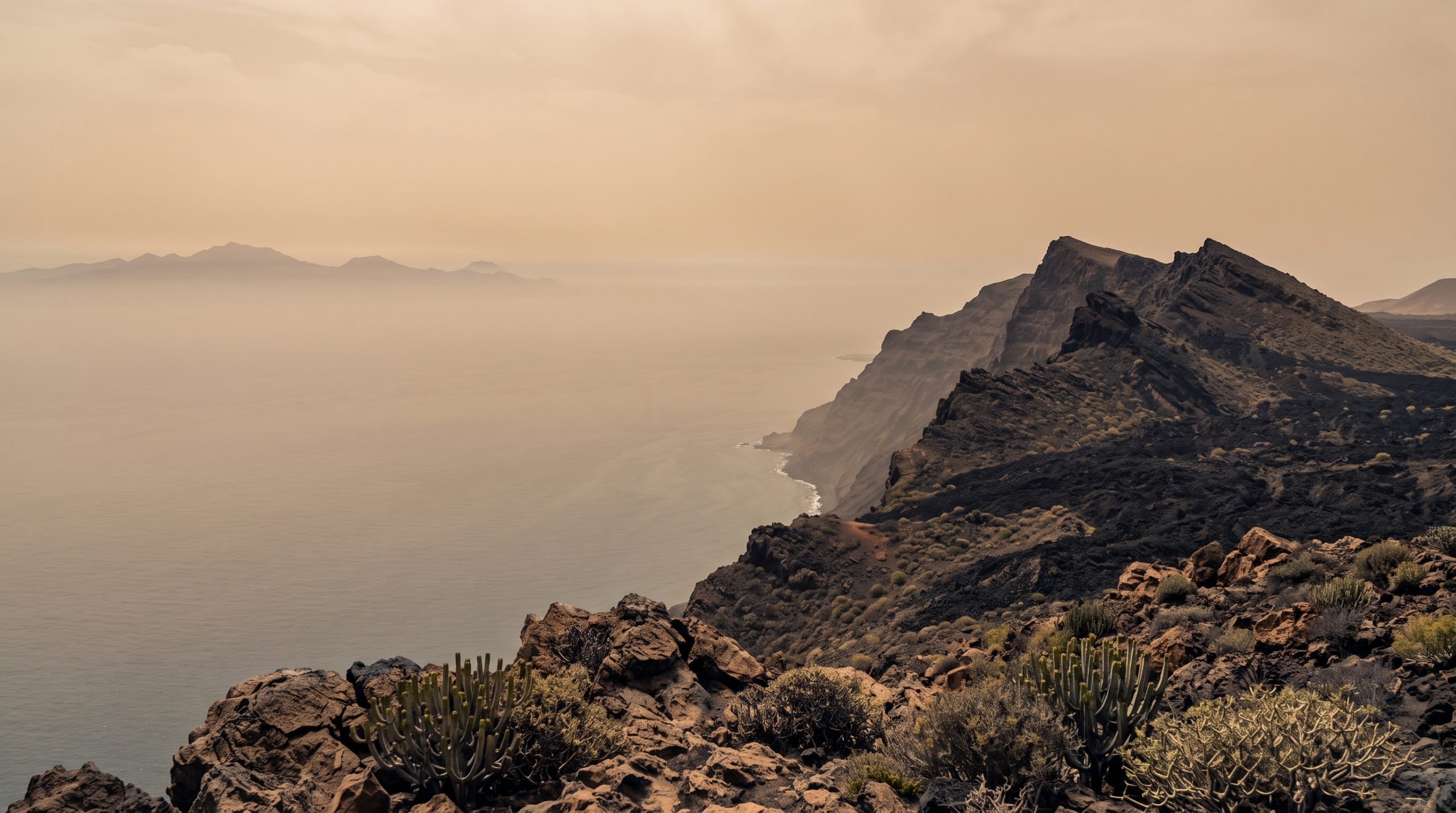
The first sign is never the sky. It is the light on a white wall at seven in the morning, warmer than it has any business being, and a sun you can look straight at without flinching. Step outside and Teide has gone from a mountain to a rumour, the horizon has dissolved, and the whole island is sitting inside a soft orange box. That is a calima.
Saharan dust arrives here often enough that it belongs in your planning rather than in your worries. Research led by the Paul Scherrer Institute with Spain’s IDAEA-CSIC puts it at roughly 40 percent of days across the islands, about 146 a year, most of them so mild you would only catch it on a long lens. The heavy episodes, the ones that erase a twenty-kilometre view and turn the sun into a flat disc, are much rarer, and they cluster in a part of the year we can point at on a calendar.
So this is the month-by-month version. What the air is likely doing, what the sun is doing at the same hour, and what we actually change on the morning when dust does land on your wedding day. Coast and caldera behave differently inside the same episode, so both are here.
How often the sky actually turns orange
Dust is present on around 40 percent of Canary Islands days, but the heavy, view-flattening calima concentrates in winter and early spring, with a second run during late-summer heat. If you want the cleanest air, the longest evenings and a month that averages no rain at all on the south coast, book the first half of June.
Every month, and what the air is likely doing
Figures below are long-term averages for the south coast of Tenerife, where most couples land and most of the arid, cinematic ground sits. Sunset times are for mid-month on the island, and they run later than you expect for 28 degrees north, because the Canaries keep the same clock as London while sitting sixteen degrees further west.
| Month | Coast conditions | Light | Dust and feel | Our verdict |
|---|---|---|---|---|
| January | Highs near 22°C, about 20 mm of rain across two days, sea 19°C | Sunset 18:30, 7.5 hours of sun a day | Dust season running; the January 2022 episode turned island skies orange | Workable, plan short |
| February | Coolest month at 18.5°C average, sea at its lowest 19°C | Sunset 18:55, day length 11h12 | Heaviest dust loads of the year; strong episodes have pushed the south coast past 31°C | Only with a plan |
| March | Highs 23°C, warm days reach 28.5°C | Clocks go forward on the last Sunday, sunset jumps 19:21 to 20:21 | Late dust still likely, air clearing towards month end | Second half only |
| April | Rain thinning out, comfortable at every altitude | Sunset 20:31, day length 12h50 | Dust easing, park mornings often clean | Quietly excellent |
| May | Zero rainfall in the average | Sunset 20:48, day length 13h34 | Clearest air we plan around; coast still cool for swimming | Book it |
| June | Zero rainfall, dry heat inland | Longest days at 13h57, sunset 21:05 | Clean air most years, trade wind steady on the south strip | Our first choice |
| July | Zero rainfall, sunniest month at 11.1 hours of sun a day | Sunset holding at 21:04 | Busy resorts, empty park at dawn | Strong, start early |
| August | Warmest month at 24.9°C average, no rain | Sunset 20:44, day length 13h10 | Late-summer dust arrives with heat spikes | Dawn and evening only |
| September | Sea at its warmest, 24°C | Sunset 20:10, day length 12h21 | A September 2027 episode came in with temperatures near 38°C | Good, water is best |
| October | Rain returns to the pattern, air usually clean | Clocks go back on the last Sunday, sunset drops to 18:25 | Crowds thin sharply after the first week | Best alternative to June |
| November | Mild, unsettled, green on the north side | Sunset 18:12, day length 10h45 | Dust building again towards December | Fine for a full day |
| December | Wettest month at 30 mm, cloudiest at 5.7 hours of sun a day | Shortest day 10h20, sunset 18:13 | Winter dust season opens, resorts full | Compress the timeline |
Late May to mid-July: no rain in the average and 21:00 sunsets
This is the narrow window worth building a date around, and it is narrower than it sounds. Sunset on the island sits within a few minutes of 21:00 from the start of June until the middle of July, peaking at 21:05 around the solstice with 13 hours 57 minutes of daylight. May, June, July and August all average zero rainfall on the south coast. Put those together and you get an evening that starts at eight and does not end, on ground that has not seen rain in weeks.
The cost of it is the middle of the day. Solar noon in June lands at about 14:03 rather than midday, so the sun is still near vertical at three in the afternoon and the warm hour does not begin until well after eight. Couples who imagine a five o’clock ceremony are usually surprised by how much better seven thirty is, and by how late they will be eating. Our planning fundamentals cover how a timeline gets built backwards from that one hour.
February and March, and how we make them work
These are the two months we would steer a movable date away from. February carries the heaviest dust loads of the year and it is also the coolest month, averaging 18.5°C on the coast with the sea down at 19°C. March improves week by week, but the first fortnight still belongs to winter. If your dates are open, June gives you clean air and a 21:00 sunset, and October gives you a warm sea, thinning crowds and an 18:25 sunset that puts your ceremony in the light rather than at the end of a long wait.
If February is fixed, and it often is, we build for it rather than apologise for it. On the shortest days the sun peaks at only 38 degrees above the horizon, which means the entire day has usable angles instead of a hard, hollow middle. Dust light at that low angle is genuinely beautiful, so we plan foreground rather than distance: lava fields, dunes, cliff edges, the pine forest on the north slopes. Tell us the date and we will tell you honestly which fortnight inside that month we would pick, and what we would drop from the plan to make room for the short evening.
What the sun does across the year, and what dust does to it
The light here changes far more than the temperature does. On 21 December the sun rises at 07:53, sets at 18:13 and never climbs above 38 degrees, so you get 10 hours 20 minutes of daylight that all works, with a short warm stretch at each end. Six months later the sun is up at 07:08, gone at 21:05, and standing 85 degrees overhead at solar noon. The same island. Two completely different films.
Dust does two specific things to that. It turns the sun into an object you can put directly in frame at almost any hour, low, orange, with no flare and no highlight to protect. It also deletes contrast at distance, which means the long view of Teide from the coast is finished for the day and anything within thirty metres of you gets better. Aerials lose their horizon first, so on dust mornings the film moves lower and closer, and we save the wide sweep for the clean window. You can see both kinds of day in our published stories and films, and it is worth looking at the dust frames before you decide which month you want.
Season also decides how many of us need to be working at the same moment. In December, with the sun gone at 18:13, there is no second pass at the vows, and a dedicated photographer and filmmaker covering that same short window together is the difference between having it and hoping. In June, with light until nine, one person can move through the day slowly and still have everything. Both shapes are set out on our coverage and pricing page.
Teide, the cable car and the permit that comes before the dress
Teide stands 3,715 metres up, and the cable car upper station at La Rambleta sits at 3,555 metres, which is close but not the top. Reaching the actual summit means the Telesforo Bravo trail, PNT 10, which requires authorisation and carries a fee, applied for through the TenerifeON platform. Since 29 November 2024, walking down instead of riding down also needs authorisation on PNT 07 Montaña Blanca to La Rambleta, PNT 09 Teide to Pico Viejo, PNT 23 Regatones Negros and part of PNT 28 Chafarí.
Two practical details shape how we use the mountain. Cable car descent tickets can only be booked once you are at the upper station, by QR code, and only when the cable car is actually running. And the operator’s own access rules exclude open footwear, shorts and short sleeves, which matters when the plan involves a dress at 3,555 metres. So we treat the Rambleta hour as an addition to a day, never its spine, and we hold the vows on ground that does not depend on a machine being in service. Permit research and logistics are part of what we do for every couple; the government and park fees themselves are paid by you.
If a high-altitude hour is the reason you are looking at these islands, send us the month you have in mind and we will tell you what is realistically open in it. Check Your Date.
How we plan around calima before you land
A weather plan is not optimism. It is a document with names in it, written before the flights, so that a dusty or windy morning changes the location and not the day. The archipelago hands us an unusual advantage: the northeast trade winds keep the north coast cooler, cloudier and wetter, while the southwest is arid and sheltered by the sheer mass of Teide. Two climates, one drive apart.
| What the morning looks like | Where we move | Why it works |
|---|---|---|
| Heavy dust, no horizon | Lava fields, dunes, cliff edges, forest | Foreground carries the frame when distance is gone, and the sun becomes shootable |
| Grey trade-wind cloud on the north coast | Up into the national park | The cloud deck usually stops well below the caldera floor |
| Hard wind along the southern strip | The sheltered southwest, in the lee of the mountain | Veils, hair and vow audio all behave again |
| Winter rain between December and March | Architecture first, coast second, later in the day | December averages 30 mm for the whole month, so showers come with gaps |
The ceremony hour is the last thing we fix, once the forecast has settled rather than months out on a spreadsheet. We ask couples to land a day or two ahead of the date, because the strongest episodes can move flight times around and nobody wants their timeline built on a same-day arrival. Everything else, including which of the alternatives we are leaning towards, is written down and shared before anyone gets on a plane. Our destination guides go deeper on the ground itself, island by island.
Common questions
Does a calima ruin elopement photos in the Canary Islands?
No, it changes them. Long views vanish and the mountain silhouette goes flat, but the sun becomes a soft orange disc you can place directly in frame, and everything close in gets richer. We swap distance for foreground and keep the aerials for the clear window. It is a different day, not a lost one.
Which months have the least Saharan dust in the Canary Islands?
The heaviest dust concentrations are recorded in winter and early spring, so the cleanest stretch runs from late April through July, with May and June the two months we plan around most. Late summer brings a second run of dust episodes, usually alongside a heat spike, so August mornings and evenings are worth more than August afternoons.
What time does the sun set in Tenerife in December compared with June?
On the shortest day the sun sets at 18:13 after 10 hours 20 minutes of daylight. Around the June solstice it sets at 21:05 after 13 hours 57 minutes. That three-hour swing is the single biggest factor in how a timeline is shaped, and it is why a winter day starts earlier than couples expect.
Can we still fly a drone during a calima?
Aerials run on a permit and a time window, so we confirm both before the film is planned around them. When dust cuts visibility, the drone work moves lower and tighter, or moves to another hour or another morning inside the same trip. We build the film so that no single shot has to carry it.
We can only travel in February. What does that actually give us?
An 18.5°C average on the coast, a sea at 19°C, sunset at 18:55 in the middle of the month, and the highest chance of dust in the year. It also gives you a sun that never rises above 38 degrees, which is generous light all day long, and an island that feels wide open away from the resort strip. We plan February for close ground and a compressed evening, and it works.
Do we need a permit to reach the summit of Teide?
Yes. Summit access on the Telesforo Bravo trail requires authorisation through TenerifeON and carries a fee, and several descent trails have needed authorisation since 29 November 2024. We handle the research and the logistics; the permit fees themselves sit with you, alongside celebrant, accommodation and any unusual transport.
How much warning do we get that dust is on the way?
Days, not weeks. Dust is forecast much like weather, so the shape of your day becomes clear in the final week rather than at booking. That is exactly why the plan lists named alternatives from the start, and why the ceremony hour stays flexible until the forecast firms up.
Choosing your month with us
If your dates are open, we would book the first half of June and use the 21:00 sunset properly. If they are not, tell us the month you have and we will be straight with you about what it offers, which fortnight inside it we would choose, and what we would build differently. We are booking 2027, 2028 and 2029, and all of our planning happens in writing, at whatever pace suits you.
Send us the date and the kind of day you picture, orange sky or clear one, and we will come back with a shape for it. Tell Us Your Story.